
How Cell Phones Have Changed Learning
From studying and exam preparation to creativity, collaboration, and AI, smartphones have transformed how students learn inside and outside the classroom.

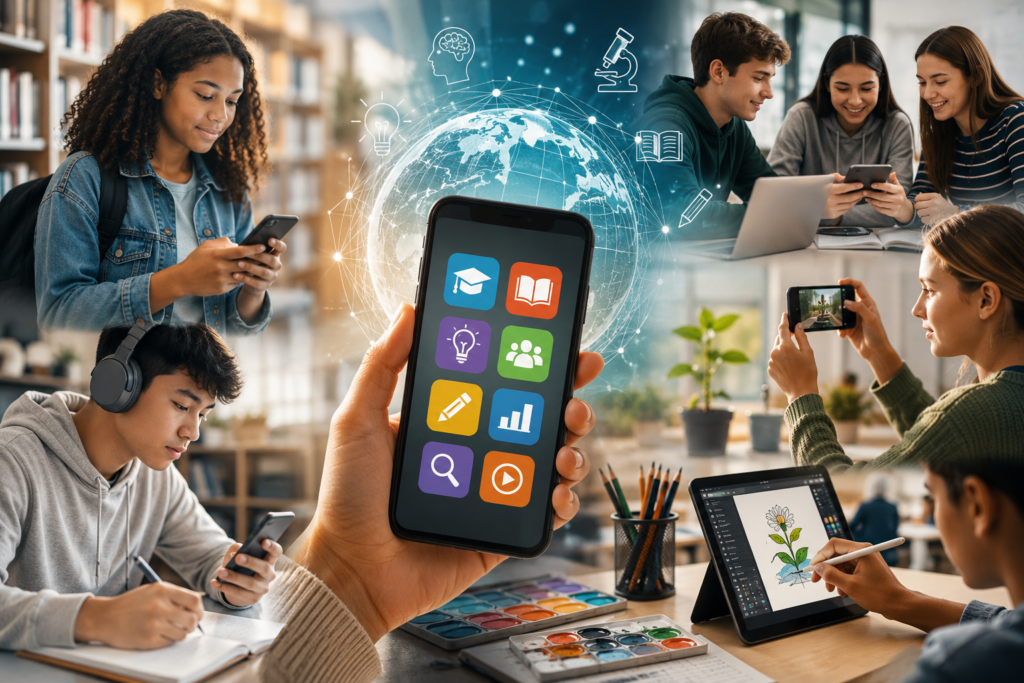
How cell phones have changed learning over the past two decades, transforming studying, creativity, collaboration, and access to knowledge.
How cell phones have changed learning is one of the defining education stories of the past two decades. Twenty years ago, students carried textbooks, notebooks, and printed study guides. Today, they carry research libraries, cameras, calculators, translators, design studios, and increasingly AI tutors in their pockets.
What began as a communication device has evolved into a research tool, study companion, creative studio, collaboration platform, and personalized learning assistant.
For superintendents, administrators, teachers, school board members, parents, students, policymakers, and education technology leaders, the question is no longer whether cell phones influence education. Their impact is undeniable. The more important question is how schools can maximize their educational potential while minimizing the distractions and challenges they create.
Over the years, smartphones have changed where learning happens, when learning happens, how students prepare for exams, how they collaborate, and even what it means to be a teacher. Few technologies have reshaped education more completely.
For superintendents, administrators, teachers, school board members, parents, students, policymakers, and education technology leaders, the question is no longer whether cell phones influence education. Their impact is undeniable. The more important question is how schools can maximize their educational potential while minimizing the distractions and challenges they create.
Over the years, smartphones have changed where learning happens, when learning happens, how students prepare for exams, how they collaborate, and even what it means to be a teacher. Few technologies have reshaped education more completely.
From Textbooks and Libraries to Learning in Your Pocket
Two decades ago, learning looked very different.
Research often meant trips to the library. Students relied heavily on textbooks, handwritten notes, desktop computers, and printed reference materials. Access to tutoring and supplemental resources depended largely on geography, transportation, and family income.
The smartphone changed that reality.
Suddenly, information became portable. Students gained immediate access to articles, videos, calculators, dictionaries, translators, and educational resources from almost anywhere.
The impact extended far beyond convenience. Smartphones fundamentally changed expectations. Students no longer had to wait until they reached a classroom or computer lab to learn something new.
Access became immediate.
But access is not the same as understanding. As information became easier to obtain, schools increasingly shifted their focus toward critical thinking, digital literacy, and helping students transform information into knowledge.
The Smartphone Era Changed Studying
Perhaps nowhere has the impact of smartphones been more visible than in the way students study.
Studying is no longer tied to a desk or a specific time of day. Students review material on buses, between activities, and during short breaks throughout the day.
Mobile technology introduced flexibility into learning.
Students now use their phones to:
- Create flashcards.
- Organize assignments.
- Set reminders.
- Review notes.
- Watch instructional videos.
- Practice vocabulary.
- Track progress.
- Monitor deadlines.
The rise of mobile technology also encouraged microlearning, allowing students to study in shorter and more frequent sessions.
At the same time, smartphones introduced a new challenge. The device used for studying is also the device used for texting, gaming, and social media.
This paradox sits at the center of the smartphone conversation. The same device that supports learning can also compete for attention.
As a result, digital literacy increasingly includes self-regulation, focus, and healthy technology habits.
Exam Preparation Became More Personalized
Smartphones have dramatically changed how students prepare for assessments.
Practice tests, educational videos, note-sharing platforms, and adaptive learning tools have placed resources once available primarily through tutoring programs into the hands of millions of learners.
Students preparing for AP exams, state assessments, college entrance tests, and career certifications can access support whenever they need it.
Preparation has become more personalized.
Students can:
- Take practice quizzes.
- Receive immediate feedback.
- Identify weak areas.
- Review targeted explanations.
- Repeat lessons at their own pace.
This shift has made learning more responsive and more individualized.
For many students, smartphones have expanded access to academic support. Yet the digital divide remains real. Device quality, internet access, and home learning environments continue to influence educational opportunity.
Access to technology does not automatically guarantee equitable learning experiences.
Learning Is No Longer Confined to School
One of the most profound changes brought about by smartphones is that learning is no longer confined to classrooms.
Students learn while traveling, working part-time jobs, participating in athletics, visiting museums, or watching educational videos at home.
Learning has become continuous.
Knowledge is available at virtually any time and in almost any place.
This shift accelerated during the pandemic, but it began years earlier. Smartphones helped blur the line between formal and informal learning.
As a result, schools are increasingly asking an important question:
If information is available everywhere, what experiences should schools provide that technology alone cannot?
The answer increasingly points toward collaboration, creativity, critical thinking, and human relationships.
Phones Have Become Creative Studios
One of the most overlooked aspects of smartphones is their role in creativity.
Much of the public discussion focuses on consumption, but smartphones have transformed students into creators.
Modern phones contain powerful cameras, microphones, editing tools, and design capabilities that previous generations could only access through expensive equipment.
Students now use smartphones to:
- Create podcasts.
- Produce documentaries.
- Edit photographs and videos.
- Design graphics.
- Record interviews.
- Build digital portfolios.
- Capture scientific observations.
- Produce music.
- Create presentations.
In project-based learning environments, phones have become powerful tools for authentic work.
Students can investigate community problems, collect evidence, interview stakeholders, document prototypes, and present solutions using devices they already own.
Design Thinking and Innovation
Smartphones have also become tools for design and innovation.
Students use them to:
- Sketch ideas.
- Prototype products.
- Gather user feedback.
- Create logos.
- Develop websites.
- Document engineering projects.
- Build portfolios.
For career and technical education programs, smartphones support media production, agriculture, health sciences, entrepreneurship, and business education.
In many ways, the phone has become the first design tool students reach for.
Phones Have Created a Generation of Content Creators
The smartphone era has produced a generation of filmmakers, photographers, podcasters, graphic designers, and entrepreneurs.
Students are learning storytelling, branding, communication, and digital production skills in ways that were unimaginable twenty years ago.
These creative experiences increasingly align with the skills demanded by colleges and employers.
Collaboration Has No Boundaries
Smartphones have changed collaboration.
Group work no longer ends when students leave the classroom.
Shared documents, messaging tools, learning platforms, and video conferencing allow students to communicate and work together regardless of location.
Collaboration has become more flexible and more connected.
Yet constant connectivity also introduces new challenges. Students often feel pressure to remain available around the clock.
As digital communication becomes central to learning, schools are recognizing that collaboration itself must be taught.
Communication, etiquette, academic integrity, and responsible participation have become essential skills.
AI Is Transforming Smartphones Into Personal Tutors
The latest evolution of mobile technology may be the most significant yet.
Artificial intelligence is transforming smartphones into personalized learning companions.
Students increasingly use AI-powered tools to:
- Generate study guides.
- Summarize readings.
- Explain difficult concepts.
- Practice foreign languages.
- Brainstorm ideas.
- Explore coding.
- Create presentations.
- Receive writing feedback.
For the first time, students have access to tools capable of adapting explanations and providing immediate support.
In many respects, AI is extending the educational potential of smartphones beyond access to information and into personalized learning.
Students now carry something previous generations never possessed: on-demand academic support.
At the same time, AI raises important questions about academic integrity, assessment, and critical thinking.
School leaders are increasingly recognizing that AI literacy may become as essential as digital literacy.
Understanding when and how to use AI responsibly will likely become one of the defining educational challenges of the coming decade.
Smartphones Changed the Role of Teachers
As smartphones expanded access to information, they also changed the role of educators.
Teachers are no longer simply providers of knowledge.
Instead, they increasingly serve as guides, coaches, mentors, and facilitators of learning.
Their responsibilities now include helping students:
- Evaluate sources.
- Think critically.
- Verify information.
- Use AI responsibly.
- Manage distractions.
- Collaborate effectively.
- Create rather than simply consume.
This shift represents one of the most important transformations in modern education.
Technology has not made teachers less important.
If anything, it has made their expertise even more valuable.
Accessibility and Personalized Learning
For many students, smartphones have become essential learning supports.
Speech-to-text, translation tools, captions, reminders, and audio playback provide greater independence for students with disabilities, multilingual learners, and students who need organizational support.
These tools expand opportunities and increase accessibility.
As schools reconsider phone policies, these considerations remain important.
The same device viewed as a distraction for one student may be a critical support for another.
The Challenge of Attention
Despite their educational potential, smartphones also present significant challenges.
Social media, games, notifications, and entertainment constantly compete for students’ attention.
As a result, attention has become one of education’s most valuable resources.
This reality helps explain why many districts are reexamining their phone policies.
The issue is not whether smartphones belong in students’ lives. They already do.
The challenge is helping students develop the habits and self-regulation necessary to use powerful technologies wisely.
Why Phone Policies Are Becoming More Nuanced
The conversation around smartphones has evolved.
Rather than asking whether phones should exist in schools, many leaders are asking how and when they should support learning.
Districts across the country are experimenting with:
- Bell-to-bell restrictions.
- Phone pouches.
- Teacher-directed instructional use.
- Digital citizenship initiatives.
- AI literacy programs.
- Age-appropriate technology policies.
Successful approaches recognize that smartphones are neither inherently good nor inherently harmful.
Their impact depends largely on how they are used.
Looking Ahead
The smartphone may be the most influential learning technology since the internet itself.
Over the past two decades, cell phones have transformed studying, exam preparation, creativity, collaboration, accessibility, and access to knowledge. They have changed where learning occurs and expanded opportunities for students around the world.
Today, students carry research libraries, cameras, design studios, translators, calculators, and increasingly AI tutors in their pockets.
The challenge facing education leaders is not deciding whether smartphones belong in the learning ecosystem. That question has largely been answered.
The challenge is determining how schools can cultivate focus, responsibility, creativity, and digital wisdom in a world where powerful learning tools are always within reach.
The future of learning will not be defined by the presence of smartphones.
It will be defined by how effectively schools teach students to use them.
Subscribe to edCircuit to stay up to date on all of our shows, podcasts, news, and thought leadership articles.
Related reading
More on K-12