Arrival and Dismissal Safety: Is Your School Ready?
The school day begins at the curb, where buses, cars, walkers, bicycles, e-bikes and families converge.

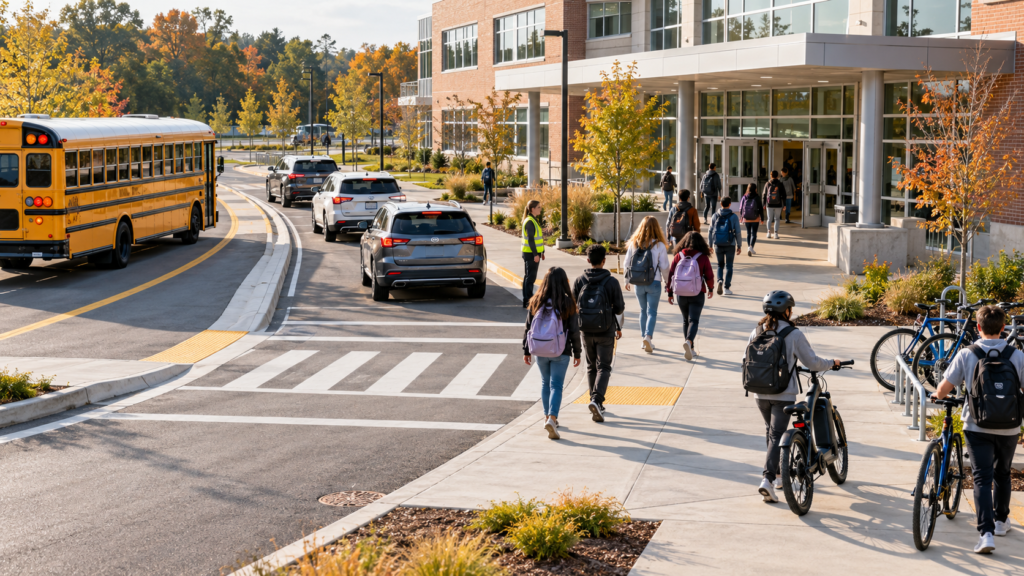
Arrival and dismissal safety requires coordinated traffic, supervision, access, communication and e-bike policies before routines break down.
Arrival and dismissal safety depends on what happens before a student enters the building and after the final bell rings. During these brief windows, buses, cars, pedestrians, bicycles, e-bikes, staff members and visitors may all be moving through the same area at once.
 Safer EdAt the Curb: Is Your School Ready for Arrival and Dismissal?Play episode: At the Curb: Is Your School Ready for Arrival and Dismissal? (13 minutes 33 seconds)Follow on SpotifyApple
Because the routine repeats every day, it can feel predictable. Yet one late bus, blocked crosswalk, last-minute transportation change or unsupervised entrance can expose a weakness in the system.
The question is not simply whether a school has a traffic map or dismissal procedure. It is whether those plans still work when the curb becomes crowded, the weather changes and people begin making decisions under pressure.
In this episode of Safer Ed, sponsored by Science Safety and produced in partnership with edCircuit, we examine arrival and dismissal as connected safety systems. The conversation includes traffic flow, supervision, family communication, building access, accessibility and the growing presence of e-bikes on school campuses.
The Curb Is Part of the Campus
School safety planning often concentrates on what happens inside the building. Arrival and dismissal show why that boundary is too narrow.
Students may already be navigating bus lanes, parking lots, crosswalks and sidewalks while staff members manage traffic and monitor entrances. In the afternoon, the school remains responsible for getting students to the correct bus, vehicle, activity or approved adult.
The curb is where transportation, supervision, security and communication meet. A vehicle line can move efficiently while a pedestrian route remains unsafe. A supervised entrance can become vulnerable if the person watching it is also directing traffic. A student may appear to have left appropriately even though a transportation change was never verified.
Arrival and dismissal safety must be treated as a coordinated school operation—not a traffic-control assignment handed to a few visible adults.
Watch the Plan in Action
A diagram can identify bus lanes, crosswalks and pickup areas. It cannot show how people actually use them.
The best way to understand the system is to observe it during the busiest part of the day. Stand where students cross. Note where vehicles stop unexpectedly. Look for places where children disappear from view. Watch what happens when a bus is late or a caregiver needs additional time.
The National Highway Traffic Safety Administration reminds drivers to be especially alert around schools and bus stops during morning and afternoon travel periods. Schools can support that message by making student routes visible and vehicle movements predictable.
Observation should include different days and conditions. A calm morning may not reveal what happens during heavy rain, construction, a delayed opening or the first week of a new semester.
Look closely at a few critical questions:
Where do students and vehicles cross paths?
Which areas lose adult visibility when traffic backs up?
Can walkers and cyclists reach the building without moving between vehicles?
What happens when someone misunderstands the traffic pattern?
The purpose is not to blame families, students or staff. It is to find places where safety depends too heavily on everyone making the perfect decision at the perfect moment.
Clear Roles Matter More Than More Adults
Adding adults does not automatically improve supervision. Each person needs a defined location, responsibility and level of authority.
One staff member may manage a crosswalk while another monitors the bus area. Someone else may supervise an entrance or assist students leaving vehicles. Those jobs should not be layered onto one person simply because that person is already outside.
An adult cannot effectively direct traffic, greet families, answer questions and monitor an entrance at the same time. When responsibilities overlap, the plan can appear fully staffed while important spaces remain unmonitored.
Staff members also need to know who can pause the process. If a vehicle blocks a crosswalk or an unknown person approaches an open door, they should not have to wait for an administrator to recognize the problem.
Role clarity turns supervision from a visible presence into an active safety system.
Dismissal Changes Must Reach the School
Dismissal becomes more complicated when plans change.
A caregiver texts a student to ride home with a friend. A practice is canceled. A different family member arrives for pickup. The change may be reasonable, but it still has to reach the people responsible for that student.
A message sent directly to a child does not automatically update the classroom teacher, front office, transportation team or after-school program. A reliable process must verify who authorized the change and notify the staff members who need to act on it.
This is not about making family schedules more difficult. It prevents a student from being released based on incomplete or conflicting information.
The procedure should also address a late caregiver, a missing bus or a student who reports to the wrong location. Responsibility cannot become unclear simply because the regular schedule has ended.
E-Bikes Require More Than a Bike-Rack Rule
E-bikes are becoming more common among students, but many school procedures still treat them like conventional bicycles.
Their speed, weight and acceleration change how riders interact with pedestrians and vehicles. A student may approach an entrance faster than a driver or crossing monitor expects. On a crowded sidewalk, an e-bike can also be harder to stop or maneuver safely.
Clear expectations should cover where riders enter campus, when they must dismount, which paths they may use and where e-bikes are parked and secured. Helmet requirements and operating restrictions should reflect applicable state and local law.
Battery storage and charging require separate attention. The U.S. Consumer Product Safety Commission’s micromobility guidance advises consumers to follow manufacturer instructions, use the recommended charger and remain present while charging.
Schools need to decide whether removable batteries may enter the building and whether charging is allowed on school property. If charging is permitted, it should occur only in an approved location using authorized equipment. Staff members also need a response for a battery that appears damaged, swollen, unusually hot, leaking or producing an unfamiliar odor.
The time to answer those questions is before a battery appears beside an outlet in a classroom, hallway, locker room or athletic facility.
The Plan Must Work When Conditions Change
Arrival and dismissal can place pressure on normal building-access procedures. Multiple doors may be opened while staff attention shifts outside. Visitors, contractors and late-arriving students may approach during that transition.
Each entrance needs a purpose, a schedule and an assigned adult. The staff member directing vehicles should not also be expected to notice everyone entering behind them.
Weather creates another test. Rain reduces visibility. Snow narrows travel lanes. Extreme heat or cold can make outdoor waiting unsafe. A thunderstorm may force students into spaces that were not designed for dismissal.
The plan must also account for students who need additional time, physical assistance, specialized transportation, visual supports, a quieter waiting location or a direct handoff between adults. Those needs are not exceptions to the system. They are part of it.
Alternate waiting areas, accessible routes and staff coverage should be identified before conditions change. Families also need consistent instructions in the languages and formats they use.
Measure More Than How Quickly the Lot Clears
Schools often evaluate dismissal by how long it takes. Time matters, but speed is not the same as safety.
A fast car line is not successful if students cross between vehicles. A bus departure is not successful if someone boards the wrong route. Dismissal is not complete simply because the parking lot is empty.
A brief review can focus on more meaningful indicators:
Were students visible and accounted for?
Did vehicles remain in their assigned areas?
Were entrances supervised and secured as planned?
Could staff communicate when the routine changed?
Were students with additional needs fully supported?
Did e-bike riders and pedestrians use predictable paths?
The process should be revisited throughout the year. Enrollment, construction, transportation choices and after-school schedules change. A procedure that worked in September may not work the same way in January.
Before Tomorrow Morning
Arrival and dismissal safety does not require schools to predict every disruption. It requires a system that stays clear when the routine changes.
Before the next school day begins, leaders should confirm that student and vehicle routes are separated, staff members understand their assignments, transportation changes can be verified and building access remains controlled. Walkers, cyclists, e-bike riders, bus riders and students with individual support needs must all be included.
The curb is part of the campus. It is also one of the clearest places to see whether a school’s safety systems are truly working together.
Listen to “At the Curb: Is Your School Ready for Arrival and Dismissal?” on the Safer Ed Podcast for a deeper conversation about traffic, supervision, e-bikes, communication and responsibility during two of the busiest transitions of the school day.
To learn more about how responsibility follows students across school environments, explore Science Safety’s free Duty of Care learning module.
Subscribe to edCircuit to stay up to date on all of our shows, podcasts, news, and thought leadership articles.
Related reading
More on Safer Ed