



How Google changed education is one of the most important stories in modern learning. Twenty-five years ago, research meant encyclopedias, library visits, and card catalogs. Students spent hours searching for information before they could begin writing papers or completing projects.
Today, most answers begin with a Google search.
What once required shelves of books, physical reference materials, and trips to the library can now be accomplished in seconds. In the process, Google changed not only how students find information, but also how they study, write, collaborate, and think.
For superintendents, administrators, teachers, school board members, parents, students, policymakers, and education technology leaders, the question is no longer whether Google has influenced education. Its impact is undeniable. The more important question is how schools should prepare students for a world where information is nearly unlimited.
Few technologies have reshaped education more profoundly.
From Encyclopedias to Search Engines
Before Google, access to information was far more limited (this link no longer available).
Students relied on textbooks, dictionaries, encyclopedias, libraries, and printed reference materials. Research often involved searching shelves, flipping through indexes, and spending hours locating sources.
Knowledge was available, but finding it required time and effort.
Google fundamentally changed that process.
Suddenly, information became available within seconds. Articles, maps, images, historical documents, videos, and news were instantly accessible.
Information moved from scarcity to abundance.
That shift transformed education.
Google Changed Research Forever
Perhaps Google’s greatest impact has been on research.
Students no longer begin with the library.
They begin with a search.
Research became faster, broader, and more accessible. Students could compare perspectives, locate primary sources, explore images, and access information on virtually any subject.
But research also became more complicated.
The challenge was no longer finding information.
The challenge became finding trustworthy information.
As a result, schools increasingly emphasized information literacy and source evaluation.
Students now need to know:
- How to identify credible sources.
- How to distinguish facts from opinions.
- How to recognize misinformation.
- How to verify claims.
- How to compare perspectives.
The age of search transformed the skills students need to succeed.
Information Became Infinite
For generations, access to information represented one of education’s greatest barriers.
Google removed many of those barriers.
Students suddenly had access to nearly unlimited information, regardless of where they lived.
This democratization expanded opportunities and changed expectations around independent learning.
Yet abundance created new challenges.
Students no longer struggled with too little information.
They struggled with too much.
Information overload became part of the learning experience, making critical thinking more important than ever.
Google Expanded How Students Experience Information
Google transformed more than text-based research.
It changed how students experience information.
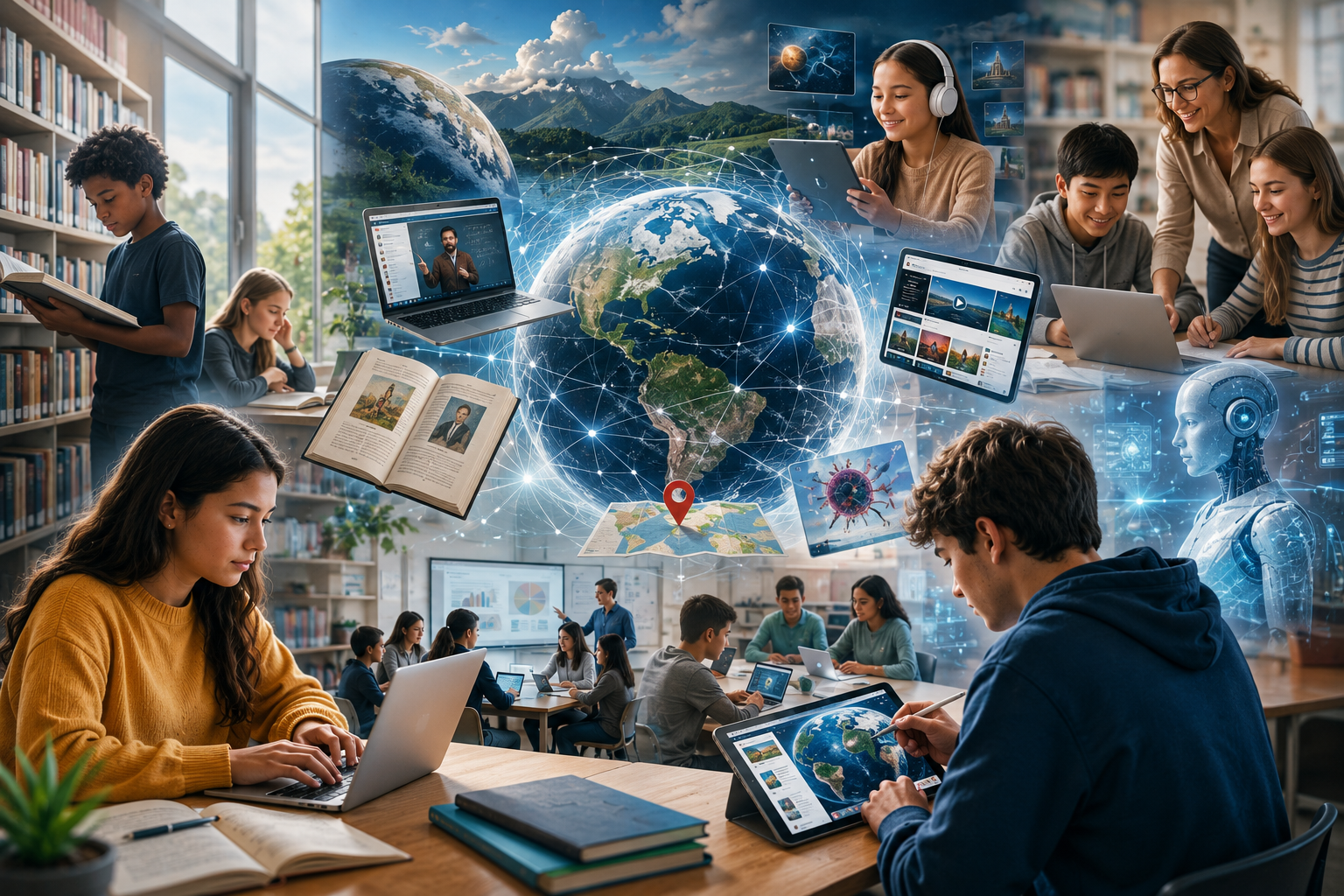
Through Google Images, students could visualize scientific concepts and historical events. Google Maps and Google Earth allowed learners to explore cities, countries, and geographic features without leaving the classroom.
Google Scholar opened the door to academic journals and scholarly sources that previously felt inaccessible to many learners.
And YouTube, owned by Google, revolutionized learning through video.
Millions of students turned to tutorials, lectures, demonstrations, and educational creators to deepen their understanding of subjects ranging from algebra and chemistry to history and music.
Learning became increasingly visual, interactive, and multimedia-based.
Students were no longer limited to reading information.
They could see it, hear it, and experience it.
Google Changed Homework
Homework changed dramatically in the Google era.
Students gained immediate access to explanations, examples, tutorials, and supplemental resources.
Instead of relying solely on textbooks, learners could:
- Search unfamiliar terms.
- Find practice problems.
- Explore videos.
- Access historical documents.
- Conduct independent research.
- Review concepts at their own pace.
Assignments themselves evolved.
Teachers increasingly designed work that emphasized analysis, synthesis, and creativity rather than simply locating facts.
The expectation shifted from finding information to using information effectively.
Google Changed Studying
Google transformed how students prepare for tests and assignments.
Study sessions no longer depend entirely on class notes and textbooks.
Students supplement learning through:
- Search results.
- Instructional videos.
- Practice quizzes.
- Scholarly articles.
- Examples and explanations.
Questions that once remained unanswered until the next school day can now be explored immediately.
Learning became more flexible and more independent.
Google Changed What It Means to Research
Perhaps the most profound change was philosophical.
Before Google, research largely meant locating information.
Today, research means evaluating information.
Finding answers has become relatively easy.
Determining whether those answers are accurate, credible, and trustworthy has become much harder.
Research is no longer simply about gathering facts.
It is about analyzing sources, recognizing bias, comparing viewpoints, and developing informed conclusions.
This shift represents one of the most important changes in modern education.
Google Changed the Role of Teachers
As access to information expanded, the role of educators evolved.
Teachers are no longer simply providers of information.
Instead, they increasingly serve as guides, coaches, mentors, and facilitators of learning.
Their work now includes helping students:
- Evaluate sources.
- Ask better questions.
- Detect misinformation.
- Verify claims.
- Think critically.
- Synthesize information.
- Develop digital literacy skills.
Technology has not diminished the importance of teachers.
If anything, it has made their expertise more valuable.
In an age of information abundance, educators help students transform information into understanding.
Google Classroom Changed Schools
Google’s influence extended far beyond search.
Google Docs, Slides, Sheets, Drive, and Google Classroom transformed how schools operate.
Assignments became digital.
Collaboration became seamless.
Feedback became faster.
Teachers could distribute materials, monitor progress, and communicate with students more efficiently.
Cloud-based workflows reduced paper and made learning more accessible outside the classroom.
During the pandemic, these tools became essential for remote learning and helped schools maintain continuity during unprecedented disruptions.
For many districts, Google Workspace fundamentally changed daily teaching and learning.
Collaboration Became Easier
Group work changed dramatically in the Google era.
Students can now collaborate in real time regardless of location.
Shared documents allow learners to:
- Write together.
- Provide feedback.
- Track revisions.
- Share resources.
- Manage projects.
Collaboration no longer ends when students leave school.
This flexibility reflects the way teamwork increasingly occurs in colleges and workplaces.
Google Changed Creativity
Google’s ecosystem expanded opportunities for creativity and student voice.
Students use digital tools to:
- Design presentations.
- Build websites.
- Publish blogs.
- Create multimedia projects.
- Produce videos.
- Develop digital portfolios.
- Collaborate on storytelling.
Students are no longer simply consuming information.
They are creating and sharing knowledge.
This shift aligns with the growing importance of communication, creativity, and digital fluency.
Accessibility Improved
Google also expanded access for many learners.
Translation tools, voice typing, captions, and accessibility features support students with disabilities and multilingual learners.
These technologies increase independence and help remove barriers to participation.
Accessibility has become a central part of educational technology, and Google’s tools have played a major role in that evolution.
Why Critical Thinking Matters More Than Ever
Google solved many problems associated with information scarcity.
But it also created new challenges.
The rise of misinformation, biased sources, clickbait, and increasingly AI-generated content means students must develop stronger critical thinking skills than previous generations.
They need to learn how to:
- Verify information.
- Recognize bias.
- Evaluate evidence.
- Detect misinformation.
- Distinguish fact from opinion.
Facts have become easier to access.
Wisdom has become harder to develop.
That reality makes critical thinking one of the most important skills schools can teach.
AI Represents Google’s Next Educational Revolution
Google’s story in education is still unfolding.
Artificial intelligence is transforming search once again.
AI-powered tools are beginning to provide explanations, summaries, recommendations, and personalized support.
Search is evolving from delivering information to helping users understand it.
This shift has profound implications for schools.
Students must learn how to use AI responsibly, evaluate AI-generated content, and continue developing the critical thinking skills technology cannot replace.
Just as digital literacy became essential during the search era, AI literacy may become essential during the next chapter.
Looking Ahead
Google may be one of the most influential educational technologies in history.
It transformed research, changed homework, reshaped teaching, and expanded access to information for billions of people.
But perhaps its greatest impact was changing what it means to know something.
In the age of search, memorizing facts became less important than understanding ideas, evaluating sources, and asking better questions.
The future of education will not be defined by how quickly students can find answers.
It will be defined by how wisely they use them.
Subscribe to edCircuit to stay up to date on all of our shows, podcasts, news, and thought leadership articles.
Related reading
More on EdTech