
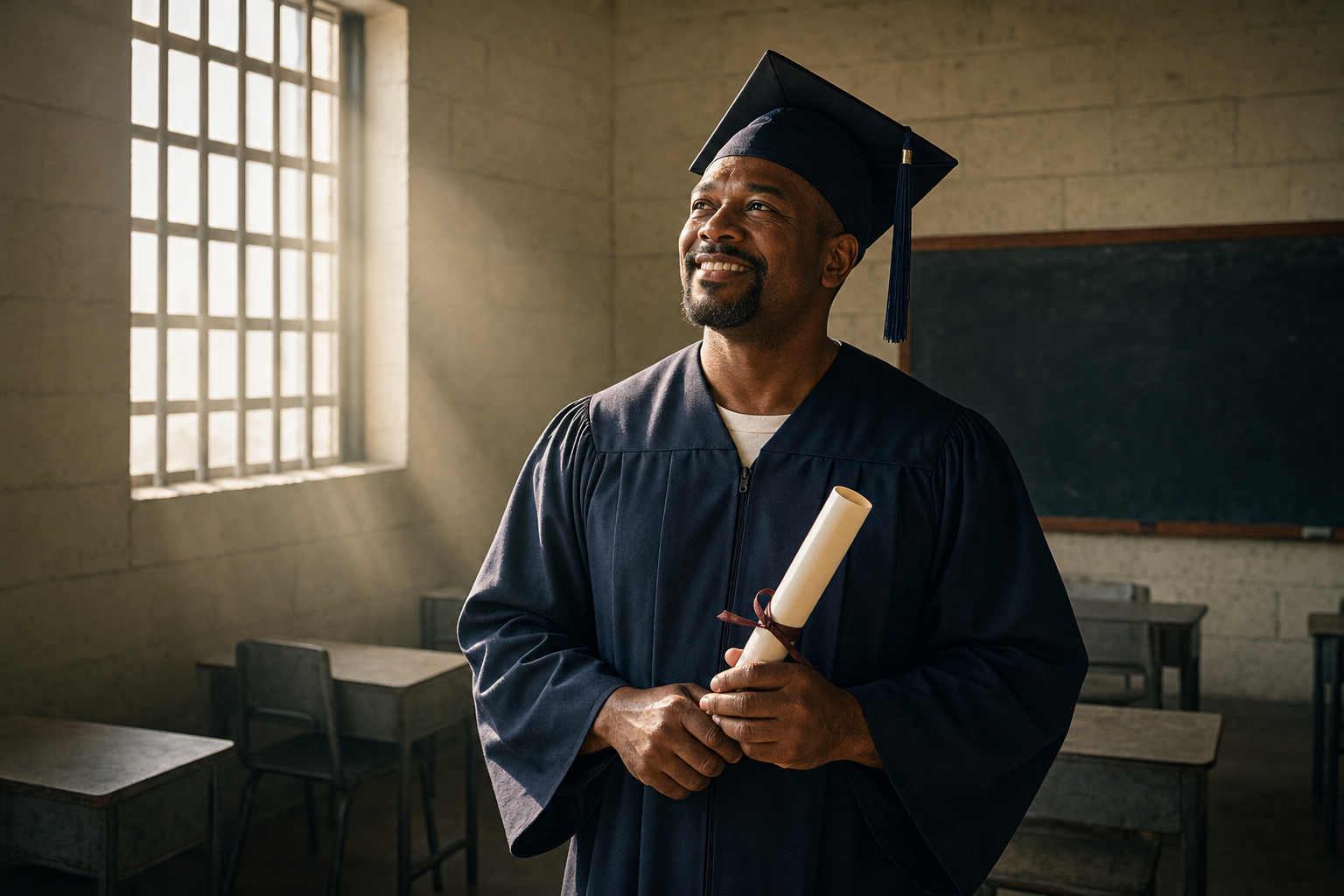

The Bard Prison Initiative led the second InformED Report for April 25, 2017, edCircuit’s short video news briefing for educators. The edition described how eligible men at the Woodbourne Correctional Facility in New York could study toward a Bard College bachelor’s degree while incarcerated, and the low rate at which the program’s graduates returned to prison.
The edition also covered LEAP Innovations, a Chicago nonprofit that lets schools try education technology for a school year before buying it, and closed with a spotlight on responsive classrooms in Lidgerwood, North Dakota. Each story concerned the conditions under which learning works: for adults in prison, for teachers choosing tools, and for young children deciding where to sit.
In this edition
- The Bard Prison Initiative offers Bard College degrees at Woodbourne Correctional Facility, and about 2 percent of its graduates return to prison against a national rate of over 50 percent.
- LEAP Innovations in Chicago pairs teachers with an education technology company for a school-year trial, with training and feedback, before a school buys.
- Spotlight: Teachers in Lidgerwood, North Dakota, use responsive classrooms in which young children choose where to sit each day.
College degrees behind bars at Woodbourne
The Bard Prison Initiative, started by Max Kenner while he was a Bard College undergraduate, enrols incarcerated students in Bard College courses leading to associate’s and bachelor’s degrees. Its first bachelor’s degrees were awarded at the Woodbourne Correctional Facility, a medium-security prison in New York, in June 2008, and the program has since operated in several New York state prisons. Many of its students were convicted of serious felonies, and few had finished high school before prison.
The figure most often cited for the program concerns what happens after release. Bard Prison Initiative materials report that slightly more than 2 percent of its graduates return to prison, compared with a national rate of return of over 50 percent; students who took classes without finishing a degree returned at about 5 percent. These are the program’s own figures, and a program that admits students by application may enrol people already more likely to succeed, so the comparison with the national rate is not a controlled one. Even with that caution, the gap is wide.
The episode noted that the program also saves taxpayers money, because each person who does not return to prison is a cost the state no longer carries. For educators, the program’s experience is a reminder that serious academic work can matter to adults whom schools did not reach the first time, and that the return on that work can be measured long after the classroom.
LEAP Innovations lets schools test ed tech before buying
Schools often buy education technology on the strength of a sales presentation, with little evidence of how a product will work in their own classrooms. The Hechinger Report described in February 2017 how LEAP Innovations, a Chicago-based nonprofit, approaches the problem through its Pilot Network. A team of four to six teachers and a principal states what the school needs, reviews pitches from companies, and chooses one program to try for a full school year. The company provides the license at no cost and trains the teachers, and LEAP staff gather feedback on how the technology performs in the school.
The arrangement gives companies a real-world trial and direct comment from teachers, and gives schools better information before spending money. LEAP’s chief executive, Phyllis Lockett, described the ed tech market as “the wild West” and said about 80 percent of schools keep the program after the trial. Districts without such a partner can still borrow the core idea: define the need first, let the teachers who will use a tool help choose it, and decide on purchase only after a structured trial with clear questions.
InformED Report spotlight: responsive classrooms in Lidgerwood
The spotlight came from Lidgerwood, North Dakota, where, as The Washington Times reported from an Associated Press story, teachers were adopting responsive classrooms. In these rooms young students come in each day and choose where they want to sit, whether in a favourite rocking chair or at a desk, and teachers work to build a positive learning environment from the start of the day.
According to the episode, the approach was gaining ground, and teachers valued the way it joins academic learning with attention to children’s social, emotional and physical needs. Schools considering a similar change will find that it works best alongside clear routines, so that a child’s choice of seat supports attention rather than competing with it, and so that the room stays calm enough for every child to learn.
Sources
- Ellen Condliffe Lagemann, “Reversing the Tide,” Bard Prison Initiative, August 25, 2019.
- Nichole Dobo, “Make a match: How some schools decide what education technology to buy,” The Hechinger Report, February 15, 2017.
- Associated Press, “21st century learning in a responsive classroom,” The Washington Times, February 4, 2017.
About the InformED Report
The InformED Report is edCircuit’s short news program on education. This edition first ran on April 25, 2017. In 2026, edCircuit re-presented it with a new anchor and this full written account. Both report the stories as they stood on that date and link the original reporting, so readers can see exactly where each claim came from.
Subscribe to edCircuit to stay up to date on all of our shows, podcasts, news, and thought leadership articles.
Related reading
More on InformED Report