

edCircuit note: In this 2020 interview, Jamie Thom, author of A Quiet Education, explains how the listening, reflection and empathy that introverts bring can strengthen teaching and school leadership. An update below the interview gathers practical strategies and research since 2022 on supporting introverted students and introvert teachers.
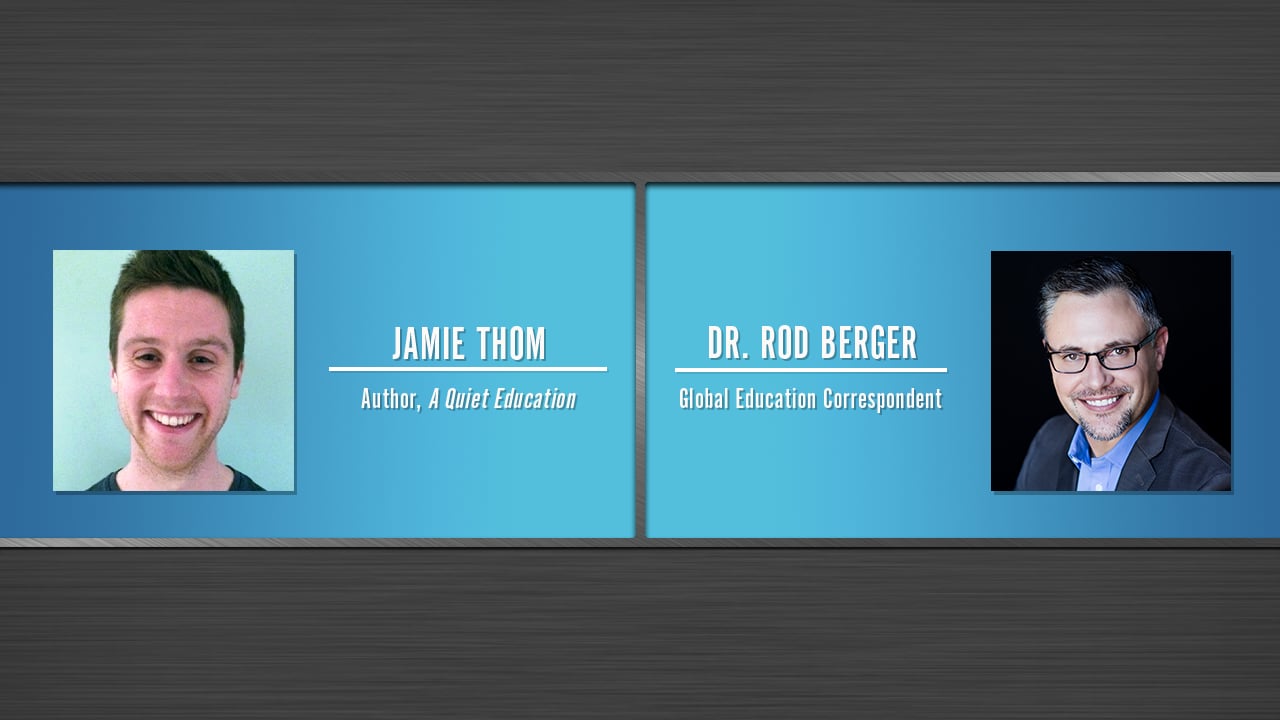
An interview with Jamie Thom, author of A Quiet Education
In this interview with Jamie Thom, author of A Quiet Education: Challenging the Extrovert Ideal in our Schools (John Catt Educational), gain an understanding of how the qualities of introverts can serve to improve the learning environment.
Thom sheds light on the often missed qualities of introversion that can not only benefit teaching but also enhance school leadership positions. Often, it’s not the loudest person in the room that deserves the focus but rather the person who is more skilled at listening, empathy, and reflection that can bring about a higher level of effective teaching and leadership.
As you listen to the interview, think through the following questions to consider how specific personality traits affect your teaching and leadership:
• How are the “introvert” qualities of listening, silence, and providing space for thinking a principal aim of yours as an educator?
• Many teachers identify themselves as introverted, yet teaching often asks for extroverted skill sets. What methods do you use to recharge and find balance in your day to honor your needs?
• The dynamics in schools often apply the extroverted ideal to leadership positions. Do you find a reserved approach often gets lost in the equation? What traits, such as listening and humility, would you like to see promoted more in education?
• Many popular collaborative learning models seem to be engineered toward the extroverted student. How can the introverted student be better supported and scaffolded into the collaborative process?
Learn more about Jamie Thom’s book, A Quiet Education, and more great John Catt Educational publications, by visiting us.johncattbookshop.com

Introverted students and introvert teachers: what schools can do now
Introverted students often do their best thinking before they speak, and the questions Jamie Thom raises in the interview above still matter in classrooms built around discussion, group projects and participation grades. Since the interview was recorded in 2020, teachers and researchers have added practical detail on how to give quiet students a fair share of classroom talk, and on how teachers who are introverts themselves can manage a working day that is full of people. This update gathers that work for school leaders and teachers deciding how to plan lessons, group work and staff time.
What introversion is, and what it predicts
Introversion is a personality trait, usually described as a preference for quieter settings and a tendency to recharge alone. It is not the same as shyness or anxiety, although a student can be both. Brett Vogelsinger, a ninth-grade English teacher in Doylestown, Pennsylvania, made that distinction in a 2023 KQED MindShift episode on inviting introverted students to share their thinking, describing a rethink of what counts as participation in that classroom. The same episode replays Susan Cain, author of Quiet, estimating that a third to a half of people are introverts; that is Cain’s estimate rather than a measured figure for students.
It also helps to be careful about what personality predicts. A 2022 synthesis in the Journal of Personality by Ethan Zell and Tara Lesick, which pooled 54 earlier meta-analyses covering more than 550,000 people, found that conscientiousness was the Big Five trait most clearly linked to academic performance, and that extraversion was more closely tied to job performance than to school results, according to a PsyPost summary of the Zell and Lesick synthesis. The associations were small and correlational, so they do not show that personality causes results. The practical reading for a school is modest: being outgoing is not what makes a student successful, so a classroom that rewards only the quickest and loudest answer is measuring something other than learning.
Giving quiet students in class a way into discussion
Most of the practical advice since 2020 changes the structure of discussion rather than asking the student to change. The teachers in the MindShift episode describe several routines. Vogelsinger gives students time to review their own written responses on a class message board before whole-class talk, so no one is asked to produce a polished answer on the spot. Students hold up one color of card to offer a new idea and another to build on a classmate’s idea, which lets the teacher see who has something to say and choose who speaks next. In another routine, every student writes a response on paper, and the written answers of students who did not speak aloud are collected so their thinking still counts. Vogelsinger and colleagues also ask students to reflect each quarter on how they take part in class.
These routines share three features a teacher can use in any subject: thinking time before talk, more than one way to contribute, and participation that is recorded in writing as well as aloud. Pair or small-group talk before a whole-class discussion does the same work. Teachers who grade participation can check whether their rubric gives credit for written contributions, careful listening and building on others’ ideas, or only for the number of times a student speaks.
Introverts in group work
Thom’s last question above asks how introverted students can be supported and scaffolded into collaborative learning. The MindShift reporting notes that team projects can be draining for introverted students, who may do their strongest thinking alone or in quiet settings. That is a case for designing group work carefully rather than abandoning it. Clear roles that students can choose, short timed turns so one voice does not take over, a few minutes of individual work before the group meets, and groups of three or four rather than larger teams all lower the pressure on a quiet student while keeping the benefits of working together. Allowing part of a task to be finished independently gives a student a way to recover without opting out.
Supporting the introvert teacher
Thom also asks how teachers who identify as introverts recharge during a day that asks for constant interaction. The day is demanding for every teacher. RAND’s 2024 State of the American Teacher survey of more than 1,400 K-12 teachers found that 59 percent reported frequent job-related stress, down from 78 percent in 2021, and that teachers worked an average of 53 hours a week, compared with 44 for other adults with at least a bachelor’s degree, as Chalkbeat reported on the RAND teacher survey. The survey does not report results by personality, so it cannot say whether introverted teachers are affected more than others.
First-person accounts show leaders what helps. Avery Thrush, a former sixth-grade science teacher in Nashville, wrote in a 2022 EdSurge essay on introverted teachers that the constant stimulation of the school day was draining and that a 47-minute planning period rarely felt calm. Thrush pointed to small changes, such as a quieter lunch, co-teaching to share the load of being the only adult in the room, and unstructured time with students at recess, as the kind of adjustment that tends to fall to the bottom of a school’s priorities.
For principals, the practical steps cost little: protect planning periods from routine interruptions, run meetings to an agenda with materials sent in advance so staff can think before they respond, offer written ways to contribute to staff discussions, and avoid reading the most vocal person in a meeting as the most committed. Thom’s point about leadership applies here too. Listening, reflection and careful preparation are leadership qualities, and schools that look for them when they appoint department heads and assistant principals widen the pool of people they consider.
Related reading
More on Teaching Strategies