

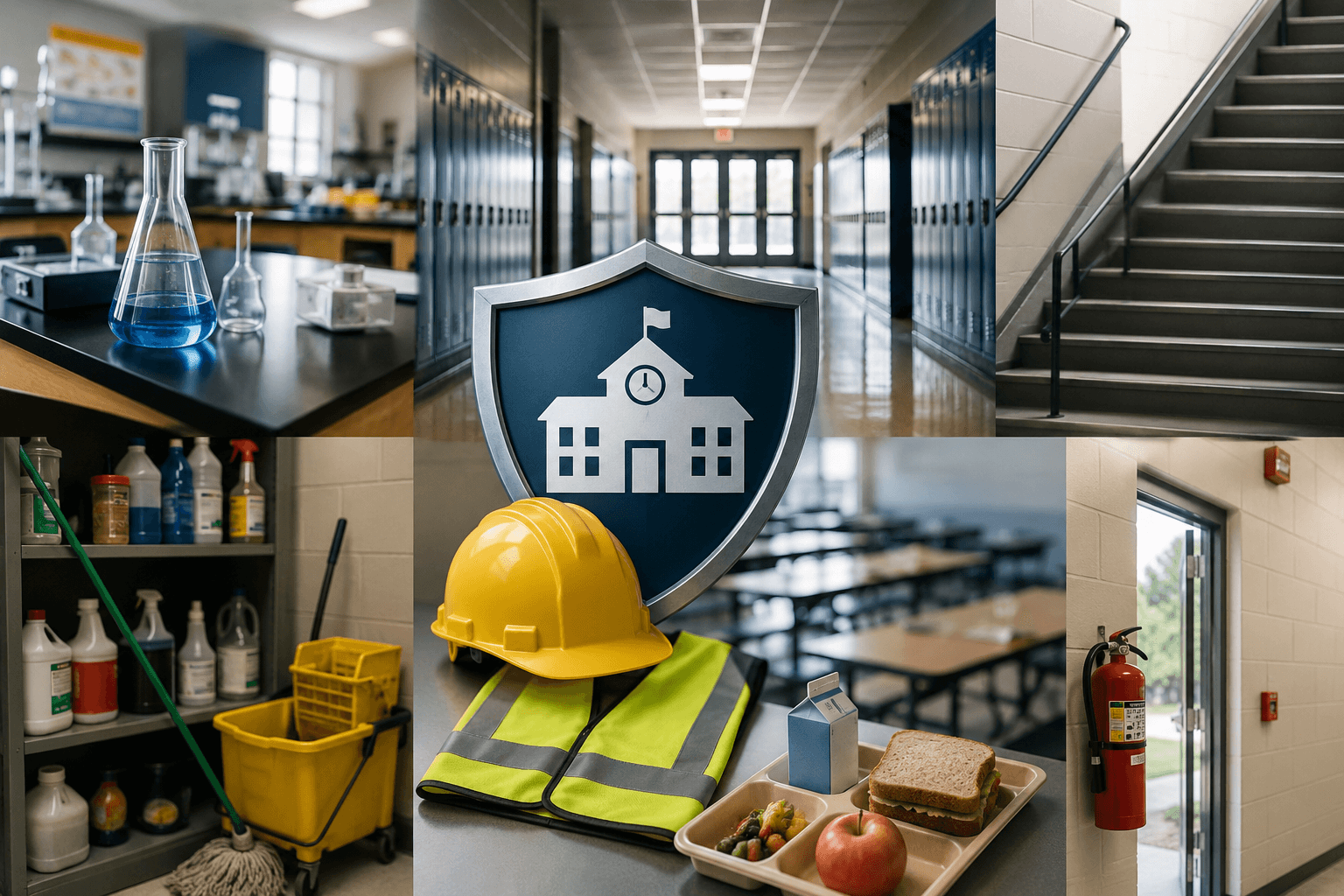
School safety usually brings to mind locked doors and emergency drills. A great deal of it is quieter: a blocked exit near a stairwell, unlabeled chemicals in a custodial closet, an extension cord across a classroom floor, an eyewash station in a science prep room that nobody has tested in months. These are the hazards the federal Occupational Safety and Health Administration exists to prevent in workplaces, and a school is a workplace for teachers, custodians, food service workers and maintenance staff, as well as a place of learning for students.
Whether OSHA’s rules legally apply to a particular school depends on the state and on whether the school is public or private. The safety principles behind them apply everywhere. This article explains OSHA requirements for schools, where the most common hazards are found, and what school leaders can do before an injury forces the issue.
Does OSHA apply to schools?
It depends on the school. Federal OSHA covers private employers, including private and religious schools, under its rules for nonprofit and educational employers. Federal OSHA does not cover state and local government employees, which includes public school staff, according to OSHA’s own guidance. Those workers are protected only where a state runs its own OSHA-approved plan. There are 22 State Plans that cover both private employers and state and local government workers, and seven more that cover only government workers. In those states, public school employees have OSHA-style protection through the state plan; in the remaining states, public school employees fall outside OSHA’s reach, a gap the Congressional Research Service has described.
Even where OSHA does not apply, its standards describe the practices safety professionals expect in any workplace, and they are a sensible benchmark for any school. A school’s duty of care, its legal and ethical obligation to protect students and staff from foreseeable harm, does not depend on which agency has jurisdiction.
Why it matters: injuries among school workers
School work is more hazardous than many people assume. Local government elementary and secondary schools recorded 4.0 nonfatal injuries and illnesses for every 100 full-time workers in 2024, compared with 2.4 in private schools, according to the Bureau of Labor Statistics. In 2021, local government schools reported 176,200 work-related injuries and illnesses, a 40.9 percent increase from 2020, the BLS reported.
Science labs and chemical safety
Science labs and prep rooms are among the highest-risk spaces in any school. They hold corrosives, flammables, compressed gases, biological materials, heat sources and electrical equipment, often in rooms with aging ventilation and safety equipment. OSHA’s Laboratory Standard requires covered employers whose staff use hazardous chemicals in laboratories to write and carry out a Chemical Hygiene Plan and to designate a Chemical Hygiene Officer, an employee qualified by training or experience to guide its implementation.
In practice, many schools have never formally named one. When no one is assigned, responsibility does not disappear; it falls on principals, facilities directors and superintendents, who may not know the chemical inventory or the condition of the eyewash stations. Science Safety offers Chemical Hygiene Officer certification training for school staff, and every chemical in a school should have an accessible Safety Data Sheet.
Custodial closets and maintenance areas
Custodial closets are one of the most overlooked hazard areas in schools. Inspectors commonly find incompatible products stored side by side, unlabeled spray bottles, leaking containers, missing Safety Data Sheets, poor ventilation and storage that unauthorized people can reach. Bleach stored near ammonia-based cleaners is a classic example of a mistake that can produce toxic gas. Custodial and maintenance staff handle chemicals every day, often after hours with little supervision, so hazard communication training, personal protective equipment and a written chemical management procedure are basic protections, not extras.
Hallways, stairwells and emergency exits
Clutter is easy to stop noticing. Boxes stored in corridors, furniture in stairwells, overflow supplies in exit paths and cords across walking surfaces may seem harmless on an ordinary day, but in a fire, a smoke condition, severe weather or a panic, they slow evacuation and cause falls. Exit routes exist for fast escape, and anything that blocks them is a safety failure. Because conditions change during the day, the most effective schools build quick, frequent egress checks into the routines of custodial and administrative staff rather than relying on an annual inspection. The Safer Ed podcast episode When Storage Becomes Risk looks at how storage turns into a hazard in STEM spaces.
 Safer EdWhen Storage Becomes Risk: The Hidden Safety System in STEM SpacesPlay episode: When Storage Becomes Risk: The Hidden Safety System in STEM Spaces (8 minutes 37 seconds)Follow on SpotifyApple
Kitchens, classrooms and other workspaces
School kitchens operate much like commercial food service, with burns, slips on wet or greasy floors, cuts, lifting injuries and chemical cleaners as common risks, often made worse by short staffing. Classrooms carry hazards too: overloaded power strips, space heaters near paper, heavy items stored overhead, unanchored shelving that can tip, and rooms crowded with extra furniture. None of these requires an expensive fix, but each requires someone to notice it and act.
OSHA requirements for schools: where to start
For a district that wants to align with OSHA expectations, a few steps make the largest difference. Find out whether your state has an OSHA State Plan that covers public employees, and what it requires. Assign safety responsibilities by name, including a Chemical Hygiene Officer for any school with laboratories. Keep a current chemical inventory and Safety Data Sheets, and train staff in hazard communication. Inspect exits, eyewash stations, fire extinguishers and AEDs on a regular schedule. Give custodial, maintenance and food service staff the training and protective equipment their work requires, and give every employee a simple way to report hazards.
The safest schools are not necessarily the newest or the wealthiest. They are the ones where someone owns each safety task, problems are reported and fixed quickly, and leaders treat the condition of the building as part of their responsibility to students and staff.
Related reading
Subscribe to edCircuit to stay up to date on all of our shows, podcasts, news, and thought leadership articles.
More on School Safety