
 Nancy Wagner

How Businesses Can Relieve the Pressure of Taxpayer Funding for Schools
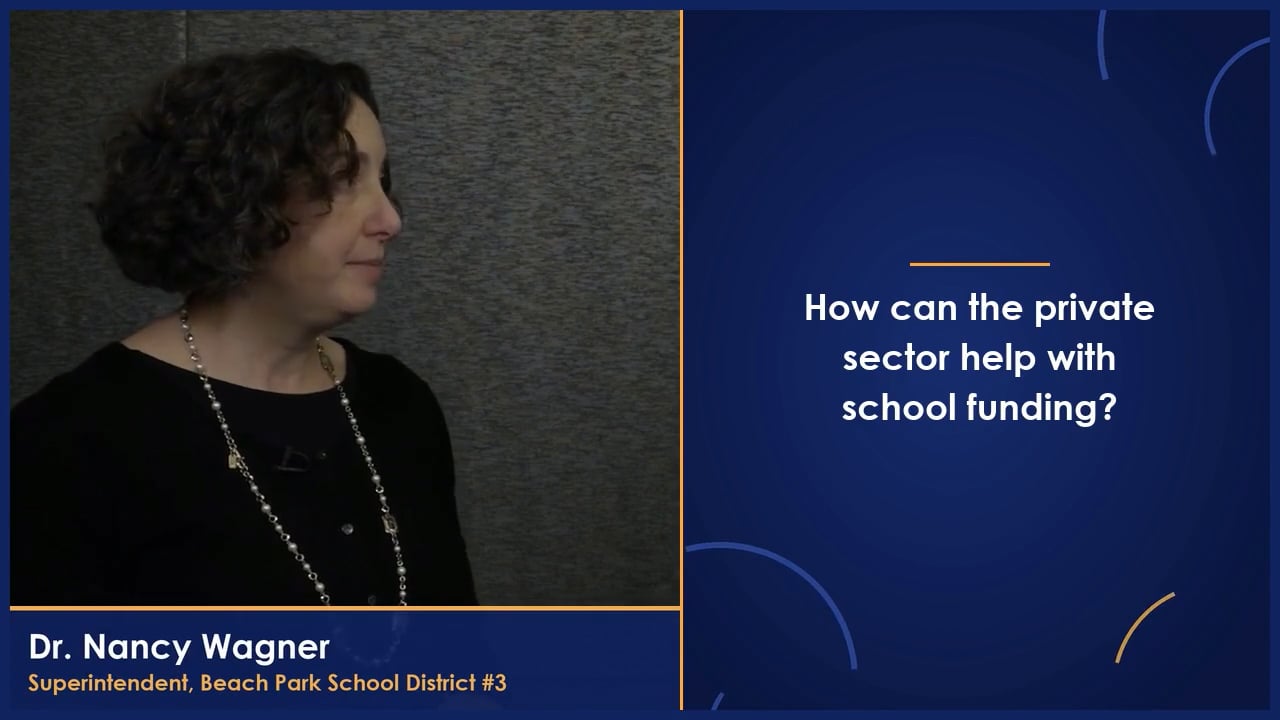
I recently had the pleasure of chatting with Dr. Nancy Wagner at the AASA conference in New Orleans. At the time of our discussion, Nancy was the superintendent at the Beach Park School District #3, north of Chicago, near the Illinois/Wisconsin border. Since that time, Nancy has chosen to take a job as superintendent in Mt. Prospect, which is closer to her home.
Dr. Wagner gives insight into how she structures public/private partnerships with corporations, and how it positively affects the students, parents and teachers in her district. School districts rely heavily on homeowner tax dollars, so it’s an added bonus to receive help from local businesses. Wagner speaks about the effective communication within the community, and touches on what seems to be top of mind with many superintendents these days – the true meaning of letter grades and what they measure.
I very much enjoyed my interview with Dr. Nancy Wagner and wish her all the happiness and success in her new career chapter as Superintendent of River Trails School District 26 in Mt. Prospect, IL.

Interview
edCircuit: Nancy, you and I were talking off-camera about your passion and platform around funding and supporting your district and sharing thought leadership amongst your colleagues of superintendents around the country.
I’m particularly interested in how we are starting to see very smart integration of corporate America and the private sector in helping to offset budget shortfalls with districts around the country in a way that we hadn’t really seen in years or decades past. How do you look at that?
Dr. Nancy Wagner: I would say that we need to start with the equitable and adequate funding. That has to be essential for all of our kids regardless of the zip code they live in. Illinois funding is really based on local tax dollars, and there’s a huge disparity.

I think it’s a great partnership to have with corporate America; I think that no one wants to pay more taxes. But if they know where their money is going and they can target it, I think people are more likely to spend their money ─ helping us put a STEM or a STEAM program together; donating 3D printers; doing things where we get mentors in with our students so they can really see people who look like them who hold wonderful jobs and learn about other professions that they’ve never even thought about.
DB: How much of that from your seat is in communicating to the community an effective marketing message that says, “Here’s what we’re doing” or “Here’s what we would like to do” so that the parents are informed in a way that is substantial. So that they’re not relying on secondhand information to say, “Wait a minute, why are we having integration of the private sector into what my child is experiencing in school?”
NW: I would say that it is important to keep that message. But, when I look at a community like mine where so much of the funding is really on the backs of our homeowners, they would welcome that.
DB: When you put it that way, you can really have a conversation about that.
I want to talk about funding. A lot of that today in education is around technology and how we can provide resources.
Do you agree with me that we are doing a better job of understanding that not all technology can service K-12? And that we can make more thoughtful informed decisions around technology that supports the high school students or community, or supports K-8? How are you looking at ways to not only personalize the learning for the student but also in a way in which you look at the technology purchases and then the dissemination of that technology?
NW: I think there was a time when we were really excited about whatever was new and flashy ─ “Look, it sparkles. We want it.” I think we’ve moved forward with “What do our kids need and what’s the best way to give that to them?”
Currently, we don’t have a one-to-one model, although it makes things more convenient. My teachers have done amazing things with a cart of Chromebooks, where they’re in the hall and they share them. There are three that go in this room during this period and the other twenty-seven go into a different classroom; and then, another time of day where they’re all gone but there are five in each of the classrooms.
I think we thought we knew what we needed. As you move further along and get more used to using technology, you realize that there are some things that are great with technology and with some things you need a different tool.
DB: Are you finding that we’re shifting from a student model or experience with consuming knowledge in the curriculum to creating at the student level and that’s impacting some of these decisions in the way in which you also support teachers in their own professional learning, since students are really taking ownership of it?
NW: I do think so. Right now, we have a digital media lab at my middle school. It has just exploded. And just like our cameraman behind the scenes, the kids stand there with those big reflective screens with the microphones; and when you watch them, they are super serious.

They want everything to be perfect. They’re making sure that they’re using great vocabulary when they’re writing their scripts. They’re making it so that it’s real and that it’s going to be consumed by not just their teacher. It really brings it to life and really makes them put their effort in.
DB: Speaking of that ownership, Nancy, have you found that now that students are taking more ownership of their own learning, that we are doing a better job in documenting that experience and communicating it to parents in a way that is reciprocal, not only in the communication between school and family but also in the way it supports engagement with the student and then supplies really valuable information to the teacher as well?
NW: I think that moved to standards-based learning and reporting, so that “I’ve got to B in my science class” really doesn’t have a great meaning. Your parents want to know that their kids are being successful so there’s that piece of “if that’s what a B means,” we need to find a way to communicate that.
But, really, what has your child learned and what are they able to do now that they have that knowledge is that critical piece. Because they are producing more products ─ I even think about our teachers who are using Twitter in the classroom. They tweet throughout the day with pictures of what the kids are doing.
Their parents know. When they come home, they can say, “I see that you guys planted seeds today” and you’ve got great dinnertime conversations without saying “What did you do at school today?”

DB: Speaking of that, how has it changed your role as superintendent when you think that, really, there’s no static position in education anymore? Every day, it’s changing. And I know we’re not, in general, comfortable with change just as human beings.
How have you become comfortable knowing that every day is going to be different and that even your own learning curve around technology and purchasing decisions, if it’s static, you’re going to lose ground?
NW: Maybe it’s from starting in the classroom as a teacher: No day is ever the same. It’s always an “anything can happen” day.
And that’s part of what I love about education because it’s kids and you never know what you’re going to get that day. Your kids who needed an extra pat on the back yesterday are the ones are giving a pat on the back to somebody else the next day.
The lesson that you’ve planned and thought was perfect bombs; then there’s another way that goes better than you ever imagined.
So I think change is just a part of education.
This interview was originally published in the Huffington Post.
More on Public-Private Partnerships: Mark Claypool in 2015
In September 2015, edCircuit spoke with Mark Claypool, president and CEO of ChanceLight Behavioral Health and Education, about his efforts to improve public-private partnerships in the education sector. The conversation took place at the BMO Capital Markets 15th Annual Back to School Education Conference in New York, which drew nearly 900 participants, including some 250 global education companies. The 10-minute interview (Play video) is available on Vimeo.
Claypool co-authored the book We’re In This Together: Public-Private Partnerships in Special and At-Risk Education. According to edCircuit’s 2015 write-up, Claypool is a social worker and education administrator who grew frustrated by shrinking resources for children with learning differences and founded the company in 1999, when it was called Educational Services of America. The write-up reported that the company had grown from a start-up to nearly $130 million in annual revenue and described it as a leading provider of behavior therapy and alternative and special education programs for children and young adults. Those figures date from 2015 and may have changed since.
The two interviews show the subject from two sides: a superintendent describing how local business help reaches students in one district, and a company leader describing how partnerships can serve students with the greatest learning needs.
Further Reading
- Scholastic – Chromebooks in the Classroom
- NY Times – How Google took over the classroom
- USA Today – Judge tosses Chicago lawsuit over school funding formula
More on K-12