

edCircuit
  • Start Here
    • Login
    • Register
    • Subscribe
    • Submit a Press release
    • Advertise or Sponsor
    • Contribute
    • Get Interviewed
  • On The Wire
  • K-12 Education
    • All K-12
    • K-12 Teachers
    • Teaching Strategies
    • Special Education and IEPs
    • Dyslexia
    • Gifted and Advanced Learning
    • Early Childhood, Pre-K and Kindergarten
    • School Calendar
    • Tutoring and Homework Help
    • Attendance and Absenteeism
    • After-School Programs
    • School Counselors
    • Homeschooling
    • School Models
    • Teacher Retention
    • Parents
    • Students
  • Teaching and Learning
    • Literacy and Reading
    • Math Education
    • Civics and History Education
    • Financial Literacy
    • Assessment and Testing
    • Curriculum and Instruction
    • Personalized Learning
    • Project-Based Learning
    • Social-Emotional Learning
    • Executive Function
    • Creativity
    • Diversity, Equity, Inclusion
  • Professional Development
    • All Professional Development
    • Educators
    • Administrators
    • edLeaders
  • Higher Education
    • All Higher Education
    • College Admissions
    • Career and Technical Education (CTE)
    • Graduation
    • FAFSA and Financial Aid
    • Student Loans
  • Artificial Intelligence
  • Cybersecurity
  • School Safety
    • All School Safety
    • Science and Lab Safety
    • School Design and Facilities
    • Bullying
    • Duty of Care and School Liability
  • Continuing Education
    • All Continuing Education
    • Online Certificate Programs
    • Teaching Jobs and Careers
    • Teacher Appreciation
  • Education Policy and Government
    • All Education Policy
    • Department of Education
    • School Choice
    • Global
    • Advocates
  • EdTech
    • All EdTech
    • Online Learning
    • Hybrid and Remote Learning
    • Augmented and Virtual Reality
    • ESports
    • Gamification and Game-Based Learning
    • Digital Citizenship
    • EdTech Entrepreneurs
    • Market Trends
    • Future of Education
  • STEM and STEAM Education
  • Media
    • EDU Shows
    • EDU Podcasts
    • Education Industry Guides and Reports
  • About edCircuit
Saturday, October 17 2026 - Welcome
  • LOGIN
Home Tags Posts tagged with "Headline"
Tag:

Headline

This if for posts to be in the featured/top section of site
A student writes in a notebook while his phone lies set aside under a red no symbol beside research charts
Hot Topics - controversialDigital CitizenshipK-12

School Cell Phone Bans: What the Evidence Shows

by EdCircuit Staff October 13, 2026
written by EdCircuit Staff 10 minutes read

School cell phone bans are now common enough to evaluate, but not old enough to support an easy verdict. Teachers and administrators often describe calmer classrooms, livelier lunchrooms, and fewer conflicts fueled by social media. Researchers have also found evidence of academic and behavioral benefits.

Other studies have reached a more cautious conclusion. Removing phones during the school day can reduce access and distraction without changing how much time students spend online overall. A ban may improve the environment inside a building while leaving sleep, mental health, and after-school habits largely untouched.

Both findings can be true.

The mistake would be treating a phone ban as either a cure for student disengagement or an empty gesture. It is a change to the learning environment. Its value depends on what happens after the device is put away—and whether schools measure more than compliance.

The first changes are usually visible

Some effects of a phone restriction do not require a test score to notice. Teachers can see whether students begin assignments more quickly. Administrators can hear whether lunchrooms are filled with conversation instead of scrolling. Counselors may notice whether conflicts arrive at school through group chats and social media at the same rate.

District reports are beginning to capture some of those changes.

Richmond Public Schools has reported stronger focus and engagement since implementing its bell-to-bell policy. District updates also describe fewer incidents involving bullying and hostile group chats. By April 2026, 95.83% of Richmond schools were strictly enforcing the policy, according to a School Board implementation review.

Spokane Public Schools reported that lunchtime behavior referrals fell 36% during the 2024–25 school year and failure-to-cooperate cases declined by approximately 22%. Students and staff also described more face-to-face interaction during the day.

Those reports matter, but they are not controlled studies. Richmond was implementing a districtwide policy across schools with different students and leadership teams. Spokane paired its phone rules with Engage IRL, an initiative designed to involve more students in clubs, sports and other in-person activities. The decline in referrals cannot be attributed to the phone policy alone.

That does not make the results meaningless. It changes the question. Instead of asking whether the ban produced every improvement, districts should ask whether the policy contributed to conditions in which those improvements became more likely.

Distraction is real, but enforcement changes the result

The case for restricting phones often begins with attention. On that point, the international data are fairly clear: digital distraction is common.

PISA 2022 results show that about 30% of students across OECD countries reported becoming distracted by digital devices during most or every mathematics lesson. Twenty-five percent said they were distracted by other students using devices. Students who regularly experienced digital distraction scored 15 points lower in mathematics than students who said it almost never happened, after accounting for student and school socioeconomic profiles.

Phone restrictions were associated with lower reported distraction—but primarily where schools actually reduced access. The OECD found that 29% of students attending schools with phone bans still reported using a smartphone several times a day at school. Another 21% said they used one every day or almost every day.

A policy posted on a website is not the same as a phone-free school.

That gap helps explain why districts may report different outcomes under rules that appear similar. A bell-to-bell policy supported by secure storage and consistent enforcement removes more access than an “off and out of sight” rule that varies by classroom. A ban introduced in elementary school may also affect students differently than one introduced in high school after years of established phone habits.

The strength of the policy, the storage method, the age of the students, and the consistency of enforcement all shape what researchers are actually evaluating.

The strongest studies do not point in one direction

A major English study provides an important caution against promising too much.

The SMART Schools study compared 1,227 students ages 12 to 15 across 30 secondary schools. Twenty schools restricted recreational phone use, while 10 permitted it. Students in restrictive schools used phones about 40 minutes less and social media about 32 minutes less during school.

The difference did not extend across the rest of the day. Researchers found no evidence that restrictive policies were associated with lower overall weekday or weekend phone use or better mental well-being. They also found no meaningful differences in sleep, physical activity, academic attainment, or disruptive classroom behavior.

The study was observational rather than experimental, so it could not establish that the policies caused—or failed to cause—the measured outcomes. Its central finding is still important: restricting access at school did not automatically change students’ broader digital lives.

Research from Norway points toward stronger benefits. In a 2024 working paper, economist Sara Abrahamsson combined administrative data with information about middle school phone policies. She found that bans were followed by lower use of health care for psychological symptoms among girls, less bullying among boys and girls, higher grades for girls and a greater likelihood that girls entered an academic high school track. The effects were larger for girls from lower-income backgrounds.

A peer-reviewed study of regional policies in Spain also found promising results. After Galicia and Castilla-La Mancha restricted phones, researchers reported reductions in bullying among teenagers. Galicia also recorded statistically significant gains in PISA mathematics and science scores, while the academic findings for Castilla-La Mancha were less conclusive because of gaps in the available data.

The Norwegian and Spanish studies used quasi-experimental methods designed to estimate effects more carefully than a simple before-and-after comparison. They still examined different countries, policies, age groups and outcomes. Norway’s findings were published as a working paper, and the Spanish researchers noted that they could not fully separate a complete prohibition from enforcement that limited phones to approved educational use.

Taken together, the research supports neither a sweeping endorsement nor a dismissal. Phone bans appear capable of reducing distraction and may improve behavior, bullying and academic outcomes in some settings. They have not consistently produced measurable improvements across every outcome or student group.

A phone-free day does not end a student’s digital life

The most revealing evidence may come from what students, families and teachers say happens outside the ban.

In 2026, researchers from the SMART Schools project conducted 40 focus groups with 177 participants across seven English schools. The resulting qualitative study found a mixed picture.

Students and teachers in restrictive schools described more face-to-face interaction during the day. Schools that permitted phones offered students more opportunities to practice self-regulation. Both approaches also produced drawbacks. Some students in restrictive schools said they compensated for lost phone time after school, sometimes displacing sleep or physical activity. In permissive schools, unauthorized photos and recordings created privacy and behavior concerns.

Neither policy prevented online conflict from entering the building. Arguments that began at night in group chats or on social media could still erupt face to face the next morning.

This is where expectations for school cell phone bans often become unrealistic. A six- or seven-hour restriction cannot, by itself, change a platform designed to hold attention around the clock. It cannot establish family boundaries at home, make social media safer or teach students how to respond to online harassment.

The school day still matters. Several uninterrupted hours can give students meaningful distance from notifications and social pressure. But the policy works within a larger digital environment that schools do not control.

What replaces the phone matters

Removing a phone creates time, but it does not determine how that time will be used.

A student without a phone can talk with classmates, participate in a club or begin an assignment more quickly. The same student can also sit alone, disengage from the lesson, or move the same distraction to a school-issued laptop.

Spokane’s experience is instructive because the district did not stop with a restriction. Engage IRL expanded opportunities for students to connect through activities. That makes it harder to isolate the effect of the phone policy, but it may help explain why the broader approach worked.

Schools should pay attention to what happens during the periods phones once occupied. Are students talking at lunch? Are libraries, recreation spaces, and clubs available? Do teachers have instructional routines that capitalize on stronger attention? Are students who relied on phones for social connection becoming more involved—or more isolated?

The answers may vary by student. A highly connected teenager may benefit from a forced break. Another student may use a phone as a bridge to friends, language support, or a community not available inside the school. Restrictive policies need enough flexibility to address documented needs without reopening access for everyone.

Digital literacy must also continue. Students still need to learn how algorithms shape what they see, how to recognize manipulation, how to protect their privacy and how to respond to harassment. A phone-free school should not become a place where educators avoid those conversations.

Districts need a measurement plan, not a victory lap

The first year of a phone ban should be treated as the beginning of an evaluation, not proof that the problem has been solved.

Districts should establish a baseline before implementation whenever possible. Academic measures might include course failures, assignment completion, assessment performance and instructional time lost to redirection. Behavior measures should separate phone violations from fighting, bullying, classroom removal and refusal to follow directions. Attendance, tardiness and visits to counselors or nurses may provide additional context.

Student and staff surveys can capture changes that administrative records miss: perceived focus, anxiety, belonging, face-to-face interaction and the amount of time teachers spend addressing phones. Families can report whether school communication systems work and whether students compensate with heavier use after dismissal.

The data should be examined by grade, school and student group. An overall decline in referrals could conceal unequal enforcement. An average academic gain could mask no change for students who were already performing well. A policy that improves lunch for most students may leave some feeling more isolated.

Implementation measures belong in the analysis as well. How often are students still accessing phones? How many devices are confiscated? How long does dismissal take? How many exception requests are approved, denied or delayed? Do staff members believe the rule is being enforced consistently?

The 2026 economic analysis of the SMART Schools data adds another useful measure: staff time. Researchers found minimal differences in student quality of life or mental well-being between restrictive and permissive schools, but restrictive policies may have produced some cost savings by reducing the time employees spent managing phone-related activity.

That is not the outcome most communities discuss when adopting a ban, but it matters. Time teachers no longer spend correcting phone use can return to instruction—even if test scores do not rise immediately.

The right conclusion is still being written

School cell phone bans should not be judged only by whether phones disappear from view. The more important questions are whether students learn more, interact differently, experience less bullying, and spend less time in conflict with adults.

The evidence so far suggests that restrictions can improve parts of the school day. They are most likely to reduce distraction when they meaningfully reduce access. Some schools and studies have reported better behavior, less bullying and academic gains. Other research shows little measurable difference in mental health, sleep or overall phone use.

That mixed record is not a reason to stop evaluating the policies. It is a reason to evaluate them honestly.

A phone ban can create space for attention, conversation and learning. Schools still have to decide what will fill it.

The final measure of success is not simply whether the phones are gone. It is what returns when they leave.

Subscribe to edCircuit to stay up to date on all of our shows, podcasts, news, and thought leadership articles.

October 13, 2026 0 comments
0 FacebookTwitterPinterestLinkedinWhatsappCopy LinkEmail
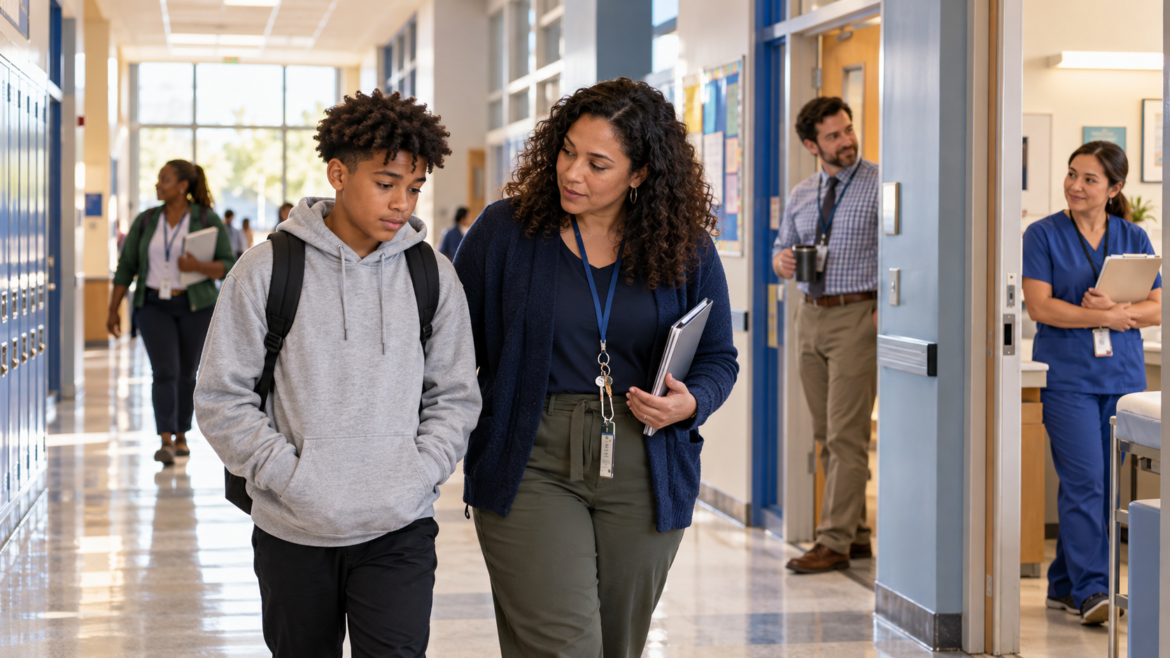
Student support: a female school counselor talking to a male student in a school hallway with staff in the background
Hot Topics - controversialK-12Safer EdSchool CounselorsSocial-Emotional Learning

Student Support Teams: Seeing the Whole Student

by EdCircuit Staff October 12, 2026
written by EdCircuit Staff 8 minutes read

Student support teams often recognize a developing concern before it appears in a discipline report, emergency call, or formal referral.

A student visits the nurse several times with headaches but has no fever or visible illness. A teacher notices that assignments have stopped coming in. A paraprofessional sees the student sitting alone at lunch. A counselor knows the family is experiencing a significant change. A case manager recognizes that coping strategies that usually help are no longer working.

Viewed separately, each observation may seem manageable. Together, they show that something has changed. The challenge is creating a system that allows the right people to connect those pieces and decide what should happen next.

That is the focus of Season 4, Episode 6 of the Safer Ed Podcast, “Before a Concern Becomes a Crisis: The People Who See the Whole Student.” The episode examines how counselors, psychologists, nurses, social workers, special education professionals, behavior specialists, teachers, coaches, and other trusted adults contribute to prevention long before a situation becomes an emergency.

Safer Ed is sponsored by Science Safety and produced in partnership with edCircuit.

A Student’s Story Is Distributed Across the School

No single employee experiences a student’s entire day. A teacher may notice academic withdrawal. A nurse may see recurring physical complaints. A coach may recognize a sudden change in effort. A bus driver may observe a conflict that never reaches the classroom. A counselor may understand family circumstances, while a special education professional may recognize a shift from the student’s established baseline.

Even an adult who spends only a few minutes with a student may hold an important piece of information.

Schools often have the people they need. What they may lack is a reliable way to connect what those people know. Without that connection, each office responds to the part it can see. Each response may be appropriate, but the larger pattern remains hidden.

Prevention begins when observations can move beyond individual rooms, inboxes, and conversations.

Distress Is Not the Same as Danger

Schools must also resist the urge to interpret every change in behavior as a safety threat.

Grief is not a threat. Anxiety is not a threat. A disability is not a threat. Anger, isolation, declining grades, or a difficult home situation does not automatically mean that a student will harm themselves or someone else.

Treating distress as dangerous can stigmatize students and push schools toward security or discipline when support is more appropriate. Dismissing observable changes because each appears minor can also leave a serious concern unaddressed.

The goal is not to profile a “dangerous student.” It is to understand what has changed, what the student may need, whether anyone may be at risk, and which response fits the facts. That requires context and more than one professional perspective.

Reporting Should Have More Than One Doorway

Employees and students should not have to determine the severity of a concern before sharing it. A concern may come through a counselor, administrator, anonymous reporting system, parent call, or team referral. Those entry points can vary. What matters is that they lead somewhere.

The joint K–12 Bystander Reporting Toolkit from the Cybersecurity and Infrastructure Security Agency and the U.S. Secret Service emphasizes that reporting programs need more than a way to submit information. Schools must also establish how reports are received, reviewed, acted upon, and followed through.

A reporting tool is not a response system by itself. If people do not know who receives a concern or whether it was reviewed, trust will erode.

Schools therefore need multiple ways to report—but one coordinated process for deciding what happens next.

Route the Concern Instead of Forcing a Category

Not every report requires the same response.

Some situations demand immediate emergency action. Others may require a formal behavioral threat assessment. Many will call for counseling, health services, academic assistance, conflict resolution, family outreach, increased supervision, or another form of student support.

The first task is triage: determine urgency, identify the appropriate pathway, and assign responsibility.

Behavioral threat assessment is an important part of a comprehensive safety system, but it should not become the default response to every struggling student. When warranted, it should examine behavior in context, consider the possibility of harm, and identify actions that can reduce risk.

The U.S. Secret Service’s Protecting America’s Schools report supports a multidisciplinary approach rather than one based on a profile or type of student. That distinction matters. A team is not searching for students who fit a label. It is evaluating facts, circumstances, communications, behavior, stressors, supports, and changes over time.

Many concerns may not require a formal threat assessment. They still deserve an appropriate response.

Start With Facts, Then Add Context

Strong decisions begin with what people actually saw, heard, received, or documented.

“The student left class three times this week and went to the nurse” is an observation. “The student is avoiding work” is an interpretation.

Likewise, a documented message is evidence. Describing the student as “dangerous” is a conclusion.

Separating facts from interpretations does not remove professional judgment. It gives that judgment a stronger foundation.

Context then helps the team understand what the facts may mean. Is the behavior new, repeated, or escalating? Has the student asked for help? What stressors are present? Which trusted relationships and supports already exist?

These questions help schools avoid both overreaction and underreaction. The purpose is to determine what the situation requires—not to fit every student into the same response.

Privacy Should Guide Information Sharing, Not Stop It

Schools are right to protect student information. Privacy laws, professional ethics, district policies, and the student’s dignity all matter.

But privacy should not leave essential information isolated when responsible school officials need it to fulfill their roles.

The answer is purposeful sharing: the right information, with the right people, for a clear educational, health, or safety purpose. The U.S. Department of Education’s FERPA guidance explains that school officials may access education records when the school has determined that they have legitimate educational interests, while schools must use reasonable methods to limit access accordingly.

That does not authorize unrestricted sharing, and it is not a substitute for district policy or legal guidance. It does mean schools should establish procedures before a difficult situation occurs so employees are not trying to interpret privacy requirements under pressure.

Ownership and Follow-Through Turn Concern Into Action

Bringing several professionals together can improve a school’s understanding of a concern. It can also blur responsibility when roles are not defined.

Who receives the report? Who determines urgency? Who speaks with the student and family? Who coordinates the support plan? Who follows up?

Without clear ownership, everyone may be involved while no one is certain who owns the next step. The teacher assumes the counselor is handling it. The counselor believes the administrator contacted the family. The administrator expects the nurse to complete the follow-up. The concern circulates, but the student experiences little meaningful change.

Every response needs a named person responsible for moving it forward. A referral is not the finish line.

Support is not complete because an email was sent or an appointment was recommended. Someone must confirm whether the student connected with the service, whether the intervention is helping, and whether circumstances have changed.

The person who reported the concern also needs appropriate closure. Confidential details may remain protected, but reporters should know their information was received and reviewed. A silent system can discourage future reporting.

Follow-up turns a response from an event into a process.

Support and Safety Are Often the Same Work

Return to the student who visited the nurse with recurring headaches.

When the nurse, teacher, counselor, case manager, and administrator connect their observations, they see more than isolated concerns. They see a student under significant stress who needs support.

The counselor meets with the student. The school contacts the family. Academic expectations are adjusted temporarily. The student identifies a trusted adult for regular check-ins, and the team schedules a follow-up.

What looked like several unrelated issues was one student asking for help in several different ways.

This is why counselors, psychologists, nurses, social workers, special education teams, and other trusted adults belong in the school safety conversation. Their work may not resemble traditional security, but it helps schools recognize concerns earlier and respond more accurately.

Support and safety are not competing goals. Often, they are the same work.

Questions for School Leaders

Schools can begin by asking:

  • Do students, families, and employees know how to report a concern?

  • Does every concern reach someone qualified to determine the next step?

  • Are counselors, nurses, psychologists, social workers, and special education professionals included early?

  • Does the team separate observable facts from assumptions?

  • Is one person clearly responsible for coordinating each response?

  • Does someone confirm whether the support plan is working?

The people who see the whole student are often the people who help a school act before a concern becomes a crisis. Their effectiveness depends on whether the system allows them to bring their observations together—and whether the school follows through once they do.

Listen to Season 4, Episode 6 of the Safer Ed Podcast, “Before a Concern Becomes a Crisis: The People Who See the Whole Student,” for a deeper discussion of coordinated support, purposeful information sharing, behavioral threat assessment, and the professionals whose daily work makes prevention possible.

To learn more, explore Science Safety’s free Duty of Care module and Behavioral Threat Assessment and Management course.

Subscribe to edCircuit to stay up to date on all of our shows, podcasts, news, and thought leadership articles.

October 12, 2026 0 comments
0 FacebookTwitterPinterestLinkedinWhatsappCopy LinkEmail
Student agency with AI: a student's pencil draws one glowing path forward while branching AI suggestions fade above the notebook
StudentsHot Topics - controversialArtificial IntelligenceK-12

Student Agency in the Age of AI

by EdCircuit Staff October 12, 2026
written by EdCircuit Staff 7 minutes read

Generative AI has made student agency harder to see. Two students can submit equally polished assignments after doing very different amounts of intellectual work. One may have wrestled with the ideas, while the other handed most of the thinking to a tool.

Schools often approach this problem by asking whether students used AI. That matters when an assignment limits or prohibits its use, but it does not tell educators enough. One student might request another explanation or ask for feedback on an argument. Another might have the tool choose the topic, organize the response, and write the draft.

That leaves teachers with a more useful question: Who remained responsible for the thinking?

Generative AI offers faster access to feedback, language support, and new ways to explore a subject. It also makes it easy to avoid uncertainty and accept an answer without fully understanding it. Whether the technology strengthens or weakens agency depends largely on how the learning is designed around it.

Better work does not always mean more learning

Generative AI is good at improving the appearance of student work. It can correct errors, organize information, strengthen a sentence, and suggest details a student overlooked. Those improvements may be useful, but they do not prove that a student has developed greater understanding.

The OECD Digital Education Outlook 2026 makes this distinction clear. Its review found that generative AI can support learning when guided by sound teaching principles. When students outsource a task, it may improve performance without producing meaningful learning gains.

Consider a student who asks an AI tool to explain a math concept in a different way and then solves a new problem independently. The tool has helped the student return to the thinking. If the student copies the original problem into the tool and transfers the answer, the task has been completed without the same intellectual work.

Both pages may contain a correct solution, but only one shows what the student can do.

This is why schools cannot rely exclusively on the quality of a final product. Teachers also need opportunities to see how students framed the problem, selected information, made decisions, and responded when something did not work.

Where AI can expand student agency

Used with a clear purpose, AI can help students take actions that previously felt out of reach.

A learner who is unsure how to begin can ask for questions that narrow a topic without requesting a completed thesis. A multilingual student can compare explanations in two languages. A student with a disability may use speech, text, or visual tools to communicate more independently. Someone who needs practice can request another example and receive immediate feedback.

Students can also compare several approaches, test an explanation for different audiences, or ask the tool to challenge an early assumption.

The value comes from what students do next. They must decide which suggestion fits the goal, reject weak or inaccurate information, and explain why they selected one direction over another.

Prompting alone is not enough. Students need to recognize confident errors, invented sources, and bias. Sometimes the responsible decision is to stop using the tool and return to a primary source, a classmate, or the teacher.

When support starts replacing the student

The risks surrounding AI are larger than academic dishonesty. A student can follow the rules and disclose every use of AI while still giving away too much of the learning process.

Imagine a research assignment in which AI suggests the topic, forms the question, summarizes the sources, creates the outline, and drafts the response. The student may type several prompts and approve each step, but the tool has made most of the decisions that gave the assignment educational value.

AI can also remove productive struggle before it has a chance to do its work. Students need time to sit with a difficult passage, attempt an imperfect solution, notice a contradiction, and decide what kind of help to seek. Those moments build persistence and judgment.

That does not mean struggle should be prolonged for its own sake. Students need appropriate scaffolds, and those supports will look different depending on their needs. The goal is to help students move forward without making every decision for them.

WestEd has recommended using AI to scaffold student choice rather than script every move. That offers a practical dividing line: Give students enough support to continue doing the work themselves.

Make the thinking visible

AI is forcing schools to reconsider what counts as evidence of learning. A final essay, presentation, design, or solution may still matter, but it can no longer be the only evidence a teacher sees.

The practical response is not to turn every assignment into an investigation of possible cheating. It is to create normal opportunities for students to show their thinking as the work develops.

Teachers might use a short proposal conference, an annotated source, an in-class checkpoint, a comparison between drafts, or a brief oral defense. Students can explain what they changed after feedback, which AI suggestions they rejected, and where they verified information.

Disclosure becomes more useful when it is specific. “I used AI” reveals little. A student could instead identify the tool, explain why it was used, describe what was accepted or rejected, and note how the output was checked. That reflection becomes evidence of both AI literacy and student agency.

Local assignments also make thinking easier to see. A student might use AI to compare solutions to a campus problem but still need to gather evidence, speak with people affected by the issue, and defend a recommendation.

Teachers do not need to add every checkpoint to every task. One or two well-placed moments can provide a clearer picture of what the student understands and who is directing the work.

Four questions for classrooms and AI policies

Schools cannot write a separate rule for every tool or new feature. Lists of permitted and prohibited uses provide clarity, but they can become outdated quickly. A few consistent questions can help students and teachers decide whether an AI use preserves agency:

  • Who set the purpose? The student should be able to explain what they were trying to understand, create, or improve before asking AI for help.
  • Who made the important decisions? The student should identify the choices that shaped the work, including the question, evidence, method, interpretation, or revision.
  • Who evaluated the output? AI-generated information must be checked rather than accepted because it sounds polished or confident.
  • Who can explain the result? The student should be able to defend the work, describe its limitations, and apply the learning without relying on the tool.

These questions move the conversation beyond detection and return responsibility to the center.

The TeachAI guidance for schools includes maintaining student and teacher agency among its core principles. It recommends that people remain critical consumers of AI and retain responsibility for academic and organizational decisions. UNESCO’s guidance on generative AI also calls for a human-centered, age-appropriate approach that protects privacy.

District leaders should consider more than whether a product is efficient or accurate. Does it encourage students to form questions? Can they challenge its recommendations? Can teachers override automated suggestions? Do students understand what happens to the information they enter?

Equity also deserves close attention. Students with strong background knowledge may be better positioned to catch a weak or inaccurate response. Other students may be more likely to trust an answer that appears authoritative. Access to AI must be accompanied by access to knowledgeable teachers, explicit instruction, and opportunities to practice judgment.

Preparing students to remain decision-makers

Students will live and work with AI. Preparing them does not require keeping every tool outside the classroom or accepting every use simply because the technology will be part of their future.

Schools have a more demanding responsibility: Teach students to use powerful tools while remaining accountable for their decisions.

AI may help a student see possibilities that were previously difficult to reach. The student must still decide what matters, determine what is accurate, and take responsibility for the result.

The future will include AI. The question for schools is whether students will enter that future prepared to make decisions—or waiting for a system to make those decisions for them.

Subscribe to edCircuit to stay up to date on all of our shows, podcasts, news, and thought leadership articles.

October 12, 2026 0 comments
0 FacebookTwitterPinterestLinkedinWhatsappCopy LinkEmail
AI policy for schools: a closed policy binder on an administrator's desk while glowing AI network lines spread from a laptop, phone and tablet
Artificial IntelligenceHot Topics - controversialK-12

Your School’s AI Policy May Already Be Outdated

by EdCircuit Staff October 9, 2026
written by EdCircuit Staff 7 minutes read

A school AI policy written in 2023 or 2024 may have been entirely reasonable at the time. Many early policies told students to complete their own work, prohibited artificial intelligence unless a teacher granted permission, and classified unauthorized use as plagiarism. Some added a short list of approved uses, including research, translation, data analysis, and grammar assistance.

Those policies responded to the most visible concern confronting schools: students using ChatGPT to write assignments.

Two years later, that concern has not disappeared, but the technology has moved well beyond the problem those rules were designed to solve. AI is now built into search engines, writing programs, productivity platforms, learning management systems, tutoring applications, and accessibility tools. It can generate and interpret text, images, audio, video, computer code, and data. Newer systems can complete multistep tasks, create realistic synthetic media, and interact with students in ways that early policies rarely anticipated.

A district does not need to abandon a policy simply because it is two years old. It does need to determine whether that policy still answers the questions educators, students, and families are asking today.

A Policy Written for Chatbots May Miss Embedded AI

One sign of an aging policy is a broad prohibition on “AI and natural language processing tools” without a clear definition of what that includes. Read literally, the language could cover spell-checkers, automated captions, translation programs, speech-to-text software, search features, and approved accommodations.

It may also overlook the fact that AI is no longer always a separate website a student deliberately visits. A student may encounter an AI-generated summary inside a search result, accept a writing suggestion inside a document, or use a feature added to a platform the district approved before that feature existed.

This creates a difficult enforcement problem. A rule can be so broad that it technically prohibits tools the district expects students to use, yet not specific enough to govern the applications that pose the greatest risks.

Updating a policy does not require schools to permit every new use. It requires them to define what is covered, identify which tools have been reviewed, and explain when AI assistance supports learning and when it replaces the work students are expected to do.

Academic Integrity Now Requires More Than a Plagiarism Rule

Submitting an AI-generated essay as original work can clearly constitute academic dishonesty. That does not mean every unauthorized interaction with AI is identical.

Using AI to generate an entire response, reorganize a paragraph, create practice questions, correct punctuation, or explain a difficult concept involves different levels of assistance. The relevant question is whether the technology replaced the knowledge, reasoning, or skill the assignment was intended to measure.

Districts can give teachers flexibility while providing students with consistent assignment-level expectations. A simple framework might identify AI use as prohibited, limited to specified tasks, permitted with disclosure, or required as part of the assignment. The designation should appear on the assignment so students do not have to guess which rule applies.

This approach also reflects what schools are learning about AI and student performance. A recent review from the U.S. Department of Education’s Institute of Education Sciences found limited but emerging evidence that teacher-mediated AI and tutoring systems that provide guidance or hints may support learning. General-purpose AI may hinder learning when it reduces cognitive effort or completes the thinking students need to practice. The distinction is not merely whether AI was present. It is whether the tool supported the learning process or substituted for it. Institute of Education Sciences

States Are Revising Their Own Guidance

The growth of state-level guidance shows how quickly expectations are changing. In April 2025, the Education Commission of the States reported that at least 28 states had published guidance on AI in K–12 education. By August 2026, AI for Education was tracking official guidance or policies from 35 states and Puerto Rico. Education Commission of the States AI for Education

The more important development is not simply the number of states involved. It is the way some states are revisiting their own work.

California issued initial guidance in 2023, then convened a statewide working group, released updated guidance, and published a model policy in June 2026. The model addresses privacy, disclosure, staff use, approved tools, instructional discretion, AI-assisted grading, and confidential information. It also states that AI detection software should not be the sole basis for discipline or a grade penalty. California Department of Education

Oregon moved its guidance from a static PDF to a web-based Version 3.0 so it could be revised more quickly. The updated material now addresses agentic AI, synthetic media, educator competencies, information literacy, student well-being, bias, privacy, and the risk of becoming overly dependent on automated systems. Oregon Department of Education

Oklahoma has also reached Version 3.0 of its state guidance and supplements it with a model district policy, professional learning, family resources, and implementation support. Its framework connects AI use with FERPA, COPPA, cybersecurity, academic integrity, privacy, and equitable access. Oklahoma State Department of Education

Other states are taking different approaches. Washington has developed human-centered guidance and sample policy information. North Carolina introduced an initial guidebook in 2024 and has continued adding resources and training. Minnesota says its guidance will receive regular updates as the technology evolves, while Colorado describes its AI roadmap as a dynamic resource. Virginia has paired guidance with educator training and system-level leadership support. Ohio requires many public schools to maintain an AI policy and provides a state model they can adapt.

These efforts are not identical, nor are all of them mandatory. Together, however, they send a consistent message: AI governance is becoming an ongoing responsibility rather than a one-time board action.

The Most Important Areas to Revisit

District leaders reviewing an older policy should begin with several practical questions.

Does the policy cover staff as well as students? Educators and administrators may use AI to prepare lessons, draft communications, translate materials, summarize information, provide feedback, or assist with grading. The policy should clarify where human review is required and what information staff may enter into an AI system.

Does it protect student information? Students and staff need to know which platforms have been approved and which information must never be entered into a public tool. Names, grades, education records, health information, disciplinary records, passwords, and unpublished student work require specific safeguards. Vendor review should also examine how prompts and uploaded materials are stored, shared, retained, or used to improve a model.

Does it preserve accessibility and equitable access? A general prohibition should not prevent a student from using technology required by an IEP, Section 504 plan, language-access plan, or other approved accommodation. Districts should also consider whether allowing paid AI products gives some students an advantage unavailable to their classmates.

Does it address high-risk uses? Current rules should cover AI-generated impersonation, deceptive synthetic media, harassment, discriminatory content, unauthorized surveillance, and automated recommendations involving discipline, placement, mental health, special education, or other consequential decisions. Qualified people must remain responsible for decisions affecting students.

Is the enforcement process fair? AI detectors can inform a conversation, but they should not be treated as proof. Schools should consider drafts, version histories, student explanations, demonstrations of understanding, and other evidence before imposing consequences. Broad warnings that students may face civil or criminal liability also deserve review by district counsel rather than being used as a general disciplinary threat.

Keep the Principles Stable and the Procedures Flexible

School boards do not need to rewrite an entire policy every time a company adds a new feature. A more sustainable approach separates lasting principles from frequently changing procedures.

The board policy can establish expectations involving student safety, academic integrity, human oversight, privacy, transparency, equitable access, and responsibility for final decisions. Administrative guidance can maintain the list of approved tools, assignment labels, disclosure methods, vendor-review procedures, data restrictions, and training requirements.

Those procedures should be reviewed at least annually and whenever a major capability, legal requirement, privacy concern, vendor change, or school incident exposes a gap. Students, teachers, technology leaders, curriculum specialists, families, special education professionals, and legal counsel can each identify problems that may not be visible from a single department.

A two-year-old AI policy is not automatically a bad policy. But if it still treats artificial intelligence primarily as a chatbot students might use to write an essay, it no longer reflects the technology operating in today’s schools.

The goal is not to chase every new product. It is to establish a review process that keeps district expectations current while preserving the principles that should not change: students must remain engaged in their own learning, educators must remain responsible for professional decisions, and technology must serve the educational mission rather than quietly redefine it.

Subscribe to edCircuit to stay up to date on all of our shows, podcasts, news, and thought leadership articles.

October 9, 2026 0 comments
0 FacebookTwitterPinterestLinkedinWhatsappCopy LinkEmail
A parent and educator share a conversation outside an elementary school while a child proudly holds her classroom artwork.
EducatorsedLeadersParentsHot Topics - controversialK-12

Family engagement starts with conversation, not communication

by Dr. Chad Stevens October 8, 2026
written by Dr. Chad Stevens 4 minutes read

Schools have always been at the heart of their communities: places where people connect, celebrate, find support and come together around a shared goal of helping children succeed. But somewhere along the way, many schools began equating communication with connection.

We became very good at sending information. Today, we can see who received a message, who opened it and when they read it, and while those capabilities are useful, they represent only the first step. A parent opening a message does not necessarily mean that parent feels connected to the school.

You don’t build community by sending more messages. You build community by starting more conversations. That distinction matters because when communication is primarily one-way, families can remain spectators. When schools create opportunities for families to ask questions, share concerns, celebrate successes and initiate conversations themselves, they begin to become partners.

For school and district leaders who want to make that shift, I believe there are four places to start.

1. Make communication easier, not more complicated

Technology should remove friction, not create it.

I was a principal in the early 2000s at a bilingual school, and I sent a lot of physical letters home. Even then, I couldn’t be certain parents received them or understood them. Technology has solved many of those problems, but in some cases, it has created new ones.

Families may now have to navigate multiple systems, remember different passwords or figure out which platform contains which information, while teachers face the same overload. Start by looking at family communication from the user’s perspective. How many places must a parent check to understand what is happening at school? How many steps does it take to contact a teacher? How many systems are teachers expected to update?

Then look for opportunities to simplify. The goal should be intuitive communication that fits naturally into people’s lives. At ClassDojo, we think about this constantly because reducing those barriers makes it easier for teachers and families to move from simply exchanging information to having actual conversations. 

2. Make two-way communication the expectation

Schools should also examine whether their communication systems are primarily designed to distribute information or encourage interaction. One simple question can reveal a lot: Can families easily start the conversation, or are we expecting them to wait for us?

Creating genuine two-way communication means giving parents clear opportunities to ask questions, respond to teachers and reach out when they need support. It also means ensuring educators understand that family-initiated communication is something to welcome, not manage.

District leaders can reinforce that expectation by looking beyond traditional measures such as messages sent and open rates. Pay attention to responses, family-initiated conversations and the types of interactions taking place. Those measures tell you much more about whether communication is becoming engagement.

3. Remove the barriers that keep families on the outside

Access remains an issue for some families, but the digital divide isn’t only about devices or connectivity. There can also be a language divide, a usability divide and, perhaps most importantly, a trust divide. If families don’t trust the school, giving them another communication tool won’t solve the problem.

Schools need to meet families where they are by communicating in the languages they use, considering how they access information and making participation as simple as possible. We also have to recognize that parents are overloaded; families don’t need one more complicated thing to manage, and every unnecessary step creates another opportunity for someone to disengage.

School leaders should regularly ask families what makes communication difficult. Their answers may reveal barriers that aren’t visible from inside the district office.

4. Build trust in the everyday moments

Trust isn’t created by one big event. Back-to-school night, family nights and school celebrations all matter, but community is built just as much on an ordinary Tuesday afternoon. It’s the principal stopping a student before they get on the bus and saying, “I saw what you did in science today. You did a great job, and I’m proud of you.” Or it’s seeing a parent in the pickup line and taking a few seconds to say, “Your child did something terrific today. Make sure you ask them about it.”

Those moments are powerful precisely because they are authentic rather than scripted or part of a communications campaign. They show families that the adults at school know and care about their children.

Technology can extend those moments beyond the school building. A quick message, photo or positive update can give families a window into their child’s day and create an opening for a conversation at home. That’s when technology is at its best: not when it replaces human connection, but when it helps create more of it.

Schools don’t need to communicate more for the sake of communicating more. They need to make it easier for families and educators to connect, respond and participate, because the measure of a strong school community isn’t how many messages we send. It’s how many meaningful conversations those messages help begin.

Subscribe to edCircuit to stay up to date on all of our shows, podcasts, news, and thought leadership articles.

October 8, 2026 0 comments
0 FacebookTwitterPinterestLinkedinWhatsappCopy LinkEmail
Science: Teacher and diverse students examining plant growth using tablets and magnifying glass in classroom
EducatorsK-12 TeachersHot Topics - controversialSTEM and STEAM EducationK-12Assessment and Testing

Low Floor, High Ceiling: Finding Science Intervention That Meets Every Student at Their Level

by Cole Hawkins October 8, 2026
written by Cole Hawkins 4 minutes read

When districts implement science interventions for students, we talk a lot about meeting students where they are. The challenge is figuring out how to do that in a classroom where one student may need significant support, while another is ready to expand their learning well beyond the lesson in front of them.

That’s why I have come to think about effective science interventions as having a “low floor, high ceiling.”

A low floor doesn’t mean lowering expectations or watering down the content. It means scaffolding that content to make it more accessible to a student who needs an alternative entry point. A high ceiling means that same resource can keep challenging a different student who is ready to go further and expand their knowledge.

Finding that balance is difficult, especially when teachers are managing large classes, limited instructional time, and students with learning gaps across different standards. Technology can help educators tier instruction to meet every student exactly where they are, but the tool alone is only part of the equation.

Start with strong data to identify what students need

Effective science intervention begins with strong data.

In our district, teachers use common formative assessments and other data to identify where students are struggling. When we began using our new science intervention, one of the things that stood out to me was its ability to pair the data we already had with assessment data from the platform.

That matters because “intervention” doesn’t mean giving every student who struggled with an assessment the same extra lesson. One student may need additional scaffolding around a concept. Another may understand the content but struggle to interpret a graph or dataset.

And what about the students who demonstrate mastery on an assessment? These learners may already be ready for enrichment, so an extra lesson on what they already know could be holding them back from deepening their knowledge.

The more ways we can evaluate students’ understanding, the clearer the picture becomes of what they know, where they’re struggling and what they need next. That allows teachers to determine the appropriate next step and tier instruction to every student based on their level of mastery.

Multiple pathways to learning help every student learn

A young girl looks intently into a microscopeThe best science interventions make grade-level content accessible, not easier.

When students have learning gaps, our goal shouldn’t be to remove the complexity of science content. Instead, we need to give students different ways to access it.

Science lends itself particularly well to this because understanding can be developed through data, graphs, visuals, videos, simulations, and hands-on activities. It’s common for students to need to encounter the same idea in several different modalities before they truly understand the concept.

This is part of what makes the “low floor, high ceiling” approach so meaningful. We can adjust when a student needs more support with language translation and read-aloud tools while still providing opportunities to enrich upward when another student is ready.

Through this approach, learning science is accessible to everyone without requiring everyone to take the same pathway to get there.

Technology shouldn’t operate on autopilot

Teachers only have so much time and attention to divide across their classrooms, so an online platform that provides automated assignments, auto-grading and another way to assess and support individual students is incredibly valuable. However, even high-quality science intervention programs that offer automated assignments and engaging content are not meant to operate alone.

In my own district, the teachers who are consistently most successful with our science intervention platform are the ones helping drive the bus, rather than having their students simply click through activities.

This active teacher guidance looks different depending on the classroom. At one campus, teachers used the program during a dedicated intervention and extension period and focused students on specific areas of need. At the high school level, our biology teachers assigned digital activities for homework that they reviewed and applied to classroom learning the following day.

There is no single “right way” to leverage technology as a means for science intervention. However, the best implementations involve active teachers who know what their students need and find ways to connect online standards-based lessons back to the classroom instructional experience.

Effective interventions give teachers capacity

Teachers spend considerable amounts of time finding resources, designing activities, giving assessments, and making decisions about what comes next when students either demonstrate mastery of the content or need further support.

A high-quality, engaging intervention resource like Penda Learning can remove some of that burden and expand teachers’ capacity in the classroom. In our district, that is an important consideration whenever we implement a new program or initiative. We look for resources and tasks that not only give students different entry points and opportunities to extend their learning but also make the best possible use of teachers’ limited time.

Our science intervention program equips teachers to evaluate data and identify gaps, determine their next instructional move, and instantly access aligned content. This results in less time spent building intervention materials from scratch and more time available to respond to students’ instructional needs.

Subscribe to edCircuit to stay up to date on all of our shows, podcasts, news, and thought leadership articles.

October 8, 2026 0 comments
0 FacebookTwitterPinterestLinkedinWhatsappCopy LinkEmail
Newer Posts
Older Posts

Participate

  • Contribute
  • Sponsor
  • Submit Release
  • Subscribe
  • Get Interviewed

We value your privacy

We use cookies to enhance your browsing experience, serve personalized ads or content, and analyze our traffic. By clicking "Accept All", you consent to our use of cookies.

Customize
  • Needed for the site to work: signing in, the cart, your consent choice. Always on.

    8 cookies
    • ss_consent 1 yearYour cookie choice on this site, so you are not asked again.
    • wordpress_logged_in_* 2 days, or 14 days with "remember me"Keeps you signed in as you move between pages.
    • wordpress_sec_* 2 days, or 14 days with "remember me"The secure half of your sign-in.
    • wordpress_test_cookie SessionChecks that your browser accepts cookies when you sign in.
    • wp-settings-* 1 yearYour display settings when signed in.
    • wp_woocommerce_session_* 2 daysYour shopping session: the cart and the checkout.
    • woocommerce_cart_hash SessionTells the site whether your cart has changed.
    • woocommerce_items_in_cart SessionWhether your cart holds anything.
  • Remembers choices you make, such as a language or a region, and supports features like live chat.

    1 cookie
    • woocommerce_recently_viewed SessionThe products you looked at, so the site can show them again.
  • Helps us understand how visitors use the site: which pages are read, and for how long.

    2 cookies
    • _ga 2 yearsGoogle Analytics: tells one visitor from another. Set only after you allow analytics.
    • _ga_* 2 yearsGoogle Analytics: keeps your session state. Set only after you allow analytics.
  • Measures how fast pages load so we can make them faster.

  • Used to show you content and offers that match your interests, on this site and elsewhere.

    1 cookie
    • sbjs_* SessionWooCommerce order attribution: where you came from, so a purchase can be credited to the campaign or site that sent you.

Your browser asks us not to sell or share your information (Global Privacy Control), so advertising cookies stay off.

Do not sell or share my personal information

Some cookies from other companies help show you offers on other sites. Tick the box and save your preference to opt out of that sharing; untick it to opt back in at any time.

Your browser sends Global Privacy Control, so this preference is set for you and cannot be changed here.

Sign In

Keep me signed in until I sign out

Forgot your password?

Password Recovery

A new password will be emailed to you.

Have received a new password? Login here

Shopping Cart

Close

No products in the cart.

Close
-
00:00
00:00

Queue

Update Required Flash plugin
-
00:00
00:00

Your cart (items: 0)

Products in cart

Product Details Total
Subtotal $0.00
Shipping and discounts calculated at checkout.
View cart
Go to checkout

Your shopping cart is empty

Return to shop

Notifications