They’re not all socially misfit nerds who easily progress on their own  There is a myth that surrounds the gifted child. That they are super smart, that they can figure out anything, that they have all the answers. The problem with these representations is that giftedness becomes like a gimmick, so when we are faced with a real gifted child, we expect them to do unrealistic, amazing things like some sort of parlor trick.
There are many myths about gifted children, but here are ten of the more common ones:
1.) Gifted children will succeed in life no matter what
This one can be problematic because if one believes this, as many do, the thinking becomes that gifted children do not need any specialized education aimed at their abilities. What then happens is the gifted child becomes bored because he is not being challenged and becomes turned off by school.
2.) Gifted children love school and get high grades
What it should read is gifted children love to learn. The problem is that sometimes, what children want to learn and what school is offering can be two very different things. If a child is not willing to play the game of school, the grades might not reflect his ability.
3.) Gifted children are good at everything they do
This false assumption can cause unreal expectations. There are some children who are very good at some subject areas but not so hot at others. The math whiz who always seems ahead of everyone else does poorly in social studies because he does not like to read. We cannot assume that just because a child has the label of gifted that he excels at all subject areas.
4.) Gifted children have trouble socially at school fitting in
The myth prevails that all gifted children are nerdy and as a result, are socially awkward and have trouble making friends. Just like all kids, gifted children come in all shapes and sizes. What causes some of this awkwardness is that in the United States, we group children together based not on their abilities but by their age. Most children enter kindergarten when they are around six years of age and progress up the ladder with other children their same age. The problem with this is that those who have higher ability might have difficulty finding peers amongst the children their age.
5.) Gifted children tend to be more mature than other kids their age
 Many gifted children are more mature than other kids their age. That does not mean though they are ready to have mature conversations that children a few years older than them are having. Emotionally they are still the age on their birth certificate. They might be able to talk about quantum physics but still throw a fit when things do not go their way. No matter how smart they appear to be, it is important not to forget they are children.
6.) Gifted children are always well-behaved and compliant
On the contrary, some gifted children can come across as trouble makers because they are questioning things. This might be something the teacher said, some policy at the school, or some comment a fellow student has made. Their minds are designed to question things and sometimes these powers can be used for evil as well as good. In addition, if a gifted child becomes bored, he might misbehave because he does not have anything else to do.
7.) Gifted children’s innate curiosity causes them to be self-directed
There are skills that are natural to students and there are others which have to be learned. If you assume that gifted children are self-directed and you turn them loose on a project, you might be surprised. This sometimes can mask itself because a child might be motivated about something in particular, so she works tirelessly on it. Motivated and self-directed are not necessarily the same. Some gifted students will be motivated because of their curiosity and will do the work because it is exciting or fun. However, there will come a time when this curiosity wains, especially as the gifted child learns more and more and things are not so new, and getting her to do classroom tasks can be a challenge. Being self-directed means doing things you are not motivated by but you know it needs to be done. This is a learned skill.
8.) All children are gifted
There are some who are opponents to giftedness because what it means to them is by saying these children are gifted, is that other children are not gifted. It is making a child feel as though he is not special and we do not want anyone to feel that way in our land of equity. Let us not forget that being identified as gifted is not for the purposes of social status, it is not a pat on the shoulder; it is not a reward. The purpose for the identification of gifted children is it allows school districts to determine what services would be best for those children, just as if a child were to be identified as learning disabled, the district would do the same.
9.) All gifted children are quirky
 Those who have taught gifted children for any amount of time recognize that some of their students have certain quirks. This could be such things as a lack of social awareness, a tendency toward perfectionism, becoming stressed about seemingly small things, worrying about problems halfway across the globe, or the overexcitabilities talked about in chapter 1. If you are going to teach gifted children, it just becomes standard practice that you learn to accept these quirks as a part of doing business. These quirks can sometimes make a child stand out from the rest of the class, especially if she is in a regular education classroom. These quirks become more the norm in a program will all gifted children because more children have them, so it does not stand out so much.
10.) Special education children cannot be gifted
Special education and gifted seem to be on opposite ends of the spectrum, and yet there are those children known as twice exceptional or 2E. This is a child who has been identified as gifted but also has been diagnosed with a learning disability such as ADHD, dyslexia, emotional disturbance, or autism. Servicing this child can be very challenging because you have to feed both ends of the spectrum. There has to be enough challenge to satiate this child’s desire to learn while giving them enough support to help him to succeed. It is a tricky balancing act and one that is not always done well.
Understanding that these are myths can go a long way in helping teachers to have a better understanding of who they are working with and how to best challenge them. Like most myths, there are glimpses of truth to some, but to make a blanket statement that all gifted children are like this is to suggest that all gifted children are the same. That would not be true of any group of students. In reality, gifted children are just like your typical child with the same needs and wants. However, their potential is the true gift, so trying to find ways to tap into this and use it to the best of the ability is the challenge of many teachers and parents of gifted.
Author
Todd Stanley is the author of several education books including Project-Based Learning for Gifted Students and Performance-Based Assessment for 21st-Century Skills, both for Prufrock Press.
Additionally, he wrote a series of workbooks for them entitled 10 Performance-Based Projects for the ELA/Math/Science Classroom. He wrote Creating Life-Long Learners with Corwin Press and is a regular contributor of blogs to Corwin Connect which can be accessed at https://corwin-connect.com/author/toddstanley/.
You can find out more about Todd at MyEdExpert.com and you can follow him on Twitter.
Subscribe to edCircuit to stay up to date on all of our shows, podcasts, news, and thought leadership articles.

 Like their colleagues, both Lance and Sam have used programs and apps like
 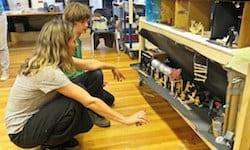 Sam adds, “There was a focus for technology in the classroom, but we learned that with the tools we needed better ways to give the kids the personalized learning they needed. We were concerned with finding those moments of time to use that device as a way to move student learning forward and not sticking the kid on the device for an hour and calling that ‘class time.’” Sam says the solution was to trust the teachers. The idea is to give them ample professional development and technology to help them move the needle and then let the teachers make the decisions about students on an individual basis in a classroom devoted to personalized learning.

 Through the years, I often heard the call of the paints, brushes, and canvases. I wanted to express myself, but I criticized my self-expression before it was even a pencil sketch. “You can’t paint that. You can’t think that. You can’t feel that. You can’t. You can’t.
  I think one of the biggest obstacles as educators and parents is getting over the idea that taking care of ourselves is in some way selfish. It’s not. Giving our souls time and space to
 Gabriel Carrillo has been listening to podcasts for a long time. Between comedy, sports, professional development, and food podcasts, he’s a fan of diverse subjects and genres. But as an educator as well as an edtech specialist and guru, he’s always found consistently good and knowledgeable podcasts about education technology to be few and far between. After pondering his options for far too long, with his wife’s encouragement, he decided to plunge into the world of podcasting. But, his wife first asked the all-important question: “What’s different about you? What’s YOUR spin?”
 Gabriel will be talking about the steps and strategies he used to build a successful podcast, among other topics, in his presentations at the 2019
 Even though those are also “what” questions, notice that they require thinking. Once students have correctly guessed the location of the partner classroom, do additional research, focusing on making connections to each student’s life. Then, ask students to create a web showing the connections they have with the other location. For example, you may have a student who has visited the partner location, or one who saw a kangaroo in a whale (which connects to the classroom in Australia). Share with the partner classroom and have those students add to the web.
  Vicki also uses maps with her students in a different ways. Students can take Google Maps and identify points on a map, such as Napoleon’s March. They can also create their own maps with 360 degree cameras. For example, if you are teaching the Civil War, and your school is located near a historic battlefield, students can visit the landmark, take their own videos and either embed the views in google maps, or they can identify and video what they consider to be the most important part of the battle. As a part of the final product, students justify why their location is most important, and provide appropriate links to other resources that support their position. As Vicki points out, creating maps not only requires students to show an understanding of content and technology, it “uses computation and sequential thinking which pushes you higher.”
 Evelyn McCulloch didn’t think much about technology in the classroom until she taught third grade in Beijing, China in 2011. She was inspired by her students to reach out to the international education community, and the dialogue and collaboration she found encouraged her to delve deeper into the edtech world that was emerging at the time. When she returned to teach in the United States, she brought her knowledge for edtech back with her and discovered 3D printing as an excellent tool to teach her students about utilizing innovation and technology. As a result, her students have been working with three local Orlando hospitals for the past five years to tackle authentic problems, using their 3D printing skills to create 3D-printed inner ear bones, surgical tools, practice devices, and models to prototype ideas for doctors and patients.
 With over 16,000 edtech startups around the world, Evelyn says it is critical for educators to be discerning in what tools they choose. “Choose the tool to fit the task and support learning,” she advises. “Use a variety if you wish, focusing on tools that increase efficiency and collaboration between students and other classrooms.” She seeks out and values the relationships with vendors that have a strong foundation in pedagogy and innovation. She says it’s important to use larger vendors like Google’s G Suite and Apple to employ common platforms that easily collaborate, communicate and share with other classrooms around the country and world. It gives students a real sense of belonging by participating in problem-solving communities while learning and using tools and strategies they will utilize far into the future.
 Evelyn McCulloch is a Director of Teaching and Learning and Design Thinking Educator in a Maker Space at