


edCircuit
  • Start Here
    • Login
    • Register
    • Subscribe
    • Submit a Press release
    • Advertise or Sponsor
    • Contribute
    • Get Interviewed
  • On The Wire
  • EdTech
    • All EdTech
    • Online Learning
    • Hybrid and Remote Learning
    • Augmented and Virtual Reality
    • ESports
    • Gamification and Game-Based Learning
    • Digital Citizenship
    • EdTech Entrepreneurs
    • Market Trends
    • Future of Education
  • K-12 Education
    • All K-12
    • K-12 Teachers
    • Teaching Strategies
    • Special Education and IEPs
    • Dyslexia
    • Gifted and Advanced Learning
    • Early Childhood, Pre-K and Kindergarten
    • School Calendar
    • Tutoring and Homework Help
    • Attendance and Absenteeism
    • After-School Programs
    • School Counselors
    • Homeschooling
    • School Models
    • Teacher Retention
    • Parents
    • Students
    • STEM and STEAM Education
  • Teaching and Learning
    • Literacy and Reading
    • Math Education
    • Civics and History Education
    • Financial Literacy
    • Assessment and Testing
    • Curriculum and Instruction
    • Personalized Learning
    • Project-Based Learning
    • Social-Emotional Learning
    • Executive Function
    • Creativity
    • Diversity, Equity, Inclusion
  • Professional Development
    • All Professional Development
    • Educators
    • Administrators
    • edLeaders
  • Higher Education
    • All Higher Education
    • College Admissions
    • Career and Technical Education (CTE)
    • Graduation
    • FAFSA and Financial Aid
    • Student Loans
  • Artificial Intelligence
  • Cybersecurity
  • School Safety
    • All School Safety
    • Science and Lab Safety
    • School Design and Facilities
    • Bullying
    • Duty of Care and School Liability
  • Continuing Education
    • All Continuing Education
    • Online Certificate Programs
    • Teaching Jobs and Careers
    • Teacher Appreciation
  • Education Policy and Government
    • All Education Policy
    • Department of Education
    • School Choice
    • Global
    • Advocates
  • EDU Shows
    • All EDU Shows
    • Safer Ed
    • Mind the Gap
    • EdTech Questions
    • CoffeEd
    • InFocus
    • InformED Report
  • EDU Podcasts
    • All EDU Podcasts
    • Author Chats
    • CoSN The Podcast
    • Education Today
    • Building the Bridge
    • Students Speak
  • Education Industry Guides and Reports
  • Archived Media
    • Future of School: The Podcast
    • Equity Everywhere
  • About edCircuit
  • Subscribe
edCircuit
  • LOGIN
Home Tags Posts tagged with "Headline"
Tag:

Headline

This if for posts to be in the featured/top section of site
A young girl shows a colorful drawing to three adults while sitting at a round table in a classroom, moving from communication to connection through her art.
K-12EducatorsK-12 TeachersParentsHot Topics - controversial

From communication to connection: Why schools must move beyond information to involvement

by Jennifer Wagner May 18, 2026
written by Jennifer Wagner 5 minutes read

There was a moment recently when I realized something uncomfortable about the way we communicate in schools.

We were sending more information than ever before including emails, newsletters, updates across multiple platforms—everything a family could need to stay informed. And yet, I couldn’t say with confidence that families felt more connected.

That disconnect isn’t unique to one district. It’s happening everywhere.

For years, school communication has been measured by output. Did we send the message? Did we post the update? Did we check the box? But families don’t experience communication that way. They experience it in moments—quick glances between work and home, short interactions on their phones, fragmented attention in the middle of busy days. If what we send doesn’t meet them in those moments, it doesn’t land.

In districts like ours—serving more than 12,000 students across 26 schools—that realization forced a shift in thinking. Like many systems, we had a mix of tools and approaches. Some classrooms were highly connected to families, while others relied on more traditional methods that were becoming less effective including weekly Friday folders that often get left in the student’s backpack.

At the same time, our community was becoming more complex. We serve families who speak 31 different languages. We were asking them to engage with systems that were not always intuitive or aligned with how they communicate in their daily lives. The more we examined it, the clearer it became: we weren’t struggling to communicate with families. We were struggling to involve them. And that distinction matters.

Involvement starts with visibility, not volume

Involvement doesn’t come from sending more information. It comes from giving families meaningful access to what is happening inside our schools.

That shift became clear not in a strategy meeting, but in conversations with families. What they valued most wasn’t another update. It was the simple moments—a photo from the classroom, a short video, a quick message that gave them a window into their child’s day.

Those moments change how families experience school. They feel more connected and more willing to engage. In practice, that shift shows up in interaction. In our district, it has translated into tens of thousands of exchanges between educators and families each month, with most messages read the same day.

When communication is timely and accessible, families are more likely to participate. In a single month, more than 100 school events were shared with families through digital channels, shifting communication from static announcements that could be easily missed to real-time updates and reminders delivered directly to families’ phones.

That shift matters. Instead of simply knowing an event is happening, families are more consistently reminded and better positioned to attend, turning awareness into participation.

For districts serving multilingual communities, accessibility is foundational. Communication that requires translation outside the moment creates friction. But when families can receive and respond in their own language, engagement becomes more immediate and more consistent.

Consistency and simplicity drive real engagement

As we worked to strengthen communication, another challenge surfaced. It wasn’t just how we were communicating—it was how consistently that communication was happening across the district. Elementary schools often set the standard. Families are used to frequent updates and classroom visibility. But as students move into middle and high school, that connection can fade. If we want to build real involvement, communication has to follow students throughout their entire experience.

That requires more than adding another tool. It requires alignment around approaches that are simple enough for educators to use consistently and accessible enough for families to rely on. Because if something is complicated, it won’t be used—not consistently, and not at scale. Across districts, we’re seeing a clear pattern: when communication becomes easier to deliver and easier to consume, it becomes more consistent. And when it becomes consistent, engagement follows.

In some schools, this visibility now extends into school culture. When families can see what’s happening day to day—whether it’s classroom learning or student behavior—it creates a shared understanding of expectations. Students gain ownership, and families have a clearer picture of progress.

In our district, that has translated into tens of thousands of positive behavior interactions being shared with families each month.

The shift that matters most

Public schools are operating in a more competitive environment than ever before. Families have more choices, more information, and higher expectations. They are not just asking whether their child is learning, and they are asking what that experience looks like and whether they can see it for themselves.

If we can’t answer those questions clearly and consistently, someone else will.

That has changed the role of communication. It is no longer just about sharing updates. It is about showing what makes our classrooms meaningful places for students. Tools can support that shift, but they are not the story. In our case, adopting a platform like ClassDojo for Districts helped us move toward more immediate, visual communication—but the real change came from rethinking how and when we engage families.

We have to stop thinking of communication as something we send and start thinking of it as something families experience. That shift sounds simple, but it changes everything.

When communication is visible, accessible, and consistent, families don’t just receive it—they act on it. And that’s when engagement becomes real—because we’ve realized our goal isn’t just to inform families—it’s to involve them.

Subscribe to edCircuit to stay up to date on all of our shows, podcasts, news, and thought leadership articles.


May 18, 2026 0 comments
0 FacebookTwitterPinterestLinkedinWhatsappCopy LinkEmail
A group of students in graduation caps and gowns take a selfie outdoors, proudly standing beneath a "class of 2026" banner in the background.
StudentsHot Topics - controversialArtificial IntelligenceGraduationK-12

Class of 2026: Graduating in the Age of AI Change

by EdCircuit Staff May 18, 2026
written by EdCircuit Staff 5 minutes read

The Class of 2026 is graduating in the age of AI, stepping into a world shaped by tools, systems, and technologies that did not exist when they first entered school.

From their earliest school years to now, change has been constant. What they experienced in elementary school looks very different from their high school reality. This class has not just witnessed change. They have adapted to it in real time.

From DVDs to On-Demand Everything

This generation grew up during a major shift in how content is consumed. Early experiences with DVDs and scheduled television quickly gave way to streaming platforms and instant access.

They didn’t just watch content. They controlled it.

They could pause, skip, replay, and search instantly. Platforms like YouTube became learning tools as much as entertainment.

This shift didn’t just change what they watched. It changed how they expect to learn—on demand, at their own pace, and often visually.

A Generation Shaped by Gamification

The Class of 2026 also grew up in the era of video games—not just as entertainment, but as a way of thinking and learning.

From early console games to mobile apps and online platforms, they are used to systems that reward progress, provide instant feedback, and encourage persistence through challenges.

That mindset has carried into education.

Many of today’s learning tools mirror game design: levels, progress tracking, badges, and immediate responses. Students are often motivated by clear goals and visible progress, much like advancing through a game.

This raises an important shift in how learning is experienced. Students are not just completing tasks. They are engaging in systems that feel interactive and responsive.

For educators, this creates both opportunity and challenge. When used well, gamification can increase engagement and persistence. But it also means students may expect constant feedback and stimulation, which traditional models do not always provide.

Learning Through Disruption

One of the most defining experiences for this class was the sudden move to online learning during COVID-19.

Students logged into classes from kitchen tables and bedrooms. Zoom became the classroom almost overnight.

This required independence. Students had to manage their time, stay engaged, and complete work without the structure of a physical classroom.

That experience changed expectations. Learning is no longer tied to a single space. It is something that can happen anywhere.

The Emergence of AI in Everyday Learning

As this class progressed through high school, artificial intelligence became part of their academic experience.

AI tools are now part of daily student workflows, from writing support to study help and instant feedback.

These tools reflect something familiar. Like games, they respond immediately. They adapt. They guide.

But schools are still defining boundaries. Questions about appropriate use and academic integrity remain.

The Class of 2026 has learned not just with AI, but alongside it.

A World Changing Beyond the Classroom

The changes this class has experienced extend far beyond school.

They have grown up alongside the rise of electric vehicles, the introduction of electric school buses, and the early stages of self-driving technology.

What once felt futuristic is becoming more visible.

Transportation is shifting. Energy use is changing. Entire industries are adapting.

For this class, these are not abstract ideas. They are part of the world they are preparing to enter.

Always Connected, Always Scheduled

This generation has rarely been offline. Smartphones and smartwatches shape how they manage their time.

Schedules live in apps. Reminders are constant. Notifications guide daily routines.

Students are more scheduled than ever, but not always less distracted.

This raises a key question:
Has constant connectivity improved time management, or created new challenges?

The answer depends on the student. Some thrive with structure. Others struggle with constant interruption.

Phones in the Classroom

Phones have been a constant presence throughout this class’s education.

They can support learning, offering quick access to information and collaboration tools. But they can also divide attention.

Schools have responded in different ways, and this class has adapted to all of them.

This ongoing tension reflects a larger issue: how to balance access with focus.

Learning Without Boundaries

Students today can learn almost anything at any time.

A concept can be explained in seconds through a video. A skill can be learned entirely online.

This has created more independent learners, but it also requires discipline. Students must filter information, stay focused, and manage distractions.

What This Means for Educators and Families

For educators and families, the Class of 2026 represents both progress and complexity.

Students are adaptable and comfortable with technology. They are used to interactive systems, instant feedback, and flexible learning environments.

At the same time, they need guidance in areas technology cannot replace—focus, critical thinking, and balance.

Families now play a role in helping students navigate not just school, but the digital environments that shape it.

Looking Ahead

As the Class of 2026 graduates, they are entering a world that will continue to evolve.

AI will expand. Automation will grow. Technology will continue to shape how people live and work.

What sets this class apart is their ability to adapt. They have moved through disruption, adjusted to new systems, and kept moving forward.

A Defining Question

If there is one question that captures this generation, it may be this:

Has growing up with interactive, always-on systems made them more prepared, or simply more dependent on them?

The answer is still unfolding.

A Milestone Worth Recognizing

Graduation marks the end of a unique journey.

The Class of 2026 has moved from DVDs to streaming, from video games to gamified learning, from classrooms to Zoom, and into AI-supported education.

They have watched the world shift toward electric transportation and automation.

The real story is not the technology they grew up with, but how they learned to keep up with it.

Subscribe to edCircuit to stay up to date on all of our shows, podcasts, news, and thought leadership articles.
May 18, 2026 0 comments
0 FacebookTwitterPinterestLinkedinWhatsappCopy LinkEmail
A teacher assists a student using a laptop in a classroom with other students at desks; digital network graphics overlay the scene, highlighting how AI is reshaping school systems by enhancing technology and connectivity.
Hot Topics - controversialArtificial IntelligenceK-12

How AI Is Reshaping School Systems

by EdCircuit Staff May 15, 2026
written by EdCircuit Staff 5 minutes read

School systems in the AI era are being reshaped by a convergence of forces—artificial intelligence, evolving instructional models, rising parent expectations, and increasing complexity. What once operated as a stable structure is now becoming dynamic, forcing schools to rethink not just how they teach, but how they function as interconnected systems.

In many districts, these changes are already visible—AI-generated lessons, real-time data dashboards, and new expectations for personalization are becoming part of everyday practice.

This is not a shift in tools. It is a shift in structure.

And that shift is already underway.

From Stability to System Complexity

For decades, school systems operated within a relatively predictable model. Curriculum moved at a set pace, instruction was largely standardized, and decision-making followed established processes. Technology, while present, typically supported rather than reshaped these structures.

That model is no longer sufficient.

Today’s systems are expected to respond faster, personalize learning, and integrate multiple layers of technology simultaneously. As these demands increase, so does the system’s complexity.

Complexity is no longer a problem to solve—it is a condition to manage.

This marks a fundamental transition from static systems to adaptive ones.

AI as a System-Level Force

Artificial intelligence represents a fundamental departure from previous waves of education technology.

AI does not sit beside the system—it reshapes it from within.

It now influences how instructional materials are created, how assessments are designed, how feedback is delivered, and how student progress is analyzed. It extends beyond the classroom into administrative processes and strategic decision-making.

This is what makes AI different from every technology that came before it.

Its impact is not isolated to a single function—it is distributed across the entire system.

The Changing Role of the Teacher

As systems evolve, so does the role of the teacher.

The traditional model centered on content delivery is giving way to a more complex and dynamic role. Teachers are becoming designers of learning experiences, facilitators of inquiry, and guides for students navigating an increasingly AI-supported environment.

AI can assist with generating content, differentiating instruction, and providing feedback. But the challenge is not whether teachers will use AI—it is how their role evolves alongside it.

The human elements of teaching—judgment, empathy, and context—remain irreplaceable.

Students still learn best from people they trust.

Rethinking the Learning Experience

The student experience is also undergoing a significant transformation.

AI-enabled systems allow for more personalized learning pathways, enabling students to move at different paces and receive immediate, targeted feedback. This creates the potential for more responsive and individualized learning environments.

However, personalization introduces new complexity.

As flexibility increases, systems must work harder to maintain coherence.

Schools must balance individualized learning with consistent expectations, ensuring that flexibility does not come at the expense of rigor or equity.

Data as the Foundation of Decision-Making

As systems become more interconnected, data is taking on a central role in how education operates.

Data is becoming the operating system of modern school systems.

Continuous streams of information—on performance, engagement, and progress—offer new opportunities for insight. When effectively connected and interpreted, this data can inform instruction, guide interventions, and support strategic planning.

But data alone does not create clarity.

The challenge lies in integration, interpretation, and alignment. Without intentional design, data can overwhelm rather than inform.

The goal is not more data—it is better decisions.

Leadership in a System-Based Environment

The evolving landscape is redefining leadership.

Leadership is shifting from managing schools to designing systems.

This requires a broader perspective—one that considers how technology, instruction, data, and communication intersect. Decisions can no longer be made in isolation; each choice influences the system as a whole.

System design is becoming the most important leadership skill in education.

Leaders who understand how to align these elements will be best positioned to navigate the complexity ahead.

Navigating the Pace of Change

One of the most significant challenges facing school systems is determining how quickly to adapt.

The pressure to innovate is constant. At the same time, the need for stability remains.

Moving too quickly can create fragmentation and overwhelm. Moving too slowly can lead to stagnation and missed opportunities.

The goal is not speed—it is alignment.

Successful systems balance innovation with intentional design, ensuring that progress is both meaningful and sustainable.

What Future-Ready Systems Are Doing Differently

Across the country, some districts are beginning to approach this transformation with greater clarity.

Rather than focusing on individual tools, they are thinking in terms of systems. They are prioritizing integration, reducing unnecessary complexity, and aligning technology decisions with instructional goals.

Professional learning is becoming more targeted and strategic. Governance structures are being developed to guide decision-making. The emphasis is shifting from accumulation to coherence.

These systems are not necessarily more advanced.

They are more connected.

The Human Element in an AI-Driven System

Despite rapid technological change, the foundation of education remains human.

Relationships, trust, and connection continue to define meaningful learning experiences.

AI can enhance systems, but it cannot replace human judgment, empathy, or the contextual understanding that educators bring to their work.

In many ways, as systems become more advanced, the human element becomes more essential.

The most effective school systems will be those that integrate technology in ways that strengthen—not diminish—the human experience.

A Defining Moment for School Systems

This moment represents a turning point.

School systems are not simply adapting to new tools—they are being asked to rethink how they operate at a fundamental level.

The decisions made today will shape the future of teaching, learning, and leadership.

This is not just a period of change.

It is a period of redesign.

Moving Forward

The future of school systems in the AI era will not be defined by how much technology is adopted, but by how intentionally systems are designed.

Because in the end, the goal is not to build more advanced systems—it is to build better ones. Systems that work, systems that connect, and systems that keep people at the center of learning.

Subscribe to edCircuit to stay up to date on all of our shows, podcasts, news, and thought leadership articles.

May 15, 2026 0 comments
0 FacebookTwitterPinterestLinkedinWhatsappCopy LinkEmail
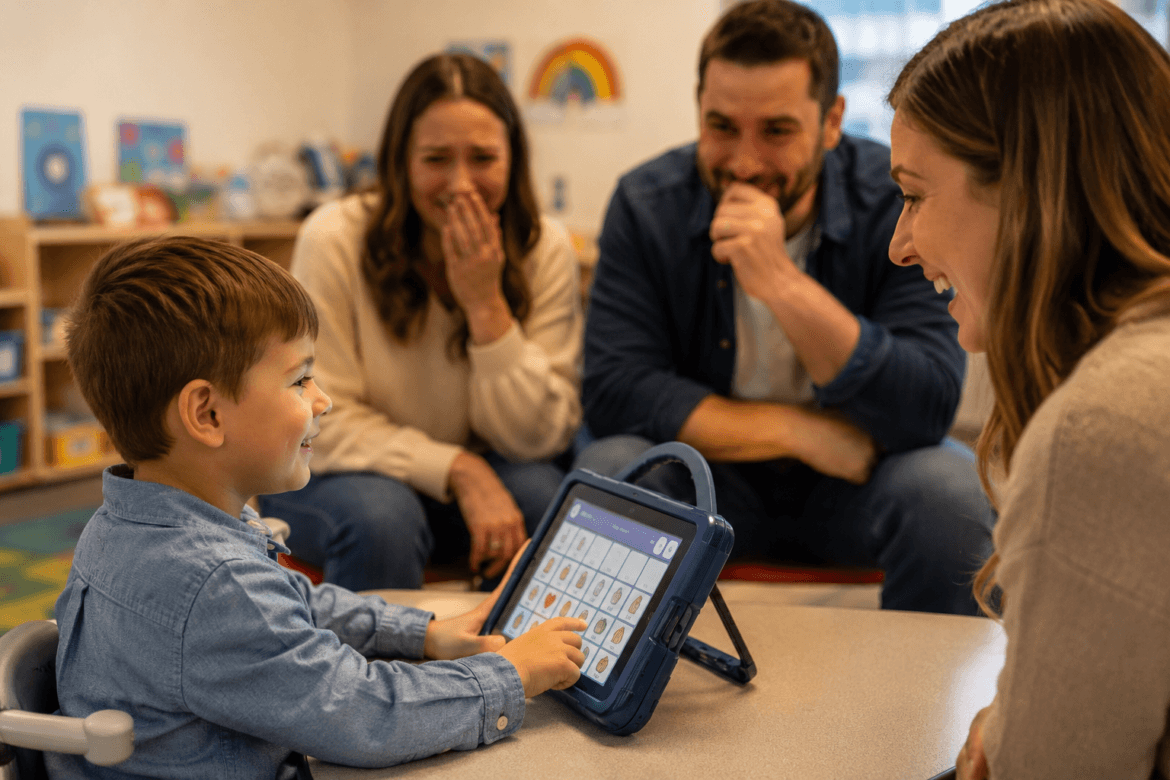
Young boy uses a tablet at a table as three parents watch and smile in a colorful classroom setting.
EducatorsHot Topics - controversialK-12

National Speech-Language-Hearing Month Honors SLPs

by EdCircuit Staff May 14, 2026
written by EdCircuit Staff 8 minutes read

National Speech-Language-Hearing Month celebrates the speech-language pathologists (SLPs) and audiologists who help students, families, and adults communicate, connect, and thrive.

A young student presses a button on a communication device for the very first time.

“I love you.”

For the parent sitting nearby, the moment can feel overwhelming. For the speech-language pathologist supporting that child, it is a powerful reminder of why the profession matters so deeply.

Moments like these happen every day in classrooms, therapy rooms, hospitals, clinics, and homes across the country. Speech-language pathologists help people communicate, connect, learn, and build confidence in ways that often change the direction of a person’s life.

Some help young children say their first words. Others support students struggling with language development, social communication, or literacy skills. Many work with adults recovering from strokes, traumatic brain injuries, neurological conditions, or hearing loss. No matter the setting, speech-language pathologists help people feel understood.

That impact is why it matters. The month celebrates speech-language pathologists and audiologists whose work helps students, families, patients, and communities communicate more confidently and connect more meaningfully. Supported in part by the American Speech-Language-Hearing Association, the national observance shines a spotlight on professionals whose work often happens quietly but changes lives every single day.

For many outside the profession, the role of an SLP is often misunderstood. Some assume speech-language pathologists only help children pronounce sounds correctly or overcome stuttering. The reality is far more complex.

SLPs work with communication in nearly every form imaginable. They support individuals with language disorders, articulation challenges, cognitive communication difficulties, swallowing disorders, voice conditions, social communication needs, traumatic brain injuries, developmental delays, autism spectrum disorders, and neurological conditions. They work with toddlers learning first words, students building literacy skills, adults recovering from strokes, and elderly patients trying to maintain communication and safe swallowing abilities.

Their work is educational.
It is medical.
It is emotional.
And it is profoundly life-changing.

The Professionals Behind the Scenes

In schools across the country, speech-language pathologists are among the most essential — and often most overlooked — members of the educational team.

While teachers are visible in classrooms each day, SLPs frequently move quietly behind the scenes, balancing enormous caseloads and responsibilities that many families never fully see. A school-based SLP may spend a single day traveling between multiple buildings, coordinating schedules with teachers, documenting progress, attending meetings, conducting evaluations, completing Medicaid billing paperwork, communicating with parents, and delivering individualized therapy sessions — all while ensuring students receive legally required services and meaningful support.

Their schedules are often relentless.

A morning might begin with articulation therapy for elementary students, transition into language interventions connected to literacy instruction, continue with social communication support for middle school students, and end with high school meetings focused on accommodations and transition planning.

And through all of it, SLPs are helping students do something foundational to every aspect of life:

Communicate.

Communication affects nearly everything inside a school environment. It impacts reading, writing, classroom participation, social interaction, emotional regulation, self-advocacy, and confidence. When students struggle to communicate effectively, they often struggle academically, socially, and emotionally as well.

SLPs help bridge those gaps.

They help students participate more confidently in classroom discussions.
They help children express frustration without behavioral outbursts.
They help students build literacy and language connections.
They help individuals advocate for themselves.
They help students feel heard.

That kind of work changes educational outcomes — but it also changes lives.

The Emotional Weight of the Profession

Speech-language pathology is deeply personal work.

Many communication challenges are tied closely to confidence, identity, and emotional well-being. Students who struggle to communicate may experience embarrassment, isolation, anxiety, or frustration that extends far beyond academics. Families often carry emotional stress while trying to navigate evaluations, interventions, and support systems for their children.

SLPs become trusted guides through those experiences.

They celebrate progress that others may overlook.
They reassure families during difficult moments.
They help students regain confidence after setbacks.
They provide encouragement when progress feels slow.

And sometimes, the biggest victories are the smallest moments.

A student raising their hand in class for the first time.
A child successfully ordering food independently.
A teenager confidently participating in a conversation.
A parent hearing a clearer sentence after months of therapy.

These moments are difficult to measure on spreadsheets or reports, but for families, they can mean everything.

Many speech-language pathologists will say their greatest rewards are not found in documentation, evaluations, or meetings.

They are found in hugs from students.
In smiles after successful communication.
In emotional thank-you messages from parents.
In watching someone finally feel understood.

Technology Has Changed the Profession

Technology has dramatically reshaped speech-language pathology over the last two decades.

What once relied heavily on flashcards, worksheets, mirrors, and paper visuals has evolved into a profession deeply connected to digital tools and assistive technologies. Today’s SLPs use tablets, speech-generating devices, communication applications, teletherapy platforms, visual supports, adaptive software, and artificial intelligence tools to help individuals communicate more effectively and independently.

For nonverbal students and individuals with significant communication challenges, augmentative and alternative communication (AAC) technology has been transformative.

Modern AAC systems allow users to communicate wants, needs, emotions, ideas, questions, and opinions with greater independence than ever before. For many families, hearing a child independently communicate through technology can become one of the most emotional moments of their lives.

Technology has also expanded access to services.

Teletherapy and virtual intervention platforms now help SLPs reach students in rural communities, underserved districts, and areas facing significant staffing shortages. During and after the COVID-19 Pandemic, speech-language pathologists adapted rapidly to virtual environments while continuing to support students and families during one of the most disruptive periods in modern education.

Digital tools now assist with:

  • Progress monitoring
  • Therapy engagement
  • Data collection
  • Collaboration with teachers
  • Parent communication
  • Personalized interventions
  • Accessibility supports

But despite all the innovation, one thing has not changed:

The heart of the profession is still human connection.

No device replaces patience.
No software replaces compassion.
No technology replaces encouragement.

SLPs combine innovation with empathy in ways that make communication more accessible and more meaningful.

Collaboration Across Entire Support Systems

Speech-language pathologists rarely work alone.

Inside schools, they collaborate constantly with classroom teachers, intervention specialists, occupational therapists, psychologists, administrators, paraprofessionals, counselors, and families. Their role intersects with nearly every support system connected to student success.

An SLP may help a teacher modify communication strategies inside the classroom.
They may work alongside occupational therapists to support students using assistive devices.
They may collaborate with school psychologists during evaluations.
They may guide parents on communication strategies to continue at home.

Their expertise becomes part of a much larger team focused on helping students succeed academically, socially, and emotionally.

That collaboration often goes unnoticed, but it is critical to creating inclusive learning environments where students feel supported and understood.

The Growing Challenges Facing SLPs

As awareness surrounding communication needs has grown, so have the demands placed on speech-language professionals.

Many districts across the country face shortages of qualified SLPs while student needs continue to increase. Large caseloads, staffing shortages, compliance requirements, and expanding responsibilities have placed significant pressure on professionals already balancing emotionally demanding work.

In some districts, SLPs travel between multiple schools each week while managing dozens of students across multiple age groups and service plans. Others balance school responsibilities with home visits, outpatient services, or additional clinical work.

And despite the intensity of those demands, they continue showing up each day ready to support students and families with compassion and professionalism.

That commitment deserves recognition.

Supporting Communication Across a Lifetime

While schools play a major role during Speech-Language-Hearing Month, speech-language pathology extends far beyond K–12 education.

SLPs work extensively with adults in hospitals, rehabilitation centers, nursing homes, universities, and home healthcare settings. They support stroke recovery, traumatic brain injuries, Parkinson’s disease, voice disorders, swallowing challenges, neurological conditions, and cognitive communication impairments.

For adults recovering from medical trauma, communication can become central to reclaiming independence and quality of life.

The ability to safely swallow food again.
The ability to speak clearly with loved ones.
The ability to communicate needs and emotions.
The ability to reconnect socially and emotionally.

These are not small victories.

They are life-changing milestones.

Why National Speech-Language-Hearing Month Matters

Professions centered around communication often work quietly in the background. SLPs rarely seek attention for the work they do, yet their impact reaches classrooms, homes, clinics, hospitals, and communities every single day.

Communication is connection.
Communication is confidence.
Communication is learning.
Communication is belonging.
Communication is independence.

Speech-language pathologists help make all of those things possible.

As schools continue focusing on inclusion, accessibility, student wellness, literacy, and personalized learning, the role of speech-language pathologists will only become more important. Their ability to support communication across educational, emotional, social, and medical settings makes them essential members of both healthcare and educational communities.

This month is an opportunity to celebrate professionals whose work often happens quietly but whose impact lasts a lifetime.

Behind every breakthrough in communication is usually someone who refused to give up on helping another person feel heard, understood, and connected to the world around them.

And sometimes, all it takes to remind an SLP why they chose this profession is a smile, a hug, or two simple words spoken for the very first time:

“I love you.”

Play video: Expert of the Day: National Speech Language Hearing Month (2 minutes 45 seconds)2:45
Expert of the Day: National Speech Language Hearing Month2 min 45 sKCRG-TV9: Your Trusted Local News Source on YouTube

KCRG-TV9: Your Trusted Local News Source – Expert of the Day: National Speech Language Hearing Month (Play video)

Subscribe to edCircuit to stay up to date on all of our shows, podcasts, news, and thought leadership articles.

May 14, 2026 0 comments
0 FacebookTwitterPinterestLinkedinWhatsappCopy LinkEmail
Student with backpack stands between a quiet exam area on the left and a active group project area on the right, a large white arrow graphic bridging the two spaces.
Assessment and TestingCurriculum and InstructionHot Topics - controversialK-12

Assessment Testing Is Outdated in Modern Education

by EdCircuit Staff May 14, 2026
written by EdCircuit Staff 7 minutes read

For decades, assessment testing in education has been treated as a reliable measure of student ability and college readiness. It promised objectivity, consistency, and a level playing field.

That promise is breaking down.

Classrooms have changed. College admissions have changed. Workforce expectations have changed. Yet many assessment systems still reflect a model built for a different era—one focused on speed, recall, and uniformity rather than depth, application, and growth.

Higher education is already adjusting. K–12 systems are not moving as quickly.

That gap is no longer easy to ignore.

Assessment Testing: The Misalignment Is No Longer Subtle

Walk into a modern classroom, and the shift is obvious. Students are collaborating on projects, analyzing real-world problems, and using digital tools to create and communicate ideas.

Now compare that to how most standardized tests operate:

  • Timed, high-pressure conditions
  • Heavy reliance on multiple-choice questions
  • Focus on isolated subject knowledge
  • Limited opportunity to demonstrate applied thinking

The disconnect is clear.

A student might spend weeks building a climate research project—gathering data, presenting findings, and defending conclusions—only to be evaluated later on a 60-minute multiple-choice exam covering disconnected standards.

Students who can lead discussions, design solutions, or communicate complex ideas often struggle to show those strengths in a timed testing environment. Yet those scores still carry outsized weight.

Measurement is driving instruction instead of reflecting it.

Colleges Are Already Moving Away from Test Scores

Admissions offices have been reevaluating standardized testing for years, but the shift accelerated during the pandemic.

Hundreds of institutions temporarily waived exams like the SAT and ACT. What began as a necessity has become a long-term change.

Today, many colleges fall into three categories:

  • Test-optional: Students decide whether to submit scores
  • Test-blind: Scores are not considered at all
  • Holistic review: Greater emphasis on GPA, coursework, essays, and experiences

Systems such as the University of California have adopted test-blind policies, while many private and flagship institutions continue to extend test-optional approaches.

The reasoning these colleges give is consistent: high school GPA, especially when paired with course rigor, is a stronger predictor of college success than a single standardized test score. Not every college agrees: Dartmouth reinstated required testing, starting with the Class of 2029, after its researchers found that test scores were among the most reliable indicators of success in its curriculum, surpassing high school GPA.

Equity concerns also remain central:

  • Access to test preparation varies widely
  • Scores often correlate with income and available resources
  • A single test day can be affected by stress, health, or external factors

For many institutions, heavy reliance on test scores no longer aligns with their goals.

K–12 Systems Are Caught in a Contradiction

While colleges evolve, many K–12 systems remain anchored to test-driven accountability models.

This tension shows up in classrooms every day:

  • Teachers are encouraged to design deeper learning experiences
  • Districts promote project-based and student-centered instruction
  • Yet performance is still judged largely by standardized test results

In practice, this leads to compromise.

A teacher may guide students through a multi-week inquiry project, then pivot to test prep as assessment season approaches. A school may emphasize critical thinking but still center evaluation around benchmark scores.

The message becomes inconsistent: innovation is encouraged, but only up to a point.

Assessment Testing: The Real Cost of Staying the Same

Outdated assessment systems don’t just lag behind. They actively shape classroom experience.

Instructional Narrowing

In many schools, weeks leading up to state exams are dominated by practice tests and review packets. Extended projects and discussions are put on hold to focus on format and strategy.

Student Disengagement

Students recognize when something feels disconnected. A timed exam rarely reflects how they actually learn or solve problems, which reduces motivation over time.

Reinforced Inequities

Students with access to tutoring, prep programs, and stable testing environments have clear advantages. Without context, scores often reflect opportunity as much as ability.

Incomplete Measures of Ability

A single score cannot capture growth, persistence, creativity, or collaboration—yet those are the skills schools claim to prioritize.

For administrators and policymakers, this directly impacts outcomes, equity, and public trust.

Assessment Testing: What Modern Assessment Needs to Include

Updating the assessment does not mean removing accountability. It means broadening it.

A more effective system includes multiple measures:

Performance-Based Assessment

Students demonstrate knowledge through presentations, research, and real-world problem-solving tasks.

Portfolio Systems

A body of work collected over time shows growth, depth, and revision in ways a single test cannot.

Competency-Based Progression

Students advance based on mastery, not time spent in a classroom.

Formative Assessment

Ongoing feedback helps guide learning in real time instead of evaluating it after the fact.

Balanced Use of Standardized Testing

Standardized tests can still provide useful system-level data, but they should be one measure among many—not the defining one.

These approaches better align with how students learn and how success is measured beyond school.

Implementation Is the Real Challenge

There is broad agreement that change is needed. The difficulty is execution.

Modernizing assessment requires:

  • Professional development so teachers can design and evaluate new assessment models
  • Time and infrastructure to support portfolios and performance tasks
  • Clear rubrics to ensure consistency across classrooms
  • Updated accountability frameworks that move beyond single-score evaluation

These are complex shifts that require coordination and investment.

But maintaining the current system also has a cost—one that continues to grow.

The Role of Test Developers Is Changing

Assessment providers are not becoming irrelevant. They are being pushed to evolve.

There is increasing demand for tools that measure complex skills, including:

  • Scenario-based assessments
  • Interactive digital simulations
  • Adaptive testing models
  • Embedded performance tasks within digital platforms

Districts still need reliable data. What they need now are tools that reflect modern learning, not outdated formats.

What This Means for Students and Families

As colleges place less emphasis on standardized test scores, the definition of success is shifting.

Students are evaluated more heavily on:

  • Consistent academic performance over time
  • Strength and rigor of coursework
  • Writing, communication, and critical thinking skills
  • Real-world experiences, leadership, and initiative

For families, this requires a shift in focus.

Preparation is no longer about maximizing a single score. It is about sustained effort, meaningful learning, and skill development over time.

A Texas District That Built Its Own Measures

Some districts have been building alternatives for years. In a 2017 interview published by edCircuit, Dr. Kim Alexander, then superintendent of Roscoe Collegiate Independent School District in Texas, described a multiple-measure local accountability system that Roscoe had been developing for more than ten years. Roscoe was one of 44 Texas districts in the Texas Performance Assessment Consortium (TPAC), a group working on alternatives to standardized testing for accountability.

Roscoe used three local measures. For college readiness it used progress toward an associate degree. In Alexander’s words, “we figured if you’re halfway finished, you might be college ready.” For workforce readiness it developed STEM endorsements and certifications in biomedical science and engineering. The third measure was student research from a school-wide 4-H program, built around agriculture with help from Texas A&M’s AgriLife Extension. Every student in grades three through twelve carried a research project, and the work went into digital student portfolios that people outside the district could review.

Alexander described the same problem this article does. “We’re really abusing that instrument, the standardized test, in the name of accountability,” Alexander said, adding that teachers are pushed to teach to a multiple-choice test that does not measure “really deep and meaningful learning.” Alexander’s answer to the question of what should replace the test was to build the alternative and show the evidence: portfolios of real student work, and tracking of what graduates go on to do after they leave school.

The Direction Is Clear. The Pace Is Not.

Assessment is not disappearing. It is being redefined.

Higher education has already taken meaningful steps away from test-centric models. K–12 systems are beginning to respond, but progress remains uneven.

The risk is not change. The risk is delay.

Every year, outdated assessment systems remain in place, and the gap widens between what students learn, how they are evaluated, and what is actually required for success beyond school.

The question is no longer whether assessment should change. It is whether systems will move fast enough to stay aligned with the students they serve.

Subscribe to edCircuit to stay up to date on all of our shows, podcasts, news, and thought leadership articles.

May 14, 2026 0 comments
0 FacebookTwitterPinterestLinkedinWhatsappCopy LinkEmail
A young person in a yellow hoodie studies at a desk with a laptop displaying digital brain graphics, surrounded by books and notebooks—an inspiring scene of homework in the AI era, set in a well-lit room.
Hot Topics - controversialArtificial IntelligenceTutoring and Homework HelpK-12Assessment and Testing

Homework in the AI Era: Why Schools Are Rethinking It

by EdCircuit Staff May 13, 2026
written by EdCircuit Staff 5 minutes read

Homework in the AI era is rapidly becoming one of the most disruptive shifts in education as artificial intelligence tools challenge long-standing assumptions about what students actually learn outside the classroom. In many classrooms, teachers are seeing homework submitted that reflects a level of polish and completion that does not always match in-class performance.

For decades, homework has been viewed as a cornerstone of learning—reinforcing skills, building responsibility, and providing insight into student understanding. But today, that foundation is shifting.

Artificial intelligence has not simply changed how students complete homework. It has changed what homework represents.

And increasingly, educators are asking a fundamental question: if students can complete homework with significant external assistance, what purpose should it serve?

Why Homework Is Being Questioned Now

The role of homework has been debated for years, but artificial intelligence has accelerated the conversation in ways few anticipated.

Traditional homework models were built on a simple assumption: that students would complete assignments independently, allowing teachers to assess their understanding based on the work submitted.

That assumption is no longer reliable.

Students now have access to tools that can:

  • generate essays and written responses

  • provide step-by-step solutions to complex problems

  • summarize readings instantly

  • refine and edit writing with advanced precision

  • brainstorm ideas with minimal effort

Completion no longer guarantees comprehension.

This shift is forcing educators to reconsider whether homework, as traditionally designed, can still serve as a meaningful measure of learning.

The AI Factor at Home

Artificial intelligence is most commonly used outside the classroom, where access is unrestricted and supervision is limited.

For many students, AI is becoming as natural to use as a calculator or search engine. Some use it to check their thinking, others to generate ideas, and some to complete assignments more efficiently.

In many cases, students are not trying to avoid learning—they are adapting to the tools available to them.

For teachers, however, this creates a new level of uncertainty.

Assignments that once offered clear insight into student understanding are now more difficult to interpret. Without visibility into how the work was produced, the final product alone is no longer a reliable indicator of learning.

Equity Concerns Are Growing

Beyond questions of authenticity, the changing nature of homework is also raising important concerns about equity.

Students do not all have the same home environments or access to support. Some benefit from:

  • reliable internet and multiple devices

  • familiarity with AI tools and digital platforms

  • access to tutors or academic support

  • guidance from family members

Others may have limited access to technology or fewer resources to support their learning.

AI does not eliminate inequity—it can amplify it.

Students who understand how to use AI tools effectively may gain an advantage, not necessarily because they understand the material more deeply, but because they can produce more polished outputs.

This raises a critical question for schools: Does homework still provide a fair and consistent measure of student learning?

Homework vs. Learning

As these challenges become more visible, educators are beginning to separate two roles that homework has long served: practice and assessment.

For years, homework has functioned as both a way for students to practice skills and a way for teachers to evaluate understanding. In the AI era, those roles are increasingly difficult to combine.

Homework can still be valuable for:

  • reinforcing concepts

  • building routines and responsibility

  • encouraging independent thinking

But it may no longer serve as a reliable measure of independent understanding—especially when the conditions under which it is completed vary so widely.

This distinction is reshaping how educators think about assigning and grading homework.

What Schools Are Doing Instead

In response to these changes, many schools and districts are beginning to redesign how and when learning is evaluated.

Rather than relying heavily on homework for assessment, educators are shifting toward approaches that make student thinking more visible.

Emerging strategies include:

Moving Key Work Into the Classroom

Teachers are placing greater emphasis on in-class assignments where they can observe student thinking in real time.

Using Homework as Practice, Not Evaluation

Homework is increasingly ungraded or low-stakes, allowing students to focus on learning rather than performance.

Designing More Reflective Assignments

Assignments that require personal connection, explanation, or reflection are more difficult to outsource entirely to AI.

Incorporating Process-Based Learning

Drafts, checkpoints, and revisions provide insight into how students develop their work over time.

Expanding Project-Based Learning

Projects that involve collaboration, presentation, and application make learning more visible and meaningful.

These approaches reflect a broader shift away from evaluating isolated outputs and toward understanding the learning process.

A Changing Mindset Around Homework

Perhaps the most significant shift is not structural, but philosophical.

For decades, homework has been associated with rigor. More homework often meant higher expectations and stronger academic discipline.

Today, that assumption is being reconsidered.

Educators are asking:

  • Does homework deepen understanding or simply ensure completion?

  • Does it support learning, or does it create unnecessary pressure?

  • How does it impact student well-being and time outside of school?

In many cases, schools are moving toward more intentional homework practices—assigning it when it serves a clear purpose rather than as a routine expectation.

This shift reflects a growing recognition that more work does not always mean more learning.

Preparing Students for a Different Future

The conversation about homework is part of a larger transformation in education.

Artificial intelligence is changing how students access information, solve problems, and complete tasks. As a result, schools must prepare students not just to complete assignments, but to think critically, evaluate information, and use tools responsibly.

Homework, in this context, must evolve.

Rather than focusing on completion alone, assignments should help students:

  • practice skills in meaningful ways

  • reflect on their learning

  • develop independence

  • engage with ideas beyond the classroom

This requires thoughtful design and a willingness to move beyond traditional expectations.

What Comes Next

Homework in the AI era is not disappearing—but it is being redefined.

Schools are moving away from viewing homework as a primary measure of learning and toward seeing it as one part of a broader learning process. Assessment is shifting into the classroom, and assignments are being designed to emphasize thinking, reflection, and application.

For educators, this moment represents both a challenge and an opportunity.

The challenge is adapting long-standing practices in response to rapidly changing technology. The opportunity is to create more meaningful, equitable, and effective approaches to learning.

In the AI era, homework will no longer be defined by what students complete at home—but by how effectively it supports thinking, learning, and growth beyond it.

Subscribe to edCircuit to stay up to date on all of our shows, podcasts, news, and thought leadership articles.

May 13, 2026 0 comments
0 FacebookTwitterPinterestLinkedinWhatsappCopy LinkEmail
Newer Posts
Older Posts

Participate

  • Contribute
  • Sponsor
  • Submit Release
  • Subscribe
  • Get Interviewed

We value your privacy

We use cookies to enhance your browsing experience, serve personalized ads or content, and analyze our traffic. By clicking "Accept All", you consent to our use of cookies.

Customize
  • Needed for the site to work: signing in, the cart, your consent choice. Always on.

    8 cookies
    • ss_consent 1 yearYour cookie choice on this site, so you are not asked again.
    • wordpress_logged_in_* 2 days, or 14 days with "remember me"Keeps you signed in as you move between pages.
    • wordpress_sec_* 2 days, or 14 days with "remember me"The secure half of your sign-in.
    • wordpress_test_cookie SessionChecks that your browser accepts cookies when you sign in.
    • wp-settings-* 1 yearYour display settings when signed in.
    • wp_woocommerce_session_* 2 daysYour shopping session: the cart and the checkout.
    • woocommerce_cart_hash SessionTells the site whether your cart has changed.
    • woocommerce_items_in_cart SessionWhether your cart holds anything.
  • Remembers choices you make, such as a language or a region, and supports features like live chat.

    1 cookie
    • woocommerce_recently_viewed SessionThe products you looked at, so the site can show them again.
  • Helps us understand how visitors use the site: which pages are read, and for how long.

    2 cookies
    • _ga 2 yearsGoogle Analytics: tells one visitor from another. Set only after you allow analytics.
    • _ga_* 2 yearsGoogle Analytics: keeps your session state. Set only after you allow analytics.
  • Measures how fast pages load so we can make them faster.

  • Used to show you content and offers that match your interests, on this site and elsewhere.

    1 cookie
    • sbjs_* SessionWooCommerce order attribution: where you came from, so a purchase can be credited to the campaign or site that sent you.

Your browser asks us not to sell or share your information (Global Privacy Control), so advertising cookies stay off.

Do not sell or share my personal information

Some cookies from other companies help show you offers on other sites. Tick the box and save your preference to opt out of that sharing; untick it to opt back in at any time.

Your browser sends Global Privacy Control, so this preference is set for you and cannot be changed here.

Sign In

Keep me signed in until I sign out

Forgot your password?

Password Recovery

A new password will be emailed to you.

Have received a new password? Login here

Shopping Cart

Close

No products in the cart.

Close
-
00:00
00:00

Queue

Update Required Flash plugin
-
00:00
00:00

Your cart (items: 0)

Products in cart

Product Details Total
Subtotal $0.00
Shipping and discounts calculated at checkout.
View cart
Go to checkout

Your shopping cart is empty

Return to shop

Notifications