
Integrate stories of STEM careers into the standards curriculum
By Joshua Sneideman
 Four years ago, I was honored to be the Albert Einstein Distinguished Educator at the US Department of Energy (DOE) in the Office of Renewable Energy. My time at the DOE impressed upon me one STEM lesson greater than any other then or since. The people, the amazing STEM professionals working in renewables and energy efficiency were the real STEM story. The scientific breakthrough in solar efficiency was a process driven by people. I kept thinking to myself as I attended one after another-national meeting on STEM education, or the 3 pillars of NGSS, or STEM as a national security issue, if only we could share the stories of the REAL STEM PROFESSIONALS we could capture the interest of the next generation.
 I recall at a meeting with former NASA Administrator and Astronaut Dr. Charles Bolden, I asked “How can we motivate students today the way an entire generation of students was motivated by John F. Kennedy to go to the moon?” His response was both insightful and alarming. He noted that today, NASA does so many different things it is hard to capture their attention in the same moon-shot sort of way. He posited this was a dilemma. I see this as the golden opportunity of STEM in the 21st century. The opportunity to connect almost every student with some aspect of STEM in the modern world that connects to them personally. Not only at NASA and the department of Energy but across all industries, STEM is in high demand. Consider that 27 percent of new agricultural jobs find STEM skills a necessity, according to a 2015 article in US News and World Report.
If we could find meaningful ways to communicate the positive impact STEM professionals in EVERY industry are having on society, solving local and global problems, confronting the challenges of the 21st century, we could tap into the potential of this generation!
 They say, today’s student may have 10-15 different careers. Knowing this, how do we prepare students for success? I believe that if students recognized in a more profound way the translatability of their STEM interest to diverse fields, recognizing they will change jobs this many times, they will be more motivated than ever to work hard at math and science.
The National Research Council notes in their report, Successful K-12 STEM Education, 2011 indicates that for student interest in STEM to persist to workforce entry, it must be developed prior to leaving the 8th grade. The National Academies of Science in their report, Expanding Underrepresented Minority Participation: America’s Science And Technology Talent At The Crossroads (2011) recommend improving access and increase underrepresented minority student awareness of and motivation for STEM education and careers through improved information, counseling, and outreach. Taken in conjunction with the Girl Scouts’ report Generation STEM which indicates that STEM Girls as they call them, “have had significantly greater exposure to STEM fields.” In sum, the missing puzzle piece becomes abundantly clear.
 The missing puzzle piece in STEM is for late elementary and middle school educators to find ways to integrate stories of STEM careers into the standards curriculum to increase awareness and interest in these fields before not after students enter high school.
Author
Joshua Sneideman is Vice President of Learning Blade and the 2013 -2015 Albert Einstein Distinguished Education Fellow. In 2015 the U.S. Secretary of Energy Dr. Ernest Moniz recognized Sneideman for his efforts to increase minority participation in STEM education. A 10-year middle school math and science teacher, he has authored two TED-Ed videos on energy and the history of Earth as well as two hands-on STEM books for kids. He has contributed teacher professional development for National Geographic, The Smithsonian Education, NASA, Department of Education, and the US Department of Energy.
Further Reading
- Press of Atlantic City – Teentech introduces high school girls to STEM careers
- Jacksonville Free Press – Young Women of Color Conference Focuses on STEM Careers
- US News and World Report – Kelvin Beachum of the New York Jets Connects STEM and Sports


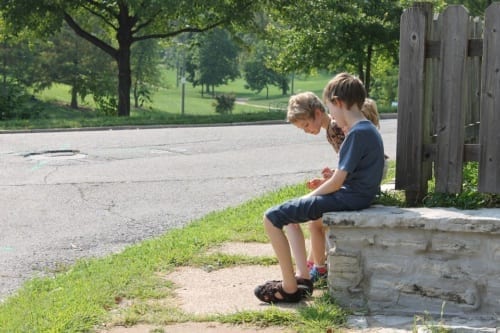 Summer is right around the corner and that always means great news for students and teachers alike– no more classes, no more homework or grading, and no more early mornings. However, a term that all parents and teachers should be wary of is what the education industry refers to as the “summer slide,” and it affects thousands around the world throughout the summer break season.
 Typically in the summer, parents witness a lack of desire to continue learning and a sense of lethargy that sets in after a few difficult weeks that are spent on final exams or papers. The conclusion of the positive momentum that leads up to the slide results in learning loss from the prior months, decline in reading and math skills, and the inability to get off to a positive start in the fall. This can set a student up for a poor start to the next school year and potentially a significant decline heading into the future.
 Encourage reading. As stated before, it is okay to take a little time off from school – every student needs it. But it is important for them to continue reading, whether it’s a book, morning newspaper or magazine. It is critical to keep reading skills in top shape heading into the new school year. Don’t let them sit around and watch television all day – push them to read.
 As a parents, it is more than okay to let children have some fun and enjoy the summer. But it is incredibly important to continue to think “big picture” when the summer slide starts to hit. No one wants to see their students lose the positive educational gains they developed during the school year. Relaxation is healthy, but too much of it can be harmful to a student’s development.
 Students throughout the U.S. face persistent challenges of postsecondary readiness, access, affordability and completion. Because of these challenges, students often must enroll in remedial courses, drop out before earning a degree or graduate with thousands of dollars of student loan debt.
 Unfortunately, traditional policy and funding silos have made it challenging to bring these programs to scale.
 ESSA State Plans – ESSA empowers states and local decision-makers to implement the strategies they choose for improving teaching and learning, provided they are grounded in evidence of success. Because of this, there is a unique opportunity to create more early college high school and dual and concurrent enrollment opportunities for students. As states collaborate with stakeholders to design new education systems that comply with ESSA, CHSA is working to elevate opportunities in the new law to expand and scale dual and concurrent enrollment and early college high school programs. We released guidance and recommendations to states aligned to these opportunities in ESSA and we continue to track and engage with states as they release public drafts of their state plans for comment. CHSA hopes to serve as an ongoing resource to states throughout plan development and implementation to expand high-quality postsecondary pathway options for students.
 HEA Reauthorization – Similarly, the CHSA has begun to engage around reauthorization of the Higher Education Act. Members are participating in a working group to develop recommendations for advancing these programs through the law and continue to work closely with our congressional champions to help them integrate these programs into their priorities for reauthorization. The Higher Education Act could be a powerful vehicle for scaling these programs particularly as we look to modernize the federal financial aid system to increase student access and affordability of higher education.
 The time is past due for online professional learning to be the go-to method for the teaching profession. It’s less expensive, offers continuous learning, employs familiar tools for online sharing and peer collaboration, encourages focused rather than passive learning and provides schools with easy ways to continually train and retrain new as well as experienced teachers. In short, the online experience meets the redefined goals for professional learning as outlined by
  The key to a true hybrid PD is to visualize how learners today move back and forth between a digital and face-to-face environment. A blended solution should offer a choice-driven, coherent, and grounded opportunity that meets teachers’ professional needs and fits today’s lifestyle — a kind of thoughtful, just in time, approachable path to professional learning. Here are some elements:
 Job embedded. Rarely can online material match perfectly with daily experience. A teacher must extract useful knowledge that can be
 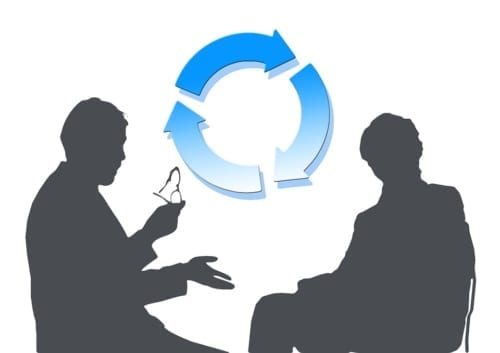 Make it a Conversation. Learning is rapidly moving from a vertical, hierarchical form of transmission to a peer-driven, social learning experience. The online learner needs to feel fully connected to others in the course. This can extend to having teachers sit side-by-side at computers as each go through the course. They alternate between the screen and the person next to them. It works, particularly for a conversation rich subject like PBL, which has many moving parts and requires a broad skill set from a teacher.
 Don’t Make Everyone Go Online. Learning online sounds liberating to many people. To others, as one teacher said, “It just makes me want to clean out my purse.”
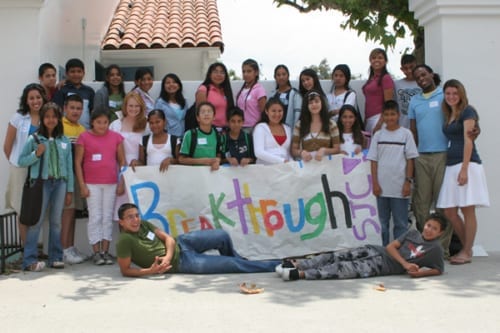
 Our goal at Breakthrough San Juan Capistrano is to get low-income first-generation students in and through college, and the same is true for the school district our students attend. Even though we have similar missions, we get there walking different paths. There are considerable structural, bureaucratic, demographic and political differences operating in school districts and not in nonprofits. But as a program director working with a college access nonprofit supporting 160 students (94 percent which will be the first in their families to attend college) some key nonprofit best practices could support school districts in our shared efforts to close the opportunity gap and enable more underserved youth to graduate college. In the last three years 88 percent of our students have applied and been admitted to 4-year universities, so there is something we can offer to support our common purposes.
 Even though national graduation rates as an aggregate have increased over the last decade, the rate of low-income first-generation students entering and finishing college has remained stagnate. According to Pell Institute report on “6-Year Degree Attainment,” only 10.9 percent of low-income, first-generation students attained a Bachelor’s degree, whereas 54 percent of non-low-income, non-first-generation students obtained their degrees. In the grand scheme a less college-educated nation can atrophy an economy, reduce civic engagement and curtail innovation. And, as reported by the Office of the President in 2014, “Increasing college opportunity is not just an economic imperative, but a reflection of our values. We need to reach, inspire, and empower every student, regardless of background, to make sure that our country is a place where if you work hard, you have a chance to get ahead.” As the rate of low-income, first-generation students starts to grow, an event horizon of demography and college attainment will culminate in a large uneducated workforce in just a few decades. This is not as a result of malintent, but severe structural inequities. As noted in the The State of School Counseling: Revisiting the Path Forward 2017, “High student to counselor ratios tend to be exacerbated in urban settings, with counselors also among the most under-resourced and vulnerable to school budget cuts, compounding the difficulty in providing services in communities with the greatest need.” Something must be done and there are ways that school districts can be creative, audacious and innovative with the resources they do have and ones they just need to uncover. And, nonprofits can serve as a guide to uncover some of those resources.
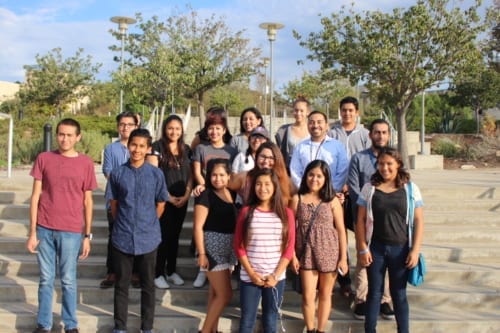 Operating in silos can occlude the combined impact of resources, efforts and services for organizations. As a nonprofit, actively seeking external organizations to either fill, extend or deepen program leverages the best of what we do in the service of our students. Start by mapping out all the community-based organizations in the local community that work towards the same goals of supporting underserved communities in an effort to understand the landscape. Initial contact should be focused on orienting one another to the services offered and ways these services can be aligned. Maintain constant communication to ensure alignment. For example, we partner with the local Boys and Girls Club to host college application workshops for all our students, we’ll host a workshop one month while they host another. In the end all our students have access to workshops and as an organization we are only planning one every two months. School districts can start looking past their walls to seek other organizations’ support.
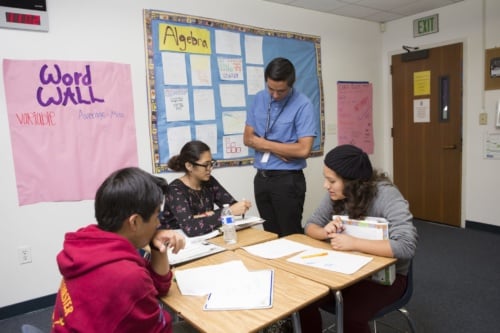 The Parent Teacher Association (PTA) has been an effective way to mobilize parents to support the cultural and social aspects of schools, however, tapping into the community to extend the impact of day-to-day programming on students can be critical to filling the void of scarce resources. Identifying, training and building in volunteers to serve as mentors, a second set of eyes on college essays and more can further enrich the work that counselors do every day. In our organization, we mobilized and train community members to mentor our seniors through the college application process. We serve as the direct trainers, maintain accountability and quality while mentors act as the first line in supporting our students to finish their applications on time. There is more planning, program creation and process development at the front end, but in time it will free up and enable students to have the critical support they need throughout the admissions process.
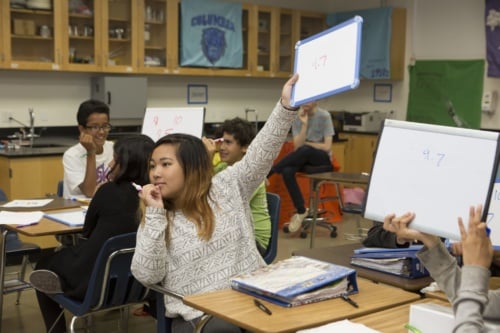 Rapid creative, human-centered innovation is key to improving programs within nonprofits and many startup organizations. By getting feedback from users, i.e. students and families, designing program based on that feedback, implementing and evaluating enables identifying the high-leverage actions or behaviors necessary for successful outcomes. The key is a rapid cycle of feedback and action. Our organization is constantly eliciting feedback and other forms of data (academic) from students and families to understand the effectiveness and impact of our program. If there’s a gap we fill it immediately, gather more data and make adjustments. If school districts only have a finite budget and resources, it’s critical to deeply understand from students and families what works well and continuously improve, innovative and create.