
edCircuit
  • Start Here
    • Login
    • Register
    • Subscribe
    • Submit a Press release
    • Advertise or Sponsor
    • Contribute
    • Get Interviewed
  • On the Wire
  • EdTech
    • All EdTech
    • Online Learning
    • Hybrid and Remote Learning
    • Augmented and Virtual Reality
    • ESports
    • Gamification and Game-Based Learning
    • Digital Citizenship
    • EdTech Entrepreneurs
    • Market Trends
    • Future of Education
  • Artificial Intelligence
  • K-12 Education
    • All K-12
    • K-12 Teachers
    • Teaching Strategies
    • Special Education and IEPs
    • Dyslexia
    • Gifted and Advanced Learning
    • Early Childhood, Pre-K and Kindergarten
    • School Calendar
    • Tutoring and Homework Help
    • Attendance and Absenteeism
    • After-School Programs
    • School Counselors
    • Homeschooling
    • School Models
    • Teacher Retention
    • Parents
    • Students
    • STEM and STEAM Education
  • Teaching and Learning
    • Literacy and Reading
    • Math Education
    • Civics and History Education
    • Financial Literacy
    • Assessment and Testing
    • Curriculum and Instruction
    • Personalized Learning
    • Project-Based Learning
    • Social-Emotional Learning
    • Executive Function
    • Creativity
    • Diversity, Equity, Inclusion
  • Professional Development
    • All Professional Development
    • Educators
    • Administrators
    • edLeaders
  • Higher Education
    • All Higher Education
    • College Admissions
    • Career and Technical Education (CTE)
    • Graduation
    • FAFSA and Financial Aid
    • Student Loans
  • Cybersecurity
  • School Safety
    • All School Safety
    • Science and Lab Safety
    • School Design and Facilities
    • Bullying
    • Duty of Care and School Liability
  • Continuing Education
    • All Continuing Education
    • Online Certificate Programs
    • Teaching Jobs and Careers
    • Teacher Appreciation
  • Education Policy and Government
    • All Education Policy
    • Department of Education
    • School Choice
    • Global
    • Advocates
  • EDU Shows
    • All EDU Shows
    • Safer Ed
    • Mind the Gap
    • Education Industry Questions
    • CoffeEd
    • InFocus
    • InformED Report
  • EDU Podcasts
    • All EDU Podcasts
    • Author Chats
    • CoSN The Podcast
    • Education Today
    • Building the Bridge
    • Students Speak
  • Education Industry Guides and Reports
  • Archived Media
    • Future of School: The Podcast
    • Equity Everywhere
  • About edCircuit
  • Subscribe
edCircuit
  • LOGIN
Home Tags Posts tagged with "Headline"
Tag:

Headline

This if for posts to be in the featured/top section of site
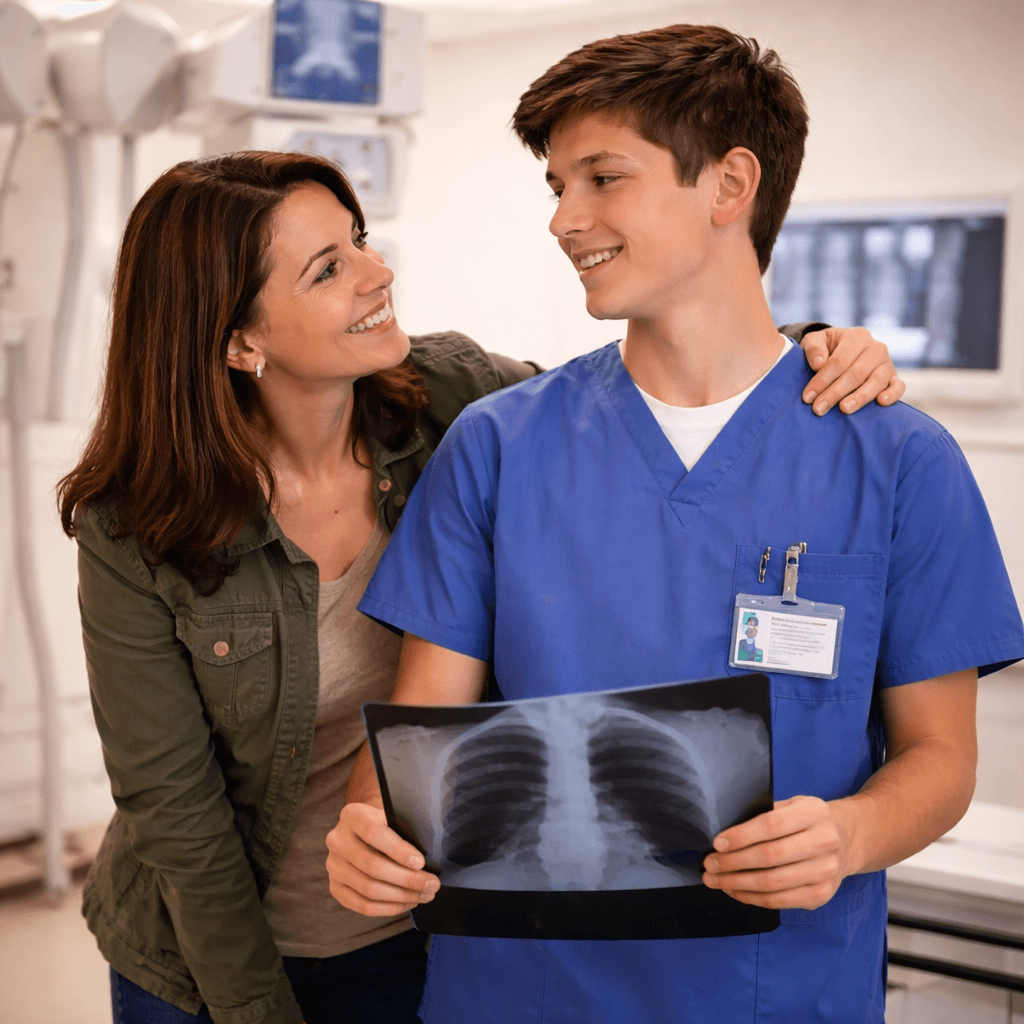
A woman smiles and stands next to a young man in blue scrubs holding a chest X-ray, highlighting Career and Technical Education Through a Parent’s Eyes in a medical setting.
Hot Topics - controversialCareer and Technical Education (CTE)K-12

Career and Technical Education Through a Parent’s Eyes

by EdCircuit Staff February 17, 2026
written by EdCircuit Staff 5 minutes read

Career and Technical Education often changes the future not just for students, but for the families who support them.

For Julia, a single mother raising her son Patrick, the question of “what comes next” after high school had always lingered quietly in the background. Like many parents, she wanted stability for her child. She wanted him to feel confident about his future, not overwhelmed by it. And she wanted an education pathway that felt realistic, meaningful, and achievable.

What she didn’t expect was how profoundly Career and Technical Education (CTE) would reshape that conversation — and how much pride it would bring into their home.

When Learning Finally Clicks

Patrick was never unmotivated. He was curious, thoughtful, and steady — but traditional classroom learning didn’t always hold his attention. He learned best by doing, by seeing how things worked, and by understanding why his work mattered.

When Patrick was introduced to a healthcare-focused CTE pathway, something changed. Through coursework connected to patient care and allied health, he began exploring careers that blended science, technology, and service. One pathway stood out immediately: X-ray technology.

For the first time, school wasn’t just about completing assignments. It was about preparing for a role in the real world — one where Patrick could help people, work with advanced technology, and build a future with purpose.

A Career Pathway With Direction

X-ray technology falls within the Patient Care/Allied Health pathway, a growing area of Career and Technical Education aligned with workforce demand. CTE programs in this field are typically competency-based, designed to prepare students over one to two years through a blend of classroom instruction and supervised clinical experience.

Patrick’s program reflects that structure. His coursework includes:

  • anatomy and imaging principles

  • patient positioning and care

  • radiation safety and protection

  • equipment operation and exposure techniques

In addition to classroom learning, students gain experience in clinical healthcare settings, where professionalism and responsibility are not optional — they are expected.

For Julia, seeing her son take this responsibility seriously has been one of the most powerful shifts.

Confidence That Carries Beyond the Classroom

At home, the change is noticeable. Patrick talks about what he’s learning with clarity and confidence. He understands the expectations of his field and the steps required to move forward.

His CTE pathway prepares him for state certification exams, including limited-scope permits, and ultimately for licensure through the American Registry of Radiologic Technologists (ARRT). These are not abstract goals — they are concrete milestones connected to real credentials and real careers.

For families, that clarity matters. Instead of uncertainty, there is a roadmap. Instead of vague plans, there is progress.

Learning Outcomes That Reflect Real-World Expectations

High-quality CTE programs are designed around outcomes that align with industry and professional standards. In radiologic science and X-ray technology programs, students are expected to graduate with skills that extend far beyond technical knowledge.

Program learning outcomes typically include the ability to:

  • demonstrate clinical competence in patient positioning, exposure selection, and radiation protection

  • apply critical thinking by adapting procedures and evaluating image quality

  • communicate effectively and respectfully in diverse healthcare environments

  • model professionalism as part of an interdisciplinary medical team

These outcomes shape not only employability, but character. They teach students how to show up prepared, ethical, and accountable — traits that families value just as much as credentials.

Why CTE Matters to Families

For families like Julia and Patrick’s, Career and Technical Education represents more than an academic option. It represents possibility.

CTE offers:

  • earlier exposure to meaningful careers

  • a clearer return on educational investment

  • opportunities to earn credentials while still in school

  • confidence for students who thrive through hands-on learning

It also challenges long-standing assumptions about what success looks like. CTE pathways demonstrate that college and career preparation are not opposites — they are often intertwined.

Pride Looks Different, But It’s Powerful

Parental pride doesn’t always come from report cards or acceptance letters. Sometimes it comes from quieter moments — a student studying for a certification exam, talking about patient safety, or describing a clinical experience with care and maturity.

For Julia, pride shows up in watching Patrick commit to something he believes in. It’s in seeing him take ownership of his future. It’s in knowing that his education is preparing him for work that matters.

Career and Technical Education made that possible.

Celebrating CTE Month Through a Family Lens

Career and Technical Education Month is often marked by program showcases, student projects, and workforce partnerships. But behind every CTE pathway is a family watching closely — hoping, supporting, and celebrating milestones along the way.

From a parent’s perspective, CTE Month is a reminder that:

  • learning doesn’t follow one path

  • hands-on education has dignity and value

  • students succeed when education aligns with their strengths

These programs don’t just prepare students for jobs. They help families envision a future with confidence.

Changing the Narrative Around Opportunity

For years, CTE was misunderstood as a lesser option. Today’s programs tell a different story. They are rigorous, aligned to industry standards, and responsive to workforce needs. They open doors to healthcare, technology, engineering, and skilled professions that communities depend on.

Patrick’s journey into X-ray technology reflects that shift. His pathway is not a fallback. It is a deliberate, respected choice — one that combines education, skill, and service.

Looking Ahead With Confidence

Career and Technical Education gives students something invaluable: direction. And for families, direction brings relief, pride, and hope.

As Career and Technical Education Month is celebrated, stories like Julia and Patrick’s highlight why these programs matter. They show how CTE supports students who learn by doing, prepares them for meaningful careers, and strengthens families along the way.

That impact reaches far beyond the classroom — and it’s worth celebrating.

Subscribe to edCircuit to stay up to date on all of our shows, podcasts, news, and thought leadership articles.
February 17, 2026 0 comments
0 FacebookTwitterPinterestLinkedinWhatsappCopy LinkEmail
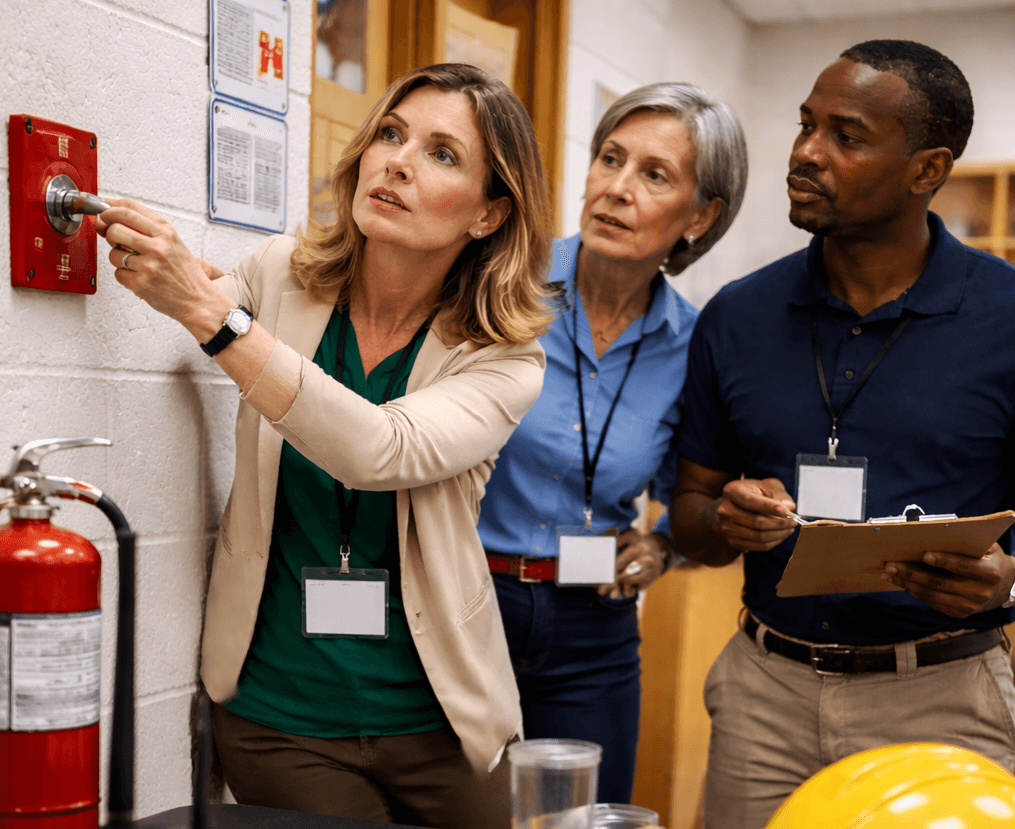
Three adults with name badges observe as one woman demonstrates how to use a fire alarm pull station during safety training in a hallway; a fire extinguisher and hard hat are visible nearby.
K-12Safer Ed

Safety Training That Sticks in Real Classrooms

by EdCircuit Staff February 16, 2026
written by EdCircuit Staff 5 minutes read

Safety training determines what happens in the first ten seconds

Safety training is often measured by attendance, completion certificates, and documented compliance. Yet when a real moment unfolds in a lab, makerspace, or CTE classroom, those records do not determine the outcome. What determines the outcome is whether the adults in the room have physically practiced the response in the same environment, under the same conditions, with the same constraints they face every day.

The difference between knowing and doing is where safety lives.

This is the central focus of the latest episode of the Safer Ed Podcast, Training That Sticks: Why Drills and Professional Development Determine Safety Outcomes. The conversation challenges a long-standing assumption in K–12 education: that providing information is the same as building readiness.

It isn’t.

Safer EdTraining That Sticks: Why Drills and PD Determine Safety OutcomesFebruary 16, 2026 · 5 min 48 sPlay episode: Training That Sticks: Why Drills and PD Determine Safety Outcomes (5 minutes 48 seconds)0:00-5:48Follow on SpotifyApple

Completion is not competence

Schools have never provided more safety training. Online modules, annual refreshers, policy reviews, and sign-in sheets create the appearance of a complete system. But near-miss data tells a different story. In real classrooms, educators still hesitate, improvise, or rely on the most experienced person in the room to take the first action.

That pattern does not reflect a lack of professionalism—it reflects a mismatch between how training is delivered and how people actually perform under pressure.

In calm environments, adults can describe procedures perfectly. They can identify emergency equipment on a slide. They can pass an assessment. But in a live instructional setting, they are managing behavior, materials, supervision, and time simultaneously. When something unexpected happens, there is no extra space for analysis.

The response must be automatic.

Why spatial fluency matters

Training that changes outcomes always includes a physical component.

Educators must stand where they will stand. Walk the actual exit route. Reach the real shutoff. Navigate the same pathways students use. These are not small details—they are the sensory experiences the brain retrieves during a high-stress moment.

A safety plan reviewed in an auditorium does not prepare a teacher to act in a crowded lab.

A five-minute walkthrough in the actual room does.

That physical familiarity builds confidence, reduces hesitation, and creates coordinated movement. It also reveals obstacles—blocked access points, congested transitions, equipment staged in the wrong location—that written plans cannot capture.

Drills must reflect real conditions

Many drills occur under ideal circumstances: announced in advance, conducted in quiet spaces, and executed without the complexity of active instruction. But incidents do not occur under ideal conditions.

They happen:

  • during cleanup

  • during transitions

  • when multiple activities overlap

  • when supervision is divided

Training that takes place in calm environments prepares people for calm environments. Training in real conditions prepares people for real-world situations.

This shift does not require more time. High-functioning schools embed micro-practice into existing routines: the first two minutes of a lab become a shutdown rehearsal; a staff meeting includes a five-minute scenario tied to a real near miss. Over time, those repetitions create an automatic response.

Role clarity and distributed leadership

One of the most consistent friction points in emergency response is hesitation about who initiates the first action.

Safety plans often assume that everyone will move simultaneously and correctly. In practice, adults look to one another for confirmation. That brief pause changes outcomes.

Training that sticks rehearses leadership as a behavior, not a position. Different staff members initiate responses during drills. Support staff are included. Substitutes receive rapid physical orientation to the room.

This creates distributed competence—a system in which the first critical step can occur immediately, regardless of who is present.

Measuring performance, not participation

Most schools measure training by completion. Effective systems measure execution.

  • How long does it take to begin the first action?

  • Where does movement slow down?

  • Is communication clear and consistent?

  • Can safety equipment be accessed without obstruction?

These are performance indicators. And they are best observed during drills.

When someone watches the process solely to identify friction points, training becomes a diagnostic tool for the entire safety system. A blocked shutoff is not a training failure—it is a layout issue revealed through training. Congestion at an exit is not a behavioral problem—it is a scheduling and space issue.

This is how professional development connects directly to facilities, purchasing, and instructional planning.

The power of the post-drill debrief

The most important learning often happens after the drill ends.

What slowed us down?
What was confusing?
What assumptions didn’t match reality?

When those reflections are documented and revisited, they become institutional memory. As staff, schedules, and spaces change, the organization continues to improve instead of starting over.

Just as importantly, this process builds psychological safety. When educators see that raising concerns leads to system improvements, reporting increases. Silence disappears.

Training builds trust—and trust changes outcomes

In schools where drills are practiced in context and debriefed openly, something shifts. Adults trust each other’s actions because they have seen them before. They trust the system because they have tested it. Students respond more quickly because expectations are consistent across rooms.

Trust reduces hesitation.

Reduced hesitation keeps small incidents from becoming larger ones.

A practical tool for evaluating readiness

One of the most common variables in safety performance is overcrowding. Class size, furniture layout, and equipment storage all affect movement, supervision, and access to emergency systems.

To help schools evaluate that intersection, Science Safety provides a free Occupancy Load Calculator that allows educators and leaders to assess how many people a space can safely accommodate under real-world conditions.

Used alongside drills and walkthrough observations, it turns intuition into evidence and supports informed decisions about scheduling, layout, and program expansion.

You can access the tool here:

https://sciencesafety.com/free-occupancy-load-calculator-tool/

From compliance to capability

Safety outcomes are not determined by the existence of a plan. They are determined by what people can do without hesitation.

Repeated, contextual, and physically practiced training turns written procedures into coordinated action. It transforms near misses into rehearsed responses. And it allows innovation in STEM and CTE spaces to grow without quietly accumulating risk.

In the end, the goal is not more training.

The goal is training that works.

Subscribe to edCircuit to stay up to date on all of our shows, podcasts, news, and thought leadership articles.

February 16, 2026 0 comments
0 FacebookTwitterPinterestLinkedinWhatsappCopy LinkEmail
Three professionals collaborate at a table with laptops and digital charts in a modern tech office, driving K–12 innovation in 2026, while others work at interactive screens in the background.
EducatorsedLeadersHot Topics - controversialCoSN The PodcastK-12

Driving K–12 Innovation in 2026: What Leaders Must Know

by EdCircuit Staff February 16, 2026
written by EdCircuit Staff 5 minutes read

K–12 innovation is entering a defining moment as district technology leaders juggle competing priorities: piloting artificial intelligence tools, defending cybersecurity budgets, struggling to fill IT vacancies, and rethinking how students demonstrate learning.

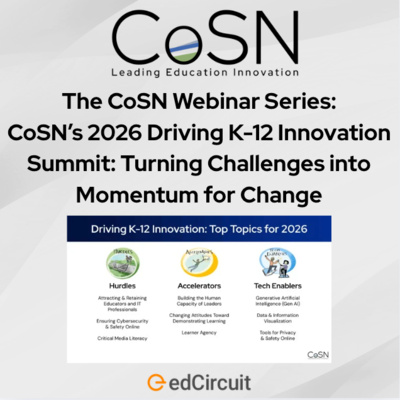
To bring clarity to that complexity, the Consortium for School Networking (CoSN) released its annual report, Driving K–12 Innovation 2026: Hurdles • Accelerators • Tech Enablers, drawing on global perspectives from education and technology leaders to identify what will most shape schools in the year ahead.

The 2026 findings point to a central truth: progress will hinge less on acquiring new tools and more on strengthening culture, leadership, and trust.

District leaders can also explore the full report and dive deeper through the accompanying webinar (Play video) conversation and recorded podcast episode.

Three Lenses for Leading Change

The report organizes transformation through a practical framework:

  • Hurdles — barriers districts must overcome

  • Accelerators — forces pushing instructional and operational change forward

  • Tech Enablers — tools that make new approaches possible

Together, these lenses serve as a strategic diagnostic for superintendents, CTOs, curriculum leaders, and cabinet teams deciding where to focus funding, staffing, and professional learning.

The Biggest Hurdles Facing Districts

Attracting and Retaining Educators and IT Professionals

Staffing shortages remain one of the most stubborn obstacles to K–12 innovation. Districts are competing with private-sector salaries while educators confront burnout, heavy workloads, and declining morale.

The report stresses that retention is not merely an HR issue — it is foundational to cybersecurity readiness, instructional continuity, and long-term transformation. Districts investing in culture, growth pathways, and leadership pipelines are better positioned to sustain innovation over time.

Ensuring Cybersecurity and Safety Online

Cybersecurity has moved from a background IT concern to a front-line operational responsibility.

From ransomware and phishing to student-data protection, districts are being asked to safeguard every device, application, and network — often without dedicated funding streams. Leaders cited in the report emphasize that durable protection depends on district-wide culture, training, governance, and policy alignment, not just technical controls.

Critical Media Literacy

New to the Hurdles list in 2026, critical media literacy reflects rising concern about misinformation, deepfakes, and AI-generated content.

The report frames these skills as essential to civic participation and workforce readiness, urging districts to embed evaluation of sources, ethical reasoning, and digital discernment across grade levels rather than treating media literacy as a one-off unit or elective course.

What’s Accelerating K–12 Innovation

Despite persistent challenges, several forces are pushing districts forward.

Building the Human Capacity of Leaders

Leadership development emerges as a cornerstone of progress. The report highlights coaching models, ethical AI literacy, and continuous professional learning as critical to building resilient systems that can adapt to rapid technological change.

When leaders focus on people first, districts create the conditions for experimentation, collaboration, and responsible innovation.

Changing How Students Demonstrate Learning

Traditional testing models are under renewed scrutiny.

Across systems, educators are experimenting with portfolios, multimedia presentations, design challenges, and community-based projects that allow students to show deeper understanding and creativity. The report argues that this shift toward authentic assessment aligns closely with career readiness and learner agency — but requires cultural change, thoughtful policy updates, and sustained leadership support.

Learner Agency

Learner agency continues to gain momentum as schools rethink students’ roles in classrooms.

Students are increasingly positioned as designers and problem-solvers, while educators are granted flexibility to explore inquiry-based practices and emerging technologies. The report links this dual agency — for teachers and learners — to stronger engagement and more durable instructional change.

The Tech Enablers to Watch in 2026

Three technology categories stand out for their growing influence.

Generative Artificial Intelligence

Artificial intelligence is already reshaping instruction and district operations, but the report avoids hype. Instead, it stresses responsible adoption, equitable access, and governance frameworks that keep human relationships at the center of learning.

Leaders are encouraged to treat AI as a teaching partner — not a shortcut — and to ensure professional development keeps pace with adoption.

Data and Information Visualization

New to the Tech Enablers list are data-visualization tools, which reflect districts’ growing need to translate raw information into insights.

Dashboards and analytics platforms can expose equity gaps and support earlier intervention, but the report cautions that tools alone are insufficient. Without a strong data culture and sustained staff training, even sophisticated systems fail to drive instructional improvement.

Tools for Privacy and Safety Online

Returning to the list after several years, privacy and safety technologies underscore escalating cyber risk.

From application-vetting platforms to network-monitoring tools, districts are investing in safeguards that protect students while keeping digital learning environments accessible and functional.

Three Themes That Tie It All Together

Running beneath the Top Topics are three unifying ideas:

  • Ethics and trust are non-negotiable

  • Equity and access must guide innovation

  • Culture matters more than hardware

Together, these themes reinforce the report’s central message: sustainable K–12 innovation depends on people first and technology second.

What District Leaders Should Take Away

For superintendents, CTOs, and instructional leaders preparing for 2026, the report points to several priorities:

  • Invest in leadership development and staff retention

  • Build cybersecurity cultures, not just technical defenses

  • Embed media literacy across curricula

  • Rethink assessment systems

  • Establish AI strategies grounded in ethics and equity

  • Strengthen district-wide data literacy

Innovation in the coming year will not be defined by isolated pilots or one-time purchases. It will be shaped by sustained collaboration, thoughtful governance, and shared vision.

District leaders seeking deeper insight can explore the full report and continue the conversation below through the summit webinar and on-demand podcast.

The CoSN PodcastThe CoSN Webinar Series: CoSN’s 2026 Driving K-12 Innovation Summit: Turning Challenges into Momentum for ChangeFebruary 10, 2026 · 1 h 19 minPlay episode: The CoSN Webinar Series: CoSN’s 2026 Driving K-12 Innovation Summit: Turning Challenges into Momentum for Change (1 hour 19 minutes)0:00-1:19:40Follow on SpotifyApple
Play video: CoSN Driving K-12 Innovation Summit 2026 (1 hour 23 minutes)1:23:00
CoSN Driving K-12 Innovation Summit 20261 h 23 minCoSNweb on YouTube

CoSNweb – CoSN Driving K-12 Innovation Summit 2026 (Play video)

Subscribe to edCircuit to stay up to date on all of our shows, podcasts, news, and thought leadership articles.
February 16, 2026 0 comments
0 FacebookTwitterPinterestLinkedinWhatsappCopy LinkEmail
Three students stand outdoors on campus, smiling and looking at a document together as they discuss their College Decision Next Steps. Each carries backpacks and notebooks.
Higher EducationCollege AdmissionsFAFSA and Financial AidHot Topics - controversial

College Decision Next Steps After Acceptance

by EdCircuit Staff February 13, 2026
written by EdCircuit Staff 4 minutes read

College decision next steps become urgent each February as acceptance letters turn anticipation into action. Financial aid portals fill inboxes, campus visits stack up on calendars, and students face one of the first truly high-stakes choices of their lives. For parents, teachers, guidance counselors, and both K–12 and higher-education administrators, this is the moment when confidence matters as much as credentials.

This stage is less about rankings and more about readiness. Families are weighing affordability, academic programs, distance from home, and campus culture—while admissions teams and college leaders focus on transparency, yield, and ensuring students understand what enrollment truly entails. The right support now can determine not just where a student enrolls, but how smoothly they transition into college life.

1. Confirm FAFSA Submission and Financial Aid Status

Every family should verify that the FAFSA has been received and processed by each institution under consideration. Even small missing documents can delay award letters or reduce eligibility.

Important steps include:

  • Checking each college’s aid portal regularly

  • Responding quickly to verification requests

  • Confirming household income data

  • Reviewing dependency status

  • Comparing grants, loans, and work-study offers

Guidance counselors and educators play a critical role in helping students interpret award letters, which often look similar on the surface but mask significant differences in net cost.

2. Evaluate Scholarships—and Search for Additional Funding

By late winter, many students have received merit awards, departmental scholarships, or honors-college invitations. Others are still awaiting competitive full-tuition opportunities.

Families should:

  • Track acceptance deadlines

  • Confirm renewal requirements

  • Understand GPA or credit thresholds

  • Determine whether awards stack with institutional aid

If gaps remain, now is also the time to pursue:

  • Local foundation scholarships

  • Employer-sponsored awards

  • Civic-organization grants

  • Career-aligned professional groups

Financial aid offices can often point students toward internal awards that are not widely advertised—especially for first-generation students navigating complex systems for the first time.

3. Budget for Travel and Other Hidden College Costs

Tuition alone rarely reflects the full price of attendance. When families compare college decision next steps, they should include secondary costs that can vary dramatically:

  • Travel: Flights, holiday trips home, ride-share services

  • Housing deposits: Often due weeks before final enrollment

  • Orientation programs: Some require overnight stays

  • Books and lab fees

  • Technology purchases

  • Health-insurance adjustments

Students considering schools far from home should model yearly transportation expenses—especially if frequent travel is likely.

4. Attend Admitted-Student and Scholarship Events

Campus visits after acceptance often provide the clearest signal of fit. These programs allow students to meet peers, speak with faculty, and envision daily life.

Students should notice:

  • Classroom culture and workload

  • Access to professors

  • Advising and tutoring systems

  • Residence halls and dining options

  • Wellness resources

Scholarship finalist weekends may include interviews, group activities, or presentations. Educators can help students prepare by practicing introductions, refining goals, and crafting thoughtful questions.

5. Complete Housing Applications Early

Housing assignments often follow rolling timelines. Delaying can limit choices.

Students should:

  • Submit housing forms promptly

  • Rank residence preferences carefully

  • Complete roommate profiles honestly

  • Monitor housing portals and email

Families should also confirm which deposits are refundable before committing.

6. Speak Directly With Financial Aid Representatives

Personal conversations with aid officers often resolve confusion and, in some cases, uncover options.

Helpful questions include:

  • Are appeal processes available for changed circumstances?

  • What payment plans exist?

  • How does work-study operate?

  • When are aid decisions finalized?

For admissions teams and administrators, proactive outreach during this period can make a meaningful difference in student confidence and enrollment decisions.

7. Connect With Professors in the Intended Major

Academic fit should anchor every final choice. Speaking with faculty can clarify what life in a major actually looks like.

Topics to explore:

  • Course sequencing

  • Research opportunities

  • Internship pipelines

  • Study-abroad programs

  • Graduate-school placement

  • Career outcomes

These conversations often shape decisions more than marketing materials.

8. Compare Schools Holistically

Instead of relying solely on rankings, families should assemble comprehensive comparison charts:

  • Net cost

  • Distance from home

  • Graduation rates

  • Internship access

  • Class size

  • Support services

  • Alumni networks

Guidance counselors are essential partners here, helping students balance emotion with evidence.

9. Prepare for the Final Enrollment Decision

As deadlines approach, students should be ready to:

  • Submit deposits

  • Decline other offers courteously

  • Register for orientation

  • Set up campus accounts

  • Complete placement exams

  • Begin advising surveys

Schools can reinforce this momentum through clear communication and celebratory decision-day events.

A Shared Responsibility in a High-Stakes Moment

The college decision process extends far beyond a single student. Parents manage finances, educators decode systems, counselors provide perspective, and higher-education leaders influence outcomes through transparency and outreach.

February is the pivot point—from applications to action. With careful planning, honest budgeting, and thoughtful engagement, families can approach the next steps in the college decision with clarity rather than stress.

The goal is not simply choosing a school. It is choosing a place where a student can thrive academically, grow personally, and step forward with financial confidence.

Subscribe to edCircuit to stay up to date on all of our shows, podcasts, news, and thought leadership articles.

February 13, 2026 0 comments
0 FacebookTwitterPinterestLinkedinWhatsappCopy LinkEmail
Digital illustration honoring African American scientists who advanced safety in science education.
edLeadersHot Topics - controversialScience and Lab SafetyK-12

African Americans Who Shaped Safety in Science Education

by EdCircuit Staff February 12, 2026
written by EdCircuit Staff 5 minutes read

This Black History Month, we celebrate African Americans who shaped safety in science education, shaping safer laboratories, stronger standards, and more responsible scientific learning.

Science education has always depended on trust. Trust that experiments will be conducted responsibly. Trust that students will be protected while learning complex and sometimes dangerous concepts. Trust that educators are prepared to guide discovery without unnecessary risk. Many of the lab safety standards we rely on today were shaped by African American scientists and educators who understood that learning cannot thrive without care, preparation, and accountability.

At a time when safety protocols were inconsistent or nonexistent, these pioneers emphasized discipline, structure, and ethical responsibility in science instruction. Their influence is still felt in chemistry labs, biology classrooms, and teacher preparation programs across the country.

St. Elmo Brady

St. Elmo Brady is widely recognized as one of the most influential figures in American chemistry education. Beyond his groundbreaking work as a chemist, Brady was deeply committed to improving how science was taught, especially in laboratory settings.

Brady believed that students deserved access to well-organized labs with clear procedures and safety expectations. At historically Black colleges and universities, he helped establish chemistry programs that emphasized proper chemical handling, lab discipline, and structured experimentation. These practices were not universal at the time, particularly in underfunded institutions.

By professionalizing laboratory instruction, Brady helped set early standards for safety-focused science education. His work laid the foundation for modern lab manuals, safety briefings, and instructional consistency that protect students today.

Marie Maynard Daly

Marie Maynard Daly broke barriers as the first African American woman to earn a PhD in chemistry. Her research into cholesterol, heart disease, and human health reshaped biomedical science and influenced laboratory practices across chemistry and biology.

Daly’s work required careful control of chemical substances, biological samples, and experimental variables. In educational settings, her research reinforced the importance of safety protocols related to chemical exposure, contamination prevention, and accurate measurement.

Her legacy in science education extends beyond content. Daly modeled precision, preparation, and ethical responsibility, qualities that are central to safe lab environments. Many modern biology and chemistry lab standards reflect the principles her work embodied.

Alice Ball

Alice Ball was a brilliant chemist whose work led to the first effective treatment for leprosy. Working in the early 20th century, Ball handled complex and potentially hazardous chemical compounds at a time when lab safety infrastructure was minimal.

Her research required innovative chemical processing techniques and careful handling to ensure both effectiveness and safety. While her contributions were overlooked for decades, Ball’s work is now frequently included in science education as an example of responsible experimentation and chemical control.

In classrooms today, her story is often used to teach not only chemistry concepts but also the importance of safe procedures, documentation, and ethical recognition in scientific work.

Percy Lavon Julian

Percy Lavon Julian was one of the most accomplished organic chemists of the 20th century. His work led to the large-scale synthesis of medicinal compounds used to treat arthritis, inflammation, and hormonal disorders.

Julian worked with volatile chemicals and complex reactions that demanded strict laboratory discipline. Long before modern occupational safety standards, he developed processes that minimized risk and improved consistency in chemical synthesis.

In science education, Julian’s work highlights the connection between innovation and safety. His methods influenced how chemistry labs approach synthesis, storage, and procedural rigor, reinforcing that breakthrough science depends on controlled and safe environments.

Lloyd Noel Ferguson

Lloyd Noel Ferguson dedicated his career to strengthening science education through teacher preparation and laboratory instruction. He believed that safety awareness should be embedded into how science is taught, not treated as an afterthought.

Ferguson emphasized lab design, proper use of equipment, and instructor readiness. Through his mentorship and leadership, he helped normalize safety instruction as a core responsibility of science educators.

His influence is reflected in teacher training programs where lab safety, classroom management, and ethical experimentation are standard components of science education.

Henry Cecil McBay

Henry Cecil McBay was a chemist and educator who focused on strengthening science instruction and laboratory preparedness. He worked to improve lab conditions, curriculum quality, and professional development for science teachers.

McBay believed that students could not fully engage with science if labs were unsafe or poorly equipped. His advocacy helped elevate safety awareness in academic environments and reinforced the link between strong instruction and responsible lab practices.

His contributions helped shape a culture of safety that benefits students and educators alike.

Lab Safety as an Equity Issue in Education

Lab safety is not just a technical concern. It is an equity issue. Unsafe or poorly managed labs disproportionately affect students in under-resourced schools, limiting hands-on learning opportunities and discouraging engagement with science.

The African Americans highlighted here understood that safety enables access. Their work helped:

  • Protect students during hands-on experimentation

  • Improve consistency in science instruction

  • Support ethical research practices

  • Expand access to quality STEM education

By prioritizing safety, they helped ensure that science education could be both rigorous and inclusive.

Why Their Legacy Still Matters Today

Modern science classrooms rely on safety protocols that are often taken for granted. Eye protection, chemical labeling, ventilation standards, emergency procedures, and teacher training all trace their roots to decades of scientific leadership and educational advocacy.

Honoring African Americans who changed safety in science education reminds us that progress is built on preparation and care. Their work protects millions of students every year, even if their names are not always visible.

Celebrating Black History Month Through Safer Learning

Black History Month gives us an opportunity to recognize contributions that operate behind the scenes but shape everyday learning. Safe science labs are one of those contributions.

By honoring these pioneers, we celebrate a legacy of responsibility, excellence, and commitment to student well-being. Their influence continues every time a student enters a lab designed not just for discovery but for protection and possibility.

The future of science education depends on both innovation and safety. Thanks to these leaders, classrooms across the country are stronger, safer, and better prepared for the next generation of scientists.

Subscribe to edCircuit to stay up to date on all of our shows, podcasts, news, and thought leadership articles.

 
February 12, 2026 0 comments
0 FacebookTwitterPinterestLinkedinWhatsappCopy LinkEmail
Three students sit at a table with architectural models, blueprints, and color swatches, discussing a project. Other students work in groups in a bright, creative classroom filled with posters and models.
Hot Topics - controversialProject-Based LearningK-12

Real-World Learning in High School Classrooms

by EdCircuit Staff February 12, 2026
written by EdCircuit Staff 5 minutes read

Real-world learning often starts with a moment that feels unfamiliar to students used to traditional classrooms. A group of high school seniors stands at the front of the room, presenting a business proposal to local professionals. They are nervous, prepared, and aware that the feedback they receive will shape their final revisions. This is not a simulation for a test. It is learning built around real expectations.

Across the country, high schools are shifting away from instruction that focuses only on memorization and toward experiences that reflect real jobs, real problems, and real responsibilities. This change is reshaping how students learn and how educators define success.

Why High Schools Are Rethinking Instruction

For years, high school achievement was measured by grades, credits, and standardized assessments. While academic knowledge remains important, educators are increasingly recognizing a disconnect between what students know and what they can do.

Many graduates leave school with content knowledge but limited experience applying it. Employers and colleges report that students struggle with communication, collaboration, problem-solving, and adaptability. These gaps have pushed schools to reconsider what it truly means to be prepared.

Real-world learning addresses this challenge by connecting academic content to practical use, helping students understand not just the “what,” but the “why” behind their learning.

What Real-World Learning Looks Like in Practice

In classrooms built around real-world learning, students are active participants. Lessons are designed around problems, projects, and scenarios rather than isolated skills.

Students might:

  • Design a business plan that requires budgeting, research, and presentation

  • Analyze environmental data to propose sustainability solutions

  • Write professional emails, reports, and proposals in English classes

  • Develop marketing campaigns using real audience feedback

  • Build and test prototypes in engineering and technical courses

These tasks demand more than correct answers. Students must plan, revise, collaborate, and defend their thinking, just as they would in a workplace.

One student described it simply: “It feels more stressful than a test, but it also feels more real. You actually care if it works.”

Project-Based Learning as the Core Approach

Project-based learning has become the foundation of many real-world learning models. Instead of short assignments, students engage in extended projects that unfold over weeks or months.

Teachers guide the process, but students make key decisions. They manage timelines, divide responsibilities, and adjust their approach when problems arise. Assessment focuses on both the final product and the skills demonstrated along the way.

Many schools now replace traditional exams with presentations, portfolios, or exhibitions of learning. These assessments better reflect how students will be evaluated beyond high school.

Career Pathways and Applied Coursework

High schools are also connecting real-world learning to career pathways. These pathways align academic coursework with industries such as healthcare, technology, business, construction, and the arts.

Students may participate in:

  • Internships and apprenticeships

  • Job shadowing experiences

  • Industry mentorships

  • Certification programs alongside graduation requirements

Academic classes support these experiences. Math becomes budgeting and data analysis. Writing focuses on resumes, documentation, and professional communication. Science connects to lab safety, research methods, and real applications.

When students see how learning connects to future opportunities, engagement increases.

Learning Through Real-Life Scenarios

Scenario-based learning places students in realistic situations with constraints and consequences. These scenarios mirror the uncertainty and complexity of real work.

Examples include:

  • Responding to a simulated public health issue

  • Planning emergency response logistics

  • Resolving workplace conflicts through role-play

  • Managing limited resources within a project budget

These experiences teach students that real problems rarely have one correct answer. Instead, they learn to weigh options, make decisions, and adapt when conditions change.

Students often say this type of learning feels challenging but meaningful. “You can’t just guess,” one student noted. “You have to explain your thinking.”

The Evolving Role of Teachers

As instruction shifts, the role of teachers changes as well. Educators become designers of learning experiences, facilitators of discussion, and coaches for skill development.

This approach requires careful planning and flexibility. Teachers collaborate across subject areas, develop new assessments, and often work with community partners. While the workload can be significant, many educators report higher student engagement and deeper learning.

Professional development now focuses on project design, assessment of skills, and managing collaborative classrooms.

Measuring Success Differently

Traditional grading systems do not always capture the full impact of real-world learning. As a result, many schools are adopting alternative measures of success.

These include:

  • Portfolios of student work

  • Performance-based assessments

  • Skill-based rubrics

  • Reflection and self-assessment

Administrators and policymakers are increasingly looking at long-term outcomes such as graduation rates, postsecondary success, and workforce readiness.

Benefits Beyond the Classroom

The benefits of real-world learning extend beyond academics. Students gain confidence, independence, and a clearer understanding of their strengths and interests. They develop communication and collaboration skills that carry into adulthood.

Communities benefit as well. Partnerships with local businesses and organizations allow students to contribute meaningful work while gaining valuable experience.

Parents often notice a change, too. Students involved in applied learning tend to be more motivated and more invested in their education.

Challenges to Address

Despite its promise, real-world learning requires careful implementation. Teachers need time to plan. Schools need strong partnerships and resources. Equity must remain a priority so all students have access to high-quality experiences.

It is also important to maintain strong academic foundations. Real-world learning is most effective when it builds on solid instruction rather than replacing it.

Looking Forward

High schools are redefining what preparation looks like. Education is no longer only about delivering content. It is about helping students apply knowledge, adapt to change, and navigate complex systems.

Real-world learning reflects the realities students will face after graduation. As more schools adopt project-based, applied, and career-connected approaches, high school education continues to move closer to the world students are preparing to enter.

Subscribe to edCircuit to stay up to date on all of our shows, podcasts, news, and thought leadership articles.

February 12, 2026 0 comments
0 FacebookTwitterPinterestLinkedinWhatsappCopy LinkEmail
Newer Posts
Older Posts

Participate

  • Contribute
  • Sponsor
  • Submit Release
  • Subscribe
  • Get Interviewed

We value your privacy

We use cookies to enhance your browsing experience, serve personalized ads or content, and analyze our traffic. By clicking "Accept All", you consent to our use of cookies.

Customize
  • Needed for the site to work: signing in, the cart, your consent choice. Always on.

    8 cookies
    • ss_consent 1 yearYour cookie choice on this site, so you are not asked again.
    • wordpress_logged_in_* 2 days, or 14 days with "remember me"Keeps you signed in as you move between pages.
    • wordpress_sec_* 2 days, or 14 days with "remember me"The secure half of your sign-in.
    • wordpress_test_cookie SessionChecks that your browser accepts cookies when you sign in.
    • wp-settings-* 1 yearYour display settings when signed in.
    • wp_woocommerce_session_* 2 daysYour shopping session: the cart and the checkout.
    • woocommerce_cart_hash SessionTells the site whether your cart has changed.
    • woocommerce_items_in_cart SessionWhether your cart holds anything.
  • Remembers choices you make, such as a language or a region, and supports features like live chat.

    1 cookie
    • woocommerce_recently_viewed SessionThe products you looked at, so the site can show them again.
  • Helps us understand how visitors use the site: which pages are read, and for how long.

    2 cookies
    • _ga 2 yearsGoogle Analytics: tells one visitor from another. Set only after you allow analytics.
    • _ga_* 2 yearsGoogle Analytics: keeps your session state. Set only after you allow analytics.
  • Measures how fast pages load so we can make them faster.

  • Used to show you content and offers that match your interests, on this site and elsewhere.

    1 cookie
    • sbjs_* SessionWooCommerce order attribution: where you came from, so a purchase can be credited to the campaign or site that sent you.

Your browser asks us not to sell or share your information (Global Privacy Control), so advertising cookies stay off.

Do not sell or share my personal information

Some cookies from other companies help show you offers on other sites. Tick the box and save your preference to opt out of that sharing; untick it to opt back in at any time.

Your browser sends Global Privacy Control, so this preference is set for you and cannot be changed here.

Sign In

Keep me signed in until I sign out

Forgot your password?

Password Recovery

A new password will be emailed to you.

Have received a new password? Login here

Shopping Cart

Close

No products in the cart.

Close
-
00:00
00:00

Queue

Update Required Flash plugin
-
00:00
00:00

Your cart (items: 0)

Products in cart

Product Details Total
Subtotal $0.00
Shipping and discounts calculated at checkout.
View cart
Go to checkout

Your shopping cart is empty

Return to shop

Notifications