edCircuit
  • Start Here
    • Login
    • Register
    • Subscribe
    • Submit a Press release
    • Advertise or Sponsor
    • Contribute
    • Get Interviewed
  • On the Wire
  • EdTech
    • All EdTech
    • Online Learning
    • Hybrid and Remote Learning
    • Augmented and Virtual Reality
    • ESports
    • Gamification and Game-Based Learning
    • Digital Citizenship
    • EdTech Entrepreneurs
    • Market Trends
    • Future of Education
  • Artificial Intelligence
  • K-12 Education
    • All K-12
    • K-12 Teachers
    • Teaching Strategies
    • Special Education and IEPs
    • Dyslexia
    • Gifted and Advanced Learning
    • Early Childhood, Pre-K and Kindergarten
    • School Calendar
    • Tutoring and Homework Help
    • Attendance and Absenteeism
    • After-School Programs
    • School Counselors
    • Homeschooling
    • School Models
    • Teacher Retention
    • Parents
    • Students
    • STEM and STEAM Education
  • Teaching and Learning
    • Literacy and Reading
    • Math Education
    • Civics and History Education
    • Financial Literacy
    • Assessment and Testing
    • Curriculum and Instruction
    • Personalized Learning
    • Project-Based Learning
    • Social-Emotional Learning
    • Executive Function
    • Creativity
    • Diversity, Equity, Inclusion
  • Professional Development
    • All Professional Development
    • Educators
    • Administrators
    • edLeaders
  • Higher Education
    • All Higher Education
    • College Admissions
    • Career and Technical Education (CTE)
    • Graduation
    • FAFSA and Financial Aid
    • Student Loans
  • Cybersecurity
  • School Safety
    • All School Safety
    • Science and Lab Safety
    • School Design and Facilities
    • Bullying
    • Duty of Care and School Liability
  • Continuing Education
    • All Continuing Education
    • Online Certificate Programs
    • Teaching Jobs and Careers
    • Teacher Appreciation
  • Education Policy and Government
    • All Education Policy
    • Department of Education
    • School Choice
    • Global
    • Advocates
  • EDU Shows
    • All EDU Shows
    • Safer Ed
    • Mind the Gap
    • Education Industry Questions
    • CoffeEd
    • InFocus
    • InformED Report
  • EDU Podcasts
    • All EDU Podcasts
    • Author Chats
    • CoSN The Podcast
    • Education Today
    • Building the Bridge
    • Students Speak
  • Education Industry Guides and Reports
  • Archived Media
    • Future of School: The Podcast
    • Equity Everywhere
  • About edCircuit
  • Subscribe
edCircuit
  • Sign in
Join Free
Home Tags Posts tagged with "STEM"
Tag:

STEM

Follow
An attorney and a school principal review a lab incident report beside a gavel, safety goggles and a broken beaker sealed in an evidence bag, with the science lab visible behind glass
K-12Duty of Care and School LiabilityEducatorsSTEM and STEAM EducationSchool SafetyScience SafetyScience and Lab Safety

STEM Legal Liability in Schools – Improved Safety

by Science Safety November 21, 2022
written by Science Safety 15 minutes read
This entry is part 3 of 12 in the series Science Safety

The recent tragic event at Dinwiddie High School in Virginia involving the use of methanol in a chemistry classroom has elevated the legal liability concerns typically found across many of the Science, STEM, and CTE programs nationally in our schools. Let’s spend some time discussing STEM Legal Liabilty in schools.

This heightened sense of awareness about the hazards involved with chemical handling and the entire chemical hygiene program, safety training, standardized operating procedures and the entire risk management framework that exists today in K-12 schools and districts should evolve into a movement to understand exactly what the legal liabilities are for teachers, school principals, and school districts overall. 

According to the Pennsylvania Department of Education, there is a common misconception among administrators and faculty members that these type of accidents (e.g., eye injuries, lacerations, amputations, and other permanent injuries resulting from STEM education classroom and laboratory activities) will not happen to them or occur at their school. The reality is that these accidents occur at schools more often than administrators and faculty would like to believe.

Negligence in Schools Opens Questions For Legal Liability

Educators are those people who are responsible for our most precious assets – our children – and are held to a higher standard of safety, compliance, and liability because of this responsibility. 

As parents of students in a school system, we trust that the school bus will deliver our children to and from school daily. That the facilities have the proper safety infrastructure, sanitation, and hygiene protocols to ensure that the teaching and learning environment is safer, and that the teachers are properly trained in emergency situations and have the ability to perform a hazard analysis prior to performing any activity that has an element of risk and make a determination if the educational value exceeds the risk, and make decisions accordingly. 

This is the gold standard of safety and compliance which involves no accidents, no injuries, no loss, and no missed learning opportunities that are used as a scaffold for student learning and comprehension.  Yet, accidents and injuries occur across the nation in our schools, in science, STEM, and CTE programs due to the inherent risks associated with those disciplines, a lack of safety training, and insufficient risk identification and mitigation at the school and at the district level.  

Most accidents and injuries in science, STEM, and CTE programs are considered ‘preventable’.

Annually, there are cases involving students who have been accidentally injured or harmed in schools, with the most common injuries reported involving: cuts/lacerations; burns; slips, trips and fall accidents; impact with a projectile; inhalation of fumes; and electric shocks. 

90% of these injuries are on the hands or fingers of the injured person, with students suffering these types of injuries approximately 80% of the time. 

The leading causes of accidental injury in schools today are glue guns, equipment & machinery, power tools, chemical spills & splashes, and airborne projectiles.  Most of these incidents were handled at the school level and did not involve outside medical interventions.

These findings were recently validated by a 2021 national study on STEM and CTE completed by Dr. Kenneth Roy and Dr. Tyler Love in a report called, “A National STEM Education Imperative: What the Data Tells Us”, a fascinating snapshot of our current STEM and CTE programs from a safety perspective.    

There are also incidents that require outside medical intervention when students are injured severely and are taken to a hospital for specialized medical care.  According to Barrios et al in a 2007 study found that 58% of the time, the injury resulted from ‘a failure to properly supervise students’, which is a Duty of Care obligation.  In these situations, there is negligence on the part of the educator or instructor. 

Another layer of complication is the impact accidents have on school ecosystems.  Many teachers falsely believe that they are protected by what is collectively called the ‘Held Harmless’ clause in their employment agreements and/or teacher union/federation protective covenants because they are certified professional educators.  Let me be clear.  THIS IS A FALSE ASSUMPTION and often the teacher is found to be negligent because of failures under their duty to instruction, supervision, and/or maintenance.

 This is because under common law statutes and interpretations, teachers have a duty of care to protect their students from all reasonable, foreseeable risks of injury or harm.  When determining legal liability the standard of care often used is “what would a careful or prudent parent would do in this situation?”.  In simple terms, was the educator negligent in that instance resulting in an injury?

Duty of Care Obligations & Legal Liability

“Duty or Standard of Care” is defined as an obligation, recognized by law, requiring conformance to a certain standard of conduct to protect others against unreasonable risk (Prosser et al., 1984).  This means that school staff and school or district leaders (supervisors/administrators) are required to actively anticipate foreseeable harm to students and to others in the school.  Furthermore, these leaders are required to act to prevent resultant injury or damage.  

“The breach of a particular duty owed to a student or others may lead to liability for both the teacher and the school district that employs that teacher” (Ryan, 2001).  To meet these responsibilities, teachers of science and STEM are expected to engage in safer behaviors to protect others from foreseeable harm.  

An added layer that should be used is the Chemical Hygiene Officer, designated and trained at the school district level. This person has responsibility and accountability to oversee the district chemical hygiene plan and ensure adequate safety training, procedures, and products are in place. 

According to industry experts Dr. Roy and Dr. Love, it is imperative for science/STEM teachers and supervisors to understand their duty of care owed to students. While the duty to protect students from unreasonable risk or harm remains the same for each individual, the behavior expected of a teacher to meet the duty of care changes with each situation.

Teachers must act reasonably (objectively measured according to previous court rulings and best practices as recommended by professional associations.) to prevent harm to students. Specific behaviors that constitute meeting the duty of care owed to students are discussed below.

Failure to perform required behaviors can result in students being injured, sometimes fatally. Failure to exercise duty of care may also result in teachers and school districts being sued for negligence.

Teachers need to understand their state’s education law relative to any statutes, regulations, codes, and policies that specify a teacher’s duty of care and any possible consequences of breaching that duty.

Duty of Instruction and STEM Legal Liability

Duty of care requires that teachers provide safety instruction and the appropriate level of supervision during every lab activity that is done within their instructional space (e.g., classroom, laboratory or in the field).  Duty of Instruction means that school districts are responsible for providing safety training to employees that may be exposed to hazardous materials and procedures.

– Duty to Notify Students of Safety Practices and Procedures – Teachers have a duty to discuss safety practices with students at the beginning of the school year, establishing the rules by which all experiments will be conducted. These safety practices should be outlined in a safety acknowledgement document which students and parents/guardians sign.

These signed documents should be kept on file for at least the year during which the student is enrolled in the class, and no student should be permitted to participate in a laboratory activity without this document being on file. However, warning students of hazards in the class once at the beginning of the school year is not enough, safety must be reinforced every time students engage in any activity with the potential to cause harm. A review of safety protocols and procedures followed up by a demonstration should take place to teach students how to operate all tools and equipment safely.

Duty to Instruct and ALWAYS model Safety 

Students pay attention to what teachers do as well as to what they say. As STEM teachers we have a duty to provide safety instruction and model appropriate safety practices, such as wearing approved, certified, indirectly vented chemical splash goggles and other appropriate personal protective equipment (PPE), for our students.  

Teachers should make sure that paraprofessionals and other adults in the room do the same.  In addition, teachers must demonstrate for students how to perform various laboratory skills, techniques, and the intended proper use of laboratory equipment in the safest possible manner.

Duty to Warn Students of Hazards

Teachers must explicitly and specifically warn students of the dangers they may encounter during a laboratory activity. This includes reminding students that scalpels and scissors are sharp. While it may seem as though this is common sense, teachers protect themselves by including a written warning on any laboratory materials and making a verbal warning before the laboratory begins. Also, teachers should provide safety signage around the lab, and warn students when they see a potentially hazardous situation created from their novice actions. Teachers should also document safety actions in their lesson plans as an objective and crucial part of their procedures for that lesson.

Duty of Supervision and STEM Legal Liability

Duty to Enforce Safety

All science and STEM teachers must exercise caution when students and student assistants are working with tools of any kind. Personal protective equipment must be worn when using tools and teachers must keep students in their direct line of sight while tools are in use. Teachers must also ensure that students follow all safety procedures at all times. A student who is behaving inappropriately in the laboratory should be removed from that setting, with progressive disciplinary consequences to follow. In addition to referencing appropriate laboratory behavior in the safety acknowledgement form, schools should consider including a description of proper behavior in the laboratory in their Code of Conduct.

Teachers have the sole responsibility for the laboratory activities that are carried out in their instructional spaces; therefore, teachers must never leave their students unattended while any laboratory activity is in progress. Even if another adult (such as a paraprofessional, a specialist, or a substitute teacher) is present, unless that adult is certified in science education and has received annual safety training, the adult must not be in charge of a class engaging in a laboratory activity.

Laboratory activities or science projects that are assigned for completion at home should be reviewed by teachers to be certain that they can be conducted safely and, if applicable, that students have the necessary personal protective equipment. Teachers may be held liable if a student or family member is injured by an experiment that the student was assigned to complete at home. These activities should be reviewed with parents/guardians to ensure that necessary supervision may occur.

Duty of Maintenance

– Inspect for Safety – Teachers should inspect equipment prior to, during and after laboratory activities to ensure that they are in proper working order. Students should be asked to report any equipment that is not functioning properly, with no fear of punishment. Teachers should make sure that they perform any demonstrations and lab procedures themselves before doing them with their classes in order to ensure that they are aware of any and all safety precautions that should be taken.

– Maintain Equipment – Teachers have a duty to make sure that personal protective equipment and engineering controls are operating properly and meet manufacturer’s specifications, as well as OSHA specifications (or state health and environmental safety office specifications for non-OSHA states). If a piece of equipment is not functioning properly, it should be tagged and locked out of operation. The equipment should be repaired or replaced before being used again.

Negligence or Recklessness

In some situations, a teacher or administrator may be sued for recklessness rather than for negligence. A claim of recklessness suggests that the defendant was aware of the risk of substantial harm but engaged in the behavior anyway. In 2014, a science teacher conducted a demonstration in which she poured ethanol on a student’s wrist (with the student’s permission) and set it on fire, claiming it would burn the alcohol without injuring the student (Mack, 2014). In this case, the teacher was charged with criminal recklessness.

Both negligence and recklessness charges can result in substantial compensatory damages, but recklessness charges can also result in punitive damages in some states. Even if the teacher or administrator does not face legal consequences of negligence or recklessness, a breach of duty of care may result in termination of a teaching position or revocation of a teaching license.

The duty to maintain a safer science and engineering instructional space is shared by teachers, administrators, school boards, parents, and students. Teachers and administrators need to communicate frequently with stakeholders in order to ensure that student safety remains a school priority.

Safer Learning with Minimal STEM Legal Liability

Teachers can often achieve safer laboratory experiences and show documented evidence of meeting the Duty of Care by using the following three-step approach to activity and program planning.  It is as simple as evaluating the educational benefit versus the potential hazard or risks involved.

1. Hazard Analysis:

A hazard analysis is a list of potential sources of harm (hazards) to persons, property, or the environment. An effective hazard analysis focuses on the relationship between the worker (student), the tasks, the materials used, and the work environment. Information for the hazard analysis may come from Safety Data Sheets, GHS compliant chemical labels, manufacturer’s specifications on tools, professional organization practices and other resources.

2. Risk Assessment:

Using the hazard analysis, a risk assessment takes the results of the hazard analysis to determine the possible dangers to human health, safety, or the environment.  In other words, based on the hazards, how much of a danger is this activity going to be in the classroom? Factors associated with risk assessment include 1) Probability of harm: When considering the hazards, what is the likelihood this hazard may occur? and 2) Severity of harm. Will the hazard cause property damage, minor injury, severe injury, or death?

3. Safety Actions:

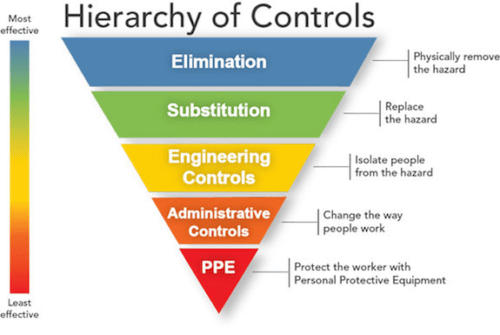
Through the hazard analysis and risk assessment, it can be determined which safety actions need to be implemented to mitigate the risks as much as possible. The Center for Disease Control (CDC) and the National Institute for Occupational Safety and Health (NIOSH) have created a hierarchy of controls. Based on the hazard analysis and safety actions, activities can be evaluated to determine how the risk associated compares to the instructional value of the activity.  Please see reference below:
STEM Legal Liability A1

Safer, Legal, and Better Professional Practices

To provide and maintain a learning and working environment for students and staff that is as safe as possible, NSTA recommends school district officials, including administrators, principals, assistant principals, science supervisors, and superintendents:

  • Review existing school or employer insurance policies to ensure adequate liability insurance coverage for laboratory-based science instruction;
  • Develop and implement comprehensive safety policies with clear procedures for engaging in lab activities; ensure that these policies comply with all applicable local, state, and federal health and safety codes, regulations, ordinances, and other rules established by the applicable oversight organization, including the Occupational Safety & Health Administration (OSHA), International Code Council (ICC), and National Fire Protection Association (NFPA); and be reviewed and updated annually in consultation with school or district science educators; 
  • Ensure better professional safety practices by following safety recommendations of established organizations, such as NSTA and its affiliates, the National Science Education Leadership Association, and the American Chemical Society;
  • Become knowledgeable of and enforce all local, state, and federal codes and regulations to ensure a learning environment for students and staff that is as safe as possible (Particular attention should be given to hazard prevention, including reasonable class sizes to prevent overcrowding in violation of occupancy load codes (ICC 2015, NFPA 2015) or contrary to safety research (West and Kennedy 2014); adequate number or size of labs (Motz, Biehle, and West 2007). Attention should also be given to replacement or repair of inadequate or defective equipment, and the proper use, storage, disposal, or recycling of biological, chemical, and physical materials.);
  • Understand that the number of occupants allowed in the laboratory must be set at a level based on building and fire safety codes; size and design of the laboratory teaching facility; biological, chemical, or physical hazards; and students’ needs (NSTA 2015a; Roy 2006).

*Note: Science classes should have no more than 24 students to allow for adequate supervision during science activities, even if the occupancy load limit might accommodate more (NSTA 2014b). It is equally important to ensure adequate workspace for each student. NSTA recommends 60 sq. ft. for each secondary student and 45 sq. ft. for each elementary student in a laboratory/classroom setting (Motz, Biehle, and West 2007).

Final Thoughts on Legal Liability in Science, STEM and CTE programs

Based on the literature reviews and position statements from trusted professional associations regarding legal liability specifically in science, STEM, and CTE programs across the country, it appears that a more holistic approach is needed from a risk management perspective that involves annual safety training specifically for grade-level and discipline-specific educators, an understanding of how to perform a hazard analysis for selected activities, a review of the existing safety and reference documentation such as safety manuals and chemical hygiene plans, as well as ensuring adequate PPE availability, engineering controls, annual physical inspections and secured storage of items found in these classes.

Many jurisdictions will have parts of a safety program in place but understanding the duty of care obligations and the shared liability that exists in K12 schools is a solid foundation to implement the other necessary complimentary parts of a total safety solution.  Teachers — If you ask yourself,  ‘Should we be doing this activity?’— the answer is always NO.  Use your good judgment and apply your prudent practices with your students and you will provide a safer platform for your students as they continue their journey towards post-secondary and the workplace.

Subscribe to edCircuit to stay up to date on all of our shows, podcasts, news, and thought leadership articles.

November 21, 2022 28 comments
0 FacebookTwitterPinterestLinkedinWhatsappCopy LinkEmail
A word cloud with large words like RISK, MANAGEMENT, PROJECT, PROBABILITY, and LOSS, surrounded by related terms such as COST, ASSESSMENT, CONSEQUENCES, IDENTIFICATION, and PROCESS.
K-12School SafetyEducatorsK-12 TeachersedLeadersAdministratorsProfessional DevelopmentScience and Lab Safety

Risk Management for K-12 Schools

by Science Safety October 26, 2022
written by Science Safety 20 minutes read
This entry is part 2 of 12 in the series Science Safety

Risk Management for K-12 Schools

Risk management in schools is the process a school or district uses to identify the risks in its activities, buildings and programs, judge how likely and how serious each one is, put controls in place, and check that the controls work. This article explains that process, gives examples of risk management in schools, shows how to do a school risk assessment, and then looks closely at the higher-risk program areas of science, STEM, CTE and physical education.

In our increasingly litigious world, it is becoming commonplace for people to use the words ‘risk’, ‘hazard’ and ‘liability’ quite interchangeably, which is incorrect, especially when you examine what risk management for K-12 means to a school, or to a whole school district.  To understand how the risk management process can influence our behaviors and choices involving field trips, student sporting events, extra-curricular activities, and even individual classroom teaching, we need to appreciate the multi-faceted role this plays in a school system. Using the context of student-based activities or investigations, teacher demonstrations and the physical learning and teaching environments in phys-ed, science, STEM, and CTE are the focal areas of this perspective as these program areas have inherent risks associated with them due to the hands-on nature of the instructional method and the tools, apparatus, equipment, and chemicals used to meet the curricular expectations for students.  Risk management policies for each school district need to be reviewed often, much like a chemical hygiene plan, and be aligned with the financial, legal, and risk aversion or risk appetite for the local jurisdiction in an effort to minimize risks, maximize safety and be financially responsible simultaneously. 

What Is Risk Management in Schools?

Risk management in schools is a repeating cycle of identifying risks, assessing them, treating or controlling them, and monitoring and reviewing the results. The international standard ISO 31000:2018 describes risk management as identifying, analyzing, evaluating, treating, monitoring and communicating risks across an organization, and states that it can be used by any organization regardless of size or sector (ISO 31000:2018, Risk management — Guidelines). Federal school emergency planning guidance uses the same logic: a school planning team identifies threats and hazards, assesses the risk each one poses, and prioritizes them before writing its plan (Guide for Developing High-Quality School Emergency Operations Plans, 2013).

  1. Identify. List the activities, places and systems where harm or loss could occur, using incident reports, insurance claims, inspections and staff knowledge.
  2. Assess. Judge how likely each risk is and how serious the result would be, and rank the risks.
  3. Treat or control. Decide for each risk whether to avoid it (do not run the activity), reduce it (training, supervision, equipment, procedures), transfer it (insurance, contracts and proof of insurance from vendors, the “proof” in the 3-P’s described below), or accept it with its educational value in mind.
  4. Monitor and review. Check that controls are in place and working, review new incidents and claims, and repeat the cycle at least once a year and whenever an activity, building or law changes.

Communication runs through every step: teachers, coaches, principals, families and the district’s insurer each need to know the decisions that affect them.

Understanding Risk Management

At the root of risk management in schools and school districts today is the guiding mantra of ‘What would a prudent person do in this situation?’ and then a determination is made based on an evaluation of the educational value vs the risks associated with performing that specific activity, that task, or being in that potential learning environment.  It is worth noting that ‘reasonable means reasonable, not perfect’ when evaluating these scenarios. Knowing that educators are expected to perform a hazard analysis for the activities they select for their classes and make a personal judgement call based on the risks contrasted with the educational value of their intended action.  Fundamentally, this is what is involved with professional risk management specialists, who ultimately can shape the curriculum based on case law, precedents, and using formulas and actuarial tables to calculate the likelihood of an accident or injury occurring.   The construct of risk management is not to prohibit teachers and students from having fun or having a memorable experience, but to temper these thoughts with some disciplined safer, and better professional practices and a thorough understanding of the actual risks involved with a particular activity, excursion, or opportunity.  We will explore this in detail after having a more comprehensive understanding of how risk management works in tandem with program services to offer a safer teaching and learning environment across the district.

Risks in the Curriculum

 We can agree that physical education, science, STEM and CTE programs have a higher element of risk associated with them than the humanities or a mathematics programs, simply due to the access to hazards such as equipment, apparatus, chemicals, dissection specimens, tools, machinery, and raw materials found in these areas. Then layer in the dimension of the students using the apparatus and equipment for the first time and you can visualize the risks in these gymnasiums, classrooms and laboratories.  Therefore, having a formalized safety training program is extremely important for both the educators and the students because this is a mechanism that risk managers refer to as a ‘reduction’ since all involved will have a greater awareness of their surroundings and have an understanding about standardized operating procedures and emergency procedures in the event of an accident or injury.  Risk managers often refer to the ‘3-P’s’ which are: Policy; Procedure; and Proof.  The policy is in place to help inform safer choices, and most school districts have standard operating procedures for almost all aspects of the school daily activity cycle for academics, athletics, field trips, and other parts of the school day, and the proof which is ‘proof of insurance’ from a vendor, supplier, or contractual risk transfer or waiver of liability situations.  This is the essence of what risk management looks like in a school district setting. 

The greatest risk is exposing students to hazardous conditions, environments, or activities which many new educators or administrators feel are ‘acceptable’.  Would it be a reasonable expectation for students to have a thorough understanding of the various tools and machinery in a CTE laboratory on their first day of class?  Is it reasonable to expect students to know the biological or chemical hazards in their STEM program in the first week of the semester? How about students participating on a high ropes adventure course as a field trip?  Honestly, there is a need for a calibration device that could be used here since it is quite varied and depends on the person, the region, and other factors. This is where a noticeable problem exists today and there is absolutely a need to re-calibrate people on what is a legitimate risk.  This has been partially created due to the inconsistencies across the school system, and not all jurisdictions manage similar risks in similar ways. 

What compounds this problem is also the reality that many people overestimate or underestimate ‘risk’ or ‘exposure’ because they are unaware of the actual ‘real’ risks are – which increases liability.   Having standardized educational or training programs will help to stabilize this and provide some consistency as a benchmark.  Insurance carriers are very skilled at this aspect of risk identification and also into risk mitigation because they have seen similar scenarios beforehand from other school district jurisdictions. Luckily, in science, STEM and CTE, there is a mechanism for making these judgement calls involving safety, risk, and liability called a ‘hazard analysis and risk assessment’.

Risk Management and Safety

You should understand this before reading onwards. Risk Management DOES NOT APOLOGIZE FOR SAFETY.  Safety for those most precious assets, our students, our children, and our loved ones is something that is expected from all layers of the school system from the district office to the principal’s office to the classroom door and even onto the school bus.  While some people may be upset or disappointed about safety protocols and procedures, these rules are in place for a reason, often as a result or an accident or injury from a similar activity in the past.  Most jurisdictions use a risk matrix tool that evaluates the risks and the potential for accidents or injuries.  Much like seatbelts in a car, which are in place to protect the occupants of the vehicle in the case of a motor vehicle accident.  Most people can reduce risk by removing hazards and modify the proposed activity to accommodate this removal or reduction of an original element of the scenario.  Once this assessment is completed, it should be communicated and shared with others to establish modified procedures and policy that allow for these ‘safer’ activities including the accommodations and changes, which is what insurance companies typically do for their member school districts to facilitate decision making through the lens of compliance and safety first. The risk management matrix tool is a dynamic resource that changes and evolves as new activities are evaluated so that better and safer choices can be made in the future.  

How to Do a School Risk Assessment

A school risk assessment scores each risk on two scales, likelihood and impact, and multiplies them to decide which risks need attention first. The federal school planning guide describes a similar approach, assigning index numbers on a scale such as 1 to 4 for probability, magnitude, warning time and duration, and then ranking each threat or hazard as high, medium or low risk (2013 federal guide, Step 2 and Table 2). A simpler likelihood-by-impact matrix suits most classroom, field trip and building decisions.

Likelihood \ Impact1 Minor (first aid)2 Moderate (medical treatment)3 Serious (hospitalization)4 Severe (permanent injury or death)
4 Likely4 Medium8 High12 Very high16 Very high
3 Possible3 Low6 Medium9 High12 Very high
2 Unlikely2 Low4 Medium6 Medium8 High
1 Rare1 Low2 Low3 Low4 Medium

The scale is an example; a district should define its own words and thresholds and use them consistently.

A worked example. A middle school plans a field trip to a river for a water-quality lesson.

  • Identify: the risks include a student falling into fast water, slips on wet rocks, a student becoming separated from the group, and transportation.
  • Assess: falling into deep or fast water is judged unlikely (2) but severe (4), a score of 8, high. Slips on rocks are possible (3) but usually minor (1), a score of 3, low.
  • Control: sampling only from a bank or a shallow, slow section chosen on a pre-visit; no wading above the knee; life jackets for anyone near the water; a stated adult-to-student ratio; a head count at every move; a first aid kit and a charged phone with the group; permission forms with medical information.
  • Re-assess: with those controls, falling into fast water becomes rare (1) with the same severe impact (4), a score of 4, medium, which the principal accepts against the lesson’s educational value.
  • Record and review: the assessment is filed with the trip approval and reviewed after the trip, including any incident reports.

The same method underlies the hazard analysis and risk assessment that science, STEM and CTE teachers perform for activities and demonstrations, described later in this article.

Understanding Risk Management

To make the whole topic of risk management easier to understand, here are some of the key takeaways for you from this important tenet of the education and insurance relationship.   From discussions with active Risk Management Officers from school districts we have compiled some of their comments here related to what risk management means to them.

  • Risk management is not always the big picture, but in the FINE PRINT – which is where the details are!
  • Risk management is about assessing the educational value vs the inherent risk for activities involving staff and students.
  • Asking questions to validate if the activity is age / stage / ability appropriate and looking for any recent accidents or injuries.
  • Asking if there can be any modifications made to reduce risk that will allow for the activity to occur?
  • Are there any possible injuries that can be foreseeable? Is there a history of injuries and what controls are in place to reduce the risk?
  • Will proper supervision offset the risks? What is the optimum number of adults to students (ratio) on a field trip or excursion?
  • Is there a banned list of activities? Is there an approved list of activities?  These are both excellent ways to provide safer guidance for decision-making.
  • Avoidance is the only 100% effective method to reduce risk but it is not always the best learning environment for students.
  • You should be able to identify risks and avoid doing things that have high risk, low educational value, and if these cannot be reduced, managed or controlled, they should not be allowed.

It is a reality today that many school district staff, including teachers are younger – and are making personal choices for a ‘perceived healthy lifestyle’ on their social media networks, however these activities typically involve risk-taking activities which is a problem.  Numerous recent events have resulted in injuries or death from people looking for that great photo or image from a spectacular vantage point.  These once-in-a-lifetime images often involve equally risky behaviors.  Take for example the activity known as ‘Zorbing’ where you roll down a hill in a large plastic bubble.  What could go wrong with an activity like this?  This is something that appeals to many people with a larger appetite for risk, but should this activity be endorsed or supported with students on a field trip excursion as part of a school program?  The mindset shift from what is perceived as acceptable to what is ‘actually’ acceptable is where that prudent person test is especially valuable in making a distinction between risk and reward.   

Examples of Risk Management in Schools

Examples of risk management in schools range from playground inspections to cyber security. The table below gives one example of a risk and a control in each common area, and the role that usually owns it; the right owner in a given district depends on its size and structure.

Risk areaExample of a riskExample of a controlWho usually owns it
FacilitiesSlips on wet entrance floorsEntrance mats, wet-floor signs and a custodial check schedule for bad weatherFacilities director, building custodian
TransportationA student left on a bus at the end of a routeA required end-of-route walk-through of every bus, recorded by the driverTransportation director
Field tripsA student separated from the groupWritten trip approval with a risk assessment, adult-to-student ratios, buddy system and head countsPrincipal, trip leader
Athletics and concussionA head injury that is not recognizedRemoval from play when a concussion is suspected, return only under the district’s return-to-play procedure and any state law, and training for coachesAthletic director, coaches, athletic trainer
Science labsA chemical splash or fire during a demonstrationA chemical hygiene plan, eye protection, safety training and a pre-activity hazard analysis (see the Lab Safety guide)Chemical hygiene officer, science department head, teacher
Cyber security and student dataA phishing email that exposes student recordsMulti-factor authentication, staff training and a written incident response planTechnology director
PlaygroundsA fall onto a hard surfaceRegular inspections, maintained impact-absorbing surfacing and recess supervisionFacilities, principal
Food allergiesA severe allergic reaction at lunch or during a class celebrationIndividual health plans, staff training, access to prescribed epinephrine and food rules for classroomsSchool nurse, principal, food service
Employment practicesA claim arising from hiring, supervision or discipline of staffBackground checks, written policies, consistent documentation and training for supervisorsHuman resources director

The federal government publishes school cyber security guidance and a toolkit for districts through the Cybersecurity and Infrastructure Security Agency (CISA, K-12 Cybersecurity). Emergencies such as intruders, severe weather and lockdowns are managed through a school’s emergency operations plan, which the School Safety guide explains.

Elementary School Risk Management

Elementary school risk management applies the same process to younger children, who are less able to recognize a hazard or follow a complex instruction, and who depend more on adults for supervision and care. The areas that most often need attention are:

  • Supervision at transitions: arrival, dismissal, recess and lunch, when students are spread out and adults are stretched thin.
  • Release to authorized adults: a checked list of who may collect each child, and a procedure when someone not on the list arrives.
  • Playgrounds: equipment suited to the age group, surfacing that is maintained, and supervisors placed where they can see the whole area.
  • Health conditions: allergies, asthma, diabetes and seizures, with individual plans that travel with the child to specials, field trips and substitutes.
  • Classroom science and art: age-appropriate materials, eye protection where needed, and adult handling of anything hot, sharp or chemical.
  • Field trips: higher adult-to-student ratios, name tags without full names on the outside, and a head count at every move.

Formalized Safety Training for Risk Management for K-12

There is another dimension to this risk management discussion which needs to be addressed, which is formalized safety training.  Safety training and awareness for teachers, principals, and students is a control measure that can reduce risk, but it is often overlooked.  According to Dr. Tyler Love and Dr. Ken Roy in their 2021 survey of schools from across the USA, made some key findings including the reality that 35% of science, STEM and CTE educators have NOT had any formal safety training in either their faculty of education experience or at the school district level when they were first hired.  Safety training is a legal requirement wherever federal OSHA or a state OSHA plan covers a school’s staff (federal OSHA does not cover state and local government employees, so coverage of public-school teachers depends on the state), and yet there is a large gap of safety trained teachers to address.  Unfortunately, it appears as if the mindset of having an adult in the classroom and overlooking the lack of safety training is a reality of the teacher shortage being experienced across the country.   Another key finding from the Love/Roy study was that a teacher with formal safety training is 49% less likely to have an accident in their program.  Not having teachers properly safety trained is not a good risk management practice and one that has implications for the students and the staff involved.  Is it reasonable to assume that teachers who have minimal background in safety can make prudent choices when it comes to performing a safety review (hazard analysis and risk assessment) and do they know what to look for? 

Many experienced classroom teachers struggle with this practice and some educators are more concerned about making memorable events for their students than about making these ‘safer’.  Recently, in Virginia, a science teacher with 15 years of experience was performing a demonstration using methanol and it ended badly with students and the teacher being taken to the hospital for burns sustained during this event.  And if this can happen with an experienced science teacher, imagine the additional risks that can accompany a new teacher without any formal safety training or actual hands-on experiences to reflect on, to make these safer choices in science, STEM or CTE for themselves, colleagues, and students.

Science programs have many legal regulatory rules to be followed and legislation that mandates certain aspects of teaching in a laboratory such as the OSHA’s Laboratory Standard, 29 CFR 1910.1450, which requires that employees, teachers included, are trained at the time of their initial assignment to a work area where hazardous chemicals are present and before assignments involving new exposure situations.  It also requires that a chemical hygiene plan is written and reviewed annually (at a minimum), a designation for a Chemical Hygiene Officer (a vital role in risk management) and literally hundreds of additional rules specifically regarding the safer operation in a laboratory and associated chemical store room at the school.  The HazCom standard is used for the CTE rooms and has additional responsibility for the employer and the employee.  Successful risk management involves a comprehensive understanding of these and many other safety aspects that are designed to keep people safer.  An important risk management pillar is to reduce risk and increase awareness and the use of student safety acknowledgment forms combined with a personalized, progressive, grade and discipline-specific safety training on the hazards in the program (science, STEM, and CTE).

 To summarize the role of risk management in CTE, science, and STEM there are some critical aspects to ensure the safer learning environment for students.  The use of a safety acknowledgement form in all classes is a great first step, especially when used with formalized, specific safety training for everyone in the school ecosystem which can drastically reduce risks and the potential for accidents or injuries.  Having educators perform a safety review based on their planned activities where they evaluate the risks and make a determination including modifications to their initial thoughts by evaluating the risks and comparing to the educational value of the activity is one of the most important criteria in risk management in these program areas.  By having a more transparent conversation about safety and risks in schools, and communicating what are actual risks vs. perceived risks and creating a matrix for making these assessments available for principals evaluating field trip safety and for the classroom teacher who can use that same methodology when choosing age and stage and ability appropriate activities for their students, the overall risk management strategy against a Science Safety Risk Management Framework will be a natural part of the pedagogical process that is woven into the culture of safety awareness in the district from the boardroom to the classroom.  Most people do not consider this aspect of school district safety until there is an injury or an accident, but risk management is a vital component to a balanced educational experience for students and staff.

Who Does Risk Management in a School District?

Risk management in a school district is shared, and works best when each role knows its part.

  • The risk manager. Where a district employs a risk manager, that person keeps the list of the district’s risks, manages insurance and claims, and advises on contracts, field trips and events. The federal planning guide includes the risk manager among the district leaders involved in fiscal recovery after an emergency (2013 federal guide). A district without a dedicated risk manager should name, in writing, who holds these duties.
  • The insurance pool or carrier. A district’s coverage comes from an insurance carrier or a pool shared with other public entities. As this article notes, insurers have seen similar claims in other districts and help member districts identify and reduce risks; their coverage conditions and claims data should feed the district’s own assessments.
  • Principals. Principals apply district policy in their buildings: approving field trips and events, making sure incident reports are completed and reviewed, and following up on hazards.
  • The safety committee. A district or school safety committee, with staff from facilities, transportation, nursing, athletics, science and administration, reviews incident patterns and inspection results and recommends changes.
  • Specialist roles. The chemical hygiene officer, athletic director, school nurse, technology director and transportation director each own the risks in their area, as the examples table above shows.
  • Teachers and coaches. Teachers and coaches make the daily judgments, using the prudent person test and hazard analysis described in this article, and their incident reports are the evidence the rest of the system relies on. edCircuit’s article on school incident reporting explains what a good report contains.

Materials to Review:

  • Love, T. S., Sirinides, P., & Roy, K. R. (2022) Examining Factors Associated With Accidents in Career and Technical Education and STEM Education Labs – A National Safety Study Paper presented at the annual meeting of the American Educational Research Association, San Diego, CA
  • A Science Safety Risk Management Framework
October 26, 2022 4 comments
0 FacebookTwitterPinterestLinkedinWhatsappCopy LinkEmail
A chemistry teacher in a lab coat, sealed splash goggles and gloves locks a jug of methanol inside a yellow flammables safety cabinet, with a fire extinguisher on the wall and an unlit flame-test dish on the bench
K-12EducatorsK-12 TeachersSchool SafetyScience and Lab Safety

Methanol in K12 is a Preventable Hazard

by Science Safety October 21, 2022
written by Science Safety 12 minutes read
This entry is part 10 of 12 in the series Science Safety

Methanol in K12 is a preventable hazard and many high school science departments have methanol (methyl alcohol; wood alcohol; wood spirits; carbinol; methyl hydrate) in their chemical store rooms safely locked in a flammables safety chemical cabinet.  That is the best place for that substance to be kept. The recent tragic chemistry experiment events which occurred in Virginia last week where three students and the teacher were injured, this clearly illustrates the dangers of using methanol in a school laboratory setting and the risks of handling this substance safely.  I feel it is my duty to inform science educators and school principals as well as district supervisors about methanol usage in secondary school environments based on my twenty-plus years specifically in this area working for some of the most recognized science education supply companies in North America.  I have spent my career exclusively in this area and am compelled to provide my perspective in order to raise the level of awareness surrounding methanol used in science and STEM programs.  

I DO NOT LIKE METHANOL BEING USED IN SCHOOLS.  Period. 

There is an Alternative

From my experiences in my role as a former Director of Education, and the Director of Safety & Compliance for a large chemical supplier as well as being a certified teacher and from a rich combined history of providing many jurisdictions with safer or ‘greener’ alternatives for certain hazardous chemicals, I feel that I have an obligation to discuss this professionally and to proactively prevent another similar fire and injury from occurring involving methanol in schools.  Often the simple substitution of methanol with a more stable alcohol like ethanol will still allow students to achieve the same expected results from a lab activity or experiment in the chemistry laboratory.  There are great organizations such as Science Safety that can assist with selecting more environmentally sensitive options and professional educator associations such as the NSTA, ACS, ACT, NABT, NSELA, and CSSS who can also provide some assistance to ensure teachers and students have a robust science program in a safer teaching and learning environment.

Often as our safety and health awareness increases with research and understanding across our educational communities and society at large we change our perspectives on once commonly used products, materials, and technologies. 

Some toxins have already been removed from schools

We have a greater knowledge of compounds that are now recognized toxins and known or ‘highly likely’ carcinogenic and we have legal, safer professional standards and hazard communication protocols for these items.  This heightened safety and health knowledge is the reason that we no longer collectively accept the use of PCB’s, leaded gasoline, benzene, asbestos, Teflon, DDT, BPA, and many more formerly common products in mainstream ways in our modern world.  We are fortunate to have oversight from regulatory agencies such as the EPA and the FDA to ensure that our communities are safer and that quality controls are in place to protect the general public interest.  We should consider removing methanol from school science departments because it is a risk to our most cherished and prized assets – our children, also known as ‘students’ in school ecosystems.  We owe them and the educators the conversation about methanol from this vantage point to explore the risks and benefits of keeping this chemical in their school inventory.

This is the same mindset that resulted in the reality that most secondary schools no longer have once commonly used heavy metal compounds like lead, cadmium, chromium, arsenic, mercury, and their derivatives used in school chemistry activities.  Most of these chemicals have been removed or purged from the shelves of high school chemical inventories as they have a limited educational value when compared to the risks associated with having these chemicals on hand in schools today.  Many are known carcinogenic or mutagenic substances that have serious health hazards associated with them.  This is the same rationale for removing older museum mount specimens stored in jars or glass cases and prohibiting the sale of formaldehyde (formalin) fixed biological specimens such as the memorable fetal pig, the rat, and sheep hearts, eyes, and brains used for dissections in biology laboratories across the country.  Educators understood that there were health concerns for them and their students from traditional formaldehyde-preserved specimens and suppliers quickly developed safer alternatives for schools to use to perform these dissections to meet these safety and health concerns. If we made these decisions and implemented changes based on combined and accepted safety and health awareness and understanding of biological specimens, we should be evaluating methanol using the same critical lens and making a decision to REMOVE METHANOL FROM SCHOOL LABORATORIES. 

Methanol in K12 is a Preventable Hazard

Now I have enough experience in the science education sector to know that some chemistry teachers, department heads, and some experienced educators will say that I am not allowing for the safer handling and use of methanol in schools by some teachers who can responsibly use it.  They will recount many experiences performing demonstrations like the ‘Colorful Rainbow’ or the ‘Whoosh Bottle’ or versions of these attention-getting demos.  While I agree that these are visually powerful and stunning introductions or reinforcement of prior learning for students, the use of methanol due to its low flash point and low vapor point is very dangerous in the chemistry program in their high school.  THE RISK EXCEEDS THE VALUE.  Methanol advocates will inform us that it is used in organic synthesis reactions, as an alternative fuel, as a solvent, and as a component of windshield washer or antifreeze and that it is also used to produce biodiesel via a recognized transesterification reaction and in certain fuel cells.  I am not saying that it does not have industrial applications but that again, METHANOL DOES NOT BELONG IN K-12 SCHOOLS. 

Some advocates will claim that removing methanol from school science departments is just another way to weaken the overall experience for students and that with proper safety training, methanol can be used safely and appropriately. Well, I disagree with that sentiment and while I may be biased as a safety advocate who prefers the ‘less is more’ approach to chemical usage, this is not the first time that accidents involving methanol have injured students and teachers in the US and sadly will not likely be the last.  As a matter of public record, methanol was found to be involved in the 2006 Calais Webber accident in Ohio; the 2014 Denver school accident that injured five students; the 2014 Halloween ‘burning pumpkin’ accident in Chicago that injured students and the teacher; the $55 million dollar judgment in NYC accident; 2015 in Fairfax Virginia serious injuries to five students and the teacher; twenty-two students and the teacher injured in Bakersfield CA in 1999; and there are many other incidents which are all attributed to methanol. 

METHANOL IS A HAZARDOUS SUBSTANCE AND SHOULD ONLY BE HANDLED IN CONTROLLED CONDITIONS BY TRAINED AND EXPERIENCED EDUCATORS.

Ultimately as professional educators, we want to provide students with the opportunity to have the most memorable and safer experiences possible in their classes that serve to make connections between the theoretical and practical science knowledge content being discussed.  The key word in that sentence is ‘safer’.  Read that again if you are still considering allowing methanol to be used in your schools. 

Duty of Care

As educators we are governed by a Duty of Care obligation which clearly applies to the choice to use methanol in the science department, especially with students present while knowing the risks and deciding to conduct the demo or worse yet, allowing students to handle methanol themselves.  How would you explain to a parent that their child, your student, was badly burned in an accident in the school science laboratory?  Then tell them that it was the result of methanol being used.  You should be very concerned if there was a severe accident in the science laboratory, since the teacher, the administrator, and the school district could be found to be negligent or worse – ‘reckless, involving deliberate indifference.   As part of the annual Risk Management Review in your school district, I encourage you to have the conversation about methanol use and judiciously evaluate the risks and make an informed decision and make an amendment to your Chemical Hygiene Plan during your annual review with the Chemical (Environmental) Hygiene Officer.

A Case for Removing Methanol in K12

As a lifelong learner, I am aware that traditional science education has been based on having engaging demonstrations as a cornerstone of the progression of students through the grade levels and students do appreciate the fire, sparks, smoke, and loud noises that accompany many of these teacher-led demonstrations.  These can stimulate students and provide them with a springboard for their innate curiosity and increase engagement simultaneously.  I employed many of these tried-and-true activities personally and have facilitated the teaching of safer practices for many science and STEM educators over the past 20+ years.  When I was conducting some seminars or training sessions I emphasized that ‘each demonstration must have an educational purpose – and not just done to amaze or impress students.  There needs to be a clear intention for doing that demonstration for your students. That said it is incumbent on the science teacher and their employer (school district) to perform a hazard analysis for each activity planned or performed in the laboratory.  This involves a thorough review of the SDS and having a comprehensive understanding of the chemical hazards, interactions, risks, and the associated PPE, storage, and handling procedures as well as chemical waste management and making an evaluation and any safety actions resulting from the risk assessment.  When conducted improperly, this evaluation or hazard analysis can make using methanol attractive for some teachers since it provides a beautiful blue flame and it is quite readily available in the chemical stock room.  There is much more to a hazard analysis than wanting to make the class remember when the teacher did some ‘magic’ in the room. 

DO NOT GET INTOXICATED BY THE ALLURE OF METHANOL – IT IS A POISONOUS SUBSTANCE.    

Chemicals have been and are still commonly used in chemistry and general science programs as they have for well over a century.  The use of chemicals in science and STEM education will not disappear since these compounds offer tremendous value to student learning and their personal trajectory through STEM programs into post-secondary and into the workforce.  Balancing this positive impact with the understanding that many chemicals have inherent risks such as being flammable, water-reactive, corrosive, or incompatible with other chemicals even due to proximity makes having chemicals in the school science program designated as ‘hazardous’.  The importance of teacher safety training with formalized, certificated, verifiable assessments and grade and discipline-specific are central to mitigating risks and minimizing liability.  This needs to include how to complete a hazard analysis and risk assessment for all teachers of science and STEM.   Recognizing some red-flag items such as methanol should be part of the safety training to proactively reduce safety concerns by removing or substituting these hazards before the demonstration or lab activity occurs.

Just for clarity, I am not advocating for removing all chemicals from science department inventories and performing virtual chemical reactions as a rule.  Instead, I am suggesting that a conversation should occur within the school district involving the Chemical Hygiene Officer, the Science/STEM Supervisor, the Risk Management Officer, experienced chemistry teachers, and other stakeholders in science education about the continued purchase, storage, and use of methanol in schools.   The added dimension is that many newly hired teachers lack practical classroom experience and often the understanding of the risks associated with chemicals being suggested for use in demonstrations or student investigations can be a significant problem and a potential for liability or legal entanglement.  If the need to demonstrate the properties or reactions involving methanol is that central to the educators’ pedagogy, there are simulations and videos of these same ‘essential’ core experiences that can be digitally shared with no risk of harm to themselves or to the students in their care while in the science laboratory.  A blended learning experience may be the safer choice in these circumstances.     

As a final thought, many science educators, supervisors, and leaders should continue the conversation about methanol and its use in science and STEM programs across the US and make a determination and potentially encourage larger professional bodies to develop a position statement about using methanol with students.  According to Dr. Roy and Dr, Love in the most recent study of STEM and CTE facilities in 2021, they reported that 35% of these teachers have never had any formalized safety training and that teachers with safety training are 48% less likely to have an accident in their classes.  This is another dimension to consider when making a decision about using methanol in your science programs.    

*If you have the conversation and hold a democratic vote and it results in a 50/50 tie, I offer my vote in support of REMOVING METHANOL FROM SCHOOL SCIENCE PROGRAMS for all the reasons listed above.*  

For those that choose to continue to use methanol in the lab or classroom you need to consider a methanol safety training course as a requirement. As a reference Science Safety Inc. is providing free access to teachers as response to the Virginia accident. Virginia schools can register and access the free methanol safety module at anytime. 

For further Review

  • Be safe, Virginia Chemistry Accident – lit students on fire
  • Key Lessons for Preventing Incidents from Flammable Chemicals in Educational Demonstrations” in Wake of Several Serious Methanol Accidents that Injured Children and Adults
  • He was engulfed in flames when a school chemistry experiment erupted. He just won $60M
  • Fire Injures Five High School Chemistry Students

The opinions in this article are solely those of its author. 

Subscribe to edCircuit to stay up to date on all of our shows, podcasts, news, and thought leadership articles.

October 21, 2022 20 comments
0 FacebookTwitterPinterestLinkedinWhatsappCopy LinkEmail
A veteran lab safety specialist shows a first-year science teacher how to use the emergency eyewash station in a school STEM lab with 3D printers and a drill press
Science and Lab SafetyK-12K-12 TeachersOnline LearningSTEM and STEAM EducationSchool Safety

Better Science and STEM Safety Approaches for New Teachers

by EdCircuit Staff October 21, 2022
written by EdCircuit Staff 12 minutes read

Join internationally recognized science and lab safety specialists Dr. Ken Roy, and Dr. Tyler Love, as they provide critical insights into the world of Science and STEM safety as it pertains to new teachers.  Both of these respected academic and practical educators bring more than 60 years of combined safety education and experience to life in this session focused on raising safety awareness in schools particularly in the areas of laboratory safety, CTE safety, and T&E safety. 

Play video: Holistic Science and STEM safety approaches for new teachers (54 minutes 52 seconds)54:52

Holistic Science and STEM safety approaches for new teachers54 min 52 sedCircuit on Vimeo

Presented by Science Safety

Overview

Given today’s litigious society, and the rise in the popularity of maker spaces and fabrication labs (Fab Labs) in Science, STEM, and CTE education, teacher and student safety programs are receiving greater attention.  With the increased emphasis on these hands-on practical courses involving students, there is an equally important aspect for the teachers and school principals to be mindful of – safety for all.  Having this increased safety awareness is only possible through a carefully architected holistic inter-connected approach from the school district level to the school level ultimately to the classroom or laboratory level with different layers of responsibility for each level.

Using recent data our hosts discuss the benefits of a formal safety training program for new Science/STEM/CTE teachers and the added dimensions of using safety acknowledgment forms, performing safety inspections, reviewing your Chemical Hygiene Plan and Safety Manuals, and how these all work together cohesively to minimize liability and increase safety awareness. 

Our hosts start the session with some interesting visual aids, and ask the audience to look at some images on their screen and determine if these are appropriate and acceptable safer practices for students.  At first pass, the images all appear to be following commonly used safer practices, but upon inspection, they note that there are multiple safety infractions occurring in each of the images.  They point out some common mistakes that occur, especially with eye protection.  They reviewed the differences and scenarios when a pair of safety glasses are acceptable in the laboratory and contrast that with when a certified, indirectly vented, chemical splash goggle is necessary.  They continue to identify that when handling specimens, liquids, chemicals and other items in the laboratory, that students must also be wearing hand protection (gloves) for safety purposes, and that quite often, students are not provided with a lab coat or a lab apron to protect their clothing when performing science, STEM, or CTE activities that require this level of PPE.  Another interesting take away from these slides was the fact that the students and the teacher in some images had long hair which was not tied back which is another safety infraction.   These introductory slides set the tone for the presentation and helped increase safety awareness simultaneously.

Science and STEM Safety Approaches for New Teachers

The presentation then moveis nto the area of ‘New Teachers’ which were defined as brand new educators or those with less than three years of teaching experience in a school setting.  Dr. Tyler Love and Dr. Roy were very clear about the role of the employer (being the school district) and the employee (being the teacher) as well as the responsibility of the employer to provide certain safety training and resources to these new teachers as soon as they are hired.  Dr. Roy has many articles on this subject of new teachers, and he noted that ‘Building safer science behaviors begins at the elementary and middle school levels. These practices serve as guidelines for future laboratory work, with many carryovers into everyday life. Safer science is critical for the teacher as an instructor and employee and for the student as a learner and citizen. Learning to teach and practice safer science is a lifelong endeavor, and I hope you will join me in this process’.

There is legislation specific to new teachers or teachers who take a new assignment (new grade level or a new subject area) that they must have safety training provide to them immediately and have this documented for liability purposes.  As Dr. Roy noted, ‘Science safety doesn’t just mean following a set of rules. Safer science practice requires common sense and the teacher’s intuition that helps predict what might happen when we least expect it. To foster inquiry in a safer environment, teachers must not only keep up-to-date with the latest information about products, hazards, and best practice but also consider the developmental level of their budding scientists. As always, remember that the best piece of safety equipment in your classroom is you—the informed adult shaping and controlling the learning and working environment.’  All school employees protected under Federal OSHA or similar state plans are covered by the 1986 Hazard Communication Standard or HazCom/ Right to Know law (29 CFR 1910.1200). However, as of 1990, because of the dangers and uniqueness inherent in laboratory work, employers under Federal OSHA or similar state plans are required to cover laboratory workers specifically (including science teachers) with the OSHA Laboratory Standard (29 CFR 1910.1450 Subpart Z).  You can search for these legal aspects online but just know that you are entitled to safety training as soon as you are hired and that it must be specific to your role as a science, STEM or CTE educator.

The importance of a Chemical Hygiene Plan

Dr. Ken Roy then continued on speaking about the importance of a Chemical Hygiene Plan and sometimes a Safety Manual provided by the district and the role of the Chemical Hygiene Officer.  The OSHA Laboratory Standard is performance based. OSHA provides the basic outline requirements, then each employer (e.g., board of education) writes a plan tailored to its independent needs. For example, plans may vary from district to district relative to differing standard operating procedures, but all plans must contain standard operating procedures. Three important components of the standard include the development of a chemical hygiene plan (CHP), the appointment of a chemical hygiene officer (CHO), and employee training. The written CHP must be developed to protect employees from hazards associated with chemicals in the laboratory. Although generic plans are available, each plan must be unique to address the specific needs of individual workplaces. The employer is responsible for developing and enforcing the plan. The standard also requires that the employer appoint a CHO to develop and implement the CHP. The CHO position is an appointment under the OSHA standard as opposed to a required new hiring.  All of these components together start to build on the complete safety program in the school district.

A Holistic Science & STEM Science Safety Program

 Our hosts introduce a Holistic Science & STEM Science Safety Risk Management Process to the audience and discuss the various aspects and how these are connected to each other and that these repeat every school year.  The discussion started on the eight pillars of the program and how each of these contribute to the overall comprehensiveness of the overall program.  Having a single or a handful of these in place does not constitute a reliable, comprehensive or complete program for school districts.  In order to achieve a more robust and dynamic safety program requires involvement from multiple levels in the school district and a clear understanding of the roles and accountability / responsibility that accompany each component of the program.

The first and most important aspect of the program is the annual safety training required for principals, teachers, and students specifically on safety awareness and connected to the subject area (Science, STEM or CTE) and across the grade levels.  This is not limited to only high school but elementary and middle school as well. The safety training must be documented and must be current, and formal with a certificate of completion and assessments.  This is very important to manage risk in the school and the school district.  Secondly, the Chemical Hygiene Plan must be reviewed at a minimum annually (typically by the Chemical Hygiene Officer) and amendments made accordingly to align with changes in chemical handling, storage, disposal, COVID-19, or other standard operating procedures in your jurisdiction.

A discussion on the importance of using a Lab Safety Acknowledgment form and that it is really not considered a ‘contract’ (since students are under the age of 18) and that these need to be kept, securely stored until the student reaches the age of 18 or 21 in different states.  Digital archiving of these forms is a great way to manage this requirement.  Then the discussion moved towards conducting a hazard analysis and risk assessment for EACH activity planned or performed in the program.  Basically, as the educator, you are responsible for the selection of the activity or STEM investigation and you have a duty of care to evaluate the hazards and mitigate these.  The question is: Does the risk exceed the educational value?  If it does – you choose another activity or different items to meet your curricular objective. 

The next important aspects of the safety program are ensuring that you have the appropriate PPE for each person in the room including the proper protective eyewear meaning safety glasses or safety goggles depending on the scenario and materials used in the activity, a fitted lab coat or apron, protective hand coverings like nitrile gloves and other necessary protective measures related to the investigation.  The next step in the holistic safety program is conducting a physical safety inspection and examining the engineering controls, PPE, safety infrastructure equipment, and many other important criteria.  The inspection must occur annually and be documented.  Any deficiency or infraction is recorded and then work orders are issued to remediate these concerns.  This annual safety inspection is critically important and a mandated requirement from OSHA. 

And finally, the chemical inventory and SDS (Safety Data Sheet) management and annual inspection is connected to the safety inspection and the review of the security including storage and safety cabinets and open shelves are the last part of the program.  Having a digital chemical inventory that indicates the amounts on hand, the chemical name, the location, and the corresponding SDS makes the science department that much more efficient.  The ability to print GHS compliant labels is also very compelling when considering the time savings and regulatory alignment is an asset in the busy department.  When conducting the inspections of the chemical store room, examining the safety storage cabinets is very important.  Looking for signs of incompatible chemical storage is pretty evident and should be documented and addressed.

By following this outline and involving the eight steps in the holistic Science safety risk management process your schools can have a safer teaching and learning environment and minimize risk, minimize liability, and provide a solid inquiry-based program for students.

Science and STEM Safety survey and research study

Our hosts provided valuable and illuminating insights into the recent survey and research study about safety in schools and a deeper analysis of the data points.  There are fascinating results and some insights into the real-world teaching environments across American schools.  These findings are frightening and preventable and clearly demonstrate that safety concerns exist in schools today and that teachers are not adequately prepared or have access to the proper items to provide a safer environment while teaching. These results are from 202o just before the pandemic and are a true reflection of the working conditions for educators. 

Science and STEM Safety survey findings

As a summary, here are some of the key findings:

  • 35% of teachers of STEM and CTE did not have any formalized safety training
  • 69% of teachers do not use a safety contract or acknowledgement form with their students
  • STEM accident increase once class size exceeds 24 students
  • 58% of teachers could not recall the last annual safety inspection in their school
  • 31% of schools did not have a reliable SDS management system in place   
  • 41% of schools perform a chemical inventory annually
  • 37% of schools are unsure how they dispose of chemicals in the district
  • 57% of schools have classes larger than 25 students, but only 26% of those schools have a facility large enough to support that many students
  • 86% of classrooms have a fire extinguisher
  • 77% of accidents involve students
  • Teachers report that overcrowding is the second largest cause of accidents in the school laboratories
  • Only 45% of schools have ANSI Z87.1 D3 2020 indirectly vented splash goggles for working with liquids but 83% have safety glasses for students working with solids
  • 51% of schools nationally have had an injury or litigation
  • 80% of science & STEM teachers reported having 1 injury in their classes in the past year
  • 62% of teachers regard students not following instructions as the leading cause of accidents or injuries

And the single most important finding after reviewing the data from the study was that TEACHERS WITH FORMALIZED SAFETY TRAINING ARE 49% LESS LIKELY TO HAVE ACCIDENTS IN THEIR LABORATORIES.  This validates the necessity for safety training and education through professional development and learning and collaborating with peers and colleagues about better professional practices and having a heightened level of safety awareness.  The single most important aspect of school safety starts with formalized safety training for the teacher.

By having a thorough understanding of the hazards and possible risks through conducting a Triple AAA activity assessment teachers can help offer safer alternatives and make the necessary evaluations prior to having students involved with the selected activity.  Dr. Roy shared some common items that should be ‘red flags’ and have no place in the STEM lab or activities.  The use of Hazard Analysis and Risk Assessments are a necessary step in the planning process and will help keep students and teachers safer when meeting the outcomes and indicators in the curriculum that are age and stage appropriate. 

Conclusion

The conclusion to this interactive session involved handling questions from the audience about their school situations and covered topics ranging from choosing appropriate safety eye protection to safer chemical storage and then to some advice for new teachers in Science, STEM and CTE programs.  Overall it was a useful and practical session for all involved.

Subscribe to edCircuit to stay up to date on all of our shows, podcasts, news, and thought leadership articles.

October 21, 2022 22 comments
0 FacebookTwitterPinterestLinkedinWhatsappCopy LinkEmail
Mostly empty STEM classroom in Kuala Lumpur, declining STEM students
InformED Report

InformED Report 12/13/16

by EdCircuit Staff December 13, 2016
written by EdCircuit Staff 6 minutes read

Play video: The InformED Report: Episode 14 (1 minute 59 seconds)1:59

The InformED Report: Episode 141 min 59 sedCircuit on Vimeo

The InformED Report for December 13, 2016 opened with efforts to bring more students into science, technology, engineering and math, from a national plan in Malaysia to a new STEM academy in Texas and a robotics class in Minnesota. It then turned to campuses after the presidential election, where more than 100 college presidents asked President-elect Donald Trump to speak out against harassment, and an Iowa lawmaker proposed penalizing colleges that offered students post-election counseling. The edition closed on a Stanford study showing how easily students are fooled by what they read online.

In this edition

  • Malaysia’s Education Ministry drafted a 2017-2025 national STEM action plan to reverse falling STEM enrollment.
  • Texas’s Mansfield school district approved $5.6 million for a STEM academy, and a Minnesota school taught seventh and eighth graders to program robots.
  • One hundred and ten college presidents urged President-elect Trump to condemn harassment and hate.
  • Iowa Rep. Bobby Kaufmann planned a “suck it up, buttercup” bill aimed at colleges’ post-election programs.
  • A Stanford study found 82 percent of middle schoolers could not tell sponsored content from a real news story.

Malaysia drafts a national STEM plan

The Malaysian Digest reported that Malaysia’s Education Ministry was drafting a 2017-2025 National Science, Technology, Engineering and Mathematics Action Plan to counter the declining number of students choosing the STEM stream. Deputy Education Minister Datuk P. Kamalanathan told parliament that the plan, to be carried out with the Higher Education Ministry and the Ministry of Science, Technology and Innovation, would focus on eight areas. They included teaching and learning policies and facilities, awareness, careers, strategic cooperation, data and research, and commercialization and innovation. The list reached well beyond the classroom, to awareness, careers and research, a sign that the ministry treated the decline as more than a teaching problem.

U.S. schools recruit early for STEM

In Texas, Amanda Rogers of the Star-Telegram reported that Mansfield school district trustees voted 6-0 on November 15 to spend $5.6 million renovating the annex behind Wester Middle School for a STEM academy. The board also voted to build a $14.9 million early childhood literacy center for 3- and 4-year-olds and for children in its Preschool Program for Children with Disabilities.

In Minnesota, U.S. News carried a report from the St. Cloud Times on Stephen Larson’s computer programming course for seventh and eighth graders at St. John’s Preparatory School. Over a semester, students learn the basics of programming on iPads and then program Arduino robots, working by trial and error. “I think technology is helping kids understand programming quicker and faster,” Larson said, adding that more students were joining in as it became easier. For district leaders, the two stories showed different scales of the same strategy: a dedicated campus where the budget allows, and a single well-designed middle school course where it does not.

College presidents ask the president-elect to speak out

Inside Higher Ed’s Scott Jaschik reported that 110 college and university presidents had signed a joint letter urging President-elect Trump to “condemn and work to prevent the harassment, hate and acts of violence” being reported across the country, including on campuses. More presidents signed after it first circulated. Mariko Silver, president of Bennington College, led the effort to organize the letter. She said students needed to hear from the country’s future leadership that they would be safe from harassment, and stressed that the letter did not align its signers with any political view. Most signers led private institutions, many of them liberal arts colleges, and seven led historically Black colleges. Silver suggested that leaders of public universities might need to consult more widely before signing such a letter.

An Iowa bill aimed at post-election campus programs

The Washington Post’s Samantha Schmidt reported on a different response. After the election, some campuses held rallies, counselors offered “healing spaces,” and some professors canceled classes or let students skip tests. Bobby Kaufmann, a Republican in the Iowa House, said he found the “whole hysteria to be incredibly annoying” and planned to introduce what he called the “suck it up, buttercup” bill when the legislature met in January. It would cut the budgets of state universities that used taxpayer money for election-related programs beyond their usual student services, by double the amount spent. He also said it would create new criminal penalties for protesters who shut down highways. The two stories marked out the choice in front of campus leaders that fall: how to support students who felt threatened without being seen by lawmakers as indulging them.

Students and fake news

In The Wall Street Journal, Sue Shellenbarger reported on a Stanford University study of 7,804 students from middle school through college, the largest yet on how young people judge information online. Some 82 percent of middle schoolers could not tell an ad labeled “sponsored content” from a real news story. More than two in three middle schoolers saw no reason to distrust a post by a bank executive arguing that young adults need more financial-planning help. Nearly four in 10 high school students accepted a photo of deformed daisies as strong evidence of toxic conditions near the Fukushima nuclear plant, though it gave no source or location. Many students judged tweets by their detail or the size of the photo rather than by who posted them.

Writing for edCircuit, Elizabeth Osborne argued that schools teach students about online predators and inappropriate posts but rarely teach them to tell what is true. She offered teachers a short list to use with students: check the URL carefully; use Wikipedia, whose content must be neutral and verifiable from reliable sources; search for the story to see whether other sites carry it or have debunked it; use a fact-checking site such as Snopes; and look into the source itself. For school leaders, the Stanford results made a case for teaching these habits in every subject, since students meet unreliable information everywhere they read.

Sources

  • Malaysian Digest, “Education Ministry Drafts Action Plan To Deal With Declining STEM Students,” 2016.
  • Amanda Rogers, “Mansfield school district approves pre-k, STEM campuses,” Fort Worth Star-Telegram, November 2016.
  • U.S. News & World Report, from the St. Cloud Times, “Minnesota High School Students Learn to Program Robots,” 2016.
  • Scott Jaschik, “President’s Message to President-Elect,” Inside Higher Ed, November 18, 2016.
  • Samantha Schmidt, “The ‘suck it up, buttercup’ bill: Iowa lawmaker targets post-election campus ‘hysteria’,” The Washington Post, November 16, 2016.
  • Sue Shellenbarger, “Most Students Don’t Know When News Is Fake, Stanford Study Finds,” The Wall Street Journal, November 2016.
  • Elizabeth Osborne, “The Hidden Danger of Social Media: Fake News,” edCircuit, 2016.

About the InformED Report

The InformED Report is edCircuit’s short news program on education. This edition first ran on December 13, 2016. In 2026, edCircuit re-presented it with a new anchor and this full written account. Both report the stories as they stood on that date and link the original reporting, so readers can see exactly where each claim came from.

Subscribe to edCircuit to stay up to date on all of our shows, podcasts, news, and thought leadership articles.

December 13, 2016 0 comments
0 FacebookTwitterPinterestLinkedinWhatsappCopy LinkEmail
Girl in safety glasses building a circuit in a school engineering lab
InformED Report

InformED Report 12/09/16

by EdCircuit Staff December 9, 2016
written by EdCircuit Staff 6 minutes read

Play video: The InformED Report: Episode 13 (1 minute 48 seconds)1:48

The InformED Report: Episode 131 min 48 sedCircuit on Vimeo

The InformED Report for December 9, 2016 began with girls in science and technology. On the first national test of technology and engineering literacy, eighth-grade girls had outscored boys, yet in the workforce women in those fields still earned less, and groups such as Girls Who Code were working to close the gap. The edition then turned to students who do not go to college, and the case for bringing back vocational training, before closing on the rising cost of college for the students who do.

In this edition

  • On NAEP’s first technology and engineering literacy test, 45 percent of eighth-grade girls scored proficient, compared with 42 percent of boys.
  • Deloitte projected that the UK gender pay gap would not close until 2069, and Girls Who Code had taught more than 10,000 high school girls.
  • Writers in MNN and Forbes argued for bringing vocational training back into high schools.
  • Tuition at Texas public universities had risen 147 percent since 2002, and low-income students were the least likely to enroll and finish.

Girls outscore boys on a national technology and engineering test

In The Washington Post, Emma Brown reported on results from the Technology and Engineering Literacy assessment, part of the National Assessment of Educational Progress (NAEP). The federal government first gave the test in 2014 to eighth graders in public and private schools, and released the results in May 2016. Overall, 43 percent of students scored proficient. Among girls the figure was 45 percent, and among boys 42 percent. The test measured skills such as understanding technological principles, designing solutions, and communicating and collaborating, and girls were particularly strong in the last of these.

The same results showed large gaps by race and income, much as other NAEP subjects do. Only 25 percent of students eligible for free or reduced-price lunch scored proficient, compared with 59 percent of more affluent students. Eighteen percent of Black students and 28 percent of Latino students were proficient, compared with 56 percent of white and Asian students. As a first administration, the test gave a baseline rather than a trend. For middle school leaders, it was evidence that girls were not entering high school behind in these skills, and that the wider gap lay along lines of income and race.

The gender gap after school, and the effort to close it

The picture changed in the workplace. BBC News reported a Deloitte analysis of UK government statistics that found an hourly gender pay gap of 9.4 percent, about £1.30 an hour, narrowing by only two and a half pence a year. At that rate, the gap would not close until 2069. (The BBC’s headline gave 2060; its report gave 2069.) Women made up just 14.4 percent of the science and technology workforce, and even their graduate starting salaries across STEM subjects averaged 8 percent less than men’s. Deloitte urged that more women be encouraged into those fields, where pay is more balanced.

In the United States, Perry Stein of The Washington Post wrote about Girls Who Code, a national nonprofit that had taught coding to more than 10,000 high school girls in camps and after-school programs since its founding in 2012, including a seven-week summer immersion program. The group cited a Bureau of Labor Statistics estimate of 1.4 million computer science job openings by 2020, with only 400,000 people trained to fill them, and said girls were on track to fill just 3 percent. Read alongside the NAEP results, the stories pointed schools to a later stage: if eighth-grade girls were holding their own on these skills, the gap in careers was opening afterward, in who chose the courses and the jobs.

The case for vocational training

Writing for MNN, Starre Vartan traced how American high schools moved from teaching everyone both academic and practical subjects, to tracking students by ability, to putting nearly everyone on a college-prep path. Tracking had drawn objections because poorer and minority students were steered away from college. But college is not every student’s route, she argued. As of 2014, 66 percent of high school students enrolled in college, and earlier data showed only about 60 percent of enrolled students graduating within six years. By her count, that left 59 of every 100 students whose high school program had not prepared them for the work they would do.

In Forbes, Nicholas Wyman made a similar case. Through most of U.S. history, he wrote, high school students learned job-ready skills alongside the three Rs, until a 1950s philosophy split the college-bound from everyone else. For high school leaders, both pieces raised a practical question: how to offer career and technical courses with real routes into skilled work, without returning to the tracking that had once steered poorer students away from college.

The rising cost of college

For students who do go, cost was the barrier. KTXS’s Natalie Martinez reported from Abilene, Texas, citing The Texas Tribune’s finding that costs at Texas public universities were up 147 percent since 2002. She compared the 2016 prices at the city’s three private universities with the previous year’s. Abilene Christian University rose from $30,830 to $32,020, McMurry University from $25,763 to $26,100, and Hardin-Simmons University from $24,500 to $25,830. One high school senior, with no one in his immediate family who had gone to college, described the stress of not knowing how to pay. The Abilene Education Program placed college advisers in every Abilene ISD high school to help students find an affordable path.

In Forbes, Harold O. Levy argued that American colleges serve middle- and upper-income families well but do too little to help low-income students get in and graduate, despite describing themselves as engines of upward mobility. The stakes were rising: Georgetown University’s Center on Education and the Workforce had projected that 65 percent of jobs would require education beyond high school by 2020. For high school counselors and district leaders, programs like Abilene’s showed one practical response: put advisers where students already are, early enough to plan.

Sources

  • Emma Brown, “Girls outscore boys on inaugural national test of technology, engineering skills,” The Washington Post, May 17, 2016.
  • BBC News, “Gender pay gap to remain until 2060, report says,” September 2016.
  • Perry Stein, “Camp hopes to close tech-industry gender gap by teaching girls to code,” The Washington Post, August 8, 2016.
  • Starre Vartan, “Why we should bring back vocational training,” MNN, 2016.
  • Nicholas Wyman, “Why We Desperately Need To Bring Back Vocational Training In Schools,” Forbes, September 1, 2015.
  • Natalie Martinez, “High school students face soaring cost of higher education,” KTXS, 2016.
  • Harold O. Levy, “Action Needed To Boost College Enrollment Of Low-Income Students,” Forbes, November 17, 2016.
  • Georgetown University Center on Education and the Workforce, Recovery: Job Growth and Education Requirements Through 2020, 2013.

About the InformED Report

The InformED Report is edCircuit’s short news program on education. This edition first ran on December 9, 2016. In 2026, edCircuit re-presented it with a new anchor and this full written account. Both report the stories as they stood on that date and link the original reporting, so readers can see exactly where each claim came from.

Subscribe to edCircuit to stay up to date on all of our shows, podcasts, news, and thought leadership articles.

December 9, 2016 0 comments
0 FacebookTwitterPinterestLinkedinWhatsappCopy LinkEmail
Newer Posts
Older Posts

Participate

  • Contribute
  • Sponsor
  • Submit Release
  • Subscribe
  • Get Interviewed
Logo with an orange lowercase letter e followed by the partially visible, faded text edCircuit on a light background.

edCircuit emPowers the voices of education, with hundreds of  trusted contributors, change-makers and industry-leading innovators.

Washington, DC

Share your voice

  • Contribute
  • Sponsor
  • Submit Release
  • Subscribe
  • Get Interviewed

Follow edCircuit

  • LinkedIn
  • X
  • Facebook
  • Pinterest

Learn more

  • Our Reach
  • edCircuit Media
  • Careers

YouTube channel

  • YouTube

@edcircuit

Copyright © 2014-2026, edCircuit Media – emPowering the Voices of Education.

We value your privacy

We use cookies to enhance your browsing experience, serve personalized ads or content, and analyze our traffic. By clicking "Accept All", you consent to our use of cookies.

Customize
  • Needed for the site to work: signing in, the cart, your consent choice. Always on.

    8 cookies
    • ss_consent 1 yearYour cookie choice on this site, so you are not asked again.
    • wordpress_logged_in_* 2 days, or 14 days with "remember me"Keeps you signed in as you move between pages.
    • wordpress_sec_* 2 days, or 14 days with "remember me"The secure half of your sign-in.
    • wordpress_test_cookie SessionChecks that your browser accepts cookies when you sign in.
    • wp-settings-* 1 yearYour display settings when signed in.
    • wp_woocommerce_session_* 2 daysYour shopping session: the cart and the checkout.
    • woocommerce_cart_hash SessionTells the site whether your cart has changed.
    • woocommerce_items_in_cart SessionWhether your cart holds anything.
  • Remembers choices you make, such as a language or a region, and supports features like live chat.

    1 cookie
    • woocommerce_recently_viewed SessionThe products you looked at, so the site can show them again.
  • Helps us understand how visitors use the site: which pages are read, and for how long.

    2 cookies
    • _ga 2 yearsGoogle Analytics: tells one visitor from another. Set only after you allow analytics.
    • _ga_* 2 yearsGoogle Analytics: keeps your session state. Set only after you allow analytics.
  • Measures how fast pages load so we can make them faster.

  • Used to show you content and offers that match your interests, on this site and elsewhere.

    1 cookie
    • sbjs_* SessionWooCommerce order attribution: where you came from, so a purchase can be credited to the campaign or site that sent you.

Your browser asks us not to sell or share your information (Global Privacy Control), so advertising cookies stay off.

Do not sell or share my personal information

Some cookies from other companies help show you offers on other sites. Tick the box and save your preference to opt out of that sharing; untick it to opt back in at any time.

Your browser sends Global Privacy Control, so this preference is set for you and cannot be changed here.

Sign In

Keep me signed in until I sign out

Forgot your password?

Password Recovery

A new password will be emailed to you.

Have received a new password? Login here

Shopping Cart

Close

No products in the cart.

Close
-
00:00
00:00

Queue

Update Required Flash plugin
-
00:00
00:00

Your cart (items: 0)

Products in cart

Product Details Total
Subtotal $0.00
Shipping and discounts calculated at checkout.
View cart
Go to checkout

Your shopping cart is empty

Return to shop

Notifications