



 EdCircuit Staff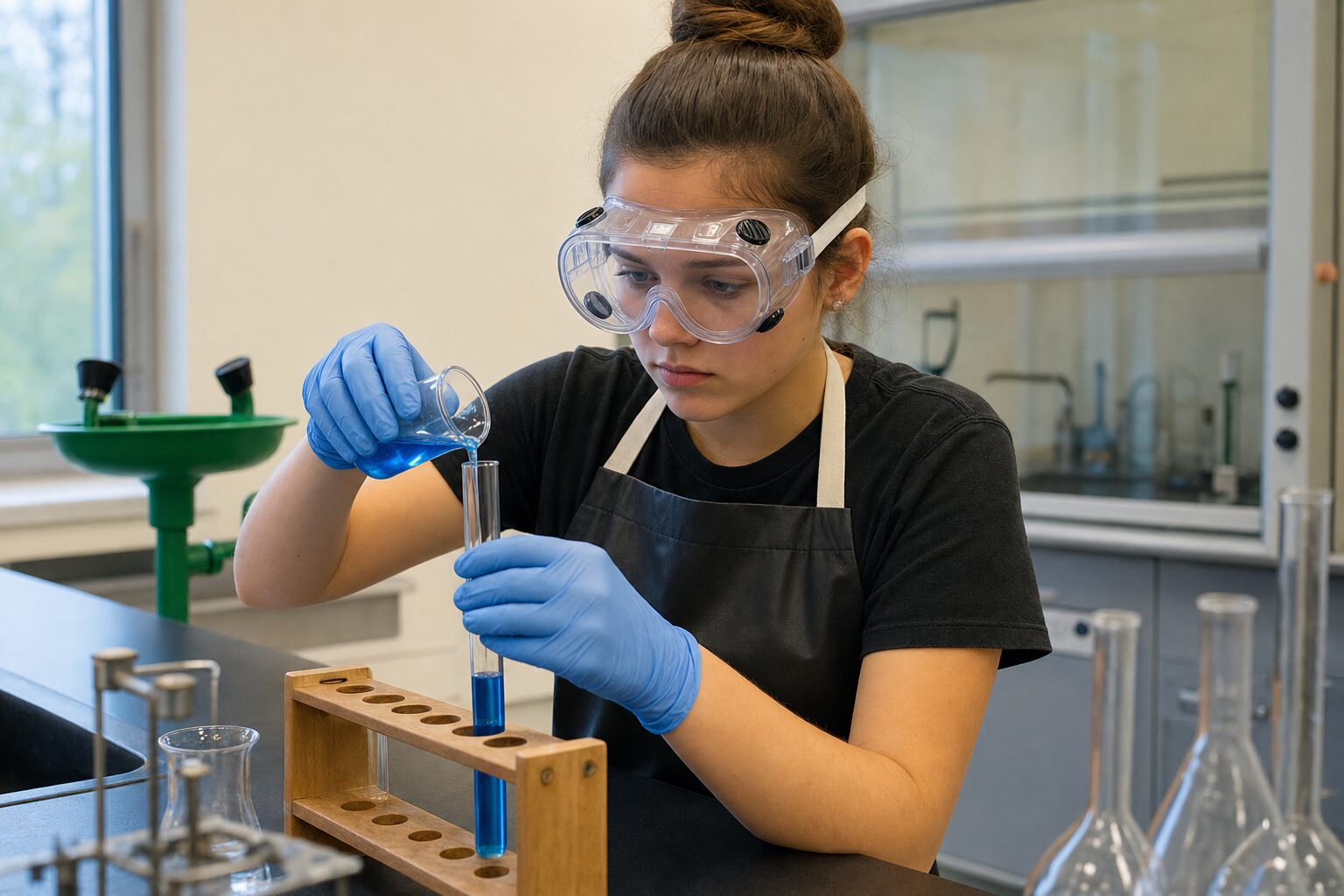
Lab safety in a school science lab is the combination of rules, equipment, training, plans and supervision that lets students do hands-on science without being hurt: eye protection and an eyewash within reach, chemicals that are labeled, stored and documented, a teacher who knows the hazards of each activity, and a class small enough for one adult to watch. The risks are real but uneven. The U.S. Chemical Safety Board identified 66 incidents in elementary and secondary schools between January 2001 and July 2018 that injured a total of 170 students, with alcohols such as methanol and ethanol the chemicals most often involved, according to a 2018 joint statement with the American Chemical Society. The National Science Teaching Association (NSTA) holds that classes of more than 24 students engaged in science activities cannot safely be supervised by one teacher, yet in a national survey of STEM and career and technical education teachers, 57 percent reported enrollments above that ratio, as NSTA reported in February 2024.
This guide to lab safety in K–12 schools explains what the term covers, which laws and standards apply to school labs, what the evidence says about accidents, how to set lab safety rules students will follow, what lab safety equipment a science room needs, how eyewash stations and fume hoods are judged, what lab safety symbols and safety data sheets mean, and what class size, training, inspections and a teacher’s duty of care require. It is written for district and school leaders, science department heads and science teachers. University research labs and workplace laboratories follow some of the same federal rules but are outside its scope. Each section links to edCircuit’s more detailed coverage.
Updated October 2026.
In this guide
- The basics: What lab safety means in schools · Laws and standards · How common accidents are
- Rules and equipment: Lab safety rules · Lab safety equipment · Eye protection · Eyewash stations and showers · Fume hoods
- Chemicals: Lab safety symbols · Safety data sheets · Chemical hygiene and storage · Demonstrations and methanol
- People and spaces: Class size and occupancy · Teacher training · Duty of care · Inspections · Students with disabilities · Questions to ask
What does lab safety mean in a school science lab?
Lab safety in a school is the work of recognizing the hazards in each science activity and reducing the chance that anyone is harmed by them. The American Chemical Society (ACS) organizes that work around RAMP, an acronym coined by chemists Robert H. Hill and David C. Finster and used throughout the society’s laboratory safety guidance:
- Recognize hazards, starting with the chemical’s label and safety data sheet, and including physical hazards such as heat, glass and electricity.
- Assess the risks those hazards pose in this activity, with these students, in this room.
- Minimize the risks, using the most effective controls available.
- Prepare for emergencies, with working equipment, practiced procedures and people who know how to use them.
The ACS Guidelines for Chemical Laboratory Safety in Secondary Schools (2016), written mainly for high school chemistry teachers but intended for science teachers in every subject, is built on the same four steps. Minimizing risk follows what safety professionals call the hierarchy of controls. In the guidance appended to its Laboratory Standard, the Occupational Safety and Health Administration (OSHA) lists the measures from most to least effective as engineering controls, administrative controls, work practices and personal protective equipment: a fume hood that removes vapors protects better than goggles that only shield the eyes, and removing a hazardous chemical from the curriculum protects better than either.
School labs differ from research and industrial labs in ways that shape every decision. The people at the bench are children and adolescents, many using equipment for the first time; the teacher supervises a whole class at once; and science may be taught in a dedicated lab, a classroom with a few sinks, an elementary classroom or outdoors. Hazards are biological as well as chemical and physical, from microorganisms to the animals some classrooms keep. NSTA asks school leaders to build comprehensive safety programs covering engineering controls, administrative procedures and personal protective equipment, and edCircuit’s Science and Lab Safety section collects its coverage of each. For how leaders shape the habits behind those programs, see:
- Science Lab Safety Culture Starts With Leadership
- Laboratory Compliance Starts With Safety
- Science Lab Hazards Schools Often Miss
- Animals in the Science Classroom: Responsibility, Safety, and Student Learning
What laws and standards apply to school science labs?
School labs are governed by a mix of federal workplace rules, state laws, building and fire codes, and professional standards, and which of them are legally binding depends on the state and on whether the school is public or private. The two federal rules that matter most are OSHA’s:
- Laboratory Standard (29 CFR 1910.1450). It applies to “all employers engaged in the laboratory use of hazardous chemicals” and requires a written chemical hygiene plan with standard operating procedures, criteria for control measures, a requirement that fume hoods and other protective equipment function properly, employee training, and the designation of a chemical hygiene officer. The plan must be reviewed at least annually. Training must be given when an employee is first assigned to a work area with hazardous chemicals and before assignments involving new exposure situations.
- Hazard Communication Standard (29 CFR 1910.1200). It requires labels and safety data sheets for hazardous chemicals. For laboratories, it applies in limited form: employers must keep incoming labels intact, keep the safety data sheets that arrive with shipments readily accessible to laboratory employees and train those employees (see Safety data sheets).
Both protect employees, which means teachers, lab aides and other staff, not students. Coverage of staff also varies. Federal OSHA covers private employers, including private schools, but not state and local government workers. Public school employees are covered only where the state runs an OSHA-approved State Plan: there are currently 22 State Plans covering both private sector and state and local government workers (21 states and Puerto Rico) and seven covering only state and local government workers (Connecticut, Illinois, Maine, Massachusetts, New Jersey, New York and the Virgin Islands). In the remaining states, OSHA’s rules do not legally bind public school districts. NSTA nevertheless encourages all school districts, “including those not covered under OSHA’s Laboratory Standard,” to comply with it. For how coverage works and where districts start, see OSHA Compliance in Schools: Hidden Safety Risks.
The main sources a school lab program draws on, and whether each binds a school:
| Source | What it covers | Status for schools |
|---|---|---|
| OSHA 29 CFR 1910.1450 | Chemical hygiene plan, chemical hygiene officer, training, exposure limits | Law for private schools and, in State Plan states, public schools; protects employees |
| OSHA 29 CFR 1910.1200 | Labels, safety data sheets, hazard training | Same coverage as above; limited provisions for laboratories |
| OSHA 29 CFR 1910.151(c) | Facilities for quick drenching or flushing of the eyes and body where corrosives are present | Same coverage as above |
| State eye protection laws | Industrial quality eye protection in school labs and shops (for example, Ohio and Illinois) | Law in the states that have them; cover students, teachers and visitors |
| Building and fire codes (NFPA 101, International Building Code) | Occupant load, exits, fire protection | Law where adopted by the state or locality |
| ANSI/ISEA Z87.1 and Z358.1 | Eye protection; emergency eyewash and shower equipment | Consensus standards; binding when a law adopts them, and used by OSHA as guidance |
| NSTA position statements (revised April 2024) | Safety programs, training, class size, liability | Professional standards; courts may measure the standard of care against them |
| ACS secondary school guidelines (2016) | RAMP, rules, equipment, emergencies, sample safety contract | Professional guidance; the ACS states it does not set minimum legal standards |
Professional standards matter even where they are not law. NSTA’s guidance on the legal implications of duty of care notes that, in the absence of specific laws or local policies, the care expected of teachers and leaders is measured against standards adopted by the profession, such as NSTA’s own position statements (see Duty of care). For the documentation side of compliance, see Laboratory Compliance Starts With Safety.
How common are accidents in school science labs?
There is no complete national count of injuries in K–12 science labs; the best available figures come from incident reports gathered by federal investigators and from surveys of teachers, and both point to the same risk factors. The main sources:
- Chemical incidents. From January 2001 to July 2018, the U.S. Chemical Safety Board (CSB) identified 261 incidents in laboratory, experimentation or presentation settings, 66 of them in elementary and secondary schools, injuring 170 students. Alcohols (methanol and ethanol) were most often involved, followed by nitric, hydrochloric and sulfuric acid. The CSB notes that its incident data come from media articles and are not verified by a second source (CSB and ACS, 2018).
- Class size. In a national survey of 718 K–12 educators in 42 states teaching design-based technology and engineering, enrollments above 24 students were associated with a 48 percent increase in the odds of an accident, and educators who had completed a series of pre-service and in-service safety training were 49 percent less likely to have had an accident in their classes, as summarized in a 2024 study in the Journal of Technology Education by Tyler Love, Mark Threeton and Kenneth Roy. The same body of research found accidents decreasing where all students had appropriate personal protective equipment, flammables were kept in lockable cabinets and master shut-off switches were installed.
- Teacher preparation. In the same 2024 study’s sample of 191 northeastern educators, the odds of an accident were 83 percent lower when, alongside other safety factors, the teacher had completed undergraduate coursework covering safety topics.
These figures have limits. Media-based counts miss incidents that are not reported in the news, and teacher surveys rely on recall of accidents over several years; the technology and engineering study defines accidents broadly, from spills and broken glass to small fires. They are best read as evidence about which conditions raise and lower risk rather than as rates. NSTA’s safety statement cites earlier research by Sandra West and Lisa Kennedy in Texas secondary schools showing that accidents rise dramatically as enrollments exceed 24 or when individual workspace is inadequate. edCircuit has covered recent incidents and the grade where many students first meet a chemistry lab:
- Lab Safety Lessons From Fishers High School
- Why 9th Grade Science Labs See the Most Accidents and What Schools Can Do About It
- How to Improve Lab Safety for 9th Graders
- Who Owns Safety? Turning Near Misses Into Action
What lab safety rules should students follow?
Lab safety rules work best as a short, written school or department policy that students learn, are tested on and sign with a parent or guardian before their first lab. The ACS recommends that the list given to students be manageable and specific to the class and setting, that students and their parents or guardians sign a safety contract, and that each student demonstrate understanding through an assessment such as a quiz. Its sample code of conduct bars a student from lab work until the signed contract is returned. NSTA likewise recommends written safety acknowledgment forms, kept on file for as long as the state’s statute of limitations requires.
Most school rule sets share a core, and students follow rules more consistently when they understand the reason for each. Common rules, drawn from the ACS sample code of conduct and NSTA’s statements, with the reasons behind them:
- Perform only the activities the teacher has authorized, following the written and spoken instructions. The teacher has assessed the hazards of the planned procedure, not of improvised variations.
- Wear approved eye protection whenever chemicals, heat or glassware are in use, by the students or the teacher. Splashes and breakage happen at neighboring benches as well as one’s own.
- Do not eat, drink, chew gum or apply cosmetics in the lab, and wash hands afterward. NSTA recommends that no food or drink meant for people be permitted where lab activities take place, because residues on benches and hands can be swallowed.
- Tie back long hair, avoid loose or flammable clothing and wear closed shoes. Hair and sleeves catch fire or snag in equipment.
- Never touch chemicals or equipment until instructed, never point a heated test tube at anyone and never leave a flame or hot plate unattended.
- Report every spill, breakage, injury or near miss to the teacher immediately, however small. A near miss is the cheapest warning a lab will ever receive.
- Never remove chemicals or equipment from the lab, and never enter storage or preparation rooms without a staff member.
- Know where the eyewash, shower, fire extinguisher and exits are, because the ACS recommends that students learn to use all safety equipment at the start of each semester.
Rules also need consequences that are applied consistently. The ACS sample sets out progressive responses to violations, from a recorded warning to removal from lab work, with alternative assignments so that a student can still meet course requirements. NSTA’s duty-of-care guidance adds that warning students once at the beginning of the year is not enough; safety should be reinforced each time an activity carries the potential for harm. For a student-facing list written for younger learners, see Science Safety Lab Rules for Kids and Students. For rules in the context of new teachers and first-year students, see New Teachers, Real Risks: Safer STEM Strategies for Today’s Classrooms.
What lab safety equipment does a school science lab need?
A school lab where chemicals are used needs equipment in three groups: protection worn by people, engineering controls built into the room, and supplies for responding to emergencies. NSTA recommends that all schools, “even if not required by law,” provide eyewash stations and showers, fume hoods, ventilation and fire extinguishers, together with goggles, gloves and aprons. The equipment the ACS recommends for secondary labs, with the guidance attached to each:
- Chemical splash goggles, stored in an ultraviolet sanitizing cabinet when they are shared (see Eye protection).
- A plumbed eyewash station and a safety shower, both checked regularly for flow of clean water (see Eyewash stations and showers).
- Chemical- and flame-resistant aprons or lab coats, and non-latex gloves, with written procedures for cleaning and disposal.
- A fire extinguisher suited to the classes of fire the lab could have; staff authorized to use one must be trained.
- A fume hood where volatile, toxic or flammable materials are handled (see Fume hoods).
- A first aid kit, with the caution that teachers should generally call the school nurse or emergency services rather than treat students themselves, and should notify parents or guardians after an incident.
- A spill kit and a broken-glass container. The National Research Council’s Prudent Practices in the Laboratory (2011) advises that spill control kits be kept nearby and that staff be trained to use them; the ACS adds that students should not clean up broken glass.
Expert guidance has changed on at least one familiar item. The ACS guidelines state that fire blankets are no longer recommended for the high school laboratory and advise “stop, drop and roll” instead, while Prudent Practices says to use a fire blanket only as a last resort, because blankets can hold in heat and worsen burns, and to douse a person whose clothing is burning in a safety shower. Schools that still keep fire blankets should make sure staff know that guidance. Equipment also has to fit the room: the technology and engineering research described above associates master shut-off switches for gas and electricity, and lockable flammables cabinets, with fewer accidents. For buying and maintaining equipment, see:
- School Equipment Safety Decisions Start Before Purchase
- Using PPE to Create Safer Environments
- Physical Safety Inspections in Science Labs
What eye protection is required in a school lab?
Eye protection in school labs should meet the ANSI/ISEA Z87.1 standard, and where chemicals can splash, that means chemical splash goggles rather than safety glasses. Prudent Practices describes safety glasses with side shields that meet Z87.1 as the minimum protection acceptable for regular laboratory use and recommends chemical splash goggles or face shields when hazardous materials could splash. Ordinary prescription glasses are not adequate, because they lack side shields and impact resistance. For school STEM and career and technical labs, NSTA safety columnist Ken Roy points to safety glasses with side shields or indirectly vented goggles that meet the Z87.1 D3 rating, the marking for splash and droplet protection.
Some states write eye protection into law. Two examples:
- Ohio. Every student and teacher must wear industrial quality eye protective devices while participating in or observing chemical or physical laboratories involving caustic or explosive materials, hot liquids or solids, or other hazards, and devices must be furnished to visitors (Ohio Revised Code 3313.643; current version effective October 3, 2023). The law defines the devices by reference to ANSI Z87.1.
- Illinois. The Eye Protection in School Act requires every student, teacher and visitor to wear an industrial quality eye protective device in chemical or combined chemical-physical laboratories involving caustic or explosive chemicals or hot liquids or solids (105 ILCS 115/1). Schools must furnish devices to visitors.
Two practical points recur in the guidance. Shared goggles need to be sanitized between users; the ACS recommends an ultraviolet sanitizing cabinet and notes that some schools ask students to buy their own. And guidance on contact lenses has changed: Prudent Practices notes that many organizations have removed most restrictions on wearing them in the lab, provided chemical splash goggles are worn. Teachers and other adults should wear the same protection as students; NSTA’s duty-of-care guidance describes modeling safety as part of a teacher’s duty of instruction.
What are the requirements for eyewash stations and safety showers?
Where the eyes or body of any person may be exposed to injurious corrosive materials, OSHA requires “suitable facilities for quick drenching or flushing of the eyes and body” within the work area for immediate emergency use (29 CFR 1910.151(c)). OSHA’s rule does not define “suitable.” For that, the agency points to the consensus standard ANSI/ISEA Z358.1. In a 2010 letter of interpretation, OSHA summarized the standard’s requirements that an eyewash deliver flushing fluid at not less than 0.4 gallons per minute for 15 minutes and be placed on the same level as the hazard where it can be reached in no more than 10 seconds, immediately adjacent to the hazard for a strong acid or caustic. OSHA does not enforce consensus standards, but said that compliance with this one will usually meet the intent of its rule.
School guidance adds several points:
- Plumbed units, not bottles. The ACS recommends a plumbed eyewash station, warning that portable bottles left unused can grow bacteria and do not hold enough water to flush the eyes for the recommended 15 minutes.
- Regular checks. The ACS says shower operation must be verified regularly, including the flow of clean water, and NSTA asks districts to ensure custodial or facilities staff carry out regular preventive maintenance on eyewashes, showers and ventilation.
- Training and drills. Teachers need to know the first aid steps: flush eyes for at least 15 minutes, and for skin contact rinse for 15 minutes, using the shower if necessary and removing contaminated clothing, while medical help is called (ACS, 2016). The teacher should demonstrate the eyewash and shower to students each semester.
- Access for everyone. Prudent Practices considers it prudent to provide barrier-free safety showers and eyewash units for all laboratories and notes a maximum reach height of 48 inches for shower controls.
What does a fume hood do, and how is it tested?
A fume hood is an enclosure, open on one side behind a movable sash, that draws air from the lab and exhausts it so that vapors, gases and dust released inside do not reach the people working at it. OSHA’s Laboratory Standard defines a laboratory-type hood as a device enclosed on five sides, built and maintained “to prevent or minimize the escape of air contaminants into the laboratory,” that allows chemical work without putting any part of the body other than hands and arms inside. A school’s chemical hygiene plan must require that fume hoods and other protective equipment function properly and set out how that will be ensured.
The common measure of a hood’s performance is face velocity, the average speed of air drawn through the open sash. Prudent Practices explains that no regulations specify an acceptable face velocity, and that face velocities that are too low or too high both reduce containment. Its guidance:
- Typical range. Several professional organizations recommend 80 to 100 feet per minute for traditional hoods. Face velocities approaching or above 150 feet per minute should not be used, because they can create turbulence at the sash and reduce capture. Newer high-performance, or low-flow, hoods are designed to contain vapors at 60 or 80 feet per minute.
- Testing. Each hood should be evaluated before first use and at least once a year to visualize airflow and verify face velocity against the criteria in the lab’s chemical hygiene plan. A more rigorous containment test, ASHRAE/ANSI 110, should be done at installation, after significant changes to the ventilation system and periodically.
- Placement. Hoods should not sit on busy aisles, because a person walking past creates air currents strong enough to pull contaminants out of an open hood.
Good habits at the hood matter as much as the airflow. OSHA’s fume hood QuickFacts advise users to confirm the hood is on and the airflow gauge is in range, keep the sash at the marked operating height and below the face, keep materials at least six inches inside, avoid blocking the baffles, close the sash when the hood is not in use, never store chemicals in it, and tag a malfunctioning hood out of service until it is repaired. A fume hood is not a storage cabinet or a substitute for good ventilation in the rest of the room. For ventilation in labs, career and technical education shops and ordinary classrooms, see School Ventilation Safety: Labs, CTE & Classrooms.
What do lab safety symbols mean?
The lab safety symbols students and teachers see most often are the hazard pictograms on chemical labels, set by OSHA’s Hazard Communication Standard under the Globally Harmonized System of Classification and Labelling of Chemicals (GHS), and the NFPA 704 diamond posted for firefighters. Each GHS pictogram is a black symbol on a white background inside a red-bordered diamond and stands for one or more hazards. OSHA’s 2024 pictogram QuickCard lists them:
- Health hazard: carcinogens, mutagens, reproductive toxicity, respiratory sensitizers, target organ toxicity, aspiration toxicity.
- Flame: flammables, pyrophorics, self-heating substances, substances that emit flammable gas, self-reactives, organic peroxides, desensitized explosives.
- Exclamation mark: skin and eye irritants, skin sensitizers, harmful acute toxicity, narcotic effects, respiratory tract irritants.
- Gas cylinder: gases and chemicals under pressure.
- Corrosion: skin corrosion and burns, eye damage, substances corrosive to metals.
- Exploding bomb: explosives, self-reactives, organic peroxides.
- Flame over circle: oxidizers.
- Skull and crossbones: acute toxicity that is fatal or toxic.
- Environment (non-mandatory under OSHA’s rule): aquatic toxicity.
A GHS label also carries a signal word (“Danger” for more severe hazards, “Warning” for less severe), hazard statements and precautionary statements. The NFPA 704 diamond works differently, and the difference regularly confuses students and staff. The main contrasts, from OSHA’s comparison QuickCard and the ACS secondary school guidelines:
| GHS label (OSHA HazCom) | NFPA 704 diamond | |
|---|---|---|
| Purpose | Tells people who use the chemical about its hazards in normal use and foreseeable emergencies | Gives emergency responders quick information during a fire or spill |
| Format | Pictograms, signal word, hazard and precautionary statements | Four colored fields: blue (health), red (flammability), yellow (instability), white (special hazards such as OX for oxidizers and W for water-reactive) |
| Numbers | Hazard categories, where 1 is the most severe; shown on the safety data sheet, not required on the label | Ratings from 0 to 4, where 4 is the most hazardous |
| Health effects | Acute and chronic | Acute only |
Because the numbering runs in opposite directions, the GHS category numbers on a safety data sheet should never be copied into an NFPA diamond. The ACS notes that the NFPA system was designed for firefighters and was not meant to tell lab users about a chemical’s hazards; that is the job of the label and the safety data sheet. Teaching students to read both is one of the learning outcomes in the ACS guidelines.
What is a safety data sheet, and how do schools use it?
A safety data sheet (SDS) is the document a chemical’s manufacturer, importer or distributor must provide for each hazardous chemical, setting out its hazards and how to handle, store and respond to it. Under OSHA’s Hazard Communication Standard, every SDS uses the same 16 numbered sections, listed in OSHA’s SDS QuickCard and in Appendix D of the standard:
- 1. Identification: product name, recommended use and restrictions, supplier contact, emergency phone number.
- 2. Hazard identification: classification, signal word, pictograms, hazard and precautionary statements.
- 3. Composition/information on ingredients.
- 4. First-aid measures, by route of exposure, with symptoms.
- 5. Fire-fighting measures, including suitable and unsuitable extinguishing media.
- 6. Accidental release measures: containment and cleanup.
- 7. Handling and storage, including incompatibilities.
- 8. Exposure controls/personal protection: exposure limits, engineering controls, personal protective equipment.
- 9. Physical and chemical properties, such as flash point and vapor pressure.
- 10. Stability and reactivity.
- 11. Toxicological information.
- 12–15. Ecological information, disposal considerations, transport information and regulatory information. These sections must appear, but OSHA does not enforce their content because other agencies regulate those subjects.
- 16. Other information, including the date of preparation or last revision.
Schools use safety data sheets at several points: before buying a chemical, when deciding whether an activity is suitable for a grade level, when writing standard operating procedures, when storing chemicals by compatibility (Section 7 and Section 10), and in an emergency, when Sections 4, 5 and 6 tell staff and responders what to do. OSHA requires employers to keep an SDS for each hazardous chemical and make it readily accessible to employees during every shift; electronic access is permitted as long as it creates no barrier to immediate access. NSTA goes further, recommending that all school employees, independent contractors and emergency personnel have direct access to safety data sheets for every hazardous chemical used in instruction, and that teacher training cover how to read and apply them.
The format is changing in detail. OSHA updated the Hazard Communication Standard on May 20, 2024, to align it with Revision 7 of the GHS, and in January 2026 extended its compliance dates by four months. Under the current text of 29 CFR 1910.1200(j):
- May 19, 2026: manufacturers, importers and distributors evaluating substances must comply with the updated provisions.
- November 20, 2026: employers must, as necessary, update workplace labeling, their hazard communication program and employee training for newly identified hazards of substances.
- November 19, 2027: manufacturers, importers and distributors evaluating mixtures must comply.
- May 19, 2028: employers must make the same updates for mixtures.
Until those dates, either the 2012 version or the updated standard may be followed. For a school, the practical effect is that revised safety data sheets will arrive with new shipments and should replace older copies in the binder or database, and staff training should cover any newly identified hazards. See also Chemical Safety in Educational Settings: Best Practices for Schools.
Chemical hygiene plans, storage and the chemical hygiene officer
Most of the day-to-day work of lab safety happens outside class time: keeping a current chemical inventory, storing chemicals by compatibility in suitable cabinets, removing what is no longer used, and writing the procedures teachers follow. Under OSHA’s Laboratory Standard, that work is organized through a written chemical hygiene plan and a designated chemical hygiene officer, and NSTA recommends that every district designate one or more chemical hygiene officers or an equivalent person. OSHA’s non-mandatory guidance also recommends an annual physical inventory and advises against storing chemicals in fume hoods, on the floor, on benchtops, in exit paths or near heat. edCircuit covers each part in depth:
- Chemical Hygiene Plan: A Portland Reminder for Every School
- Chemical Hygiene Officer: Why Every District Needs One
- STEM Lab Storage Safety: When Storage Becomes Risk
- Chemical Safety in Educational Settings: Best Practices for Schools
- Summer Science Lab Shutdown Checklist for Teachers
Are flame demonstrations and methanol safe in school labs?
Demonstrations that burn methanol or other flammable liquids in front of students have caused some of the most serious injuries in school science, and both federal investigators and the ACS have warned against them in their usual form. In October 2014, after three methanol fires in eight weeks injured children and adults, the CSB issued a safety bulletin with four key lessons:
- Do not use bulk containers of flammable chemicals in demonstrations when small quantities are sufficient.
- Require written procedures, effective training and appropriate personal protective equipment whenever demonstrations involve hazardous chemicals.
- Conduct a thorough hazard review before any demonstration.
- Put a safety barrier, preferably a physical shield, between the demonstration and the audience.
The incidents share a pattern. In one of the three investigated in 2014, at a Denver high school on September 15, 2014, a teacher who had just started his career added methanol from a four-liter container to a flame that was not rising as he had hoped; the fire flashed back into the container, and four students were burned, one seriously. The CSB found that the school lacked adequate safety procedures and a lab safety training program and cautioned that a chemistry degree is not a substitute for a safety management system. Similar “rainbow” demonstrations burned three students and a teacher at a Fairfax County, Virginia, high school in October 2015 and injured 17 students and a teacher at a Hendersonville, Tennessee, school in May 2018 (CSB and ACS, 2018). In October 2022, after a methanol fire injured students and a teacher at Dinwiddie High School in Virginia, the CSB again urged schools to follow its guidance. Its 2013 video, After the Rainbow, tells the story of a 2006 demonstration in which Ohio high school students were severely burned.
Professional views differ on how far to go. The ACS secondary school guidelines discourage the rainbow demonstration but state that it may be performed safely only by trained and experienced demonstrators, while the CSB suggests that where the risk is too high or the quantity cannot be reduced, schools consider alternatives such as video demonstrations. Some safety advocates writing for edCircuit argue for removing methanol from school science programs altogether. Whatever a district decides, the CSB’s lessons describe the minimum. edCircuit’s coverage:
- After the Rainbow: A Cautionary Tale of Chemistry and Carelessness
- Methanol in K12 Is a Preventable Hazard
- Science Lab Fires: Duty of Care, Response, and Recovery
- When the Science Lab Catches Fire: Duty of Care, Prevention, and the Barnegat High School Wake-Up Call
How many students can safely work in a science lab?
NSTA recommends no more than 24 students in a science class doing lab activities, with at least 60 square feet per student in a secondary lab and 45 square feet per student in an elementary lab-classroom, even if the room’s legal occupancy would allow more. Its liability position statement (adopted 2007, revised April 2024) sets out those figures, and its safety statement identifies three separate concerns in overcrowding: adult supervision, individual workspace and the occupancy load the space was designed for.
Two different limits are at work, and they are often confused:
- Occupant load is a legal limit set by building and fire codes for safe exit. Ken Roy, writing for NSTA, explains that the NFPA 101 Life Safety Code allows one person per 20 net square feet in ordinary classrooms but one person per 50 net square feet in labs, shops and similar rooms, and that only the authority having jurisdiction, such as a fire marshal, can approve a different figure.
- Class size is the number of students a teacher can supervise safely during hands-on work. NSTA’s 24-student limit rests on research showing accidents rising as enrollment passes that number, which the technology and engineering studies described above have since echoed.
The gap between guidance and practice is wide: in the national survey NSTA cited in 2024, only 26 percent of STEM and career and technical educators taught in facilities large enough to support lab instruction for more than 24 occupants. NSTA asks teachers to document overcrowding and report it to school and district officials, and to modify or drop an activity they judge cannot be done safely; its safety statement says the district should not discipline a teacher for exercising that judgment in an objectively reasonable manner. For more, see:
- Why Occupancy Load Matters in Classrooms and Science Labs
- The Impact of Overcrowding on Classroom Safety: A Teacher’s Duty of Care
- The Challenges of Overcrowded Classrooms in Education
What safety training do science teachers need?
Science teachers need safety training before they first work with hazardous chemicals, before any new kind of exposure and at regular intervals afterward, covering the hazards, the equipment, the school’s chemical hygiene plan and their legal duties. OSHA’s Laboratory Standard requires training at an employee’s initial assignment and before new exposure situations and leaves the frequency of refresher training to the employer. NSTA recommends annual training and says programs should cover:
- the operation of engineering controls and personal protective equipment, and all parts of the chemical hygiene plan;
- the legal duty or standard of care teachers owe students, state safety regulations and school board policies;
- reducing the risk of exposure to bloodborne pathogens;
- strategies for students with academic, remedial or physical needs and for English learners; and
- how to read and apply safety data sheets.
The evidence supports treating training as part of the safety system rather than an add-on. In the CSB’s Denver investigation, a teacher with a chemistry degree and college lab experience had received no training on the hazards of methanol demonstrations, and the board concluded that employers should not rely on college-level experience in place of oversight, hazard assessment, training and procedures (CSB, 2014). The survey research described in How common are accidents associates comprehensive safety training with substantially fewer accidents. New teachers, teachers assigned outside their subject and substitutes need particular attention; NSTA’s duty-of-care guidance says an adult who is not certified in science education and has not had annual safety training should not be in charge of a class doing a lab activity. See also New Teachers, Real Risks and Using Artificial Intelligence to Elevate Science Lab Safety.
What is a teacher’s duty of care in the science lab?
Duty of care is the legal obligation to act as a reasonably prudent person would to protect others from unreasonable risk; for science teachers, it means anticipating foreseeable harm in lab activities and acting to prevent it. NSTA defines it as “an obligation, recognized by law, requiring conformance to a certain standard of conduct to protect others against unreasonable risk,” and notes that a breach may lead to liability for both the teacher and the district that employs the teacher.
NSTA’s guidance on the legal implications of duty of care explains that a negligence claim generally requires four elements: a duty of care, a breach of that duty, the breach as the cause of the injury, and actual damages. It describes three duties that together make up a science teacher’s responsibility:
- Duty of instruction: teach safety practices and procedures, model them consistently, and warn students specifically of the hazards of each activity, in writing and aloud.
- Duty of supervision: enforce safety rules consistently and equitably, keep students in sight while hazardous work is under way, and never leave a class unattended during a lab activity.
- Duty of maintenance: inspect equipment before, during and after activities, remove anything that is not working properly, and keep equipment and facilities in good repair.
The duty is shared. NSTA’s liability statement assigns districts the duty to adopt and annually review safety policies, provide training, maintain engineering controls, conduct annual safety audits, support teachers who modify or replace unsafe activities, and carry adequate liability insurance, and it asks school boards to review science facilities and instruction every three to five years. The liability statement also reminds teachers that insurance may not cover reckless or intentional acts, and NSTA’s duty-of-care guidance notes that a teacher or administrator who is aware of a risk of substantial harm and proceeds anyway may face a claim of recklessness rather than negligence. For more, see STEM Legal Liability in Schools – Improved Safety and Science Lab Fires: Duty of Care, Response, and Recovery.
How often should a school science lab be inspected?
A school science lab should have a formal safety audit at least once a year, with equipment checked more often and the chemical hygiene plan reviewed annually. The recurring checks in federal rules and professional guidance:
- Every activity: the teacher inspects equipment before, during and after use (NSTA).
- Regularly: eyewash stations, safety showers and fire extinguishers are tested and kept unblocked, and an extinguisher is recharged or replaced after use (OSHA Laboratory Standard, Appendix A).
- At least annually: fume hood face velocity and airflow checks (Prudent Practices); review of the chemical hygiene plan (OSHA); a physical chemical inventory (OSHA guidance); and a safety audit of science facilities and supplies (NSTA).
- Every three to five years: a districtwide review of science facilities and instruction, which NSTA recommends where possible.
Inspections are most useful when the findings lead to repairs and when the people who use the lab can report problems without fear of blame. edCircuit’s inspection series covers what to look for and how to act on it:
- Science Lab Safety Inspections Save Lives
- Physical Safety Inspections in Science Labs
- Science Lab Hazards Schools Often Miss
- Who Owns Safety? Turning Near Misses Into Action
Lab safety for students with disabilities
Students with disabilities belong in the science lab, and planning for their safety is part of planning the lab. NSTA asks that teacher safety training include strategies for accommodating students with academic, remedial or physical needs, and that administrators tell teachers, within privacy law, about student health concerns that could put a student or others at risk. Physical access matters as well: Prudent Practices recommends barrier-free eyewash units and safety showers in all laboratories. Survey research on technology and engineering classes has found accidents increasing with the share of students with disabilities in a course, alongside other demands on a teacher’s attention such as more hands-on time and more course preparations. The finding describes conditions in a course rather than individual students, and the response NSTA describes is training, planning and accommodation. A student’s IEP or 504 plan can set out accommodations for lab work; see edCircuit’s Special Education Guide and Safer Learning for Students with Additional Needs.
Questions to ask about lab safety in your school
For school and district leaders
- Does every school with a science lab have a written chemical hygiene plan, reviewed in the past year, and a named chemical hygiene officer?
- Is our state an OSHA State Plan state, and do our policies meet the Laboratory Standard whether or not it binds us?
- How many science sections exceed 24 students, and which labs are below the occupant load and square footage per student the codes and NSTA call for?
- When were each lab’s eyewash stations, showers and fume hoods last tested, and who is responsible for fixing what fails?
- Does every science teacher, including new, substitute and out-of-field teachers, receive safety training before their first lab and every year after?
- Have we updated our hazard communication training and safety data sheet files for OSHA’s November 2026 deadline?
- What is our policy on flame demonstrations and methanol?
For science teachers
- Have I assessed the hazards of this activity for these students in this room, using the safety data sheets, and written down the precautions?
- Does every student have a signed safety contract on file and a passing score on the safety quiz?
- Is the eyewash reachable within 10 seconds of every station, and does it run clean?
- Is the fume hood’s airflow in range, and is it free of stored chemicals?
- Do I have the goggles, gloves and spill materials this activity needs, and are the goggles clean?
- Is my class small enough for me to see every student while the activity is under way, and have I reported in writing if it is not?
- Do I know what to do, and whom to call, if a student is splashed, burned or cut?
Safety as part of science teaching
Hands-on investigation is how students learn to do science, and every professional body that writes about lab safety says so before it says anything about hazards. The safeguards described here, from signed rules and splash goggles to tested eyewash stations, trained teachers and reasonable class sizes, exist so that schools can keep that work in the curriculum rather than abandon it. Much of the responsibility falls on teachers in the room, but the conditions that make safe teaching possible, including space, equipment, training and time, are decided by school and district leaders. Labs are safest where both sides treat safety as part of teaching science, review it every year and act on what students and teachers report.
Related reading
Subscribe to edCircuit to stay up to date on all of our shows, podcasts, news, and thought leadership articles.
More on Science and Lab Safety

