



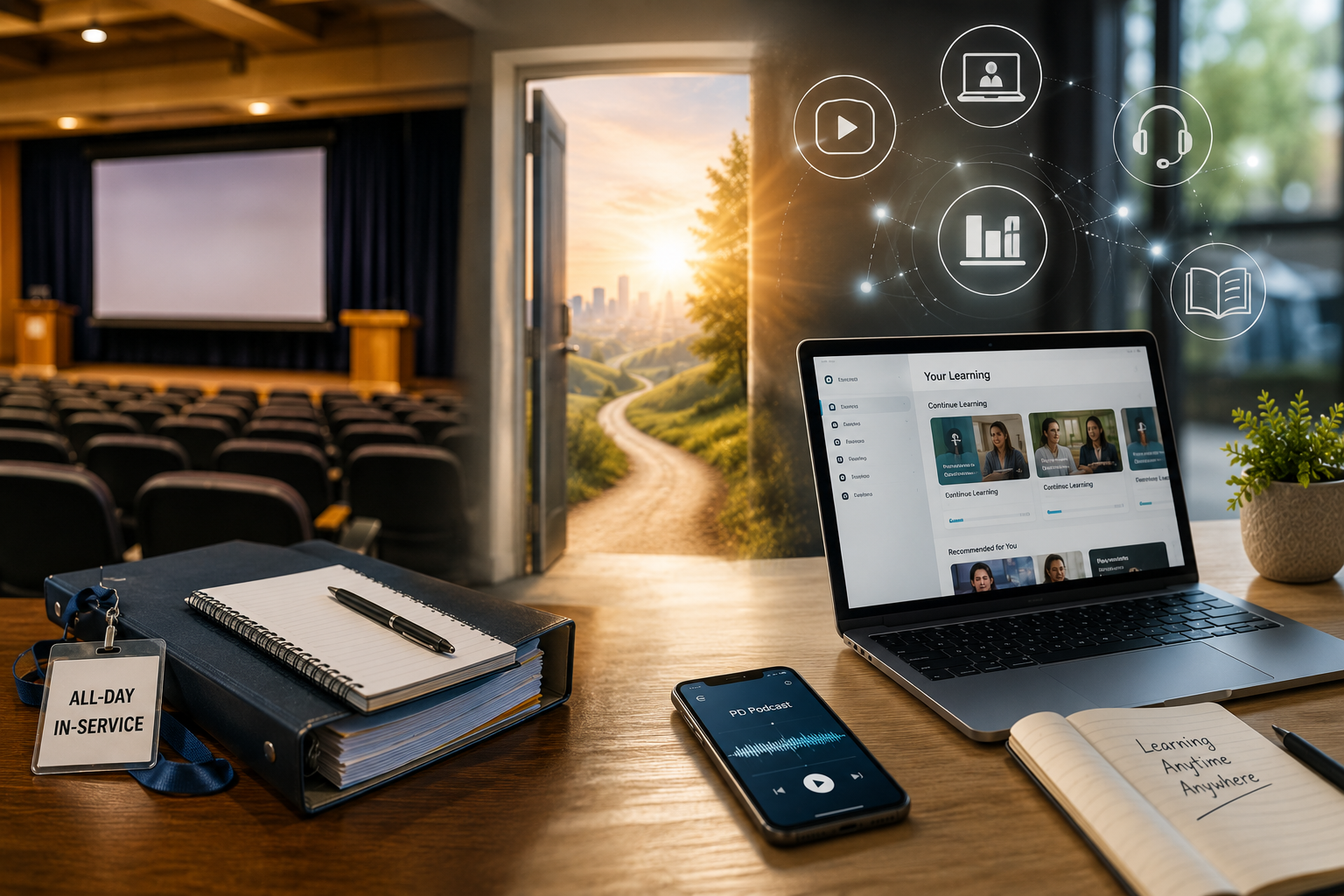
Teacher in-service has expanded far beyond the traditional school auditorium, transforming professional learning into a flexible, year-round experience for today’s educators. District leaders welcomed staff back for another school year, keynote speakers shared their vision, departments gathered for breakout sessions, and teachers left carrying binders filled with notes, handouts, and ideas they hoped to put into practice.
For generations, this tradition marked the official beginning of a new academic year. It was an opportunity to reconnect with colleagues, celebrate accomplishments, hear district priorities, and prepare for the students who would soon fill classrooms.
Those experiences still have tremendous value.
What has changed is that they no longer represent the entirety of professional learning.
Over the last decade, teacher in-service has evolved from a handful of scheduled events into a continuous learning experience that follows educators throughout the school year. Technology has allowed districts to move beyond the limitations of time and place, creating opportunities that are more flexible, more accessible, and increasingly personalized to the needs of individual educators.
The auditorium has not disappeared.
It has simply become one stop along a much larger professional learning journey.
Why Schools Needed Something Different
Traditional in-service worked well for many purposes.
It brought entire districts together under one roof, creating shared experiences that helped establish culture and communicate priorities. School leaders could introduce new initiatives, celebrate success stories, recognize employees, and ensure everyone began the year with a common understanding of district goals.
Those moments remain important today because relationships remain at the heart of education.
Yet even the most successful in-service days had limitations.
Teachers were expected to absorb hours of information while simultaneously preparing classrooms, organizing curriculum, responding to emails, attending department meetings, and getting ready for students to arrive. Presentations covered a wide range of topics, often leaving little opportunity to revisit information once the day had ended.
If an educator missed a session because of illness, coaching responsibilities, or another obligation, catching up could be difficult. If new legislation, instructional practices, or safety requirements emerged during the school year, districts frequently had to wait months before formally addressing them.
School leaders increasingly recognized that professional learning should not be confined to a few days on the calendar.
Learning needed to become continuous.
Technology Changed More Than Delivery
Technology did far more than digitize presentations.
It fundamentally changed access to professional learning.
Learning management systems gave districts centralized libraries for professional development. Video conferencing platforms connected educators across multiple buildings without requiring travel. Recorded webinars allowed teachers to revisit presentations whenever questions arose. Podcasts turned commutes into learning opportunities, while mobile devices placed professional development in educators’ hands wherever they happened to be.
Artificial intelligence is now beginning to shape this evolution even further. Educators can use AI to summarize research, generate lesson ideas, explore instructional strategies, and increasingly receive personalized professional learning recommendations based on their role, interests, or professional goals.
Technology removed barriers that had existed for decades.
Teachers no longer needed to be in one room at one specific time to receive meaningful learning. Instead, professional development became available whenever educators had the time, energy, and need to engage with it.
A literacy teacher could watch a webinar after school.
A principal might complete leadership training before a board meeting.
A science teacher could review updated laboratory safety procedures before introducing a new experiment.
Learning shifted from being calendar-driven to being need-driven.
The Pandemic Accelerated an Existing Trend
The COVID-19 pandemic did not create virtual professional learning.
It accelerated changes that were already underway.
Almost overnight, districts learned how to conduct workshops, coaching sessions, faculty meetings, conferences, and collaborative planning through digital platforms. Educators became comfortable participating in webinars, virtual professional learning communities, cloud-based collaboration, and online coaching.
When schools returned to more traditional operations, they did not abandon those innovations.
Instead, districts kept what worked.
Today, many professional learning programs combine face-to-face collaboration with digital resources that remain available throughout the year. Rather than choosing between in-person and online learning, districts are increasingly blending both approaches to create more flexible experiences.
The result is professional learning that is available far beyond opening day.
Learning That Fits Real Life
Perhaps the greatest advantage of today’s approach is flexibility.
Teaching has always been demanding, but today’s educators juggle instruction, assessment, technology integration, parent communication, extracurricular activities, committee work, and countless unexpected challenges throughout every school day.
Finding several uninterrupted hours for professional development is not always realistic.
Modern learning models recognize that reality.
Instead of asking every educator to stop what they are doing for a full day of training, districts increasingly provide opportunities that fit naturally into existing schedules.
A teacher staying late after volleyball practice can watch a recorded instructional technology session that evening.
Another educator completes a fifteen-minute cybersecurity refresher during a planning period.
An assistant principal listens to a leadership podcast while commuting between schools.
A first-year teacher revisits classroom management videos several times during the opening weeks of school.
Professional learning becomes more manageable because it becomes more accessible.
Educators gain greater control over when, where, and how they continue developing professionally.
Learning When It Matters Most
One of the most powerful changes is not where learning happens.
It is when learning happens.
Traditional professional development often required educators to wait until the next scheduled workshop before learning something new.
Today’s teachers rarely need to wait.
A teacher curious about artificial intelligence can complete an introductory course that evening and begin using new strategies the following morning.
A counselor responding to updated mental health guidance can immediately access new training.
A science teacher introducing unfamiliar laboratory equipment can review safety procedures minutes before instruction begins.
Five- and ten-minute microlearning modules now allow educators to gain practical knowledge exactly when they need it rather than months before they are able to apply it.
Professional learning has become immediate, relevant, and actionable.
That shift dramatically increases the likelihood that new knowledge will improve classroom practice.
Collaboration Has Expanded Beyond School Walls
Technology has transformed collaboration just as dramatically as it has transformed instruction.
Professional learning no longer ends when teachers leave the auditorium.
Instead, conversations continue throughout the year.
Educators collaborate through virtual professional learning communities, shared workspaces, discussion boards, video meetings, and professional networks that connect teachers across districts, states, and even countries.
An elementary teacher in Ohio can exchange literacy strategies with colleagues in Texas.
A technology director can participate in national cybersecurity discussions without leaving the office.
A science teacher can learn directly from university researchers and national organizations while planning new laboratory experiences.
Podcasts have also become one of the fastest-growing forms of professional learning. Educators now consume leadership insights, instructional strategies, technology updates, and classroom innovations while commuting, exercising, or preparing classrooms. Professional learning no longer requires sitting in front of a screen to make a meaningful impact.
Geography is no longer the defining factor in who educators can learn from.
Finding the Right Balance
Despite the rapid growth of online learning, few educators believe every aspect of teacher in-service should become virtual.
There is still tremendous value in gathering together.
Opening-day celebrations.
Collaborative planning.
Shared problem-solving.
Relationship building.
Those experiences strengthen school culture in ways technology cannot fully replace.
The future is not about replacing auditoriums with laptops.
It is about giving educators the right learning experience for the right purpose.
Sometimes that experience happens in a room filled with colleagues.
Sometimes it happens through a webinar, podcast, coaching session, or short online learning module.
The strongest professional learning programs recognize the value of both.
Looking Ahead
The movement from auditoriums to anytime learning represents far more than a technological advancement.
It reflects a deeper understanding of how adults learn and grow.
Professional learning is no longer confined to a room, a schedule, or a handful of days before students return to school.
It is continuous.
It is flexible.
It is increasingly personalized.
That is good news not only for educators, but for students.
Every opportunity a teacher has to learn, reflect, refine instruction, and explore new ideas ultimately creates better learning experiences inside the classroom.
The biggest lesson of the past decade is not that schools replaced auditoriums with laptops.
It is that professional learning is no longer tied to a place.
It is tied to opportunity.
The auditorium will always have a place in education.
But the future of teacher in-service will not be defined by where educators learn.
It will be defined by how often they have the opportunity to learn.
The Future of Professional Learning Series
Part 1: How Teacher In-Service Has Changed
Part 2: From Auditoriums to Anytime Learning (Current Article)
Coming Next: Why One-Size-Fits-All Professional Development Is Disappearing, exploring how districts are replacing universal training with personalized learning pathways designed around each educator’s role, experience, and professional goals.
Subscribe to edCircuit to stay up to date on all of our shows, podcasts, news, and thought leadership articles.
Related reading
More on K-12 Teachers