The Power of One Note in Music Education
Bill Swick of the Las Vegas Academy of the Arts talks about his start in music and his nationally known guitar curriculum.


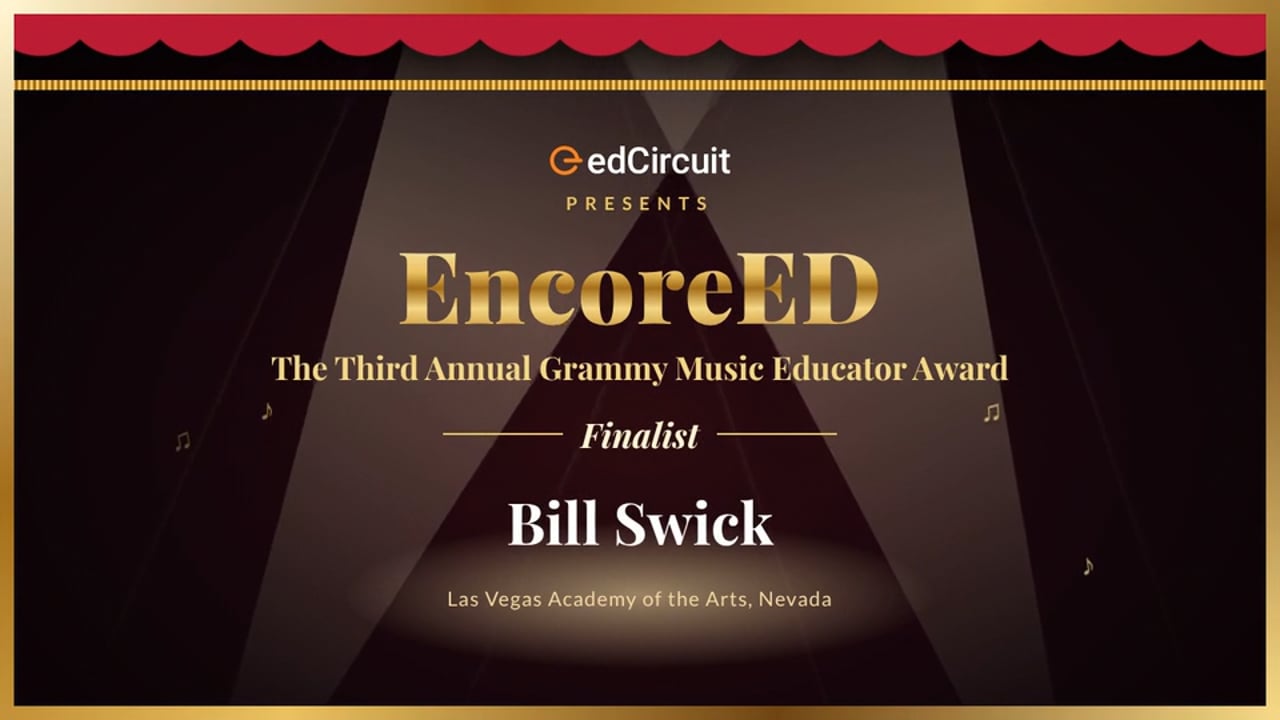
In this interview, edCircuit interviews Bill Swick, chair of the music department for the twelve-time GRAMMY award-winning Las Vegas Academy of the Arts.
Bill Swick currently chairs the music department for the twelve-time GRAMMY award-winning Las Vegas Academy of the Arts and is the guitar task force chair for CCSD, the nation’s fifth-largest public school district. Swick discussed his own origins in the music industry and how one fateful day changed his life forever.
Swick is nationally known for his guitar curriculum. The guitar curriculum developed by Mr. Swick includes over 20 volumes of edited repertoire tailored for beginning students and college music majors, and over 400 guitar ensemble arrangements. The lessons in his classroom guitar editions have been developed with the intent to take remedial beginners to advanced stages of music reading and improvisation. He is also the inventor of the “Swickster,” a guitar with a specially developed fingerboard and teaching system designed to introduce and make guitar playing fun and practical.
Many of his graduates from the Las Vegas Academy have been placed in major conservatories and music colleges receiving full scholarships. The program he has developed at the Academy is arguably one of the leading public high school programs in the United States.
The Music Educator Award was established to recognize current educators who have made a significant and lasting contribution to the field of music education. The winner receives a $10,000 honorarium and a $10,000 grant for his or her school, and is flown to Los Angeles to receive the award and attend the Grammy award ceremony. The ten finalists, as well as their schools, each receive a $1,000 honorarium.
About this episode
In this episode of EncoreED, Bill Swick talks about the day a middle school guitar class changed his career, how technology measures his students’ growth, and what music teachers in any school can give students. Swick did not seek the award: his principal nominated him quietly, and from there came specific video submissions, a place in the top 25 and then the top ten. His students at the Las Vegas Academy of the Arts, he says, are used to awards across music, theater and dance, because the school focuses on excellence.
A school that supports music
Having taught at other schools, Swick knows how fortunate his school is. Not every administrator supports music, he says, and as principals gain more authority some music departments are being weakened or eliminated, which he finds disheartening.
One fateful day
Swick always wanted to teach college guitar and did so, first at Drake University and then at the University of Nevada, Las Vegas, which brought him to the city in 1982. Years later, the head of fine arts for the Clark County School District asked him to observe a new middle school guitar teacher. He walked into a class of about thirty sixth and seventh graders playing Surfin’ USA, having a great time and sounding wonderful, and went home and told his wife he had seen what he would do for the rest of his life. Moving from college to public school meant a year of part-time study to earn his teaching credentials, a sacrifice he considers worth it.
Making the case for music
Swick sees pockets of the country making a strong case for music education and others falling short. He points to research suggesting that brain development is enhanced when students learn to play music, especially music with several voices at once, as in ensembles, and argues that those formative years matter even for students who never major in music. Professional organizations promote music education well to educators, he says, but parents and administrators are not at those conventions, and the message is not yet reaching the right people.
Technology in the guitar room
Swick created what he describes as the first silent guitar lab in the country, then moved to iPads that guitars could plug into directly. His current assessment app lets students play a piece as many times as they like until they reach the score they want, records their performances, marks notes right or wrong, shows how much they practice and reports growth over time, giving him the hard data schools now ask for and motivating students toward mastery.
Advice for every music teacher
Besides his full-time job, Swick teaches guitar at an evening high school for students who have been removed from their day schools, some of the toughest students anywhere. He sees what the discipline of music does for them, and what it means to have a teacher who shows up every day, cares about them and shares something meant to be enjoyed. That, he says, is an important role for a teacher of any student at any level.
More conversations with the 2016 Grammy Music Educator Award winner and finalists are on the EncoreED hub.
Subscribe to edCircuit to stay up to date on all of our shows, podcasts, news, and thought leadership articles.
Related reading
More on Creativity