



 Todd Stanley
Teachers and parents need to be purposeful with resources available The starting point for the question of what defines someone as almost gifted would be answering what it means to be gifted and working backwards from there. Although there is no universally accepted definition of gifted, there have been lines drawn in the sand to enable school districts to identify those students who have high ability. Typically the identification of gifted students are those in the top 5% of a nationally normed test. If a student scores in the 95th percentile or higher, she is given the label of gifted. The tests that are used vary from state to state as each state has its own approved list of assessments that can be used to identify gifted students.
Achievement Tests vs. Cognitive Tests
There are two types of tests a typical district would give. Some are subject specific tests that look at reading, math, and even social studies and science. These are called achievement tests and are a reflection of what students have learned and how this compares with their peers. If a student were to be in the top 5% of everyone who took the test in math, then he would be considered gifted in the subject area of math. The second type of tests are cognitive tests that can give a good idea of whether a student is adept at thinking outside of the box. Cognitive tests such as the Wechsler Intelligence Scale for Children (WISC), Otis Lennon School Ability Test (OLSAT), In View, CogAT, the Stanford Binet, and the Woodcock Johnson can be used to determine a child’s School Ability Index (SAI). Students who are higher than the 95th percentile are deemed superior cognitive and thus gifted.
Measuring Performance
These tests are based on academics, but as the National Society for Gifted and Talented (NSGT) indicates, performance and accomplishment is also important. There are other methods of identification of gifted that can measure this performance and accomplishment such as creative thinking ability, visual performing arts, psychomotor which is athletics and how coordinated one is, and some states have even taken to measuring the leadership ability of students. But these are not as widely used as the specific content and cognitive tests.
Cognitive Test Scores
Cognitive tests are a greater indicator of student potential because it is a measure of intelligence, not content specific. This is the breakdown of how students typically score on cognitive ability tests:

As you can see, about 4% of the scores are in the range of gifted. Working backwards from there, the 8th stanine represents the 7% of students who scored in the 89th to 95th percentile, meaning they are in the top 10% of those who took the test. This group would constitute the students who are almost gifted. The definition of an almost gifted student would be someone who was between the top 6 to 10% of those who took the test but just missed the cutoff score by a few points. These are those students who score in the 94th, 93rd, or even 90th percentile. They are displaying an intelligence greater than nearly 90% of the population, meaning they are still fairly smart. Yet because they did not reach the magical number, they may be denied gifted services or challenging classes that are offered by their district.
These scores for the school cognitive tests mirror intelligence in general:
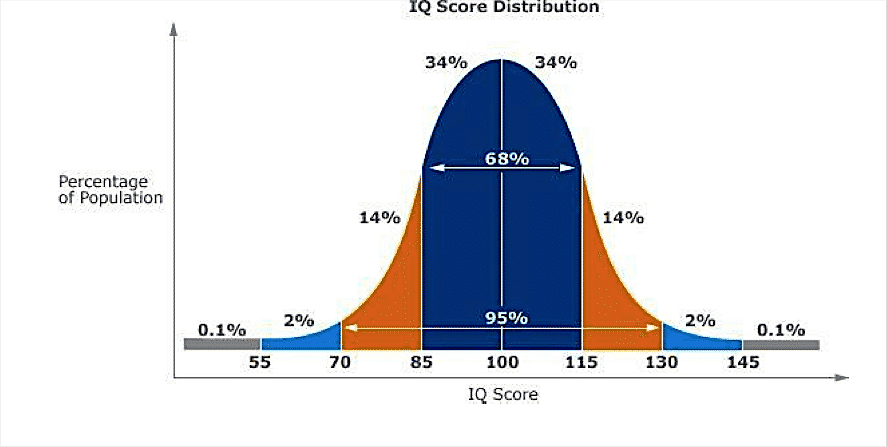
As you can see, 2.1% of the population scores 130 or higher. 14% of the population would fall into the 115-130 range, meaning that they might not be as intelligent as those above them, but they are certainly smart. What is being done for those students to challenge them to achieve at the level they are capable? We have programs for the gifted and at the other end of the spectrum with special education students. What about that student who is close to gifted but not quite there? Right now, even if they are close, many are getting no cigar.
How Do We Challenge Gifted Students
The question remains, what do we do for this almost gifted student, and how do we as an educational system challenge them? An easy fix would be just to add more services. After all, these are our future doctors, lawyers, politicians, and other such citizens who will be a major factor in steering our society into the future. Would we not want them to have the very best education possible to make these paths easier to traverse? Yet very little dollars are devoted to these bright students.
Why Shifting Budgets Doesn’t Work
Issues with gifted identification aside, the fact of the matter is we want to be able to have students reach their potential. The problem is that there are only so many resources to go around. Even if the government were to decide to provide more funding for gifted education, they would simply be robbing Peter to pay Paul. Special education would see its funding lowered to compensate or some other group that receives funding would suffer.
Where To Find Gifted Resources
The truth about these resources is they do not have to come from above; they can be provided at a grassroots level by teachers and parents. And it is not the amount of money spent on these resources but rather the way you use it. Both teachers and parents have learned in their respective fields that being purposeful in the way you use your available resources it much more important than the amount of resources used. Instead of throwing everything at the wall and seeing what will stick as happens with many reforms in education, teachers and parents need to be resourceful about their resources and use them as effectively as possible. This would ensure that almost gifted students are receiving the attention they deserve. In many cases, you have to know where to look for these resources and that is what the rest of this book will help you to accomplish.
Read more from Todd at Stanley at edCircuit and The Gifted Guy.
Gifted test scores explained: an edCircuit guide
Added by edCircuit in October 2026 to accompany Todd Stanley’s article above.
What the CogAT measures
The Cognitive Abilities Test (CogAT), published by Riverside Insights, measures reasoning in three areas, called batteries: verbal, quantitative and nonverbal.
CogAT results are reported in several ways:
- Standard Age Score (SAS). A score with an average of 100 and a standard deviation of 16, given for each battery and for the composite. On current forms it ranges from 50 to 160, according to Riverside’s score guide.
- Age percentile rank. From 1 to 99, comparing a student with students of the same age in the national norm group. A percentile of 95 means the student scored higher than about 95 percent of that group.
- Stanine. A score from 1 to 9. Riverside describes stanines 1–3 as below average, 4–6 as average, 7–8 as above average and 9 as very high.
- Ability Profile. A short code such as “8A” or “9B,” combining the student’s middle stanine with a letter that describes the pattern of their scores across the three batteries.
The OLSAT
The Otis-Lennon School Ability Test (OLSAT 8), published by Pearson, measures verbal, nonverbal and quantitative abilities for grades K–12. Its main age-based score is the School Ability Index (SAI), reported along with percentile ranks and stanines.
Stanines and percentiles
Stanines divide scores into nine bands. This is how they line up with percentiles, according to the Australian Council for Educational Research:
| Stanine | Share of students | Percentile range |
|---|---|---|
| 9 | 4% | 96th and above |
| 8 | 7% | 89th–96th |
| 7 | 12% | 77th–89th |
| 6 | 17% | 60th–77th |
| 5 | 20% | 40th–60th |
| 4 | 17% | 23rd–40th |
| 3 | 12% | 11th–23rd |
| 2 | 7% | 4th–11th |
| 1 | 4% | Below the 4th |
The “almost gifted” students Stanley describes typically fall in stanine 8.
How states set gifted cutoffs
Cutoffs vary by state and district. Two examples:
- Georgia accepts a mental-ability score at the 99th percentile in grades K–2 or the 96th percentile in grades 3–12 together with an achievement score, or strong results in three of four areas: mental ability, achievement, creativity and motivation.
- Florida requires an IQ two standard deviations or more above the mean on an individually given intelligence test, which is 130 on a test with a standard deviation of 15, plus other evidence.
The National Association for Gifted Children recommends that identification “should not be based on a single assessment”, which is one reason many districts combine ability tests with achievement scores, teacher observations and work samples.
Frequently asked questions
What is a good CogAT score? An SAS of 100 is average. Higher scores are above average, and gifted cutoffs are usually set near the top few percentiles, such as Georgia’s 96th percentile for grades 3–12. Check your district’s own criteria.
What does an IQ of 120 mean? On an IQ scale with an average of 100 and a standard deviation of 15, a score of 120 is at about the 91st percentile, higher than roughly nine in ten people.
Is one test score enough? Not according to the National Association for Gifted Children, which recommends using several kinds of evidence, as noted above.
Subscribe to edCircuit to stay up to date on all of our shows, podcasts, news, and thought leadership articles.
Related reading
More on Gifted and Advanced Learning

