Will Librarians Be The Overseers Of The Information Age?
ALA President Julie Todaro and Choosito! CEO Eleni Miltsakaki argue that librarians are becoming more important as guides to online information.



Julie Todaro, President of the American Library Association, ALA and Eleni Miltsakaki, founder and CEO of Choosito! talk about the role of librarians in today's schools. Contrary to the widely held notion that the role of the librarian is shrinking, both Todaro and Miltsakaki make strong arguments for the increased importance of librarians as overseers of an endless stream of Internet data. Todaro and Miltsakaki agree that students, more than ever, need the guidance of librarians in their educational lives.
Julie Todaro, President of the American Library Association, ALA and Eleni Miltsakaki, founder and CEO of Choosito! talk about the role of librarians in today’s schools. Contrary to the widely held notion that the role of the librarian is shrinking, both Todaro and Miltsakaki make strong arguments for the increased importance of librarians as overseers of an endless stream of Internet data. Todaro and Miltsakaki agree that students, more than ever, need the guidance of librarians in their educational lives.
Independence and the Need for Guidance
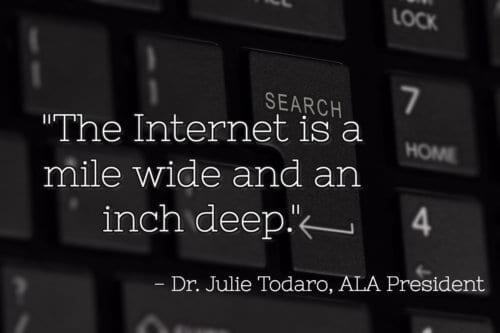
People have long said students “can do it on their own,” Todaro said, or that “Everything on the Internet is for free, and it’s there.” Her answer from early on: “The Internet is a mile wide and an inch deep.” And it is not only children, “we also expect adults to do things on their own, as well.”
Instead, “there should be an ever-continuing exchange of discussion and interaction” with teachers and librarians to help people navigate: finding the right tool, learning how it works, learning its language, and then choosing among the resources it returns. “Those are the four elements that schoolteachers, librarians, and academics deal with all the time, and they’re never-ending.”
Changing How We Look at Information
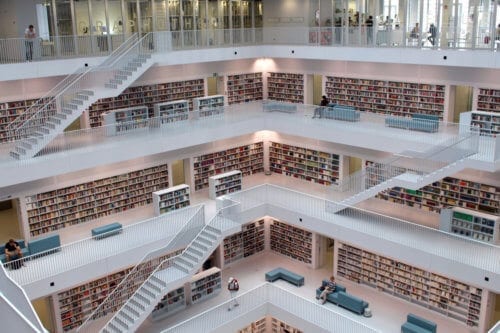
Miltsakaki spent many years at a graduate school of education working with teachers and librarians. “I find that the biggest challenge that comes with the new age of information and the new shape that information has taken is how to change how we look at information,” she said. “It seems almost hardwired in our brains that you see the printed word and you rush to read it without qualifying that printed word at all.” Books came through editors and librarians, but the web “has a very different DNA,” with user-generated content and “some reliable information and some not-so-reliable information.”
“I think the librarians are critical in this new information age in helping students and adults,” she said.
Curation in the Information Age
“We cannot manually curate, 1 trillion different resources, and there are 100 million resources added every day,” Miltsakaki said. So curation has to become a skill everyone carries. “I believe it is critically the role of the librarians to train students with the skill to say, ‘Okay, let’s look at what makes the information good information.'” That means looking past trusted sources such as Britannica to judge an individual writer: “Is he citing when he’s analyzing a topic? How is he analyzing?” Librarians “are best positioned due to their skill set. They have been trained to do just that.”
Teaching Students to Judge Credibility
Todaro remembered a student researching secondhand smoke who told her, “You don’t need to help me. I have America Online.” His first result ended in .ca. “And I said, ‘Son, that’s Canada. It’s not the United States.'” The next was a commercial site. “It was a cigarette company.” “That’s the expertise that librarians deal with every day, some of which we can transfer to people to use to apply to everything.”
Multiply that by every discipline, she said. In geography, old sources must sit beside new ones, since some schools still have “an encyclopedia set that still doesn’t have the United Arab Emirates in it.” “The printed word has always been revered, and when you put that on the screen, there’s that continued reverence.”
Professional Development for Librarians
ALA members are “constantly queried as to what kind of content they want and need,” Todaro said. School and academic librarians “have the request for information literacy and education at the top of their list,” along with help “identifying scholarly resources.”
Open Educational Resources
The “extreme ‘hot topic'” is Open Educational Resources, “resources that are created by and vetted by very expert people, some of which are free, some of which charge for the platform they’re delivered on.” Todaro also pointed to Valerie Gross, who “focuses on the public library as an educational institution,” where “every single exchange adds critical thinking as well.”
Miltsakaki agreed: “What I would love to see, that makes perfect sense, is professional development for information literacy, identifying scholarly resources, using various tools, and also accessing the OER Commons.”
The Librarian’s Place in School Life
In schools, Miltsakaki said, the librarian is often called in only for a project. “I feel the librarian still has a supplementary role in the life of the school.” “I would love to see the librarian get a little bit of the center stage.” Schools talk about critical thinkers who can “analyze information, synthesize information, create innovation, and create novel thinking,” but “the reality of the school is there is the curriculum,” and learning to evaluate information “seems to be a side part of the school life.”
Todaro’s reply: “You know, Eleni, I think you can be our new Queen.”
Research on the Value of the Librarian
“That’s really at the crux of my initiative, which focuses on the expertise, and the value of the librarian,” Todaro said. Much of the research began in Colorado, asking “What is the likelihood of having higher scores come out of a school on standardized tests, local tests with the presence of a librarian?” She planned to push forward work by David Lankes on “the strong relationship between having the information coach, the information expert, the librarian, in the schools to support the classroom faculty.”
Linking the Library to the Principal’s Plan
“Every chance librarians get, they need to link themselves to the success of the student and the student learning objectives, and completions,” Todaro said. At a recent Texas conference, one idea stood out: school librarians should get a copy of the principal’s business plan each year, then sit down and say, “I’ve identified eight areas where the library can do X for you.”
“It is one thing for me to say this but the most critical thing is for Eleni to say it,” Todaro added. “She’s an expert in another area and certainly an adjacent area.”
Librarians and Student Data
“Something important is materializing as a new critical role of the librarian in schools; it’s analyzing student data,” Miltsakaki said. When a librarian tells the principal “Here’s how I can help you succeed,” what makes it forceful “is when you have the supporting data.” Librarians “would love to see the evidence that their work is actually working,” comparing a student at the start of the year with the end, “So, kind of this more tangible proof that they are delivering learning results.”
Related reading
More on K-12