A Closer Look at Free Tuition
The edition examines New York's free tuition proposal, questions about the record graduation rate and federal grants for two Oakland schools.

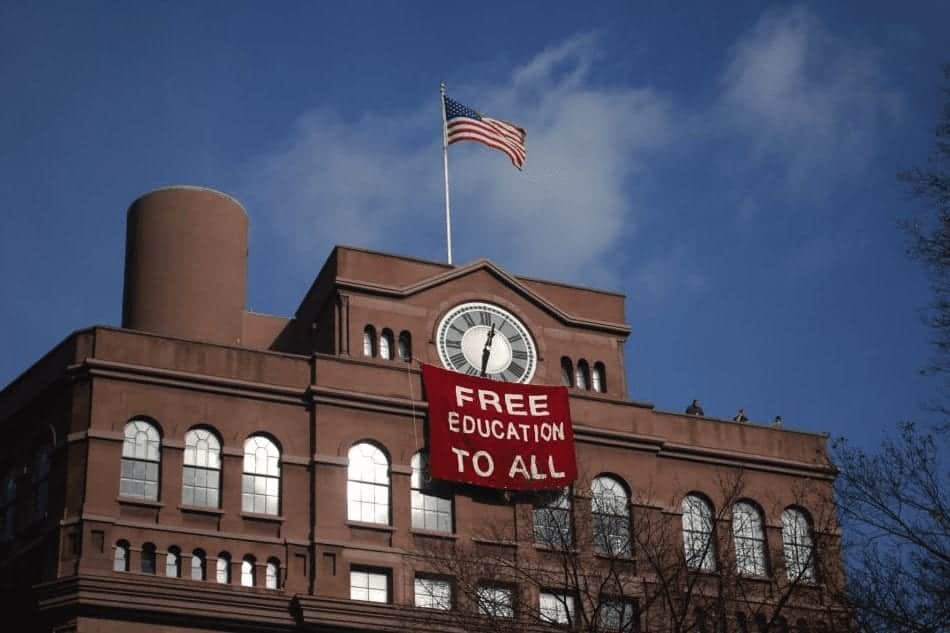
The January 27, 2017 InformED Report examined New York's free tuition proposal, questions about the record graduation rate, and $17.2 million in grants for two Oakland schools.

The InformED Report for January 27, 2017 took a closer look at free tuition, as New York Governor Andrew Cuomo proposed covering in-state college tuition for eligible families. The edition also examined whether the record 83 percent U.S. high school graduation rate reflected real learning gains, and it featured two Oakland schools that won $17.2 million in federal school improvement grants.
Each story touched on the same question from a different angle: what it takes to move students successfully from high school into college, and how public money is used to get them there.
In this edition
- The Washington Post questioned whether the record 83 percent high school graduation rate was inflated by credit recovery programs used in 88 percent of districts.
- Governor Andrew Cuomo proposed free tuition at New York’s public two- and four-year colleges for families earning up to $125,000 a year.
- Two Oakland Unified elementary schools were awarded $17.2 million in federal school improvement grants.
Is the record high school graduation rate real?
In mid-October 2016, federal data showed the U.S. high school graduation rate had reached an all-time high of 83 percent for the 2014-15 school year, with gains for every student group, including low-income students, students with disabilities and English learners. In the District of Columbia, the rate rose from 53 percent to 69 percent, the largest increase anywhere.
A January column by Jay Mathews in The Washington Post argued that the figure may be an illusion. Mathews pointed to the spread of credit recovery, used by 88 percent of school districts, in which students who fail a course can make up the credit, often through an online course. Reports suggested the bar for passing those courses had been lowered, and Mathews noted that no research showed the higher graduation numbers reflected learning gains. For district leaders, the column raised a practical point: a graduation rate is only as meaningful as the standards behind each credit, and credit recovery programs need the same scrutiny as regular coursework.
A closer look at free tuition in New York
Governor Andrew Cuomo proposed free in-state tuition at New York’s public colleges for eligible residents. He announced the plan at LaGuardia Community College in Queens alongside Senator Bernie Sanders, who had campaigned for free tuition at public colleges during his presidential run. The proposal, called the Excelsior Scholarship, would cover tuition at two- and four-year public colleges for families earning up to $125,000 a year.
Critics responded quickly. Many said the plan did not do enough for low-income students, whose tuition is often already covered by federal and state aid. Robert Kelchen, a professor at Seton Hall University, pointed out that students face many expenses in addition to tuition. For high school counselors and college access staff, the debate was a reminder that “free tuition” and “free college” are different things, and that families need help planning for the full cost of attendance.
InformED Report spotlight: Oakland schools win $17.2 million in improvement grants
Two East Oakland elementary schools, Futures Elementary School and Community United Elementary School, were awarded a combined $17.2 million in federal school improvement grants. The five-year grants come through the California Department of Education. Both schools share the Havenscourt-Lockwood campus and serve mainly low-income students, many of them English learners.
School leaders welcomed what they described as a second chance. David Montes de Oca, the district’s senior deputy chief of continuous school improvement, said the district was committed to using the funds to raise the quality of education over the long term. A five-year grant of that size allows a school to plan staffing and programs over several years rather than one budget cycle at a time.
Further reading from that week
- The New York Times: Private Colleges Suggest New York’s Free Tuition Plan Limits Choices
- The Sundial: A master plan for free tuition
- The Wall Street Journal: Betsy DeVos Questioned by Bernie Sanders on Wealth, Free Tuition
Sources
- Emma Brown and Alejandro Matos, “Nation’s high school graduation rate reaches new record high,” The Washington Post, October 17, 2016.
- Jay Mathews, “Why surging high school graduation rates might be a mirage,” The Washington Post, January 8, 2017.
- “Gov. Andrew Cuomo calls for free tuition at New York public colleges,” ABC7 New York, January 3, 2017.
- James S. Murphy, “The Gaps in New York’s Free-College Plan,” The Atlantic, January 10, 2017.
- Joyce Tsai, “Oakland: Two schools to share $17.2 million school improvement grant,” East Bay Times, December 15, 2016.
About the InformED Report
The InformED Report is edCircuit’s short news program on education. This edition first ran on January 27, 2017. In 2026, edCircuit re-presented it with a new anchor and this full written account. Both report the stories as they stood on that date and link the original reporting, so readers can see exactly where each claim came from.
Subscribe to edCircuit to stay up to date on all of our shows, podcasts, news, and thought leadership articles.
Related reading
More on College Admissions