


edcircuit
Share Your Voice on edCircuit
Promotional banner for Safer Ed: The School Safety Podcast, with students walking in a school hallway and a prominent Listen Now button.
Home K-12 Being a PD “Thought Stretcher”
3 minutes read

Being a PD “Thought Stretcher”

Professional development leader Drew Perkins explains how he uses questions to get teachers thinking about how they can improve.

Drew Perkins, a 'thought stretcher' in education professional development, explains why he gets teachers asking questions instead of telling them how to teach.
Listen to this article (3 minutes 52 seconds)Listen to this article3 min 52 s · read by a computer voice
CoffeED: Drew Perkins12 min 45 sedCircuit on Vimeo

A professional development pro questions his way forward
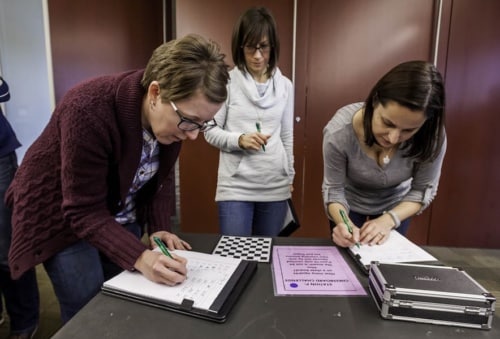
Three women stand at a table writing on clipboards Two are leaning over while writing and the third is standing behind them The table holds clipboards a chessboard a locked box and a purple information sheetDrew Perkins has a lot of questions. That’s what sets him apart as a “thought stretcher” in the world of education professional development. Instead of telling teachers and administrators how to teach, he tries to turn it around and get them asking questions about how they can get better. When a school inquires about a PD workshop, he likes to ask questions to identify needs they have and then personalize and co-construct a PD program for them.

“What is your mission statement?” Drew will ask, knowing most mission statements are a list of platitudes in a frame on the wall. He then turns that mission statement into a mission question and uses the inquiry process to say, “What do we need to know and be able to do in order to answer that question and achieve that mission? What does that vision look like? What do we want our schools and our districts to look like, sound like, and feel like? And what are the actions that we need to take as leaders, as schools, and as individuals?”

Illustrated cover for The TeachThought Podcast featuring diverse cartoon faces of teachers and the slogan We Grow Teachers at the bottomThat is what really drives his approach to professional development for individuals, teams, department heads and schools. When they are finished, he comes back and asks, “In what way did that meet and align with that mission and vision? And, if not, why not and do we need to do something differently and/or do we need to revise our mission and vision?”

It is this approach that separates Drew from the crowd and solidifies his position as an innovator and thought leader in the world of professional development.

More on professional development from February 2018

In February 2018, edCircuit writer Jim Reams described Drew Perkins as an example of a professional development leader taking a new approach, and placed that approach beside several other efforts to make professional development more useful.

Steve Dembo, a consultant and professional development expert, told EdTech Magazine that sessions should break away from rows of chairs and a lecture. “There is something very powerful about motion and the impact that it has on the brain,” Steve Dembo said, adding that a conversation held while moving around changes the dynamic.

The University of North Carolina reviewed how it prepares educators to teach reading. UNC President Margaret Spellings said at the time that the system was not doing as good a job as it could to prepare teachers to teach young children literacy, and that better preparation would improve scores.

One district made professional development about STEAM hands-on by having teachers build their favorite fruits from Lego blocks. Sonia Roy, a librarian at Coyote Canyon Elementary School who led a session called “Easy Peasy STEAM in the Primary Classroom,” said teachers are engineers who find ways to solve problems every day: they develop plans to teach the standards and test whether the approach worked.

Jim Reams concluded that educators and administrators should always look for new ways to grow, which Drew Perkins describes as stretching thoughts around new methods of professional development.

Further Reading

  1. The Washington Post – Report urges major changes in career education at Maryland school system
  2. The Hechinger Report – Three lessons from rigorous research on education technology
  3. WRAL – ‘Fighting the status quo’: Inside the combative world of NC’s new public schools chief

More on K-12

Promotional banner with a book cover on the left titled 'Purposeful Technology, Powerful Learning: You Can't Ban Possibility' and a blue text panel on the right reading '13 districts. Real classrooms. Documented stories of technology used with intention. Learn More: stayh... com' with the CoSN logo at the bottom.

Join Thousands of Other Subscribers

This field is for validation purposes and should be left unchanged.

Participate in the COmmunity

Blue hero banner promoting a CoSN resource on screen time policies for district leaders, with a booklet image and the URL CoSN.org/screentimepolicy (From Screen Time Mandates to Purposeful Technology Policies and Guidance).
Share Your Voice on edCircuit

Use EdCircuit as a Resource

Would you like to use an EdCircuit article as a resource. We encourage you to link back directly to the url of the article and give EdCircuit or the Author credit.

MORE FROM EDCIRCUIT