

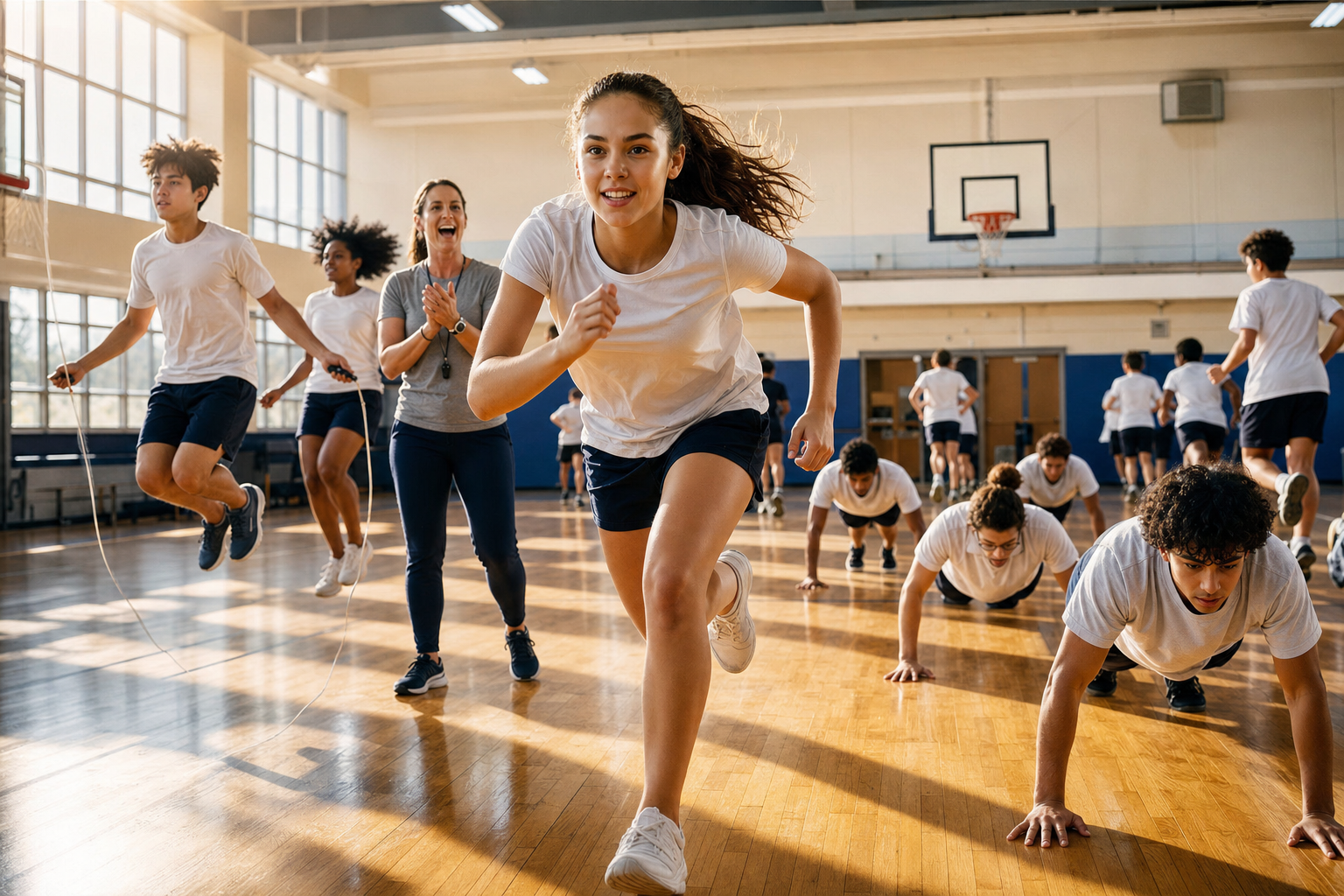
Physical education is one of the few places in the school day built around movement, and fewer students are getting it. In 2025, only 20 percent of U.S. high school students attended PE every day, down from 30 percent in 2015, and only one in four was active for the 60 minutes a day that health guidelines recommend. At the same time, the federal government has revived the Presidential Fitness Test, putting school fitness back in the national conversation. This guide covers the benefits of physical education, what the guidelines recommend, what the research says about PE and learning, and what schools can do.
How much physical activity do students need?
The Centers for Disease Control and Prevention says children and teens ages 6 to 17 need 60 minutes or more of moderate-to-vigorous physical activity every day. Most of it should be aerobic, with vigorous activity at least three days a week, plus muscle-strengthening activity such as climbing or push-ups and bone-strengthening activity such as jumping or running, each at least three days a week. Children ages 3 to 5 should be physically active throughout the day.
For schools, SHAPE America, the national organization for physical education, recommends 150 minutes of physical education a week for elementary students and 225 minutes a week for middle and high school students, for the entire school year.
How many students meet the guidelines?
Most do not. The CDC’s 2025 Youth Risk Behavior Survey of high school students found:
| Measure (high school students) | 2015 | 2025 |
|---|---|---|
| Attended physical education every school day | 30% | 20% |
| Active at least 60 minutes every day | 27% | 25% |
| Muscle-strengthening activity on 3 or more days | 53% | 51% |
| Met both the aerobic and muscle-strengthening guidelines | 20% | 16% |
The gap between boys and girls is large: 32 percent of boys were active 60 minutes a day, compared with 18 percent of girls, and 16 percent of girls attended PE daily, compared with 23 percent of boys. Sports team participation rose to 58 percent in 2025.
Childhood obesity has risen too. From August 2021 to August 2023, 21.1 percent of U.S. children and teens ages 2 to 19 had obesity, including 7 percent with severe obesity, according to the National Center for Health Statistics. In the early 1970s the figure was about 5 percent.
The benefits of physical education
Physical health
PE is the one setting where every student, not only those who play sports, gets structured time for the kinds of activity the CDC recommends: aerobic activity, muscle strengthening and bone strengthening. With only one in four high school students meeting the daily activity guideline, that guaranteed time matters.
Learning and behavior
A common worry is that time for PE takes away from academics. The evidence says it does not. A CDC review of 50 studies found that more than half of the associations between school-based physical activity and academic performance were positive, nearly all of the rest showed no effect, and only 1.5 percent were negative. All eight studies of recess found positive links with attention, concentration or on-task behavior. The CDC concluded that increasing or maintaining time for PE “may help, and does not appear to adversely impact, academic performance.”
Newer research points the same way. A 2025 meta-analysis of 17 randomized controlled trials found that school-based physical activity modestly improved overall academic achievement and math, though not reading or language, and the authors noted the small number of studies. A review of 41 systematic reviews concluded that physical activity does not appear to harm students’ academic achievement. In Sweden, a nine-year study of daily PE found that boys who had 40 minutes of PE every day were more likely to qualify for upper-secondary school, though there was no significant change for girls.
Lifelong habits
Physical education teaches movement skills, teamwork and how to plan exercise, which students carry beyond school. For students who do not play organized sports, it may be the main place they learn those skills.
Where state policy stands
Many states do not require the nationally recommended minutes of physical education in law, and substitutions and exemptions remain common, especially in middle and high school, according to a 2026 national review of state policy summarized by SHAPE America. Some states are adding protections: Texas prohibits withholding PE and recess as punishment, and Pennsylvania enacted a recess law, Act 20 of 2026, in July.
The Presidential Fitness Test returns
On July 31, 2025, President Trump signed an executive order reestablishing the Presidential Fitness Test, to be administered by the Secretary of Health and Human Services with support from the Secretary of Education, and reorganizing the President’s Council on Sports, Fitness, and Nutrition. In 2026 the test was made mandatory at the 161 K-12 schools run by the Department of Defense and encouraged, but not required, in other schools. Its tasks include push-ups, pull-ups, planks and a one-mile run, the Santa Fe New Mexican reported.
For schools deciding whether to adopt the test, the question is how it fits a PE program. Fitness testing can help students set goals, but on its own it does not add minutes of activity or teach the skills that keep students active.
What schools can do
- Protect PE time. Work toward SHAPE America’s 150 minutes a week in elementary school and 225 minutes in middle and high school.
- Limit substitutions and waivers that let students skip PE entirely.
- Keep recess, and do not withhold recess or PE as punishment.
- Add movement to classrooms through short activity breaks, which research links to better attention and on-task behavior.
- Focus on girls’ participation, where the gap in daily activity is largest.
- Use fitness data to help students, not to rank them.
Frequently asked questions
What are the benefits of physical education? Better fitness, muscle and bone strength and a healthy weight; positive or neutral effects on attention and academic performance; and the skills and habits for a lifetime of activity.
How much PE should students have? SHAPE America recommends 150 minutes a week in elementary school and 225 minutes a week in middle and high school.
How much physical activity do kids need each day? At least 60 minutes of moderate-to-vigorous activity a day for ages 6 to 17, according to the CDC.
Does PE improve grades? Research finds that physical activity at school does not harm academic performance and can modestly improve it, especially in math, attention and on-task behavior.
Is the Presidential Fitness Test back? Yes. It was revived by executive order in 2025, is required at Department of Defense schools and is encouraged elsewhere.
Subscribe to edCircuit to stay up to date on all of our shows, podcasts, news, and thought leadership articles.
Related reading
More on K-12