High School Esports: How to Start Your First Team
One teacher, five students and a manageable plan can create a program that builds teamwork, confidence and school spirit.

In this article
- 1.Step 1: Start with students, not purchases
- 2.Step 2: Find an adviser and get approval
- 3.Step 3: Bring the IT department in early
- 4.Step 4: Choose a league and a game
- 5.Step 5: Fund the next step, not the dream room
- 6.Step 6: Coach the culture, not just the game
- 7.Step 7: Keep the door open as the team grows
- 8.Step 8: Let the school see the team
- 9.Frequently asked questions
- 10.The first victory is getting started

Starting a high school esports team is simpler than it looks. Eight steps from the first meeting to the first season, with costs and leagues.
Starting a high school esports team is simpler than many schools expect. It does not require a custom gaming arena, a five-figure budget or a teacher who can beat every student in the building. Most successful programs start small: a handful of interested students, one adult adviser, equipment the school already owns and one season in an established league. This guide walks through the steps, from the first meeting to the first season and beyond.
Step 1: Start with students, not purchases
The first step is not buying computers. It is finding out what students want. Ask what they play, what equipment they use and whether they are interested in casual gaming, organized competition or both. Some students will want to compete; others may be more interested in broadcasting matches, managing technology, designing graphics or organizing events.
The first meeting does not need to fill a classroom. Five committed students are enough to begin, and they can research games and leagues, help prepare a proposal for administrators and recruit classmates. PlayVS, which the NFHS Network calls the nation’s leading scholastic esports provider, suggests posting flyers, featuring esports in morning announcements and enlisting fellow teachers to spread the word. Personal invitations matter too: the student who talks about gaming with a few friends at lunch may bring three new people to the next meeting.

Give students ownership from the start. Let them suggest a team name, describe what they want the program to become and explain why it belongs at their school.
Step 2: Find an adviser and get approval
The adult who leads the team does not need to be the best gamer in the room. An adviser’s value is organizing meetings, communicating with families, setting expectations, reserving a room and helping students work through disagreements. A ViewSonic guide for schools lays out a useful starting order: find a teacher to mentor the club, spread the word, decide the meeting time and structure, and set up reliable communication with members early.
A first proposal to the principal can be short: the number of interested students, the purpose of the program, practice times, estimated costs and the league being considered. It should also explain how academic eligibility, behavior and sportsmanship will be handled, just as for any other activity.
Step 3: Bring the IT department in early
The technology team needs a seat at the table before anyone buys equipment or registers for a season. Games may need large downloads, frequent updates, individual accounts or access to services that the school network blocks. A computer that handles class assignments easily may struggle in competition.
Test the game, accounts, headsets and internet connection well before the first official match. Expect the first practice to involve more password resets and software updates than strategy. That is normal.

Step 4: Choose a league and a game
Most high school teams compete through a league or a state association. When comparing options, look at eligibility rules, fees, season dates, roster sizes, the games offered, equipment needs and technical support.
- PlayVS and state associations. PlayVS is the esports partner of the NFHS Network, and it entered the 2026–27 school year working with 25 state and regional partners. Its high school titles include Rocket League, Super Smash Bros. Ultimate, Mario Kart 8 Deluxe, Splatoon 3, Madden NFL, League of Legends and chess, among others; some titles are not offered by every state association. Check with your state association first, because availability and recognition vary.
- NASEF. The North America Scholastic Esports Federation is free to join and offers club frameworks, a coaching certification, state-approved curricula and information about esports careers, for schools that want to connect competition with learning.
Know the costs. League pricing has changed. After restructuring in May 2026, PlayVS ended its free model and now charges high schools a flat $595 per school for the 2026–27 year ($495 if paid by September 4, 2026), covering every season, title, team and player, according to its help center. Before the free model, the Kentucky state association noted, PlayVS charged $80 per student per season. Ask your state association or league for the current fee before budgeting.
Check game ratings. Some schools and leagues limit teams to games rated E, E10+ or T by the Entertainment Software Rating Board. Louisiana 4-H Esports, for example, tells clubs to choose titles rated E, E10+ or T and to avoid M- and AO-rated games. Set a clear rule with your administration before students choose a game.
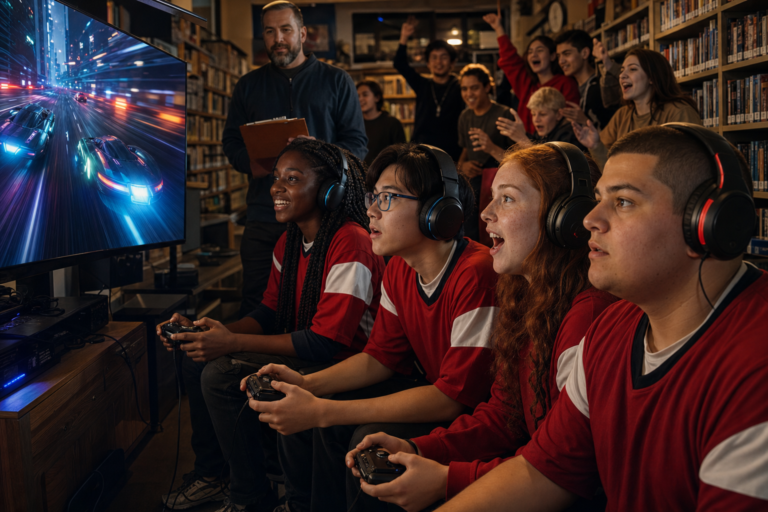
Begin with one approved game, one competition schedule and equipment the school already owns. A computer lab, library or career-technical classroom may be enough for a pilot season, and console games such as Rocket League or Mario Kart can be an affordable starting point. The goal for the first season is not to build the most impressive program in the state. It is to finish with students who want to come back.
Step 5: Fund the next step, not the dream room
A first budget should cover what students need to compete: league registration, headsets and a few spare controllers. Rather than asking local businesses for “gaming equipment,” explain what the team is building and ask for something specific. One business might sponsor headsets, another the registration fee; a restaurant might host a fundraising night. Students can take part in those conversations, which makes them practice in public speaking, planning and budgeting.
Technology companies, internet providers, banks, electronics stores, community foundations, booster groups and colleges with esports programs are all possible partners. Build in stages. In Pennsylvania, Elizabethtown Area High School’s team won its second straight state title in May 2026 and then received an $80,000 state grant for computers, consoles and furniture for a dedicated esports space, LancasterOnline reported. That came after years of results. A new team should build participation first, document what students achieve and tell their stories; larger opportunities follow.
Step 6: Coach the culture, not just the game
A group of talented gamers is not automatically a team. Students need clear expectations for attendance, academic eligibility, respectful communication, sportsmanship and care of school equipment, and they need to understand that representing the school changes how they play. Toxic comments, harassment and blaming teammates cannot be excused as part of gaming culture; a school team should model something better.
Practices should have a purpose: communication drills, reviewing past matches, strategy and specific goals for improvement. Players should learn to accept coaching, recover from mistakes and support teammates after a loss. Build healthy habits in as well: breaks in longer sessions, water, movement and posture, and honest talk about balancing schoolwork, sleep and screen time. The adviser may never be the team’s best player. What they coach is preparation, communication and conduct.
Step 7: Keep the door open as the team grows
Successful programs often attract more students than one roster can hold. A good approach is to keep general membership open while holding tryouts for competition rosters, judging communication, reliability, sportsmanship and teamwork as well as skill. Students who do not make the starting roster can play on a developmental team, serve as substitutes or take on roles as analysts, equipment managers, graphic designers, broadcasters or event organizers. The world around esports is much larger than the starting lineup, and some students discover an interest in video production, marketing or data that they did not expect.
Step 8: Let the school see the team
Esports should not stay hidden in a computer lab after school. Publish the schedule, announce results, invite families and teachers to watch matches, and recognize players at announcements, pep rallies and awards nights alongside other activities. Visibility changes how the school sees the program, and often how students see themselves. A Nebraska News Service feature on high school and college players in Nebraska describes how much belonging on a team can mean to them.
Established programs show how far a team can grow. In March 2026, Bethlehem Central High School in New York was ranked the top high school esports program in the country in the USA Today Sports/PlayVS Super 25, competing in five titles with a 93.75 percent match-winning percentage. Programs like that started the same way as everyone else: with a few students and an adult willing to help.
Frequently asked questions
How many students do you need to start an esports team? About five committed students are enough to begin, though roster sizes depend on the game and the league.
How much does it cost to start a high school esports team? It can start with equipment the school already owns plus league fees. PlayVS charges $595 per high school for 2026–27. Headsets and controllers are typical early purchases.
Does the coach need to be a gamer? No. An adviser organizes, sets expectations and supports students; strategy can come from the players themselves.
What games do high school esports teams play? Common titles include Rocket League, Super Smash Bros. Ultimate, Mario Kart 8 Deluxe, Splatoon 3, League of Legends and Madden NFL. Some schools allow only games rated E, E10+ or T.
Is esports an official high school activity? It depends on the state. PlayVS works with 25 state and regional partners for 2026–27, so check with your state association.
The first victory is getting started
A school’s first esports team does not need a custom facility, a major sponsor or dozens of players. It needs an adult willing to ask a question and students excited to help find the answers. Five students may come to the first meeting and twelve may finish the season. A few years later, the program may include competitive teams, student broadcasters and a crowd that follows the results, and some students will have found a reason to stay after school and feel the pride of being part of a team.
Subscribe to edCircuit to stay up to date on all of our shows, podcasts, news, and thought leadership articles.
Related reading
More on ESports