
AI Literacy Belongs in Every Classroom
How schools can help students understand AI, question its answers, and use it without giving up their own thinking

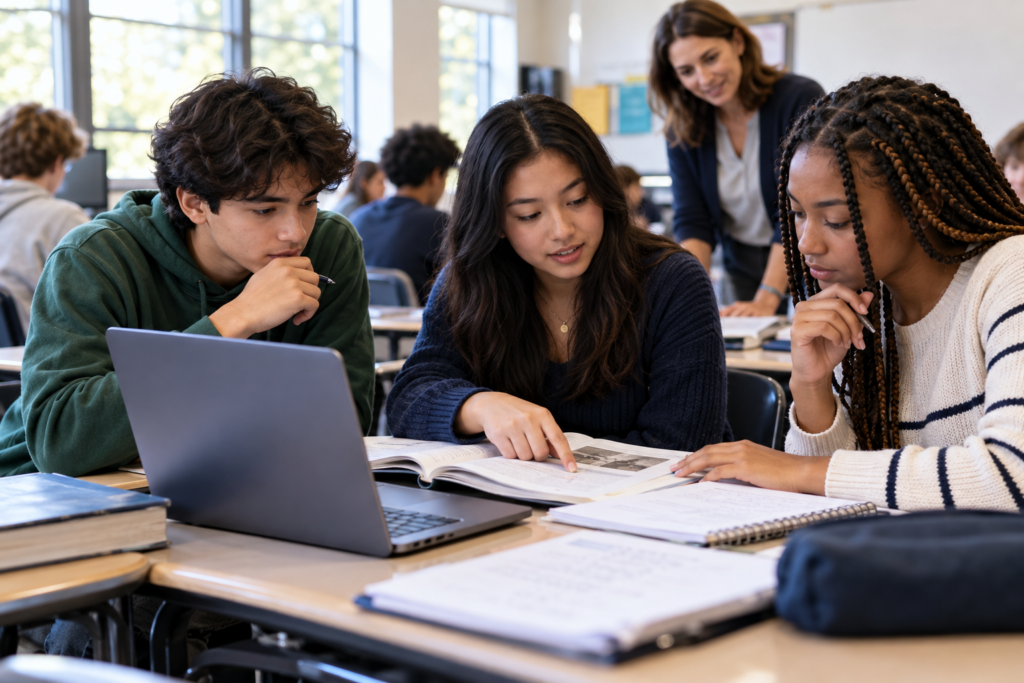
AI literacy helps students understand how AI works, check its claims, protect their data, and make thoughtful choices across school subjects.
AI literacy in schools begins with a question students can ask whenever a tool offers to help: What is this doing for me, and what do I still need to do myself? A student who can write a prompt but cannot check the answer or explain a decision has learned only a fraction of what they need.
Students encounter AI in search results, recommendations, writing and translation tools, images, and software that predicts or sorts information. They need to understand that these systems can be useful without being reliable in every instance. They also need to recognize when using one would replace the very thinking an assignment is meant to develop.
That work belongs in everyday instruction. An English class can examine a generated argument. A science class can test a generated explanation against observations. A history class can ask whose perspective a summary leaves out. Students can learn about AI even when district policy does not permit them to use a chatbot.
Define what students should learn
AI literacy is more than knowing which buttons to press. Students should be able to recognize when a system is generating, recommending, predicting, or classifying; check its claims against evidence; notice what may be missing or biased; protect personal information; and decide whether its use fits the task.
These are teachable skills. UNESCO’s student competency framework covers human-centered thinking, ethics, AI techniques and applications, and system design. The AI Literacy Framework for Primary and Secondary Education, finalized in June 2026 by the OECD and European Commission, describes engaging with, creating with, managing, and shaping AI. It includes classroom scenarios that do not require students to access an AI tool directly. These frameworks can help a district plan a progression across grades rather than offer the same introductory lesson each year.
The practical question for teachers is what understanding a student should demonstrate. Can the student identify a claim that needs verification? Explain why two answers differ? Recognize an unfair assumption? Decide to complete a task independently? Those are stronger signs of literacy than a polished prompt.
Make the learning goal determine the tool’s role
Before introducing AI into an assignment, a teacher needs to know what students are learning to do on their own. If the goal is to build an argument from evidence, having a chatbot draft the argument first removes crucial practice. If the goal is to evaluate an argument, a teacher-provided AI response with plausible but unsupported claims can become useful material.
Assignment directions should state the boundaries plainly. Students might be allowed to ask an approved tool for feedback on a draft but be required to write the draft themselves. In another lesson, they might analyze a generated answer without using AI in their final response. They should know what assistance is permitted and how to acknowledge it.
Ohio’s 2026 guidance for content-area instruction connects AI literacy to existing learning standards and calls for clear learning objectives and expectations for use. Its model-policy resources also cover privacy, tool review, staff development, and assessment. District policy establishes the boundaries; teachers make them understandable through the work students do.
Build understanding across grade levels
In an elementary classroom, students could sort pictures into categories, then discover how an incomplete set of examples leads to a poor decision. The teacher can connect that experience to how some AI systems learn from data. Students can discuss whether a computer’s answer is always correct without opening a chatbot.
In middle school, a teacher might present a short AI-generated explanation alongside a course text. Students underline what the text supports, circle claims they cannot verify, and discuss what information the answer leaves out. Where approved tools are available, they might ask the same question two ways and investigate why the responses change.
By high school, students can make judgments about AI’s place in a task. They might decide whether to use it for feedback on a draft, check a generated research claim against primary sources, or evaluate how a system could affect people who depend on its recommendations. The focus shifts from spotting an error to explaining a choice.
These are suggested lesson designs, not accounts of lessons observed in a particular district. Published district plans show how schools are setting the conditions for work like this. Redlands Unified School District emphasizes awareness and teacher modeling without direct chatbot exposure in TK–5, supervised critical use in grades 6–8, and collaboration, auditing, and ethical decisions in grades 9–12.
New York City Public Schools has chosen a more restrictive access policy for 2026–27: no student-facing generative AI in grades 2K–8 and limited, approved high school use. It still requires high school students to complete two 45-minute modules on how AI works, privacy, bias, and appropriate school use. The two approaches differ on access, but both treat understanding AI as something schools need to teach.
Show students how to question an answer
Consider an English teacher who asks students to write a paragraph arguing for a change at school. After they draft it, the class examines a generated paragraph on the same topic. It sounds confident, but which claims have evidence? Does it address the people affected by the proposal? Students annotate both versions, revise their own work, and explain one decision they made. AI becomes an object of study or a source of permitted feedback; the student’s argument remains the student’s. Ohio’s ELA guidance includes evaluating generated information and using feedback to improve writing.
In science, students could compare an AI-generated explanation of a physical process with measurements from a classroom investigation. A response that sounds right may still make a claim the data cannot support. Students identify that point, revise the explanation, and say what additional evidence would be needed. Ohio’s science guidance includes evaluating generated scientific claims and simulations for accuracy and bias.
The same habit transfers to other subjects. In history, students can compare a generated summary with primary documents and identify omitted perspectives. In mathematics, they can inspect a generated solution and explain the first step where its reasoning fails. In art or media studies, they can examine an AI image for stereotypes or details that might cause a viewer to mistake it for a real event.
The teacher need not use AI in every lesson. A carefully chosen example followed by discussion, writing, and revision may teach more than a room full of students independently prompting a tool.
Give teachers time to practice
Teachers need more than a demonstration of an AI product. A useful professional learning session could give them an AI answer and a reliable source, ask them to find unsupported statements, and have them revise an existing assignment. Staff also need guidance on approved tools, student data, accommodations, and how to respond when a student discloses AI use.
UNESCO’s teacher competency framework includes AI foundations, ethics, pedagogy, and professional learning. At Jones Middle School in Gwinnett County, the published improvement framework calls for AI learning targets in lesson planning and connections across mini-lessons, small groups, independent work, and lesson closure. That is a more durable approach than treating AI literacy as a one-day presentation.
Keep students safe and their learning visible
Before approving a tool, districts should examine its age requirements, data collection and retention, accessibility, teacher controls, and procedures for harmful or misleading output. Students should not be asked to enter private student information, counseling details, or another person’s work. Schools also need a way for students to meet the same learning goal without using a particular tool. UNESCO’s guidance emphasizes privacy, age-appropriate access, and teacher preparation.
Teachers can assess understanding by looking at the work around a finished product: an initial attempt, source notes, a marked-up generated response where appropriate, a revision, and a brief explanation of choices. A student might defend a claim aloud or solve a related problem independently. These moments reveal whether the student learned the material and can judge AI’s contribution.
District leaders can ask equally direct questions. Can students explain a system’s limitations? Verify a claim? Recognize when an assignment requires their own thinking? Can teachers describe why AI belongs in a particular lesson? The number of prompts written or tools purchased will not answer those questions.
Schools will make different choices about age, access, and products. Their shared task is to make those choices clear, give teachers time to teach them, and help students develop a habit they can carry beyond school: pausing at a convincing answer to ask, How do I know?
Subscribe to edCircuit to stay up to date on all of our shows, podcasts, news, and thought leadership articles.
Related reading
More on Artificial Intelligence