
Behavior management works best when schools understand why a behavior happens and respond consistently. AI is beginning to help with that by connecting information that usually sits in separate places: office referrals, classroom notes, counseling logs and messages to families. Used well, it can help teachers and counselors spot patterns earlier. Used carelessly, it can label students, invade their privacy and replace judgment with a score.
This article explains where AI fits in behavior management, what the evidence and federal guidance say, and the safeguards schools need.
Start with evidence-based behavior frameworks
AI does not replace the frameworks schools already use; at best it supports them.
- PBIS. Positive Behavioral Interventions and Supports is an evidence-based, three-tiered framework: universal supports for all students, targeted support for about 10 to 15 percent, and intensive support for 1 to 5 percent. The Center on PBIS counts more than 27,000 U.S. schools using it.
- Functional behavioral assessment. U.S. Department of Education guidance from November 2024 describes an FBA as a process for identifying the reasons behind a student’s behavior, so that support fits the cause.
- State guidance. Utah’s Evidence-Based Interventions for Student Behavior Support (2024) sets out proactive strategies such as changing what happens before a behavior, positive reinforcement and progress monitoring.
How AI can support behavior management
Seeing patterns across classrooms
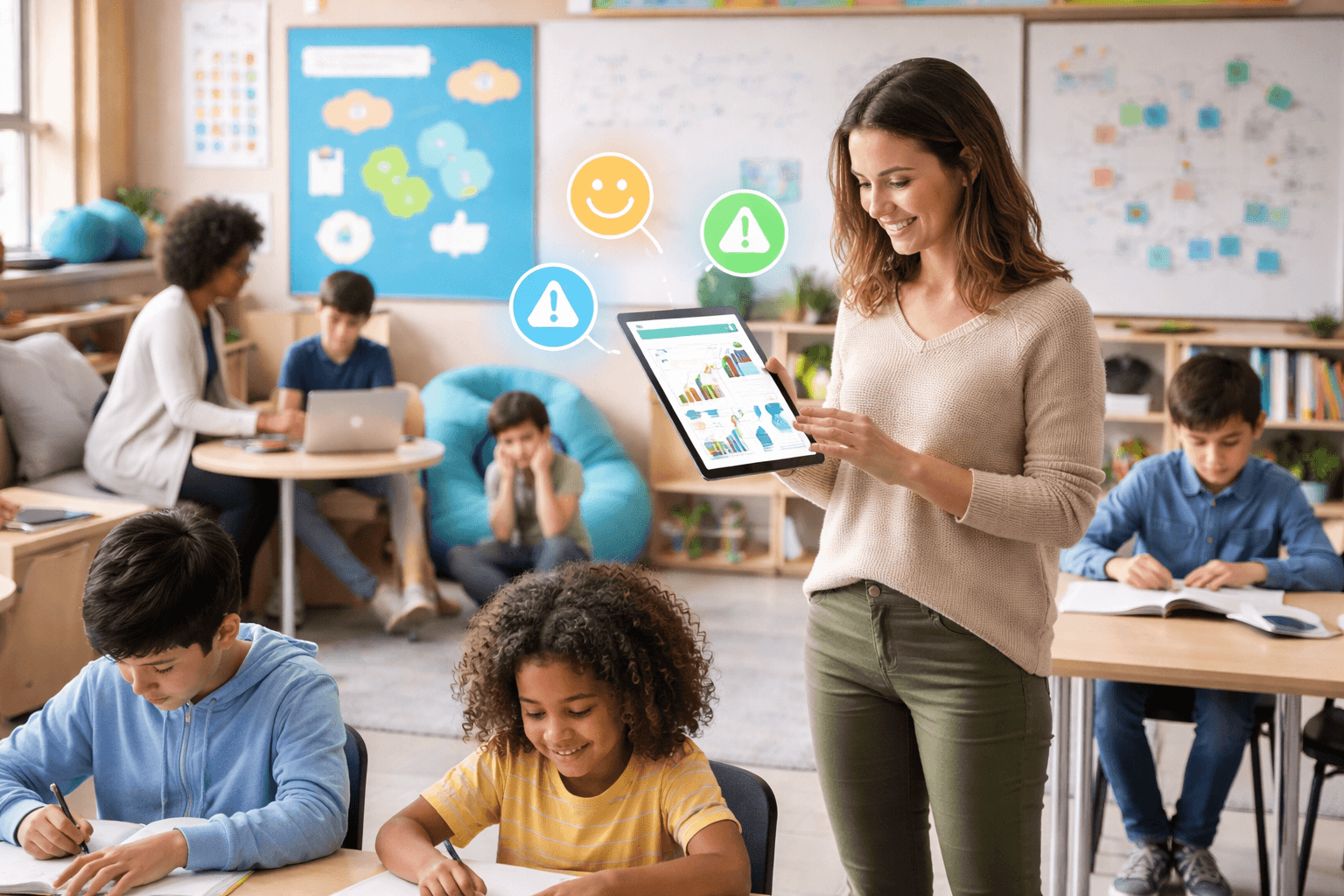
Behavior data is usually scattered. Software that brings it together can show patterns no single teacher sees, such as incidents that cluster at transitions, during testing weeks or in particular settings. That supports the core question of an FBA: what is driving this behavior?
Example: a middle school student has repeated outbursts that seem unrelated. When the records are viewed together, they all happen during unstructured transitions. The team adds a structured transition routine and a brief check-in, and responds before a crisis rather than after.
Recognizing positive behavior
Tracking positive behavior, not only problems, helps schools reinforce growth and check that recognition is shared fairly across students.
Saving documentation time
AI tools can help teachers log observations quickly and track progress toward a student’s behavior goals, leaving more time to work with students.
Example: a teacher notices that a student with ADHD responds better to immediate praise than to a weekly reward chart, and the tracking data confirms it. She changes her approach, and the data shows whether it is working.
These examples describe how such tools are meant to work. No published study has yet shown that an AI behavior tool improves student behavior, so schools should treat them as aids to existing practice, not as interventions in their own right.
The risks of AI monitoring
Behavior support can slide into surveillance. In a 2025 survey by the Center for Democracy & Technology, 89 percent of teachers said their school monitors student activity online, and among those, 29 percent said monitoring covered students’ personal devices and 39 percent said it continued outside school hours. In an earlier CDT survey, two-thirds of teachers said students had gotten in trouble as a result of AI-driven monitoring. A 2025 investigation by the Associated Press and The Seattle Times found no independent research showing that such monitoring measurably lowers student suicide or violence.
Safeguards for AI in behavior management
- Humans decide. AI can surface a pattern; teachers, counselors and families decide what it means and what to do.
- No labels from software. A risk flag should never become a label in a student’s record without review and context.
- Clear limits on data. Collect only what supports students, protect it under the district’s privacy agreements, and tell families what is collected.
- Check for bias. Review whether flags or discipline fall unevenly on particular groups of students.
- Support, not punishment. Use patterns to plan support, in line with PBIS and FBA practice.
AI can help schools move from reacting to behavior toward understanding it. That depends on keeping people, relationships and evidence-based practice at the center.
Related reading
Subscribe to edCircuit to stay up to date on all of our shows, podcasts, news, and thought leadership articles.
More on Artificial Intelligence