



 EdCircuit Staff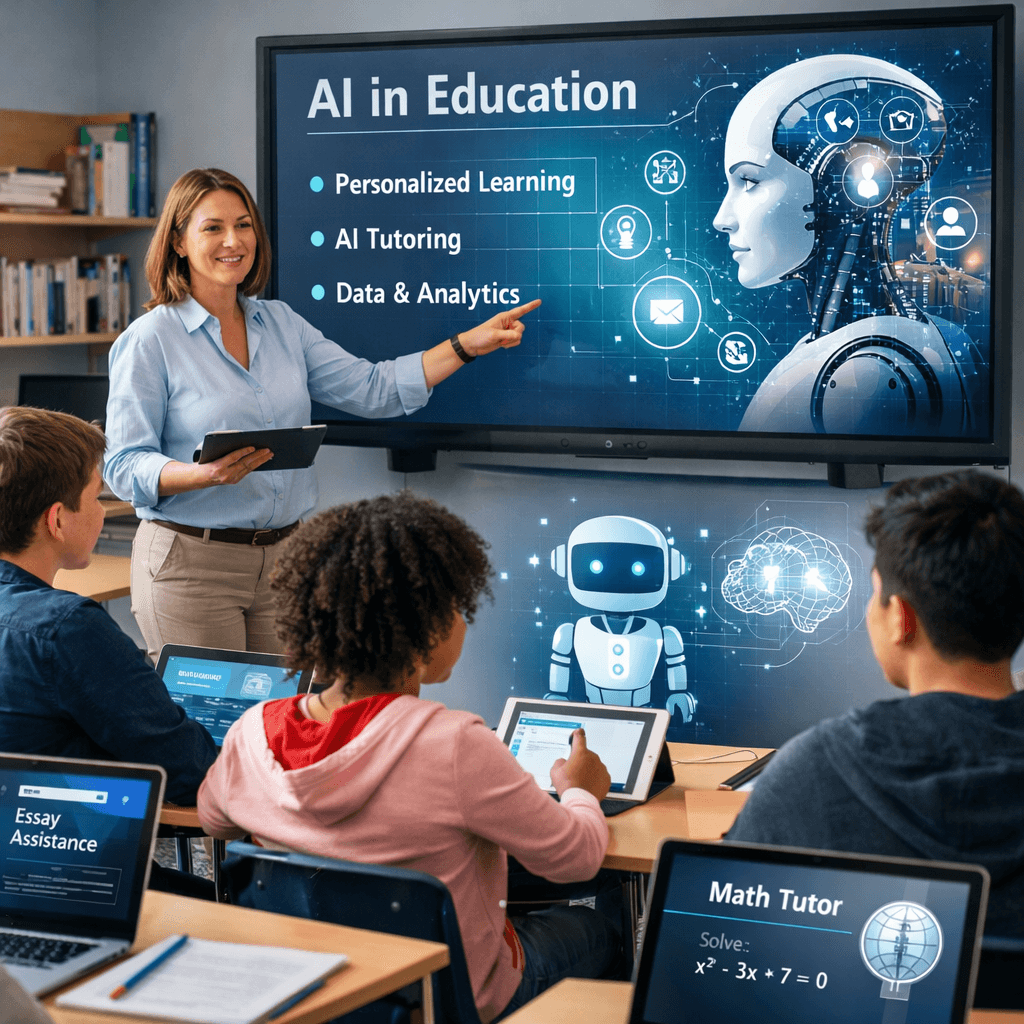
Artificial intelligence in education means using AI tools to support teaching, learning and running schools: helping teachers plan lessons and give feedback, tutoring students, making materials accessible, and analyzing data. It has moved quickly from experiment to everyday practice. In a Pew Research Center survey of U.S. teens released in February 2026, 54 percent had used chatbots to help with schoolwork, and 59 percent of K–12 educators used AI tools during the 2025–26 school year, Gallup reported.
This guide to AI in education explains how AI is used in schools and colleges, what the research says about its benefits and risks, and what teachers, students and families need to know about AI tools, homework help, cheating, AI literacy, privacy and policy. The first part applies to K–12 and higher education alike; the second covers K–12 schools, and the third colleges and universities. Each section links to edCircuit’s more detailed coverage.
Updated October 2026.
In this guide
- For everyone: What AI in education is · Who uses it · Benefits and risks · AI tutoring · AI homework help · Cheating and detectors · AI literacy
- K–12 schools: How teachers use AI · AI tools for teachers · Tools by grade · Privacy · AI policy · Questions to ask
- Colleges and universities: AI in colleges and universities
What is AI in education?
The U.S. Department of Education’s Office of Educational Technology describes AI as “automation based on associations”: systems that detect patterns in data and use them to make predictions, recommendations or new content. Its 2023 report, Artificial Intelligence and the Future of Teaching and Learning, lists the main uses in schools:
- Teaching support. Writing or improving lessons, finding and adapting materials, and suggesting lesson plans.
- Personalized learning. Adjusting the sequence, pace and hints a student receives.
- Tutoring and homework help. Explaining concepts and walking students through problems.
- Feedback and assessment. Giving faster feedback on student work.
- Accessibility. Speech recognition, text-to-speech and captions that support students with disabilities and multilingual learners.
The same report’s first recommendation is to keep “humans in the loop”: teachers and school leaders, not software, should make decisions about students.
How many students and teachers use AI?
- Teens. 54 percent have used chatbots for schoolwork, and one in 10 say they do all or most of their schoolwork with a chatbot’s help (Pew, 2026). The share of teens using ChatGPT for schoolwork doubled from 13 percent to 26 percent between 2023 and 2024.
- Students and teachers. In 2025, 54 percent of students and 53 percent of English, math and science teachers said they used AI for school, according to RAND.
- Educators. 59 percent of K–12 educators used AI tools in 2025–26, and most of them said it gave them more time for the work they value most (Gallup, 2026).
- College students. 85 percent said they had used generative AI for coursework in the past year, in Inside Higher Ed’s 2025 Student Voice survey. See AI in colleges and universities below.
Benefits and risks of AI in education
In January 2026, a Brookings Institution task force that consulted experts, teachers and families across 50 countries concluded that generative AI’s risks for students are, for now, overshadowing the benefits. Its main concern is students handing their thinking over to AI. The evidence in this guide points the same way: the benefits are real, and they depend on how AI is used.
The benefits
- Time for teachers. Teachers who use AI weekly estimate they save 5.9 hours a week, about six weeks over a school year (Gallup, 2025).
- Tutoring that works. AI tutors designed to teach have produced real learning gains in controlled studies (see AI tutoring).
- Access. Text-to-speech, captions, translation and reading-level adjustments help students with disabilities and multilingual learners.
The risks
- Less learning. Students who simply get answers can do worse later, as a math study in Turkey found (see AI tutoring).
- Unfair accusations. AI detectors wrongly flag some students’ work, especially that of non-native English writers (see Cheating and detectors).
- Hidden bias. Common Sense Media rated AI teacher assistants “moderate risk” in 2025 and found that some tools generating IEPs and behavior plans showed bias based on students’ perceived backgrounds.
- Privacy and safety. Student data, and new harms such as deepfakes and AI-enabled bullying, need clear rules.
- Unequal access. Students without AI at home or at school can fall further behind; see AI Access Is Creating a New Digital Divide.
Does AI tutoring help students learn?
The research is promising when AI is designed to teach, and worrying when students simply get answers.
- In Nigeria, a six-week after-school program using Microsoft Copilot raised secondary students’ English scores by 0.23 standard deviations, which the World Bank researchers equated to 1.5 to 2 years of typical schooling.
- At Harvard, college physics students using an AI tutor built on teaching best practices learned more in less time than students in an active-learning class.
- Tutor CoPilot, an AI tool that suggests strategies to human tutors, made K–12 students 4 percentage points more likely to master topics, and 9 points more likely with less experienced tutors, at a cost of about $20 per tutor per year.
- In Turkey, high school students who used GPT-4 freely during math practice did better in practice but 17 percent worse on the later exam than students without it. A version designed as a tutor, with safeguards against handing out answers, largely prevented that harm.
The lesson for schools is that design matters. AI that guides students to think does more good than AI that thinks for them.
AI homework help: what students and parents should know
Homework is where most students meet AI: 54 percent of U.S. teens have used chatbots to get help with schoolwork, and one in 10 say they do all or most of it with a chatbot’s help (Pew, 2026). The Turkey study above shows why the way a student uses it matters: getting answers can feel like progress and still leave a student less prepared for the test.
The major AI companies now offer modes that tutor instead of answering:
- ChatGPT study mode, launched by OpenAI in July 2025, works through problems step by step instead of giving the answer.
- Gemini Guided Learning, launched by Google in August 2025, is designed to act as a personal learning companion, and teachers can share it with a class through Google Classroom.
- Claude’s learning mode, introduced by Anthropic in April 2025, guides students’ reasoning rather than providing answers.
For parents, the useful questions are simple: did the tool explain the idea, or did it do the work, and could your child now do a similar problem without it? Many schools are rethinking homework for the same reason. See Homework in the AI Era: Why Schools Are Rethinking It and AI for Students: A Parent’s Guide by Age.
AI, cheating and AI detectors
Students and teachers both worry about cheating: 59 percent of teens think using AI to cheat is a regular occurrence at their school (Pew). AI detectors are not a reliable answer. A 2023 study found seven detectors labeled essays by non-native English writers as AI-written 61 percent of the time on average. OpenAI withdrew its own detector in 2023 because of its low accuracy, and Turnitin advises that its AI score should not be the sole basis for action against a student. A Common Sense Media survey found Black teens were about three times as likely as white teens to say their work had been wrongly flagged as AI-generated.
Clear rules work better than detection: telling students which assignments allow AI, how to disclose it, and designing work that shows thinking. See AI Rules for Schools: A Back-to-School Guide, Confronting AI Cheating in K–12 and Assessment in the AI Era.
What is AI literacy?
AI literacy is the knowledge and skills students need to use AI well and judge it critically. A framework from the OECD and the European Union, approved in 2026, defines it as the technical knowledge, durable skills and attitudes needed to engage with, create with, manage and shape AI, while critically evaluating its benefits, risks and ethics. It notes that AI literacy is different from simply using AI tools. In California, a 2024 law requires the state’s curriculum commission to consider adding AI literacy to math, science and history-social science frameworks. See AI Literacy for Students: A Grade-by-Grade Guide.
AI in K–12 schools
The sections below cover what is specific to elementary, middle and high schools: classroom practice, tools, children’s privacy law and district policy.
How teachers use AI in the classroom
Teachers most often use AI to save time on preparation. In Gallup’s 2025 survey, the most common monthly uses were preparing to teach (37 percent of teachers), making worksheets or activities (33 percent) and modifying materials to meet student needs (28 percent), and weekly users reported saving 5.9 hours a week. Many are doing this without much help: in 2026, only 18 percent of teachers said they received formal guidance on AI from their administrators, though about half of districts had trained teachers on AI by fall 2024, RAND found. See Teacher Professional Development in the Age of AI.
AI can also help with specific needs and subjects. edCircuit covers each in more detail:
- How AI Is Transforming Reading for Students
- How AI Is Revolutionizing Foreign-Language Learning
- The Role of AI in Supporting Diverse Learners in Schools (special education)
- Artificial Intelligence in Special Education and Accessibility
- Art and AI: A New Era of Student Creativity
- The Evolution of Music Education in Today’s Classroom
- How AI Is Transforming Career and Technical Education (CTE)
- How Driver’s Education Has Transformed in the Age of AI
- Empowering Student Engagement in the Age of AI
- How AI Supports Student Behavior in Schools
- Fighting Absenteeism with AI and EdTech
- Using Artificial Intelligence to Elevate Science Lab Safety
AI tools for teachers
Several large companies now offer AI tools for teachers at no cost:
- ChatGPT for Teachers. Launched by OpenAI in November 2025, a secure workspace that is free for verified U.S. K–12 educators through June 2028.
- Gemini for Education and Gemini in Classroom. Announced by Google in June 2025, with more than 30 no-cost AI tools for educators in Google Classroom.
- Microsoft Teach. A lesson-preparation tool in the Microsoft 365 Copilot app, announced in October 2025 for education customers at no additional cost.
- Khanmigo for Teachers. Khan Academy’s assistant for rubrics, quiz questions, exit tickets and other preparation, free for U.S. teachers since 2024.
Free does not mean risk-free. Common Sense Media warned in 2025 that teacher assistants can act as “invisible influencers” shaping what students learn, so teachers should review what any tool produces before it reaches students. For practical help, see AI Lesson Planning: A Teacher’s Summer Guide, AI as a Classroom Teaching Assistant and AI Training for Teachers: Beyond Prompts and Tools.
AI tools for students, by grade
Which tools fit depends on students’ ages, because many AI services are not built for children under 13 and some require users to be older. edCircuit’s grade-level guides list what each tool does and its age and privacy limits:
- The Top 10 AI Tools for Elementary Education
- The Best AI Tools for Middle School Classrooms in 2025
- The Top 10 AI Tools Shaping High School Learning in 2025
Student privacy and AI
Two federal laws matter most. COPPA protects children under 13 online; a school may consent on parents’ behalf only when a company collects information for the school’s educational use and no other commercial purpose. Updated COPPA rules took effect in June 2025, with companies required to comply by April 22, 2026 (Federal Register). FERPA protects student education records; a company can receive them only under conditions such as the school’s direct control over how records are used. In practice, schools should use AI tools with a student data privacy agreement, especially for younger students.
AI policy for schools
As of August 2026, 35 states and Puerto Rico had issued official guidance on AI in K–12 schools. At the federal level, an April 2025 executive order created a White House Task Force on AI Education, and in July 2025 the Department of Education said federal grant funds may be used for AI that meets program requirements. Yet in 2025 only 45 percent of principals reported having AI policies or guidance (RAND). A district AI policy usually covers which tools are approved, privacy agreements, acceptable student use and disclosure, academic integrity, staff training and how families are informed.
Some districts are drawing firmer lines. In September 2026, New York City announced a one-year pause on student-facing generative AI from 2-K through eighth grade for the 2026–27 school year, while teachers may still use AI for planning and operational tasks. See New York City Schools Ban AI Through Grade 8 and Your School’s AI Policy May Already Be Outdated.
Questions to ask before using AI in a school
- What problem will this tool solve, and how will we know it worked?
- Is it built for our students’ ages, and do we have a privacy agreement with the company?
- Does it help students think, or does it think for them?
- Who reviews its output before it affects a student?
- Have teachers been trained, and do students and families know the rules?
AI in colleges and universities
College students use AI even more than younger students. In Inside Higher Ed’s 2025 Student Voice survey of 1,047 students at 166 colleges, 85 percent said they had used generative AI for coursework in the past year, most often to brainstorm ideas (55 percent), to ask it questions as they would a tutor (50 percent) and to study for exams (46 percent).
Some systems have chosen to provide AI to everyone. In February 2025, the California State University system announced it would give its more than 460,000 students and 63,000 faculty and staff access to ChatGPT Edu across all 23 campuses. The same questions about learning, cheating and privacy apply, with more responsibility placed on students themselves. edCircuit covers higher education in more detail:
- How AI Is Transforming the College Lecture Experience
- AI in Higher Education: How Classrooms Transformed
- The Top 10 AI Tools Transforming Student Research in Higher Education
- Applying Smarter: How AI Is Transforming College Admissions
The teacher’s role
AI can draft, explain, translate and analyze, but it cannot know a student the way a teacher does. The research so far points in the same direction: AI helps most when teachers design how it is used, set clear limits and stay responsible for decisions about students. Schools that treat AI as a tool to support teaching, rather than replace it, are best placed to gain from it.
Related reading
Subscribe to edCircuit to stay up to date on all of our shows, podcasts, news, and thought leadership articles.
More on Artificial Intelligence

