
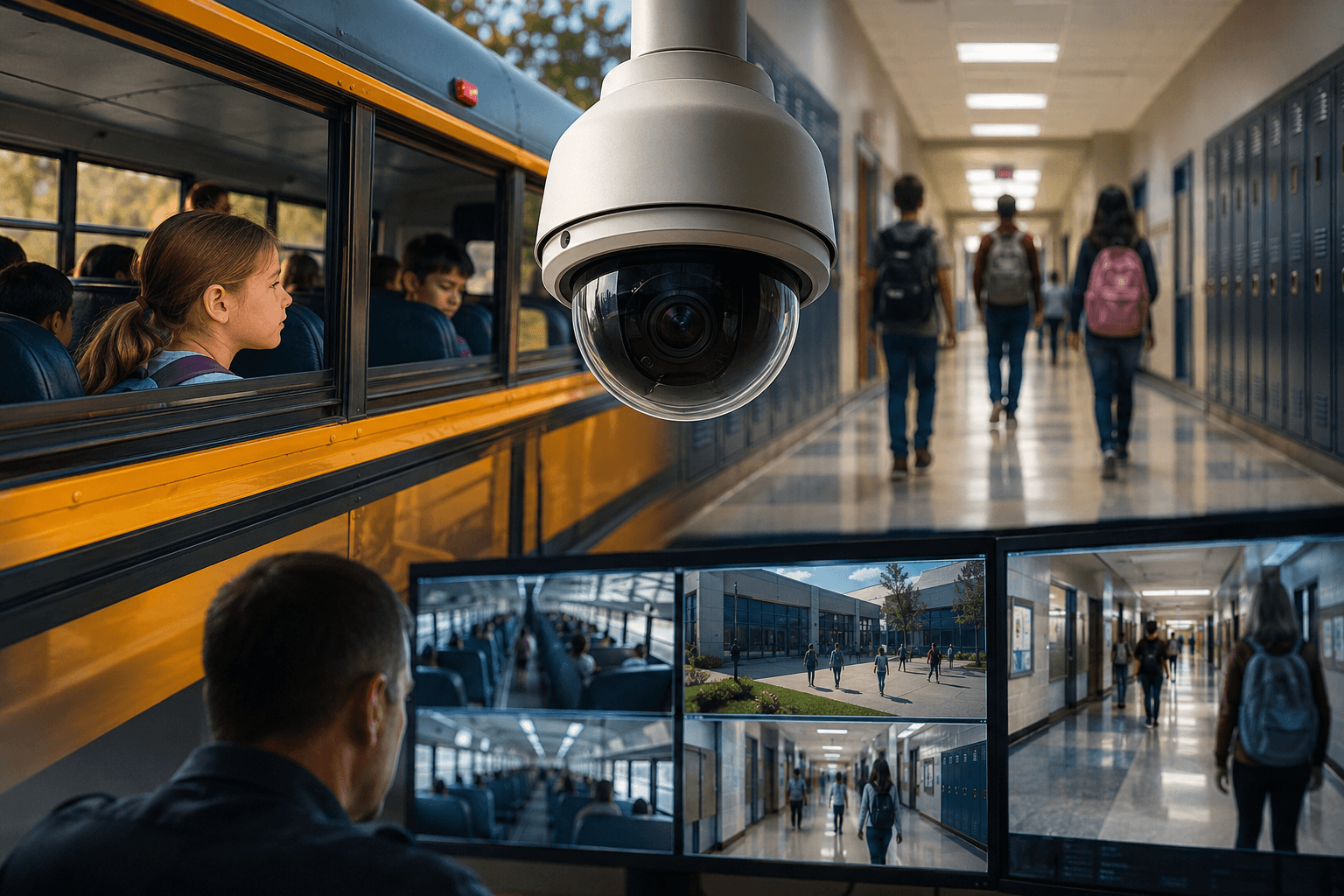
School bus cameras are now standard equipment in many districts. Cameras inside the bus record what happens in the aisle and the seats, and cameras outside, often mounted on the stop arm, photograph drivers who illegally pass a stopped bus. For families, the questions usually come after something happens: a child says they were bullied on the ride home, or a fight breaks out at the back of the bus. Does the footage exist, how long is it kept, and can a parent see it?
The answers depend on federal privacy law, state law and each district’s own policy, and they are often not what families expect. This article explains how bus cameras are used, how long footage is usually kept, whether buses record audio, who can view the video, and how a parent can ask to see it.
Why districts put cameras on school buses
A bus driver faces forward, watches the road, and is responsible for dozens of students behind them. Cameras give districts a way to review incidents the driver could not see: fights, bullying, vandalism, unsafe behavior and disputes between students and drivers. They protect drivers from false accusations as well as holding them accountable, and they help administrators investigate quickly and fairly. Exterior cameras serve a different purpose, catching drivers who ignore a bus’s flashing lights and extended stop arm, one of the most dangerous moments of a child’s school day.
Many districts now connect bus cameras to the same video systems they use in school buildings, and some are adding artificial intelligence to flag incidents or search footage. That makes the questions about storage, access and privacy more pressing. edCircuit looked at the wider picture in Cameras in Schools: Safety, Surveillance, and Privacy.
How long do school bus cameras keep footage?
Usually not long. Most bus camera systems record continuously and overwrite the oldest video once storage fills, unless someone flags a recording to keep. Retention periods are set by each district, and they range from days to weeks. One New York district’s policy, for example, keeps bus video for 30 days before it may be erased, and treats recordings used in a disciplinary matter as student records. Video connected to an incident, a complaint, a police request or possible litigation is normally saved for longer.
The practical lesson for families is timing. A parent who waits several weeks to report a problem may find the footage has already been recorded over. The first step is to tell the school promptly, in writing, the date, the approximate time and the bus route, and to ask that the video be preserved.
Do school bus cameras record audio?
Some do, but audio raises legal questions that video does not. Federal wiretap law generally allows recording a conversation when one participant consents, under 18 U.S.C. § 2511, but several states set stricter rules. Pennsylvania amended its wiretap law in 2014 to expressly allow audio recording on school buses, provided the district adopts a policy, notifies parents each year and posts a notice on each bus. Families who want to know whether their district records audio should look for it in the district’s transportation or video policy, or ask.
Who can see school bus camera footage?
Access is normally limited to administrators, transportation and security staff, and police when they are investigating. Teachers do not usually have access, and neither do parents by default. The federal Family Educational Rights and Privacy Act sets the rules when a video becomes part of a student’s education record. Under the U.S. Department of Education’s guidance on photos and videos, a recording is an education record when it is directly related to a student, such as video used to discipline that student, and the school keeps it. Parents then generally have the right to inspect and review it, but the school is not usually required to give them a copy.
Because a bus video usually shows many students, schools must blur or separate the other students’ images when they reasonably can before showing it. Courts have weighed the same balance under public records laws. In 2020, Pennsylvania’s Supreme Court held in Easton Area School District v. Miller that a school bus video was a public record that a newspaper could obtain, but that the images of the students in it had to be redacted before release.
How parents can request bus camera footage
Most districts ask parents to make the request in writing. A clear request names the date, the approximate time, the bus number or route, and what the parent believes happened, and asks the district to preserve the recording. The district will usually review the video first, decide whether it is part of the student’s record, and then arrange a supervised viewing, often in an administrator’s office, with other students blurred if possible. If a family disagrees with the district’s response, it can raise the matter with the school board, the state education department, or through a public records request where state law allows.
What district policies should include
Bus camera rules differ widely from one district to the next, which is a large part of why families are confused. A clear policy, posted where families can find it, should say where cameras are mounted and whether audio is recorded, how long footage is kept, who may view it, how parents can request a viewing, how recordings are preserved for investigations, how the system is secured against unauthorized access, and when police are involved. Districts adding AI features should also say what those features do and what data they keep.
Cameras can make bus rides safer and investigations fairer. They work best when families know the rules before an incident happens, rather than learning them afterward.
Video: 12 News – AI cameras on Wichita school buses raise privacy concerns (Play video)
Related reading
Subscribe to edCircuit to stay up to date on all of our shows, podcasts, news, and thought leadership articles.
More on School Safety