



 EdCircuit Staff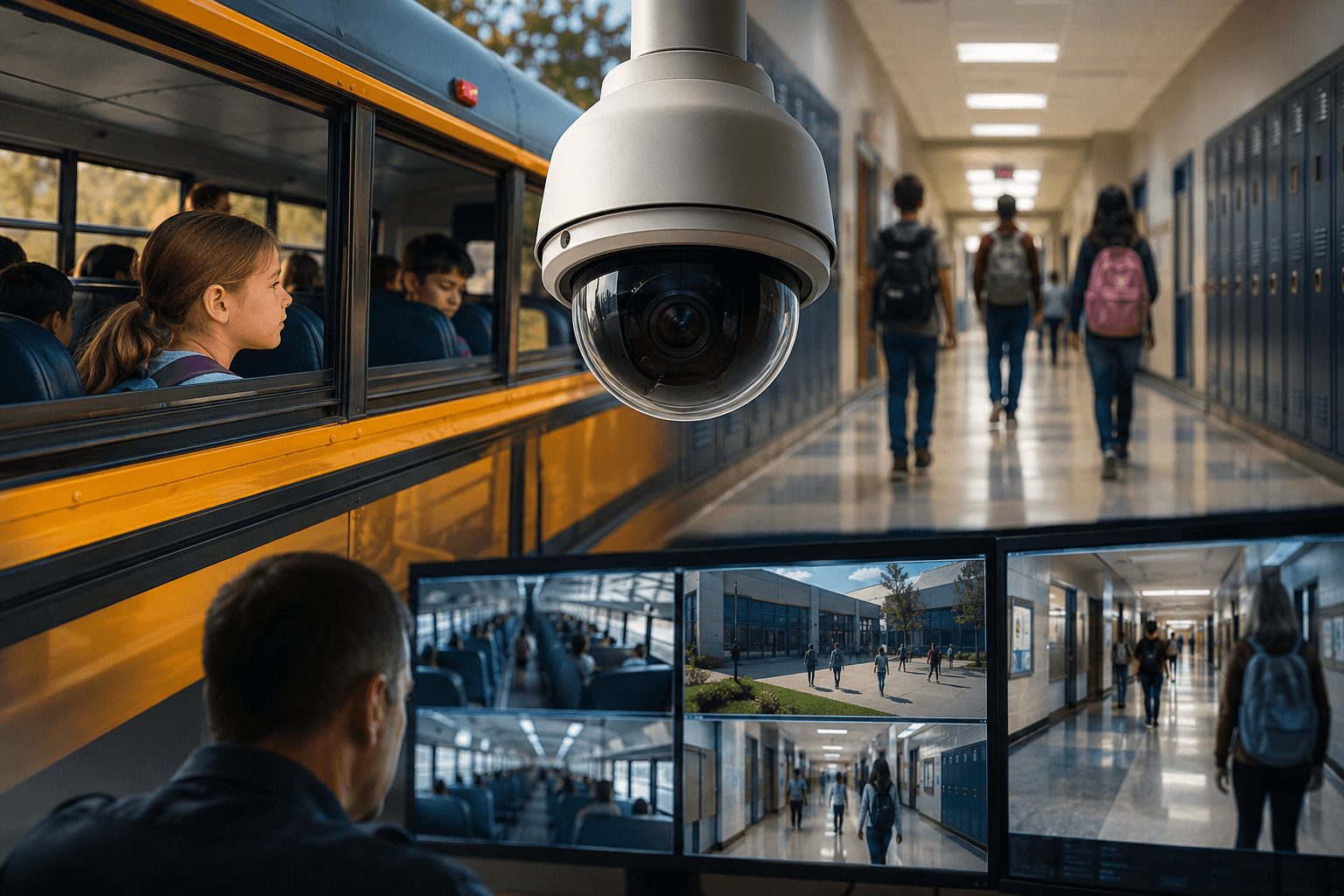
Table of Contents
School bus cameras and school surveillance systems have become a standard part of K–12 education, but many parents, educators, and administrators still do not fully understand what happens to the footage after it is recorded. Across the country, school districts now operate complex surveillance networks that include cameras on buses, in hallways, outside entrances, parking lots, cafeterias, gyms, and other common areas. These systems are designed to improve safety, document incidents, reduce vandalism, investigate bullying, and protect students and staff. Yet behind every camera is a growing set of questions about privacy, access, retention policies, student rights, and legal responsibilities.
For many families, the issue only becomes real when an incident occurs. A parent may believe their child is being bullied on the bus. A fight may happen in a hallway. A student may report harassment near a locker room or outside the school building. Suddenly, parents want answers, and the first question often becomes: “Can we see the footage?”
The answer is rarely simple.
Under federal privacy laws such as the Family Educational Rights and Privacy Act (FERPA), school surveillance footage can quickly become part of a student’s educational record depending on how it is used and maintained by the district. That means school districts must carefully balance transparency with the privacy rights of every student captured on camera.
In today’s educational environment, surveillance systems are no longer just about security. They have become part of district operations, student discipline, legal compliance, transportation oversight, and parent communication.
Why Schools Are Expanding Camera Systems
Most modern school districts use surveillance cameras for several reasons:
- Student safety
- Bus behavior monitoring
- Bullying investigations
- Threat assessment
- Building security
- Visitor monitoring
- Vandalism prevention
- Athletic and event supervision
- Staff accountability
- Emergency response documentation
School buses in particular have become one of the most common locations for surveillance systems. Cameras on buses can capture fights, unsafe behavior, stop-arm violations, vandalism, driver interactions, and bullying concerns. Some systems even include multiple camera angles and audio recording capabilities.
District leaders often argue that these systems protect everyone involved. Drivers feel safer. Administrators can investigate incidents more accurately. Students may behave differently knowing cameras are present. Parents gain reassurance that concerns can potentially be verified.
But the expansion of surveillance also creates a difficult question:
How much monitoring is too much?
What Happens to the Footage?
One of the biggest misconceptions among parents is that districts store surveillance footage forever. In reality, most school systems automatically overwrite recordings after a relatively short period unless the footage is flagged for preservation.
Retention policies vary dramatically by district and state.
Some districts store routine footage for:
- 7 days
- 14 days
- 30 days
- 60 days
- 90 days
Other districts may retain footage longer if:
- An incident report was filed
- Law enforcement requested preservation
- A disciplinary investigation is underway
- Litigation is possible
- A parent complaint was submitted
Many districts use motion-triggered cloud systems or network video recorders that continuously overwrite old footage once storage limits are reached.
That means timing matters.
If a parent waits several weeks to report bullying or harassment, the footage may already be deleted permanently.
This reality is becoming increasingly important as families assume digital evidence automatically exists forever. In many cases, districts simply do not have the storage infrastructure to retain thousands of hours of daily video indefinitely.
Some district policies specifically state that surveillance recordings are only maintained “as long as necessary” or at the discretion of district administrators.
Who Actually Has Access to School Surveillance Video?
Access is typically restricted to authorized personnel only.
Depending on district policy, access may include:
- Superintendents
- Transportation directors
- Principals
- Assistant principals
- School resource officers
- Security personnel
- IT administrators
- Legal counsel
Teachers generally do not have unrestricted access to surveillance systems, and neither do parents.
This is where FERPA becomes critically important.
According to federal guidance, a video can become an educational record if it is directly related to a student and maintained by the school district. For example:
- A hallway fight investigation
- A bullying complaint
- A disciplinary action on a bus
- A student injury
- A medical emergency
- A harassment incident
Once footage becomes tied to discipline or a student-specific investigation, districts must treat it carefully because other students also appear in the recording.
That creates enormous complications for schools attempting to balance parental rights with student privacy protections.
Can Parents Request Access to Footage?
This is one of the most misunderstood areas in education law.
Parents often believe they have an automatic right to obtain surveillance footage involving their child. In reality, schools usually distinguish between:
- Viewing footage
- Receiving copies of footage
- Public release of footage
Under FERPA, parents may have the right to inspect records directly related to their child, but districts are generally not required to provide copies of videos.
In many cases, districts will:
- Allow a supervised viewing
- Blur or redact other students
- Limit viewing to administrators’ offices
- Deny copies entirely
- Require formal written requests
If multiple students appear in the video, schools may need to redact identifying information before allowing access.
This process can be extremely time-consuming. A single 10-minute hallway recording could require hours of redaction work to protect student privacy.
Some districts deny access entirely if they believe releasing the footage would violate the privacy rights of other students.
That can frustrate families who believe surveillance footage may prove bullying, harassment, discrimination, or inappropriate staff behavior.
How Parents Typically Make a Request
Most districts require formal written requests when parents seek access to surveillance footage.
A typical process may involve:
- Submitting a written complaint
- Providing the date and approximate time of the incident
- Identifying the location
- Explaining the nature of the concern
- Requesting preservation of footage immediately
That final step is extremely important.
Parents who suspect an incident occurred often need to specifically request that footage be preserved before it is automatically deleted.
Districts may then review the footage internally before determining:
- Whether an incident occurred
- Whether the footage qualifies as an educational record
- Whether access can legally be granted
- Whether redaction is required
In some cases, parents may escalate concerns through:
- School boards
- State education departments
- Attorneys
- Freedom of Information requests
- Due process complaints
However, FERPA protections often limit how much footage can actually be released publicly.
The Growing Debate Around Privacy
The expansion of school surveillance has created growing debate across K–12 education.
Supporters argue:
- Cameras deter misconduct
- Video protects students and staff
- Investigations become more objective
- Transportation incidents are easier to resolve
- Threat assessment improves
- Emergency response improves
Critics argue:
- Students are constantly monitored
- Surveillance can create distrust
- Data security risks are increasing
- Audio recording raises legal concerns
- Districts may lack clear oversight
- Retention policies are inconsistent
There are also growing concerns about cybersecurity.
Surveillance systems themselves can become targets for hacking, unauthorized access, or data breaches. Districts must now think beyond simply installing cameras. They must also protect:
- Video servers
- Cloud storage systems
- Access credentials
- Retention databases
- Remote viewing permissions
As schools expand camera systems, cybersecurity and student privacy are becoming deeply connected conversations.
Why District Policies Matter More Than Ever
One of the biggest issues nationally is inconsistency.
Two neighboring school districts may have completely different rules regarding:
- Retention timelines
- Parent access
- Audio recording
- Redaction procedures
- Law enforcement access
- Footage sharing
- Public records requests
That inconsistency creates confusion for families and educators alike.
Strong district policies should clearly define:
- Where cameras are located
- Whether audio is recorded
- How long footage is stored
- Who can access recordings
- How parents can request review
- How evidence is preserved
- How footage is secured
- When law enforcement becomes involved
Districts that fail to establish transparent procedures may face growing legal and public trust challenges in the years ahead.
The Future of School Surveillance
School surveillance systems are likely to expand even further over the next decade.
Artificial intelligence is already entering the conversation through:
- Behavioral detection
- Weapon recognition
- Crowd monitoring
- Facial recognition debates
- Automated alerts
- License plate recognition near campuses
At the same time, parents are becoming more aware of student privacy rights and digital monitoring concerns.
That means districts are entering a new era where safety, technology, transparency, cybersecurity, and privacy must all work together.
The camera itself is no longer the biggest issue.
The real question is how schools responsibly manage the enormous amount of student data being collected every single day.
For district leaders, the future will not simply be about adding more cameras. It will be about building trust, maintaining transparency, protecting student rights, and creating policies that families understand before an incident ever occurs.
Subscribe to edCircuit to stay up to date on all of our shows, podcasts, news, and thought leadership articles.
