
AI Trust in Education Is Replacing Search
As students increasingly rely on AI instead of traditional search engines, schools are confronting major questions about trust, accuracy, digital literacy, and critical thinking.

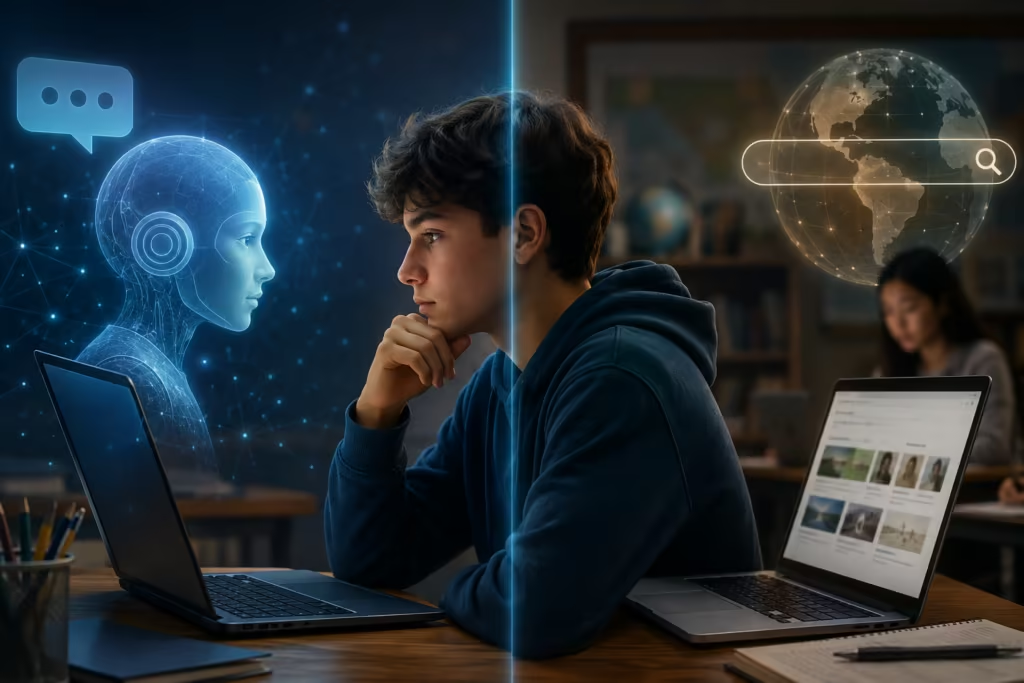
Students trusting AI over search: what surveys show, where students push back, and a lateral reading routine for class.
This explainer, published by edCircuit in June 2026 under the EdCircuit Staff byline, argues that many students now ask AI tools questions they once put to search engines, and that schools need to teach them to verify what they are told. A new section below adds survey findings, a classroom method for checking AI answers, and a caution about what the evidence shows.
AI trust in education is rapidly changing how students search for information, complete assignments, and determine what they believe online. For decades, search engines trained students to compare sources, analyze websites, and evaluate credibility. Today, however, many students are bypassing search engines entirely and turning directly to artificial intelligence for answers.
Instead of opening multiple browser tabs, students now ask AI platforms a question and receive polished responses within seconds. The process feels faster, easier, and more natural to a generation raised on instant digital experiences. But as AI becomes the preferred source of information for many students, educators are beginning to ask a deeper question: What happens when students trust AI more than search engines?
The answer could reshape the future of digital literacy, classroom instruction, research habits, and the role of critical thinking in education.
AI Is Changing Student Research Habits
For more than twenty years, search engines have defined how students gather information online. Students learned how to:
- Use keywords effectively
- Compare websites
- Analyze sources
- Detect misinformation
- Cross-reference information
- Evaluate credibility
Even when students rushed through the process, search engines still exposed them to multiple viewpoints and sources.
Artificial intelligence changes that model entirely.
AI tools do not simply provide links. They generate direct answers. Instead of requiring students to investigate information independently, AI synthesizes content into a single conversational response.
That distinction matters enormously in education.
Students are increasingly treating AI not as a tool to assist research, but as the research process itself. The shift is happening quickly across middle schools, high schools, and colleges as AI becomes integrated into browsers, productivity software, and classroom workflows.
For many students, searching the internet now feels slower than simply asking AI.
Why Students Trust AI So Easily
One of the most important developments in modern education is how quickly students place trust in AI systems.
The reason starts with design.
AI tools are built to sound confident, conversational, and personalized. Unlike traditional search engines filled with advertisements, sponsored results, and endless links, AI platforms communicate in a way that feels human.
Students can:
- Ask follow-up questions
- Request simpler explanations
- Receive personalized responses
- Get instant clarification
- Interact conversationally
That experience creates the perception of authority and intelligence.
The challenge is that AI often sounds accurate even when it is incorrect.
Many students — especially younger learners — may not fully understand that AI systems can hallucinate information, fabricate citations, or produce biased responses. Because the answers are polished and immediate, students may assume the information has already been verified.
In reality, AI systems are predicting language patterns, not independently determining truth.
The Danger of AI Hallucinations in Education
One of the growing concerns surrounding AI trust in education is the rise of “invisible misinformation.”
When students use search engines, they typically encounter multiple sources that can be compared against one another. AI-generated responses compress that process into a single answer, reducing opportunities for verification.
This creates significant risks inside classrooms.
Students may unknowingly encounter:
- Fake academic citations
- Incorrect statistics
- Fabricated historical quotes
- Misleading scientific explanations
- Biased perspectives
- Outdated information
- Oversimplified concepts
The issue becomes even more serious when students stop fact-checking AI-generated material altogether.
Educators across K–12 and higher education are increasingly concerned that excessive AI reliance could weaken critical evaluation skills that students need for college, careers, and civic engagement.
Digital Literacy Is Entering a New Era
The rise of AI is forcing schools to rethink digital literacy instruction entirely.
Traditional digital literacy focused on teaching students how to navigate the internet responsibly. AI literacy requires students to understand how artificial intelligence systems generate information in the first place.
Students now need instruction in:
- AI bias
- AI hallucinations
- Prompt engineering
- Source verification
- Ethical AI use
- Data privacy
- Algorithmic influence
- Human oversight
This represents one of the biggest shifts in educational technology since the rise of the internet itself.
District leaders are beginning to realize that AI literacy may soon become as essential as traditional reading, writing, and research skills.
Teachers Are Becoming Guides Instead of Gatekeepers
As AI becomes more common in classrooms, the role of teachers is evolving as well.
Teachers are no longer simply providers of information. Students can already access unlimited AI-generated explanations instantly from their phones or laptops.
Instead, educators are increasingly becoming:
- Critical thinking coaches
- Verification guides
- Discussion facilitators
- Ethical mentors
- Context providers
This transition may actually increase the importance of educators rather than reduce it.
AI can provide answers, but teachers help students evaluate whether those answers make sense, connect to broader concepts, or reflect credible evidence.
Human educators still play an irreplaceable role in helping students develop judgment, skepticism, empathy, reasoning, and intellectual curiosity.
Schools Are Developing AI Policies Quickly
Districts across the country are now racing to establish AI guidance before regulations fully catch up.
Many schools initially responded to AI with fear centered around cheating and plagiarism. However, the conversation has evolved significantly over the past year.
Educational leaders are increasingly focusing on responsible AI integration instead of outright bans.
District responses now commonly include:
- AI acceptable-use policies
- AI literacy initiatives
- Professional development for teachers
- Parent education nights
- Classroom disclosure expectations
- Student verification requirements
- AI ethics discussions
Some districts are also teaching students to treat AI as a “first draft” tool rather than a final authority.
That distinction is critical.
The goal is not necessarily to eliminate AI from education, but to ensure students continue practicing analysis, verification, and independent thought alongside it.
The Psychological Shift Toward Instant Answers
There is also a growing concern about how AI may influence student thinking habits over time.
Search engines required students to explore, scan, compare, and investigate. AI encourages immediate answers with minimal effort.
Some educators worry this could gradually reduce:
- Deep reading habits
- Research persistence
- Productive struggle
- Intellectual curiosity
- Long-form analysis
- Independent problem-solving
The concern is especially important for younger students still developing foundational thinking skills.
If students become too dependent on AI-generated responses, schools may face a generation less comfortable with ambiguity, uncertainty, and deep inquiry — all essential components of learning.
Parents Are Paying Attention
Parents are increasingly seeing AI appear in nightly homework routines, study sessions, and writing assignments.
Some families view AI as a valuable educational support system that can provide tutoring, clarification, and accessibility benefits. Others worry students are beginning to outsource thinking itself.
Both perspectives contain truth.
AI can absolutely enhance learning when used responsibly and transparently. Students can receive personalized support, differentiated explanations, and faster feedback. However, without strong guidance, AI can also encourage shortcut behavior and overreliance.
This creates an opportunity for schools and families to work together on developing healthy AI habits and expectations.
The Future of AI Trust in Education
The relationship between students and information is changing faster than many schools anticipated.
Search engines are no longer the unquestioned gateway to knowledge for younger generations. AI is becoming embedded directly into browsers, learning platforms, productivity tools, and classroom technology ecosystems.
The future may not involve students choosing between AI and search engines at all. Instead, AI may become integrated into nearly every digital experience students encounter.
That makes digital literacy more important than ever.
The real challenge for education is not whether students will use AI. They already are.
The challenge is ensuring students understand when to trust AI, when to question it, and when human judgment still matters most.
Because in the age of artificial intelligence, the future of education may depend less on access to information — and more on the ability to evaluate whether that information deserves our trust.
Students trusting AI over search: what the evidence shows and how teachers can respond
Students trusting AI over search is easy to assume and harder to measure. The article above describes a shift from search results to single AI answers and the risks that follow from it. This section looks at survey evidence on how students use AI tools, shows that students themselves are more doubtful than the article suggests, and describes a teaching method for checking AI answers that classrooms can use now.
What survey evidence says about how students use AI
A September 2025 report from the USC Center for Generative AI and Society, summarized by USC News, surveyed 1,000 U.S. college students. Most used AI for what the researchers called executive help, meaning fast solutions with little effort, and fewer used it for instrumental help, meaning support in understanding concepts and building skills. Students whose professors encouraged thoughtful use were considerably more likely to use AI for learning. The center also surveyed 1,505 teachers in five countries: 72% said AI streamlines routine tasks, 73% thought it can improve student outcomes and 69% said it enables more personalized learning, while many worried about plagiarism and reduced creativity.
Two limits apply. The student survey covers college students, not the middle and high school students the article above mostly discusses. And the findings describe how students use AI, not whether they trust it more than search.
Students are often skeptical
The Duke University CARADITE student survey reports that 75% of surveyed students believe AI gives inaccurate answers, 94% think its accuracy varies by subject and 62% say it oversimplifies. The page does not give a survey date or sample size, so these numbers show that skepticism exists among students at one university and cannot be generalized. They do complicate the claim that students simply accept whatever AI says. A more careful statement is that students use AI for speed, many know it can be wrong, and use can outrun the checking habits that knowing requires.
A classroom method: lateral reading
Stanford’s Civic Online Reasoning project offers a 60-minute lesson, How do I fact check AI search results?, first published in January 2025, that teaches students to check AI output with lateral reading. The lesson defines lateral reading as evaluating a source by comparing it with outside sources, an approach it credits to Wineburg and McGrew (2017). Students define the strategy, use it to research a topic and evaluate AI responses for accuracy. The page lists the subject as history-social science and gives no grade range, so teachers need to adapt it to their students.
A teacher can use the same idea in any subject with a short routine:
- Pick one factual claim in an AI answer, such as a date, a statistic or a quotation.
- Open a new tab and search for the claim, then look for two sources outside the AI tool.
- Ask who produced each source, and what evidence they give.
- Decide whether the claim holds, needs a qualifier or should be dropped.
- Record the check in the assignment so the teacher can see the process.
This routine takes about ten minutes, and it can be graded for the check, not only the final answer. It does not by itself address a student who never opens the second tab, so assignments should ask for the record of checking.
What schools and families can decide now
For districts, the evidence points toward guidance that names the skill, which here is verification, and not only the tool. Policies can state when AI use is allowed, require students to disclose it and ask for a verification step on research tasks. Professional development should give teachers time to practice lateral reading with AI output before they teach it. For families, a useful rule at home is to ask a child to show one outside source for any fact an AI tool supplied.
Readers who want a grade-by-grade approach can use edCircuit’s AI literacy for students guide. The AI in education guide covers policy and classroom use more broadly, and the digital citizenship guide places source checking within the larger set of skills students need online.
Subscribe to edCircuit to stay up to date on all of our shows, podcasts, news, and thought leadership articles.
Related reading
More on Artificial Intelligence