School Chemical Hygiene Plan: Why Every Building Needs One
Districtwide policies provide consistency, but building-specific plans and trained local leaders are what make chemical safety work.


A district policy is not enough. Every school needs a site-specific Chemical Hygiene Plan and a trained leader who can put it into daily practice.
A Chemical Hygiene Plan should never be a document that exists only in a district office.
When a container leaks, an unexpected reaction occurs, or someone reports a possible chemical exposure, the response begins inside a school building. Staff need to know what material is involved, where to find its Safety Data Sheet, whether the area should be evacuated, and who has the authority to direct the response.
Those decisions cannot wait for someone to locate a district binder or determine who is supposed to be in charge.
Every school that uses or stores hazardous chemicals needs a Chemical Hygiene Plan that reflects the conditions inside that building. It also needs clearly identified Chemical Hygiene Officer coverage from someone who understands the plan, knows the facility, and has the training and authority to act.
A districtwide policy can establish expectations. It cannot replace local knowledge.
What a Chemical Hygiene Plan Is Supposed to Do
A Chemical Hygiene Plan, commonly called a CHP, is a written program that establishes how an organization will protect employees from the health hazards associated with chemicals used in laboratory work.
Under OSHA’s Laboratory Standard, employers using hazardous chemicals in qualifying laboratory settings must develop and implement a written CHP. The plan must address standard operating procedures, exposure controls, protective equipment, employee training, prior approval for certain activities, medical consultation, particularly hazardous substances, and the personnel responsible for implementation.
The standard also requires the assignment of a Chemical Hygiene Officer. OSHA defines the CHO as an employee qualified through training or experience to provide technical guidance in developing and implementing the plan.
OSHA’s requirements are written to protect employees, including teachers and laboratory staff where the standard applies. In practice, the systems created through a strong CHP also protect the students learning beside them.
Regulatory coverage for public school employees varies. Federal OSHA does not directly cover all state and local government workers, while OSHA-approved State Plans may extend protections to public employees. Districts should verify the requirements that apply in their state rather than assume they are exempt.
Regardless of jurisdiction, the professional expectation is clear. The American Chemical Society recommends that every laboratory have a Chemical Hygiene Plan.
A District Plan Is Not Automatically a Building Plan
A districtwide chemical safety framework is valuable. It can standardize purchasing, training, documentation, storage expectations, and emergency procedures.
The problem begins when a general district document is treated as though it fully describes every school.
No two buildings have exactly the same chemical inventory, layout, ventilation system, staffing structure, storage capacity, emergency equipment, or instructional program. A high school offering advanced chemistry courses faces different risks than a middle school using smaller quantities of chemicals. A career and technical education center may contain materials and processes found nowhere else in the district.
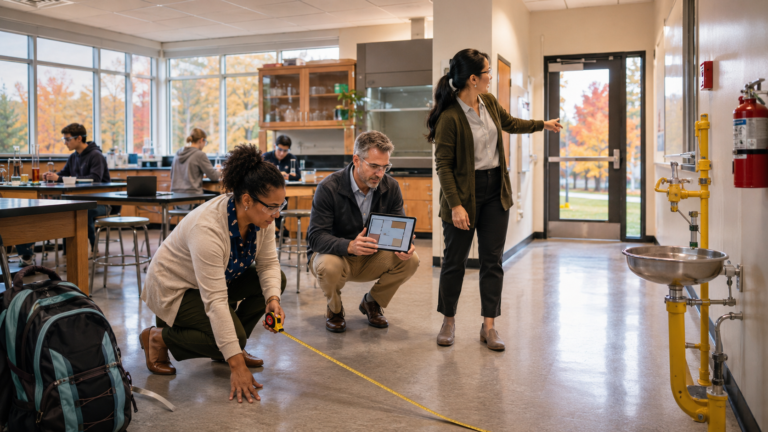
Even similar schools have important differences. One may have a functioning fume hood, while another does not. One may maintain a dedicated chemical stockroom, while another has materials distributed across several classrooms. Eyewash stations, safety showers, spill kits, exits, and emergency access points are rarely located in the same places.
A plan that ignores those differences may appear complete during a document review but provide little direction during an emergency.
OSHA’s definition of a CHP refers to hazardous chemicals used in a “particular workplace.” A useful plan must connect written procedures to the place where the work occurs.
What Building-Specific Planning Should Include
A school does not need to create its plan independently from the district. A strong model can use one district framework supported by building-level plans or appendices.
Each school’s plan should identify:
- The chemicals present and their specific storage locations
- The location of current Safety Data Sheets
- Procedures for purchasing, receiving, labeling, storing, using, and disposing of chemicals
- Rules for separating incompatible materials
- Required protective equipment and engineering controls
- Inspection schedules for fume hoods, eyewash stations, safety showers, and other emergency equipment
- Activities requiring review or prior approval
- Spill-response and evacuation procedures
- Internal and external emergency contacts
- Staff responsibilities during an exposure, spill, fire, or ventilation failure
The plan must also reflect the school’s current curriculum. If a new laboratory investigation introduces a different chemical, process, or exposure risk, the activity should be reviewed and the CHP updated when necessary.
The NIOSH School Chemistry Laboratory Safety Guide emphasizes connecting the plan to the chemicals, equipment, procedures, and controls found in the actual workplace. A template can help a district begin, but it cannot make those local decisions.
The Chemical Hygiene Officer Makes the Plan Operational
The CHP explains what should happen. The Chemical Hygiene Officer helps ensure that it does.
This does not mean the CHO personally completes every inspection, handles every chemical, or assumes sole responsibility for safety. The district remains responsible for providing appropriate resources, training, equipment, and administrative support. Teachers, facilities personnel, administrators, and other employees all have responsibilities within the system.
The CHO provides the technical leadership connecting those responsibilities.
An effective CHO helps review laboratory activities, evaluate hazards, maintain the chemical inventory, identify storage problems, coordinate training, recommend controls, and review incidents and near misses. The CHO also gives employees someone to contact when they encounter a chemical or procedure they do not understand.
Simply placing someone’s name in the plan does not provide that protection. The person needs appropriate training, access to information, time to perform the work, and authority to address unsafe conditions.
Districts can organize the role in different ways. A large district may need a district-level CHO supported by trained building CHOs or safety leads. A smaller district may have one qualified CHO serving several schools.
Either model can work when the coverage is active and clearly communicated. What should never happen is for a school to be uncertain about who provides that oversight.
Employees in every building should be able to answer:
- Who is our Chemical Hygiene Officer?
- How do we contact that person?
- Who is the trained onsite contact when the CHO is elsewhere?
- Where is our current Chemical Hygiene Plan?
- Who can stop an activity when a serious hazard is identified?
If staff cannot answer those questions without searching through old emails or calling multiple offices, the system is not ready.
Chemical Safety Extends Beyond the Chemistry Lab
Chemistry classrooms may contain the most recognizable laboratory hazards, but they are not the only places where chemicals are found.
Depending on the school, chemicals may also be present in biology classrooms, art rooms, career and technical education spaces, agricultural programs, maintenance shops, custodial areas, pools, and storage rooms.
Not every chemical in these locations falls under OSHA’s Laboratory Standard. Other hazard communication, occupational safety, fire, environmental, or waste-disposal requirements may apply. Those distinctions should be evaluated by someone with the appropriate expertise.
From a building-safety perspective, the lesson is simple: chemical risk should not be managed by departments working independently.
The CHO, administrators, facilities staff, teachers, and emergency personnel need a shared understanding of what is stored in the building and how an incident will be handled. Firefighters should not discover an unidentified chemical storage area after entering the school. A custodian should not unknowingly move laboratory chemicals during summer cleaning. A new teacher should not inherit an aging stockroom without review, training, and support.
Make the Annual Review Matter
OSHA requires covered employers to review and evaluate the effectiveness of the CHP at least annually and update it as necessary. Schools should treat that review as an operational exercise rather than a paperwork deadline.
The review should confirm that the inventory matches what is physically present, contact information is current, staff assignments have not changed, training has been completed, and emergency equipment has been inspected.
It should also examine what changed during the year.
Were new chemicals purchased? Were laboratories renovated? Did a fume hood fail? Were there spills, close calls, or recurring concerns? Did teachers introduce new demonstrations or laboratory activities?
A meaningful review uses those changes to strengthen the plan. Replacing the date on the cover page does not make a school safer.
Safety Has to Live Where the Risk Lives
District leadership is essential, but chemical safety must reach every building.
The strongest approach combines districtwide expectations with building-specific information, qualified CHO oversight, accessible procedures, and local staff who understand their responsibilities. It gives teachers someone to call before a concern becomes an emergency. It gives principals a clear system to support. It gives facilities personnel the information they need to maintain safer conditions.
A Chemical Hygiene Plan sitting in a central office may provide documentation. A current plan connected to a qualified Chemical Hygiene Officer and understood by the people who use it provides protection.
Every school that uses hazardous chemicals needs both.
Subscribe to edCircuit to stay up to date on all of our shows, podcasts, news, and thought leadership articles.
Related reading
More on School Safety