
https://vimeo.com/254728138
Celebrating the Unsung Heroes of the Global YMCA Network  The Young Men’s Christian Association was founded in London in 1844. Almost 175 years later, the modern Y is an international federation of YMCA movements in 119 countries around the world. Each association is led by its own local indigenous lay and staff leadership. The Y-USA is the largest of the YMCAs in the world, with a presence in every single state in the country. Nationwide, over 2,000 local associations are serving over 23 million people in the United States. But internationally, YMCAs serve well over twice that many at close to 58 million around the world.
For Tom Valentine, that means there are limitless opportunities out there for stories that need to be told. As the Vice President of the International Group of YMCA of the USA, he feels that there is not enough attention and appreciation paid to the daily heroes with the Y who make a huge difference every day around the globe.
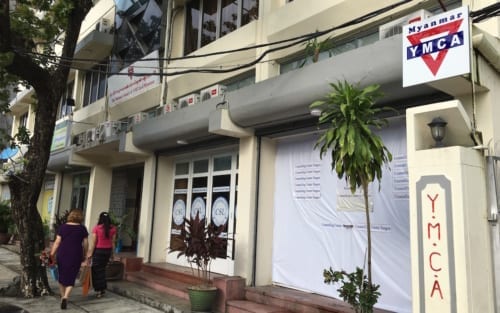 “Telling the stories of the impact that we make is a huge priority,” Tom says. ”In the United States, we have an initiative called ‘Living our Cause’ which is teaching us how to be more effective storytellers in the impact of what we do.” Tom is expanding this program internationally, and the amazing stories of impact are flowing in from across the globe.
In Japan, the story may be working with a rapidly aging population. In a place like Liberia, the story may be the eradication of the Ebola virus and civic engagement of voter education. “In fact, it was the YMCA who led the youth-voter education efforts that resulted in the highest turnout in the last election that they had,” Tom says. “It was one of the first important peaceful transitions to democracy in any country in West Africa. And that was all led by young people working with the YMCA.”
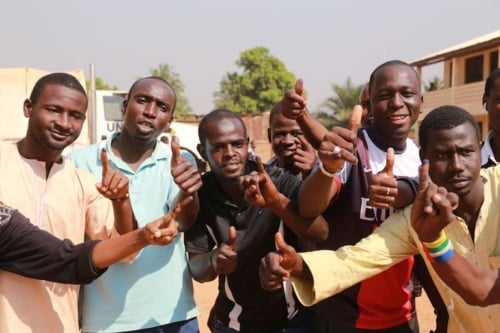 Through the African Renaissance movement, there’s a lot of sharing within regions. “All the Y’s in Africa work very closely together,” Tom says. “They may be different in different cultural and political context, but all of them have a motto empowering young people for the African Renaissance. So they’re all working to move young people from being subjects to citizens and leading civic change.”
YMCAs across America are involved in international service program exchanges, learning exchanges, and partnership exchanges. One of YMCA’s significant new initiatives at the moment is building a new generation of globally responsible young adult leaders inside the YMCA. The effort is targeting young folks in their twenties. Through mentoring and international experiences they can learn to lead positive change and help build true global communities as they develop cultural competencies. They understand social equity and inclusion at a deeper level.
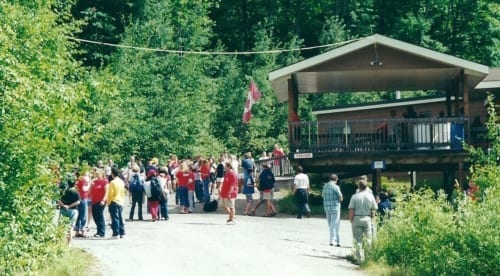 “We had two America summits with young people from South America, the Caribbean, Central America, and the U.S. and Canada last year,” Tom says. “They did social merging programs in Bogota with victims of sexual exploitation, and in schools of kids who were displaced by the conflict.” Tom says the results were astounding. “These experiences just transformed their lives,” he says.
The Y also has a lot of important international programs targeted for teens. There are international camp exchanges between various countries and Y’s. A group of young Boulder High School students recently spent two weeks in Peru where they participated in a local Y camp with Peruvian kids in Lima and working in some of the local Y’s social inclusion projects.
There is a great program through the YMCA of Greater New York called “Global Teens” where groups of teens raise their own resources and go overseas in community service projects. They have visited and worked in places like South Africa and Colombia. “Increasingly,” Tom says, “those exchanges are growing.”
In Ureki, a town in the Republic of Georgia on the Black Sea, the international YMCAs have been building a camp in what was formerly a collective farm for orange orchards. The YMCA holds camps every summer called Roots for Reconciliation with the objective of “cultural peace through camp.” The YMCA camp, with the assistance of a few organizations around the world, brought together Georgian, Armenian, Azeri Russian, Ukrainian, and American youth to talk about peace through the lens of camping.
“We really believe as a movement, we have that safe space where young people can connect with others,” Tom says. “No matter what their backgrounds are and no matter what the histories are between their countries, they need to learn about each other and build those bridges of cooperation that are so important for the future.”
About Tom Valentine:
 Tom Valentine is the Vice President of the International Group of YMCA of the USA (Y-USA). Tom leads Y-USA’s efforts to strengthen collaboration between the U.S. YMCA Movement and the YMCA Movements located in 118 countries. This includes efforts to strengthen U.S. YMCA engagement with newcomer-immigrant communities across the nation, the coordination of financial and technical support for international YMCA partners, and the mobilization of philanthropic support for global YMCA youth and community development initiatives.
Tom has more than 25 years of international development experience in Africa, Asia, Eastern Europe, Latin America and the Middle East. He led the management of over $20 million in grants from United States Agency for International Development, the David and Lucile Packard Foundation, the Kresge Foundation and the Knight Foundation. Prior to joining the YMCA in 1996, Tom worked with Catholic Relief Services in Ethiopia, Egypt, Kenya, Uganda and Burundi. Tom holds a Masters’ Degree in International Development from the Fletcher School of Law and Diplomacy at Tufts University and a Bachelor’s Degree in American Studies from Georgetown University. Tom speaks French, Spanish, Amharic, Arabic and Kiswahili.
Follow Tom Valentine on


 “It became my first question to everybody I talk to,” she says. “Because there are so many different circumstances and people talk to me about all kind of things, that when they finish talking, I ask them the second question; and the second question can be best described as the ‘why.’
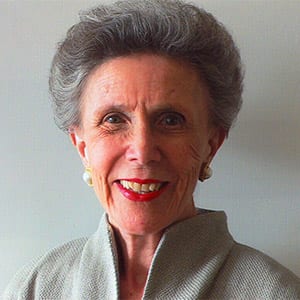 Dr. Gisèle Huff is the executive director of the Jaquelin Hume Foundation in San Francisco. After a decade in the business world, she earned a Ph.D. in political science, with a concentration in political philosophy, at
 Programming covers a broad range of activities, including analysis, problem-solving, algorithm generation, the application of computer science concepts, and testing. Meanwhile, coding is the implementation of programming: writing the actual code to execute tasks.
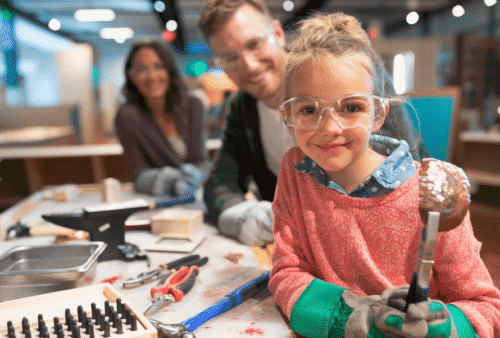 It’s imperative for parents to help spark their daughters’ ongoing interest in technology. Parents should help them cultivate the necessary skills and mindset to think like technologists. This will prepare them to navigate a world of constant and rapid technological development and be conscious consumers of technology.
 Encourage girls to disassemble things, especially old electronic devices. We often include classes about technology systems in our programs during which students ages 7-12 rip apart old laptops. This is a revelation for many of our female students since many of them have never done something like this.
  Register them in computer science or programming activities, either alone or with a friend. Until computer science education becomes part of formal school curriculum, girls will continue to be under-represented in technology education. Exposure and experience in predominantly-male learning environments will provide them with resilience, perseverance and inspiration to create more diverse, inclusive technology teams.
 Fazreen Razeek from
 When I am sitting and flipping through the television channels, there are a few things that cause me to pause. One is the movie A Few Good Men. I always stop when I come across a baseball game too. The third thing that will make me stop and pay attention is the show The Joy of Painting. And not only will I stop and watch for a few minutes, I will sit and watch transfixed until the painting is done a half hour later. My wife often times comes downstairs and finds me in a zombie-like state, staring at the screen.
  He didn’t always seem to have an exact plan when he was painting. Sure, he knew he was doing a landscape of a mountain or a sunset, but he always allowed himself some wiggle room should he make a mistake. He would say “we don’t really know where this goes and I’m not sure we care.” I would be amazed by the fact that he would make an askew paint line, a blotch, or a discoloration, and turn it into something beautiful like a mountain, a cloud, or his favorite, a tree. He actually revelled in mistakes because they were just an opportunity to create something else. He once said “ever make mistakes in life? Let’s make them birds. Yeah, they’re birds now.” He encouraged these happy accidents because that was where most of the best work was done. He would tell the audience “don’t be afraid to go out on a limb because that’s where the fruit is.”
 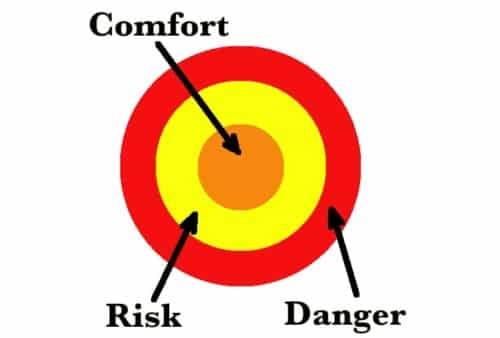 By allowing students the chance to revise their work, they are going to be more willing to take risks and try new things. This is where the greatest learning takes place. I have used this visual in a couple of my books, but it does an effective job of showing where the optimum learning takes place:
 There are those who will argue that by allowing students to rework their mistakes, you are just teaching them not to try their best the first time. That in real life, you sometimes only get one shot and children need to learn this in school. But isn’t the point of school that the student learns it? Not that they got it correct the first time?
 The process of learning something new requires a lot of effort. Just watch a baby learning to take her first steps or remember how hard it was to learn to play a musical instrument or learn a second language. Why would anyone desire to continue doing something that is so hard? The rewards that accompany success provide motivation. Without these rewards, people become discouraged and disengaged. At this point, the desire to continue learning stops, and may not rekindle without external intervention. Over the past 30 years, the gaming industry has developed many ingenious researched-based strategies that keep gamers engaged. “Game players regularly exhibit persistence, risk-taking, attention to detail and problem solving, all behaviors that ideally would be regularly demonstrated in school.” (The Education Arcade at MIT, 2012) The desire to spend the time and effort to complete another few exercises is frequently what separates students who pass from those who fail. So, what are some of these factors that spur motivation?
 How is motivation a strength of staged learning?
 Jim Britt graduated from the