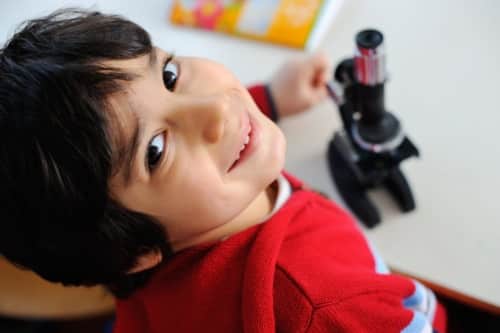
Watching fourth graders working in a team on a creative PBL science project (Their problem to solve: Educate parents and community about how common devices like TV’s and phones rely on wave technology) reminded me that great project based learning aims to produce brightness. That’s a non-evidence-based term unrelated to the repetitive mantra of more rigor.
Brightness is hard to define, but certain markers identify it: Big eyes, with greater than usual sparkle; wide grins; lots of excited chatter; deep concentration; and body language that signals increased confidence and maturity—exactly what those 4th graders were demonstrating.
The underlying cause of brightness is no mystery. It’s a natural byproduct of exceptional human performance driven by the opportunity to thrive and shine, and a state of being reached by learners of all ages when they accept a challenge, engage in creative work, experience intellectual mastery, trade ideas, find joy in trying and persisting, craft an acceptable solution, discover new facets about themselves, sense their growth, and share the whole process with someone who cares.
Do educators like brightness? Of course. It’s a fuzzy outcome, but it warms the heart of every teacher because it’s direct evidence of internal awakening. ‘Iceberg’ traits such as curiosity, creativity, and openness have been stirred. Visible joy equals meaningful learning, and often leads to higher test scores. And, as most educators sense, the tide of history is flowing toward fuzzy outcomes. At some point, they will be considered primary outcomes rather than chance byproducts of an academic system.
Here’s the argument: We’ve hit that point. Brightness now matters more than test scores. The globalized, networked, just in time world invaded classrooms a decade ago, but has finally forced upon education the Great Shift: People’s strengths count more than credentials. Many hard truths emerge from this new reality. Knowledge without application has less value. Attitude matters. Openness and flexibility determine success. Skillfulness, discernment, engagement, and creative impulse become the rulers of the land. And, the final fact: Today’s system, with its focus on content rather than human performance, will be tested until it breaks.
There’s a lot of noise in education right now, but only one signal: The need to invent a system designed for brightness so that inner strengths routinely surface in children. Can it be done? Yes, if we weave together three dominant trends in schooling today—the rise of PBL, our growing commitment to social emotional competency, and the refocus on student agency and inquiry—into a coherent human performance system.
Transforming PBL: From High Quality to High Performance
Advocates for ‘high quality’ PBL push teachers to adopt best practices that go beyond traditional ‘projects’ and engage students in authentic inquiry, deeper problem solving, and applying core skills such as teamwork and communication. This is good work, but slow—and there’s a reason: PBL relies on an outdated platform. It’s built on teacher methodology, tying it to a behavioral worldview which presumes that standards-based thinking and ‘strategies’ provoke deeper student awareness and problem-solving. While a great deal of lip service is paid to authenticity and student-driven work, most PBL doesn’t really begin with the student. It’s seen as an educational method, not a system to support human growth.
This was not always the case. In fact, PBL is a method for brightness. That’s what it’s intended to do. PBL began as ‘problem based learning’ in Canadian and Dutch medical schools in the 1960’s. Not coincidentally, this was the exact dawn of the human potential movement, in which pioneers like Abraham Maslow and Carl Rogers began developing a humanistic approach to psychology that emphasized self-aspiration, inner reflection, and a ‘person-centered’ approach to life. This cultural shift influenced early adherents of PBL, who wanted to move prospective doctors in the direction of deeper learning through less textbook diagnosis and more communication with patients.
If we want a replicable model of PBL that incorporates standards and knowledge, but also reliably yields successful fuzzy outcomes, the first step is to reclaim the belief that PBL is designed to facilitate personal growth and unleash human potential. It’s a psychological process as well as an educational tool.
With that mindset, PBL takes on a different hue. The principles of high quality project design are familiar to well-trained PBL teachers, and a reinvented PBL retains those principles. But each can be infused with a higher purpose by intentionally eliciting social emotional strengths and supporting growth while learning takes place. This requires systematic design, not lesson planning. The principles function as parts of the whole, creating a continuous set of Petri-like conditions that work synergistically to shift a student’s awareness in the direction of openness, curiosity, flexibility, perseverance, discernment, deeper engagement, mastery of content and—eventually—wisdom. Consider a transformed PBL process that can be put in place right now:
From standards to purposeful challenge.
Every great project begins with a ‘why’ that starts the engines of the inner life and spurs openness. Preparing for a test is not a ‘why’ nor do standards stir the soul. Begin with powerful, meaningful ideas that invoke meaning, purpose, and service. Go deep, then import standards into the project. The times demand it.
From a Driving Question to a ‘wicked’ problem.
The true test of the quality of a Driving Question is whether it forces discernment and flexibility. A wicked problem with multiple solutions and clear constraints—the kind that dominates life today—invites powerful critical thinking that invokes deep inner resources. PBL is NOT a brain-based exercise; it’s whole body learning experience that yields appreciation for the richness and complexity of knowledge and lingers throughout a lifetime as curiosity.
From fast to slow learning.
PBL oriented to human performance requires abandoning the folk myth that fast learners are smarter and that coverage equals learning. The quality of the work should include attention to detail, perseverance, reflection, and creative effort. The underlying change is from a ‘hand it in’ classroom culture to a design, draft, fail and perform culture that values depth over coverage.
From groups to intentional collaboration.
Group work inspires chat, but when interacting in well-organized teams or cohorts students must stretch communication skills. Those skills manifest as good listening or visible support of teammates. But ultimately, communication succeeds in the presence of empathy, tolerance, kindness, and self-awareness. Since working in teams brings out individual personality, teamwork gives teachers a grand opportunity to observe students and coach them on behavior and self-restraint.
From educational rubrics to human performance measures.
PBL has birthed a set of excellent performance rubrics that describe skills as well as content, but the new generation of rubrics must add measures that focus on the strengths underlying the skills, such as confidence, resiliency, and other factors that support the growth mindset. It will not be enough to hope that students develop strengths; the next generation of rubrics must show and tell.
From teacher to co-creator.
Differentiating ‘teacher centered’ from ‘student centered’ is no longer useful. In the system to come, everyone plays a role as a learning partner holding respect for each other. In PBL, the teacher designs, guides, mentors, teaches, and evaluates—but also incorporates creative insights, student wisdom, and opportunities to produce new knowledge. All this cannot happen unless teachers take a similar journey as students: Toward more depth of awareness, acceptance of multiple talents, deeper empathy, a never-satisfied curiosity, and the experience of the joy of work well done and knowledge well applied. The goal for both teacher and student? Brightness.
Subscribe to edCircuit to stay up to date on all of our shows, podcasts, news, and thought leadership articles.

 1. Student Portfolio Podcast
 How it works:
  4. Create Interactive Video Postcards to Classrooms Across the World
 5. Bring The Story to Life
 6. Soundtrack to Your Feelings
 Terry Eberhardt is a music teacher at
  But based on my interaction with him, I did a double degree in education and performance at Peabody Conservatory of Johns Hopkins. The whole time I was taking the education courses I was thinking,
  TE:
TE: Terry Eberhardt’s love of music began with his church choir and public school chorus. Terry was recruited to a prestigious local private high school on a music scholarship. It was there at DeMatha High School, performing in the chorus, where his love of singing blossomed. It was through the transformative experiences as a music student that he was inspired to share the gift of music with young people.
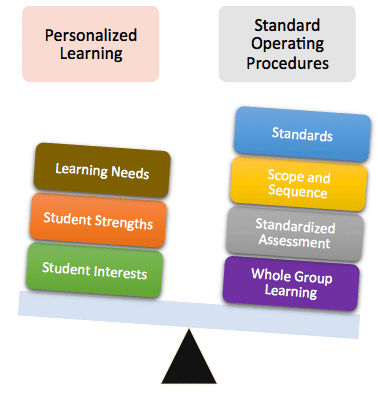 If personalized learning is the direction in which we want to move, how do we “tip the scale” in favor of it, to help us as educators to facilitate the academic success of each student through their learning needs, strengths, and interests? After all, whole group learning, standards, the scope and sequence, and, especially, the standardized assessment we typically use and teach to tend to drive our curriculum.
 It sounds simple enough, but how do we, as educators, go about setting the stage for all of this to happen? Some of the answers rely on technology, but even without a great deal of technology at educators’ fingertips, it is possible to deliver personalized learning. Here are some tips from many people who manage this on a daily basis:
 Automate what you can, and allow students to make choices whenever possible:
 If all or most of the above is put into place and practiced in classrooms, the balance can indeed be tipped in favor of personalized learning. This would mean students are likely to learn more content, learn more about themselves, and take more control of their own learning. What a wonderful scenario for our 21
 Welda Simousek is the author of several books (mentioned above), an experienced educational consultant, and owner of Welda Consults, LLC, which is a customized professional development company,
 If you walk into nearly any public high school in the United States you will see the influence that sports have on the school environment. This may be in the trophy case that sits at the front of the school. It might be the posters encouraging athletes to achieve great things against a rival. It could be the pep rally the school holds to encourage and inspire the athletes. Or the press showing up to document the signing of an athlete to a college commitment. Just listening to the announcements, the content is rife with the accomplishments of the sports teams and the athletes that participate.
 Just go to any high school football game on a Friday night. There is always a crowd, not all which are parents and students but community members as well, a lot of enthusiasm as evidenced through the noise level, and cheerleading squads and bands which support the teams. Now go into a classroom and measure the level of enthusiasm of those in attendance. It is almost passive. Where is the pep rally for the academic bowl team? Where are the posters supporting the chess members? Do community members turn out to watch the robotics crew compete?
  Imagine a school system where 100 percent of the focus is on the education of children. All resources would funnel toward this goal and all of the parent involvement would have to do with academics. Where every hire is to find the best person to teach that content area, not who can perform double duty as teacher and coach. How much movement would occur at that school in regard to achievement?
 One could easily make the argument that sports teach our children very valuable skills. Leadership, teamwork, and problem-solving are just a few of many benefits of participating in a sport. There is certainly value in sports. The problem comes when sports becomes more valued than the academics – when the focus of schools becomes more about sports than education.
 It is because there is too much opportunity in sports. Sports can lead to college scholarships. That is all fine and dandy if the student were using this chance to get a degree to lead to bigger and better things. The problem is that colleges are just as guilty if not more so in perpetuating the sports racket. When college football has become the minor leagues of the NFL and hot basketball players rarely last longer than two years in school before going into the NBA draft, college sports is big business. It brings in billions of dollars a year to universities as their sports are nationally televised and have corporate sponsors.
 other entity. Take it off of the school’s plate and onto someone else’s. The schools have enough to worry about educating the masses of their community. As a gifted coordinator who fosters the academic potentials of young children, I would like to see more emphasis put on academic success so that the students who are not athletically inclined are recognized for their achievements.
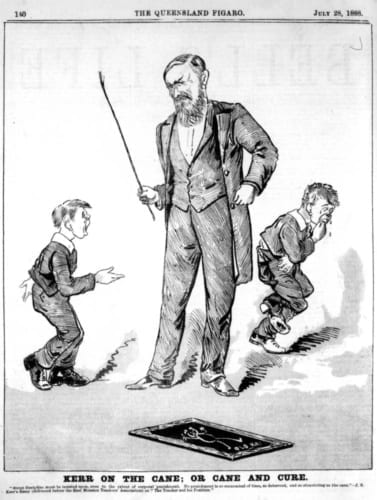 Schools around the country began implementing zero-tolerance policies in the mid-1990s to curb drug use and the possession of weapons on school grounds. Now zero-tolerance policies have spread to other student safety areas, including alcohol use, fighting, bullying and more. If a student is caught committing such an act, they often are immediately suspended or expelled – no questions asked.
 What makes zero-tolerance policies so destructive for students is they do not take into consideration the situation that caused the behavior. For example, should a student be suspended for biting a pastry into the shape of a gun? No, but it has happened. The discipline approach also does not take into account the student’s past indiscretions, or any mental health issues or special needs the student has that may have led the student to misbehave. For example, should a student on the autism spectrum who gets overstimulated and acts-out by hitting another student get suspended? No, but it has happened.
  So what does a PBIS system look like at the school level? Administrators and teachers need to define a set of student behavior expectations, and then share them with the student body. These expectations should be easy for all students to understand and should be promoted by all faculty and staff consistently and frequently.
  Data:
Data: