Art and AI: A New Era of Student Creativity
Why the Next Generation of Artists Will Blend Traditional Craft With AI-Powered Innovation

AI and art now meet in K-12 art rooms. How teachers use the tools, what NAEA says about attribution, and what copyright law means for students.
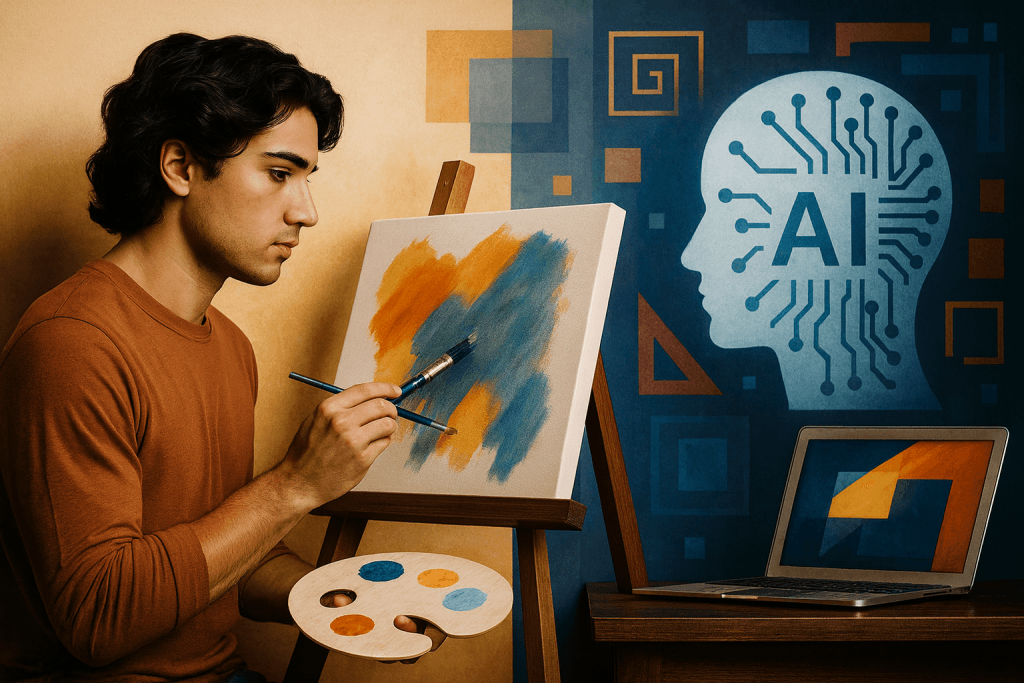
AI and art now meet in many K–12 art rooms. Students use image generators to brainstorm, photo apps to correct exposure and remove distractions, and design tools that clear backgrounds or suggest layouts in seconds. For art teachers, the question is less whether these tools will appear than how to use them so that students still learn to see, make and judge their own work.
The National Art Education Association set out its view in a position statement on AI and AI-generated imagery, adopted in April 2024. It describes AI as offering “both opportunities and challenges”: help with generating ideas, building digital design skills and differentiating lessons, alongside real concerns about authenticity, over-reliance and bias. It asks teachers to balance AI with traditional methods, and it is plain about one point: producing images with AI without proper attribution is a breach of academic integrity akin to plagiarism.
Where AI helps students make art
Getting past the blank page
A blank sketchbook stops many students before they start. Generating a few rough concepts, color palettes or compositions can give a hesitant student something to react to. The value is in what happens next: choosing one direction, changing it, and making it their own in pencil, paint or clay. Teachers who use AI this way treat the output as a reference, much as an artist uses a photograph or a thumbnail sketch, not as the finished piece.
Photography and digital design
Photography has absorbed AI faster than any other medium. Editing tools now correct exposure, sharpen detail, remove distractions and simulate depth of field, which lets beginners produce strong images quickly. The Art of Education University’s guide to how AI is changing photography in the art room suggests using that speed to teach the principles behind the edit: why an image reads as underexposed, what a shallow depth of field does to a portrait. In digital design, automatic background removal, resizing and layout suggestions free time for the decisions that matter in a portfolio: hierarchy, clarity of message and consistency across a set of work.
Access for more students
For some students with physical or cognitive disabilities, AI tools can open forms of making that were hard to reach, such as producing a design they can describe but cannot easily draw. Used this way, the tool widens who can take part in the art room rather than replacing the skills other students are building.
What students need to understand
Using AI well in art is also a lesson in ethics and visual literacy. Students should know:
- Where the images come from. Image generators are trained on very large collections of existing pictures, including the work of living artists, which raises questions about permission and credit.
- When to label AI-generated work. NAEA’s position is that unattributed AI imagery is a form of plagiarism, so classroom rules should say when and how students disclose AI use.
- Who owns the result. The U.S. Copyright Office’s January 2025 report on AI and copyrightability concluded that AI output can be protected only where a human author has determined sufficient expressive elements, and that writing prompts alone is not enough. Using AI to assist human creativity does not rule out protection.
- How to spot bias and borrowed style. Generated images can repeat stereotypes and imitate a recognizable artist. Learning to notice both is part of being visually literate today.
Is AI art “real art”?
The debate is familiar to art historians. Photography was once dismissed as a mechanical trick, and digital painting met similar doubts. What has stayed constant is that art is judged by intent: the idea, the choices and the meaning a person brings to the work. That makes a practical classroom rule easy to state. A student can use AI as one tool in a process, but the work is assessed on the decisions the student made and can explain.
How art teachers are using AI in class
- Warm-ups and studies. Generated shapes or compositions as starting points for contour drawing or color studies.
- Art history mashups. Asking what a familiar scene would look like in the style of a movement, then comparing the result with real works and discussing what the tool got wrong.
- Critique practice. Using AI suggestions as one voice in a critique, which students then accept or reject with reasons.
- Process portfolios. Requiring students to show prompts, drafts and changes, so the thinking is visible and AI use is disclosed.
What school leaders should put in place
- Approved tools and age limits. Many image generators are not designed for younger students and have their own age rules. Choose tools with a student data privacy agreement.
- Clear attribution rules. Align the art department’s expectations with the district’s academic integrity policy and with NAEA’s guidance.
- Professional development. Art teachers need time to try the tools and design projects, not only a list of approved apps.
- Equitable access. If AI-assisted design becomes part of the course, every student needs a device and school access to the tools, not only those with subscriptions at home.
- Room for both. Keep hand skills at the center. Drawing, painting and sculpture build observation and patience that no tool supplies.
Handled this way, AI and art can work together: AI becomes one more medium in a long line of new tools that artists have absorbed. Students who leave school able to use it, question it and credit it honestly will be better prepared for creative careers that already use it every day. For the wider picture of AI in schools, see edCircuit’s guide to AI in education.
Further exploration: how artists are using AI today
This panel from the San Francisco Public Library brings together artists and technologists who use AI in their practice.

San Francisco Public Library – Art Meets AI: Explore how artists are engaging with artificial intelligence (Play video)
Related reading
Subscribe to edCircuit to stay up to date on all of our shows, podcasts, news, and thought leadership articles.
More on Artificial Intelligence