
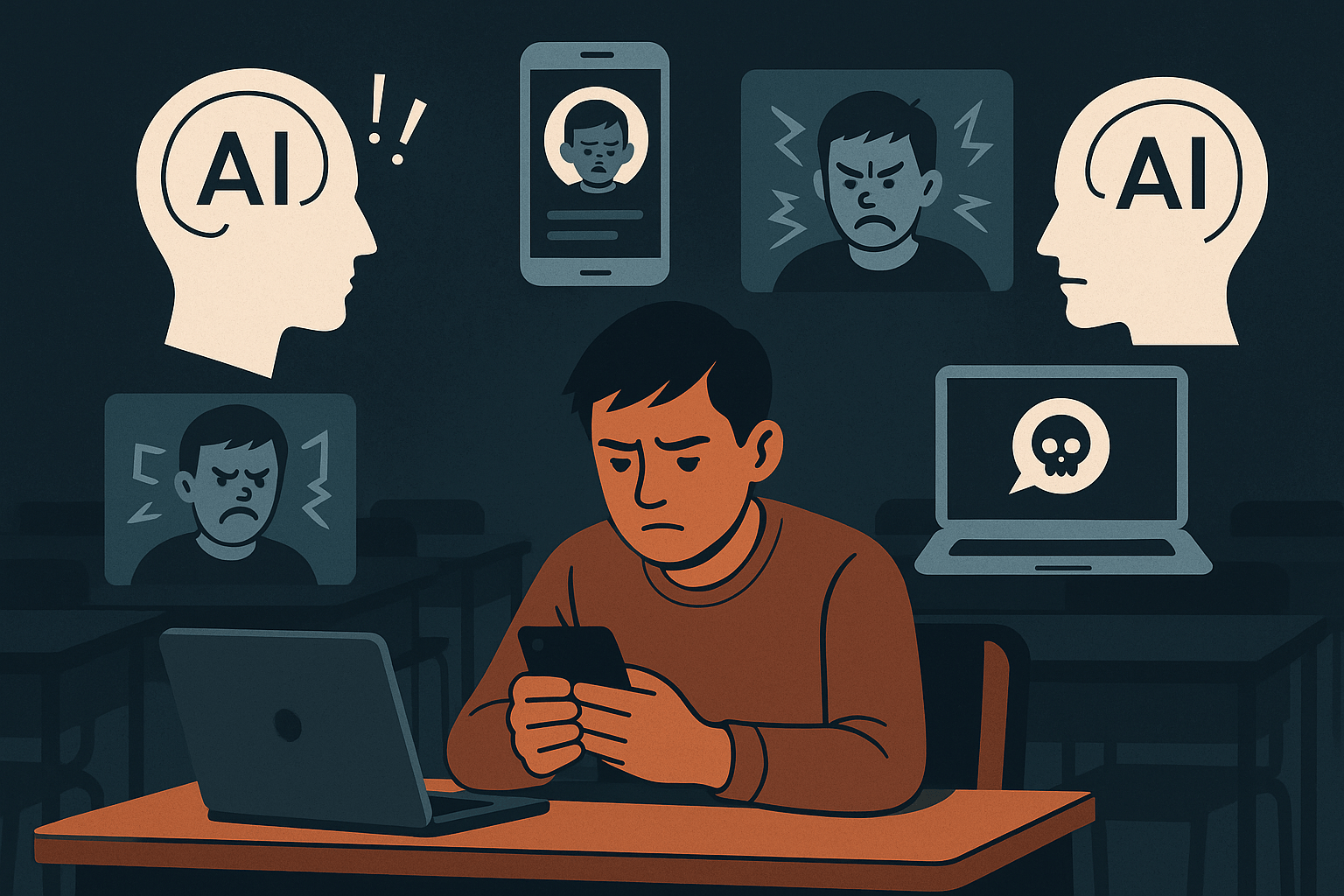
For years, schools have worked to address bullying through clear expectations, digital citizenship lessons and reporting systems. AI bullying adds something new. Students can now use AI tools to alter photos, imitate a classmate’s voice, fake screenshots or produce harassing messages in seconds, and the results can spread across a school before any adult sees them.
The scale is already significant. In 2023, 16 percent of U.S. high school students said they had been bullied electronically in the past year, and 19 percent bullied at school, according to the CDC’s Youth Risk Behavior Survey. AI-generated images are a growing part of that picture: in a Center for Democracy & Technology survey, 40 percent of students and 29 percent of teachers said they knew of a deepfake of someone connected to their school being shared during the 2023–24 school year. Thorn found that 1 in 8 teens personally know someone targeted by deepfake nude images.
How AI changes bullying
New forms of harm
Cyberbullying once meant hurtful posts, texts and group chats. AI adds:
- Deepfake images and video that place a student’s face into embarrassing or sexual scenes.
- Voice cloning that makes it sound as if a student said something offensive.
- Fake screenshots and messages attributed to a student who never wrote them.
- Chatbots used to produce streams of harassing messages or to impersonate a classmate.
These cases are no longer hypothetical. At Lancaster Country Day School in Pennsylvania, two students were charged after police found 347 AI-altered images and videos depicting 60 victims, most of them classmates; the school had received a tip months earlier but did not notify police, and its head of school and board president resigned in November 2024. In Beverly Hills, a middle school expelled five eighth-graders in 2024 after AI-generated nude images of 16 classmates were shared.
Speed and scale
AI removes two old limits on bullying: skill and time. Harmful content takes seconds to make, and one image can be copied across platforms and group chats before adults know it exists. For administrators, the speed of the response matters as much as the investigation.
Harm that is real even when the content is fake
Victims of AI-generated content often face disbelief, shame and fear that the images will resurface. That a picture is fake does not reduce the damage; it can make the student’s situation harder to explain to peers and family.
What the law now requires
The federal TAKE IT DOWN Act, signed in May 2025, covers intimate images created or altered with AI. Since May 19, 2026, covered online platforms must remove reported images and known copies within 48 hours of a valid request, and the Federal Trade Commission can seek penalties for violations. Schools can help victims and families use that process. States are also acting: Illinois, for example, expanded its school bullying and cyberbullying definitions in 2025 to include sharing unauthorized digital replicas of a student. Check your own state’s laws and involve district counsel when writing policy.
How AI can help schools respond
The same technology can also help schools see and stop bullying, if used carefully:
- Monitoring for warning signs. Tools on school devices and accounts can flag threatening language, targeted harassment or images that appear manipulated, so staff can act early.
- Anonymous reporting. Reporting apps and tip lines make it easier for students to tell adults what they see.
- Support for counselors. Tools that organize reports and track patterns can give counselors more time with students.
- Checking media. Schools need a way, with outside help if necessary, to assess whether an image or recording has been altered.
Monitoring raises its own concerns about privacy and false alarms. Districts should tell families what is monitored, how data is used and who reviews alerts, and make sure a person, not software, decides what happens next.
Updating policies for AI bullying
Many conduct codes and social media guidelines predate generative AI. Updated policies should address:
- Deepfakes and AI-altered media as forms of harassment, and, where they are sexual, as potential crimes to be reported.
- Impersonation with AI, treated like using another student’s account or identity.
- Off-campus creation, where the harm reaches school and affects students’ safety or learning.
- Creators and sharers, with consequences that distinguish the student who made content from those who forwarded it, and from students pressured into taking part.
- Reporting duties, so that staff know when to involve police and child-protection services, a step Lancaster’s experience shows schools cannot skip.
Supporting students who are targeted
- Give students a safe way to report, including anonymously.
- Move quickly to contain sharing, preserve evidence and help families request removal from platforms.
- Train staff to recognize AI-generated content and to respond without blaming the victim.
- Teach students what AI can fake, why sharing is harmful, and how to get help.
- Provide counseling early. Even when content is fake, the harm is real.
AI will keep changing how students treat each other, for better and worse. Schools that update policies, train staff, teach students and set clear reporting paths will be better prepared for the first case that reaches their office. edCircuit also covers deepfakes in schools and deepfake response plans for districts.
Free resources to support safer digital learning
As schools confront AI-driven bullying, deepfakes and online harassment, access to digital safety training matters. Science Safety offers a collection of free Cyber Learning Modules for students, teachers, administrators and school safety teams, covering:
- Online behavior risks and digital citizenship
- Recognizing manipulated images, videos and AI-generated media
- Identifying early signs of cyberbullying
- Student data privacy and responsible technology use
- Safe communication in blended and virtual environments
Each module is self-paced and easy to share with staff. Districts can explore and use these free modules here.

WKYC Channel 3 – Northeast Ohio app targets cyberbullying and aims to protect kids on social media (Play video)
Related reading
Subscribe to edCircuit to stay up to date on all of our shows, podcasts, news, and thought leadership articles.
More on School Safety