

edCircuit
  • Start Here
    • Login
    • Register
    • Subscribe
    • Submit a Press release
    • Advertise or Sponsor
    • Contribute
    • Get Interviewed
  • On the Wire
  • EdTech
    • All EdTech
    • Online Learning
    • Hybrid and Remote Learning
    • Augmented and Virtual Reality
    • ESports
    • Gamification and Game-Based Learning
    • Digital Citizenship
    • EdTech Entrepreneurs
    • Market Trends
    • Future of Education
  • Artificial Intelligence
  • K-12 Education
    • All K-12
    • K-12 Teachers
    • Teaching Strategies
    • Special Education and IEPs
    • Dyslexia
    • Gifted and Advanced Learning
    • Early Childhood, Pre-K and Kindergarten
    • School Calendar
    • Tutoring and Homework Help
    • Attendance and Absenteeism
    • After-School Programs
    • School Counselors
    • Homeschooling
    • School Models
    • Teacher Retention
    • Parents
    • Students
    • STEM and STEAM Education
  • Teaching and Learning
    • Literacy and Reading
    • Math Education
    • Civics and History Education
    • Financial Literacy
    • Assessment and Testing
    • Curriculum and Instruction
    • Personalized Learning
    • Project-Based Learning
    • Social-Emotional Learning
    • Executive Function
    • Creativity
    • Diversity, Equity, Inclusion
  • Professional Development
    • All Professional Development
    • Educators
    • Administrators
    • edLeaders
  • Higher Education
    • All Higher Education
    • College Admissions
    • Career and Technical Education (CTE)
    • Graduation
    • FAFSA and Financial Aid
    • Student Loans
  • Cybersecurity
  • School Safety
    • All School Safety
    • Science and Lab Safety
    • School Design and Facilities
    • Bullying
    • Duty of Care and School Liability
  • Continuing Education
    • All Continuing Education
    • Online Certificate Programs
    • Teaching Jobs and Careers
    • Teacher Appreciation
  • Education Policy and Government
    • All Education Policy
    • Department of Education
    • School Choice
    • Global
    • Advocates
  • EDU Shows
    • All EDU Shows
    • Safer Ed
    • Mind the Gap
    • Education Industry Questions
    • CoffeEd
    • InFocus
    • InformED Report
  • EDU Podcasts
    • All EDU Podcasts
    • Author Chats
    • CoSN The Podcast
    • Education Today
    • Building the Bridge
    • Students Speak
  • Education Industry Guides and Reports
  • Archived Media
    • Future of School: The Podcast
    • Equity Everywhere
  • About edCircuit
  • Subscribe
edCircuit
  • Sign in
Join Free
Home Tags Posts tagged with "AI"
Tag:

AI

Follow
AI literacy: a student driver and instructor on a driving lesson, with glowing AI guidance across the windshield
Artificial Intelligence

AI Is an Automobile: Why AI Literacy Comes From Driving, Not Reading

by EdCircuit Staff October 17, 2026
written by EdCircuit Staff 10 minutes read

Blackboard founder Stephen Gilfus argues that the way to understand AI is to get behind the wheel: like every transformational technology before it, understanding comes from experience, not observation. In a June essay on LinkedIn, “AI Is an Automobile,” he compared AI to the arrival of the car. People did not need a lesson on combustion engines to understand what a car could do; they watched one pass at a speed no runner, cyclist or horse could match. AI offers the same kind of jump in capability, he argues, with one difference that matters: it has no physical form. It does not drive past anyone’s house, so many people have heard about it, read about it or watched a demonstration without ever sitting in the driver’s seat. His conclusion is short: “No one truly understands the automobile from the sidewalk.”

Gilfus has watched a shift like this before. He co-founded Blackboard in 1997, when many educators doubted that teaching could happen online at all, and the learning management system it helped create is now ordinary in schools, universities and workplaces. Today he serves on the board of ISACA, the global association for IT audit, cybersecurity, risk and governance professionals, where he chairs its Innovation and Technology Committee. He also chairs edCircuit’s board.

The AI literacy gap, in numbers

The largest recent survey on the subject shows how far that experience has spread, and how people are getting it. In Trust, attitudes and use of artificial intelligence: A global study 2025, the University of Melbourne and KPMG surveyed more than 48,000 people in 47 countries between November 2024 and January 2025. Two in three said they intentionally use AI on a regular basis. Yet 61 percent had received no AI training, and half reported limited knowledge of AI.

Most people who use AI have learned it on their own, and learning by doing is how many good drivers start. The study suggests lessons still add something. At work, 58 percent of employees said they use AI regularly, and the study’s full report found that many rely on AI output without evaluating its accuracy (66 percent) and that 56 percent have made mistakes in their work because of AI. It also found that people with AI training report more trust, more use and more AI literacy.

Microsoft and LinkedIn found the same pattern in their 2024 Work Trend Index, a survey of 31,000 people in 31 countries. Three in four knowledge workers said they use generative AI at work, 78 percent of those users brought their own AI tools, and only 39 percent of people using AI at work had received AI training from their company.

How the world learned to drive

The car did not become safe and useful on the day it was invented. Over time, societies built the system that lets ordinary people drive: driving schools and instructors, practice in quiet places before busy roads, a learner’s permit before a license, a test of real skill, road signs and lane markings, traffic laws, and insurance for when things go wrong. Nobody suggested that people stop driving until all of it existed, and nobody suggested that people drive without any of it.

AI literacy needs the same system, and each piece has a counterpart:

  1. Instructors. People learn fastest with someone who has driven before: a colleague, a trainer or a teacher who shows how a tool is used on real work.
  2. Quiet streets first. Low-stakes tasks, such as drafting, summarizing or brainstorming, are better first drives than decisions about people, money or health.
  3. A permit before a license. Organizations can start with pilots for a defined group, a time limit and a review, before rolling a tool out to everyone.
  4. A test of real skill. Competence means checking output, spotting errors and knowing when not to use AI, not only writing prompts.
  5. Road signs. Rules work best where people meet them: inside the tools and workflows they already use.
  6. Insurance. Logs, human review and clear accountability exist for the day something goes wrong.

How to use AI: your first drives

For anyone still on the sidewalk, Gilfus’s advice is to get in the car, and the driving comparison suggests how:

  1. Pick a real task. Choose something you do every week, such as an email, a report outline or a meeting summary, so you can judge the result against work you know.
  2. Keep it low stakes. Start with tasks where a mistake is cheap, and keep confidential, personal or customer data out of tools your employer has not approved.
  3. Check your mirrors. Read every answer as a draft. Verify facts, figures and quotations against a source before you use them.
  4. Drive with a passenger. Use the tools and rules your organization provides, and compare notes with colleagues who use them too.
  5. Log your hours. Keep a short note of what worked and what did not. The time saved, and the errors caught, are what turn use into skill.
  6. Move to busier roads gradually. Take on harder tasks once you can reliably catch the tool’s mistakes.

Rules of the road around the world

Traffic law varies by country, but every driver meets some version of it. AI now has its rules of the road too, and several apply far beyond the place they were written.

The European Union’s AI Act makes AI literacy a legal duty. Article 4, in force since February 2, 2025, requires providers and deployers of AI systems to take measures that support the AI literacy of their staff and others using AI on their behalf. An amendment in July 2026 made clear that no specific level of literacy is mandated, and the European Commission’s AI literacy questions and answers says no certificate is required. The duty still has reach: it applies to organizations inside and outside the EU whose AI systems are used in the Union, and national authorities begin supervising and enforcing it in August 2026. The Commission’s own example is a company whose staff use ChatGPT to write advertising copy; those staff should be told about specific risks such as hallucination.

Outside the law, two widely used frameworks set shared expectations. The U.S. National Institute of Standards and Technology released its AI Risk Management Framework on January 26, 2023, for voluntary use by any organization; it is organized around four functions: govern, map, measure and manage. ISO/IEC 42001, published in December 2023, is what ISO calls the world’s first AI management system standard, and organizations can be certified against it. ISACA, the association on whose board Gilfus serves, has added AI credentials for professionals, including Advanced in AI Audit, Advanced in AI Security Management and Advanced in AI Risk.

Gilfus’s own test for any of these rules is whether people meet them at the moment they decide. In a field note on his website, “The governance gap in AI-assisted learning,” he writes that policies sitting in documents do not govern behavior: “If the rule isn’t in the workflow, it isn’t real.” A seatbelt chime works because it is in the car, not in the owner’s manual.

Drivers and the traffic system

The comparison also helps separate two kinds of AI that are often sold as one. In another field note, “AI Tutors vs. AI Orchestrators,” Gilfus distinguishes AI that works with one person, such as a tutor or an assistant, from AI that coordinates the systems around many people: identity, permissions, data, policy filters and a record of what happened. The first is the car and its driver. The second is closer to the traffic system of signals, lanes and records that lets many drivers share the road.

His summary is written for education, “Tutors answer to teachers; orchestrators answer to institutions,” but the point travels to any organization. The person using an assistant is the right judge of whether it helps them work. The organization’s technology, legal and security staff are the right judges of whether the coordinating layer protects data and keeps an audit trail. Buying the two as one product tends to measure each against the wrong standard.

Schools already run driver’s education

Education has a head start on this problem, because schools have taught people to drive for generations. The same global study found that 83 percent of students regularly use AI in their studies, while only half said their school or university has policies, resources or training to support responsible use. The driver’s-education model suggests what closes that gap: AI training for teachers that includes hands-on time with approved tools, supervised first use inside lessons, and assessment that rewards students for showing how they worked. edCircuit’s guide to AI in education covers the rest.

Where the comparison stops

No analogy is complete. A car’s failures are usually visible; an AI tool’s errors can be fluent and wrong at the same time, which is why checking output is the core driving skill. A car does not keep a record of what its driver says, while an AI tool may hold personal, customer or student data, so organizations need to decide what may be entered and where it may be processed.

Access is uneven, too. The 2025 study found higher AI use, training and knowledge in emerging economies than in advanced ones: 80 percent regular use against 58 percent, and 50 percent with AI training against 32 percent. AI literacy is not following the usual map of wealth, and organizations in advanced economies cannot assume their people are ahead.

Gilfus does not argue that experience should replace caution. In his view, AI is neither something to fear nor something to embrace blindly, and he pairs experimentation with what he calls pragmatic governance. Driver’s education makes the same bargain: it gets new drivers on the road sooner because it takes the risks seriously.

A one-year plan for any organization

Gilfus’s governance note sets out a one-year sequence written for schools and colleges. It translates to any organization that wants its people driving with skill:

  1. First three months: take inventory and set guardrails. List every AI use already in place, including tools people brought themselves, and the data each touches. Pause new uses in high-stakes areas until vendors can explain their models and keep logs, while low-stakes experiments continue.
  2. Months three to six: run guided pilots. Choose a few teams with different kinds of work and people who volunteer. State the role AI plays in each task, and report results to leadership monthly on one page.
  3. Months six to nine: build the rules into the tools. Turn interim guidance into templates, settings and contract terms, and expand only the uses the pilots supported.
  4. Months nine to twelve: make it routine. Move proven uses into regular service, review data flows and model changes each quarter, and record the training people have had.

None of this asks anyone to move faster than they are comfortable with. It asks that the people using AI, and the people making rules about it, do so with their hands on the wheel, not from the sidewalk.

Stephen Gilfus is chairman of edCircuit’s board and a director of ISACA. His field notes on AI governance and learning are at stephengilfus.com, and his original essay appears on LinkedIn.

Related reading

  • AI Rules for Schools: A Back-to-School Guide
  • AI in the Classroom: How Teachers Can Lead Responsibly
  • AI and Governance in School Districts
  • From Projectors to Virtual Dashboards: How Driver’s Education Has Transformed in the Age of AI

Subscribe to edCircuit to stay up to date on all of our shows, podcasts, news, and thought leadership articles.

October 17, 2026 0 comments
0 FacebookTwitterPinterestLinkedinWhatsappCopy LinkEmail
Woman on a corded desk phone typing on a laptop while a man looks on, in a busy office lobby setting.
Artificial IntelligenceHot Topics - controversial

Social Engineering in Schools Is Changing With AI

by EdCircuit Staff October 15, 2026
written by EdCircuit Staff 6 minutes read

Social engineering in schools can begin with a request that seems perfectly ordinary.

Imagine a school secretary receiving an email that appears to come from the principal. It asks for a student contact list before an afternoon meeting. The wording sounds familiar, and the sender explains that the principal cannot talk right now.

The request is fake. Between a ringing phone and parents waiting at the counter, though, it could pass for another task that needs to get done.

Social engineering exploits trust to persuade someone to share sensitive information, send money, or provide access. Deception that gains a person’s confidence to obtain information or commit fraud is central to the National Institute of Standards and Technology’s definition.

Artificial intelligence can make these requests more convincing. Schools need to address that risk in staff training, classroom lessons, and the procedures employees follow every day.

What AI changes

Social engineering predates generative AI. Impersonating a trusted colleague or pressuring someone to act quickly requires no sophisticated technology.

AI can make the deception easier to produce and harder to recognize. In a December 2024 public advisory, the FBI warned that criminals were using generative AI to create believable messages, reduce spelling and grammatical errors, and generate images, audio, and video for fraud schemes.

For anyone taught to spot scams by looking for awkward wording, that is a significant limitation. A polished message still needs to be checked when it asks for sensitive information or an unusual action.

The same applies to a familiar voice. The Federal Trade Commission warns that scammers can use a short recording to clone a loved one’s voice. It advises verifying the story by calling that person at a number already known to be theirs.

For a school, a voice resembling an administrator’s should not be enough to authorize an unusual payment or release sensitive information.

How it can show up during the school day

Consider a teacher receiving a false warning that their account will be suspended unless they sign in through a supplied link. That is a phishing attempt: a deceptive message intended to trick the recipient into taking an action, such as entering a password on a fake website.

A business office could receive a fraudulent request to change a vendor’s payment information. A student might be offered a scholarship that requires an immediate fee. Each gives the recipient a reason to hurry, making verification feel like an obstacle to finishing the task.

The FTC describes scholarship scams that falsely announce a student’s selection, demand upfront payments, or request financial information. Counselors can use these examples when helping students prepare for college applications.

A message that appears to come from a principal, coach, or counselor carries weight. Staff and students should feel comfortable questioning an unusual request from someone they respect. Otherwise, the sender’s apparent authority can become a reason to skip checking.

Teach students to examine the request

Social engineering fits into digital citizenship, media literacy, and college and career preparation. A short classroom exercise can give students practice responding when they feel rushed or uncertain.

A teacher might present a fictional message claiming that a scholarship will disappear unless the student pays a processing fee that afternoon. Ask students:

  • Who is the sender claiming to be?
  • What are they asking me to do or reveal?
  • How are they trying to influence my decision?
  • How could I check the request independently?

Have students explain their next step and identify whom they would contact. They might consult a counselor, find the organization’s official website independently, or involve a parent before sharing information. The exercise should leave them with a response they can use.

Younger students could examine a message promising a game reward in exchange for a password. Older students could discuss employment offers or messages that impersonate classmates.

Teachers can use a district-approved AI tool to prepare fictional examples at different reading levels. Use invented identities, keep real student information out of the prompts, and review the output before sharing it. Keep the activity focused on discussing examples, with no deceptive messages sent to classmates or collection of actual passwords.

Make verification part of school procedures

Staff need practice with requests they encounter in their jobs. Office staff could discuss a questionable records request. Employees who handle purchasing could work through a supposed vendor payment change and identify how they would verify it.

District procedures should make the next steps clear:

  • Verify changes to payment or payroll information through an established contact method before making the change.
  • Follow the school’s authorization process before releasing student records, including when a request appears to come from a senior administrator.
  • Open familiar services through a saved bookmark or approved app when checking an unexpected account warning.
  • Give staff a clear way to report suspicious requests and get help promptly.

Replying to a suspicious message or calling the number supplied in it may lead back to the same person. The FTC recommends contacting an organization through a phone number or website already known to be genuine.

Administrators need to follow the same procedures. Regularly asking employees to bypass checks because something is urgent makes it harder for staff to recognize when a request crosses a line.

Families also need to know where to confirm school payment requests and unexpected messages involving their children. Include those directions in routine communications, in the languages families use.

Make it easy to ask for help

Even a well-trained employee can be deceived. The United Kingdom’s National Cyber Security Centre cautions that people cannot be expected to identify every phishing attempt. It recommends combining education with technical protections and preparation for incidents.

Schools should pair training with email filtering, multifactor authentication, and access limited to what each role requires. Employees also need a clear reporting process if they realize they may have shared information or followed a suspicious link.

The NCSC warns that fear of punishment can discourage reporting. Staff should feel able to say, “I think I made a mistake,” immediately. That gives the school a chance to respond before more damage occurs.

At the next staff meeting, return to the secretary’s situation. Where should that employee go to confirm the request, and does everyone in the office know the process?

A school secretary who pauses to verify a request should know the principal will support that decision.

For what a school should do once a scam has worked, see edCircuit’s Social Engineering in Schools: What to Do After a Scam Works.

Subscribe to edCircuit to stay up to date on all of our shows, podcasts, news, and thought leadership articles.

October 15, 2026 0 comments
0 FacebookTwitterPinterestLinkedinWhatsappCopy LinkEmail
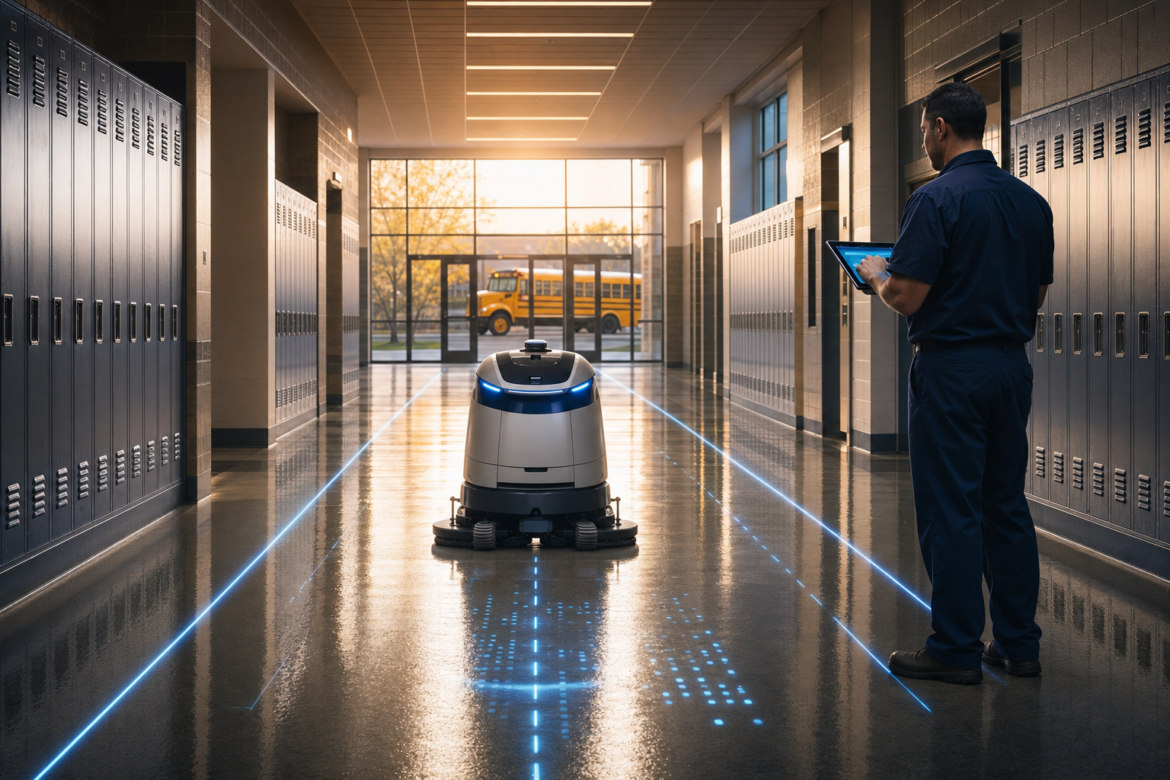
Future of AI in schools: an autonomous floor-scrubbing machine follows glowing blue route lines down a school hallway at sunrise while a facilities worker watches on a tablet and a yellow school bus waits outside
Artificial Intelligence

The Future of AI in Schools: Where Autonomous Technology Is Already at Work

by EdCircuit Staff October 13, 2026
written by EdCircuit Staff 8 minutes read

Most conversations about the future of AI in schools start in the classroom, with chatbots, tutors and lesson-planning tools. Yet some of the most practical uses so far sit outside it: in the software that plans bus routes, the machines that clean hallways overnight, the systems that run heating and air, and the tools that sort job applications in the central office. Some of these uses are delivering measurable savings. Others have failed in public, and a few raise questions about privacy and student safety that districts are still working through.

This is a look, area by area, at where autonomous and AI-driven technology is already in use in K–12 schools, what the evidence shows, and what district leaders should weigh before adopting it.

In the classroom: teachers are adopting AI faster than policy

Generative AI has reached classrooms quickly, often ahead of district guidance. CoSN’s 2025 State of EdTech District Leadership report found that 80 percent of districts have generative AI initiatives under way or planned, while 57 percent had written AI guidelines into board-approved policy. Training is catching up: an EdWeek Research Center survey found that half of teachers had received at least one AI training session by fall 2025, up from 13 percent in 2023.

Some districts are now adopting AI at scale. In August 2025, Miami-Dade County Public Schools, the third-largest district in the country, made Google’s Gemini for Education available to about 100,000 high school students and teachers, according to Google’s announcement.

Teachers remain divided on the value. A Pew Research Center survey of 2,531 public K–12 teachers in fall 2023 found that 25 percent believed AI tools do more harm than good in K–12 education and 6 percent more good than harm, while about a third saw an equal mix and another third were unsure. High school teachers were the most skeptical.

AI tutors: promising results, thin evidence so far

AI tutoring is the classroom use with the most attention and, so far, the least published evidence. Newark Public Schools in New Jersey began piloting Khan Academy’s Khanmigo in 2023-24 and has since expanded it districtwide with Gates Foundation support. District leaders say pilot students’ math scores improved, but no data had been published, and early pilot reports included basic math errors that Khan Academy says it has since fixed.

The strongest evidence so far comes from AI that supports human tutors rather than replacing them. In a randomized trial run by Stanford’s National Student Support Accelerator with more than 700 tutors and about 1,000 students from underserved communities, students whose tutors had an AI assistant were 4 percentage points more likely to master math topics, and up to 9 points more when their tutors were less experienced. The tool cost about $20 per tutor per year.

Students are not waiting for districts to decide. A Pew survey reported in February 2026 found that 54 percent of U.S. teens use AI chatbots for schoolwork, and 59 percent said AI cheating is a regular part of student life.

In the library: teaching AI literacy

School libraries are less a site of automation than a place where students learn to judge what AI produces. In Washington County Public Schools in Maryland, library media specialists teach AI literacy lessons in grades 6 through 12, adapted from Common Sense Media and taught alone or alongside English and social studies classes.

The library also offers a caution about letting AI make judgments. In 2023, Iowa’s Mason City Community School District asked ChatGPT whether books contained descriptions of sex acts to comply with a new state law, and removed 19 titles, including Beloved and The Handmaid’s Tale. The case is a reminder that decisions about what students may read call for human review.

Robots in schools: the overnight cleaning crew

Some of the clearest returns are in building operations. Spokane Public Schools in Washington bought 14 autonomous floor scrubbers, one for each middle and high school, for $1.08 million. The machines have run more than 1,500 hours across 16.5 million square feet, and floors that were cleaned once a week are now cleaned at least three times a week. Greenville County Schools in South Carolina has launched a $21.1 million robotic sweeper and scrubber program across 85 campuses, which it expects to save custodial crews four to six hours a day; that figure is a projection, not yet a measurement.

Heating and ventilation is a larger need. A federal Government Accountability Office report estimated that 41 percent of districts need to update or replace HVAC systems in at least half their schools, about 36,000 schools, and districts set aside an estimated $5.5 billion of federal pandemic relief funds for air filtration and HVAC. AI-controlled systems are one option for running that equipment more efficiently. The best-documented example is outside the United States: in Stockholm, the school-property company SISAB used AI-controlled HVAC across 87 education buildings from 2019 to 2023 and cut electricity use by 8.93 percent, according to a study by Schneider Electric.

In the cafeteria: early and mostly behind the scenes

Cafeteria automation is less developed than the hype suggests. edCircuit’s research found no U.S. district using computer-vision checkout lanes or AI waste cameras. The clearest use so far is in menu planning: Aramark Student Nutrition built its 2025-26 school menu, with more than 250 new recipes, using its own AI menu tool alongside 50,000 student surveys and dietitian input. For now, the cafeteria is a place to watch rather than a model to copy.

On the bus: routing software, cameras and electric fleets

Transportation shows both the payoff and the risk. Colorado Springs School District 11 used an AI routing tool from HopSkipDrive to cut its bus routes nearly in half, to about 55, saving more than $500,000 in a year; the superintendent said the savings protected at least 10 teaching positions. Denver Public Schools helped develop the same tool and used it to plan routes, model bell-time changes and prepare for school closures.

Routing software can also fail badly. In August 2023, Jefferson County Public Schools in Louisville, Kentucky, launched routes redesigned with AlphaRoute’s software that broke down on the first day; some students did not get home until nearly 10 p.m., and students missed more than a week of class while the district recovered. Columbus, Ohio, had dropped the same vendor the year before. Districts adopting routing tools need a tested fallback plan.

Other uses are spreading. Pittsburgh Public Schools’ AI stop-arm cameras on more than 200 buses recorded 10,989 illegal passes of stopped school buses between August 2024 and June 2025, more than 95 percent of them first-time offenses. Oakland Unified became the first major district with an all-electric bus fleet, 74 buses whose chargers can return power to the grid under AI-managed scheduling, and the EPA’s Clean School Bus Program has funded about 5,000 electric and clean buses nationwide.

Fully driverless school buses are not on U.S. roads. The one attempt to carry students in a driverless shuttle, at Babcock Ranch, Florida, was stopped by federal regulators in October 2018 because the vehicle did not meet school bus safety standards.

In the central office: hiring, paperwork and help desks

District offices are using AI for routine administrative work. Indianapolis Public Schools built internal tools that score principal applications against its hiring rubric and draft standardized salary-offer emails, keeps personal data out of them and leaves hiring decisions to people; it reports savings of more than $300,000 for 2026-27. In Texas, Katy ISD already uses AI for invoice processing, book policy reviews and Chromebook support, and plans to have AI handle about 30 percent of administrative inquiries over the next 12 to 18 months without cutting jobs, although one trustee raised concerns about relying on AI for building access.

The questions districts need to answer first

The most serious concerns involve student monitoring. An investigation by the Seattle Times and the Associated Press found that a records request at Vancouver Public Schools in Washington exposed nearly 3,500 unredacted student documents flagged by the monitoring service Gaggle, which about 2,200 students had triggered in one year; at least six students were potentially outed as LGBTQ+. The investigation found no independent research showing that such monitoring reduces suicide or violence. Earlier survey work by the Center for Democracy and Technology, reported by The 74, found that two-thirds of teachers knew of a student disciplined because of activity monitoring.

Classroom tools carry their own risks. Common Sense Media rated four popular AI teacher assistants, including Gemini in Classroom and MagicSchool, “Moderate Risk,” warning about content pushed to students without review and about bias in tools that generate behavior plans and individualized education program content.

What the future of AI in schools asks of district leaders

The evidence so far points to a practical approach. The strongest results come from narrow uses with clear measures: routes and fuel costs, cleaning frequency, energy use, staff hours recovered. Uses that make judgments about students, such as monitoring, discipline or which books stay on the shelves, need the most human oversight and the most caution.

For leaders weighing what comes next, a few questions help: what problem a tool solves and how its results will be measured; what data it collects and who can see it; how it fails and what the fallback plan is; and who stays accountable for decisions it informs. Districts that answer those questions before signing a contract are better placed to benefit from the next wave of autonomous technology, and to explain their choices to families.

Subscribe to edCircuit to stay up to date on all of our shows, podcasts, news, and thought leadership articles.

October 13, 2026 0 comments
0 FacebookTwitterPinterestLinkedinWhatsappCopy LinkEmail
An education leader places a glowing block into a layered holographic framework connected to a model school building, illustrating how to implement AI in education using an AI governance framework
Artificial IntelligenceEducation Industry Guides and ReportsK-12

How to Implement AI in Education: Using Industry Frameworks

by Stephen Gilfus October 12, 2026
written by Stephen Gilfus 35 minutes read

Implementing AI in education well means running it under an AI governance framework: an operating model in which every AI use is listed, every use is classified by risk, high-risk uses pass a human review before they reach students, vendors are held to written terms, and the whole program is monitored and reported on a fixed schedule. Industry frameworks supply most of that model. The National Institute of Standards and Technology (NIST) AI Risk Management Framework, ISO/IEC 42001, ISACA’s COBIT and the SOC 2 reports vendors already produce can be combined so that one set of controls answers to all of them. The need is plain. In spring 2025, 54 percent of students and 53 percent of English language arts, math and science teachers said they used AI for school, yet only 45 percent of principals reported school or district policies or guidance on its use (RAND, September 2025). By August 2026, 35 states and Puerto Rico had issued official guidance or policy on AI in K–12 schools, according to a tracker kept by AI for Education.

This guide on how to implement AI in education sets out ten steps that a school district, a school or a college can follow to implement AI, in order, and shows which framework does the work at each step. It is written for superintendents, school board members, college presidents and provosts, chief information and technology officers, privacy and procurement officers, internal auditors and the teachers and faculty who will live with the results, with a short section for families. It covers U.S. K–12 schools and colleges, with notes on the European Union’s AI Act for institutions whose AI is used in Europe. It is not legal advice. For the broader picture of how AI is used in classrooms, see edCircuit’s AI in Education: A Guide for Schools and Colleges; for classroom practice, see How to Implement AI in the K–12 Classroom.

Updated October 2026.

In this guide

  • Foundations: Step 1: Governance and ownership · Step 2: Inventory every AI use · Step 3: Classify data and risk
  • Frameworks and vendors: Step 4: Choose and crosswalk frameworks · Step 5: Vet vendors and SOC 2 reports
  • Putting it to work: Step 6: Policy encoded in systems · Step 7: Pilot with evidence · Step 8: Train people
  • Keeping it running: Step 9: Monitor, audit and report · Step 10: Respond to incidents · A 12-month plan
  • People: Questions to ask · Families

Step 1: Set governance and ownership

The first step is to decide who is accountable for AI and where decisions about it are made. In most institutions AI arrives before anyone owns it: a teacher signs up for a tool, a department turns on a feature in software it already licenses, a vendor adds a chatbot to an admissions page. Governance gives those decisions a home.

Two bodies are usually needed.

  • The governing board and its committees. A school board, a board of trustees or a board of regents sets the institution’s appetite for AI risk, approves the policy that states its principles, and receives regular reports. Where a board already has an audit, risk or technology committee, AI oversight belongs there rather than in a new body.
  • A cross-functional AI council. A working group, often chaired by the chief information officer together with the chief academic officer in a district or the provost’s designee at a college, reviews new uses, approves or declines them, and tracks incidents. Membership should reach beyond technology: curriculum and assessment, special education or disability services, privacy and legal counsel, procurement, internal audit or risk, student services, communications, and teachers or faculty. Colleges that conduct research add their institutional review board. Student representatives, where appropriate, can describe how AI is actually used.

The frameworks agree on this step. The NIST AI Risk Management Framework (AI RMF) is organized around four functions, Govern, Map, Measure and Manage, and treats Govern as “a cross-cutting function” that informs the other three. One of its outcomes, Govern 2.1, calls for roles, responsibilities and lines of communication on AI risk to be documented and clear throughout the organization. ISACA’s COBIT 2019 places the same duty in its governance objective EDM01, Ensured Governance Framework Setting and Maintenance, which ISACA’s 2025 white paper on AI describes as establishing a framework that “clarifies roles and maintains organizational accountability.” ISO/IEC 42001 includes an AI policy among the requirements of its management system.

Many organizations are not there yet. In ISACA’s 2026 AI Pulse Poll of more than 3,400 digital trust professionals, only 38 percent said their organization had a formal, comprehensive AI policy, and 38 percent were confident in their board’s understanding of and action on AI risks (ISACA, May 5, 2026). The respondents work across industries, not only in education, but schools and colleges face the same gap. In my work with boards, the question is no longer whether to use AI. It is how to use it at scale without taking on risk the board cannot price, and that question can only be answered by a body that owns it.

A practical test for Step 1: the council has a written charter, a published meeting schedule and a named chair; the board knows which committee receives AI reports and when. edCircuit’s coverage of district governance:

  • AI and Governance in School Districts
  • What District Leaders Must Do in the AI Era
  • AI Guardrails Are Reshaping K–12 Schools

Step 2: Inventory every AI use, including AI inside existing tools

The second step is a complete list of where AI is already in use or proposed, because most of it was never announced. The inventory has to include AI features inside products the institution already licenses, not only new tools bought as “AI.” ISACA’s Artificial Intelligence Governance Brief warns that unplanned AI adoption can occur “with little to no oversight, particularly given the availability of AI solutions included in products already in use,” and its COBIT white paper notes that AI features are embedded in commercial off-the-shelf software and common search engines that are likely already in use. In schools and colleges, that means the learning management system, the student information system, writing and tutoring tools, proctoring software, translation services, admissions and advising platforms, and the office productivity suite.

The AI RMF names the task directly. Govern 1.6 calls for “mechanisms … to inventory AI systems,” resourced according to the organization’s risk priorities, and NIST’s Generative AI Profile adds that organizations should enumerate their generative AI systems for the inventory and consider recording data provenance and other details in each entry (NIST AI 600-1). For an education institution, each entry should record at least:

  • The tool, the vendor and, where known, the underlying model and who provides it
  • What the AI does, for which grades, courses or offices, and whether students use it directly
  • The business owner, a named person rather than a department
  • The data classes it touches (see Step 3)
  • Its risk tier (see Step 3)
  • Contract status: whether a data privacy agreement is signed, whether a SOC 2 report has been received and reviewed, and whether the vendor has disclosed its model and change policy (see Step 5)

The inventory can begin as a spreadsheet. What matters is that it is complete, has an owner, and is the only list. A survey of department heads and principals, a review of single sign-on and app-store logs, and a review of purchase orders will usually find more AI than anyone expected. “You cannot govern what you cannot list,” as Stephen Gilfus puts it in his advisory work on AI governance. Two edCircuit articles describe this starting point: Where to Begin with AI in K-12, whose first phase includes identifying tools that already use AI, and Your School’s AI Policy May Already Be Outdated, on AI that arrives inside platforms a district approved before the feature existed.

Step 3: Classify data and risk

The third step attaches two labels to every entry in the inventory: what kinds of data the use touches, and how much harm it could do. Together they decide how much review a use needs.

Data classes. Without named classes, people act on defaults, and student work can end up treated as a vendor’s product data. A simple scheme with four classes, drawn from Gilfus’s field note on AI-assisted learning, works in schools and colleges alike:

Data classExamplesTypical default rule
Student ContentEssays, drafts, projects, prompts students type, recordingsProcessed only by approved tools for a stated purpose; retained no longer than the course or term needs; never used to train a vendor’s model without explicit, revocable institutional consent
Student RecordGrades, attendance, discipline, special education and 504 records, health information, identifiersStays in the system of record unless a contract meets FERPA’s conditions; never entered into public tools
Faculty WorkLesson plans, rubrics, prompts, feedback, assessmentsProcessed by approved tools; ownership and reuse addressed in the contract
Operational TelemetryLog-ins, clickstream, usage statisticsDe-identified use permitted for product stability, with retention limits

The rules are defaults the AI council can tighten. Each class should also say who may opt in or out, and where the class may be processed.

Risk tiers. The AI RMF’s Map function begins with context: Map 1.1 asks organizations to understand and document a system’s intended purposes, potentially beneficial uses and the settings in which it will be deployed. NIST’s Generative AI Profile then lists 12 risks that generative AI creates or makes worse. Several bear directly on schools: confabulation, the production of “confidently stated but erroneous or false content”; data privacy; harmful bias, including performance differences between groups or languages; human-AI configuration, which includes over-reliance and emotional entanglement; information integrity; obscene and abusive content, including synthetic images of children; and value chain and component integration, the risk of untraceable third-party components inside a product.

The EU AI Act offers the clearest list of education uses that deserve the highest tier. Annex III of Regulation (EU) 2024/1689 classifies as high-risk AI systems intended to be used in education and vocational training to:

  • Determine access or admission, or assign people to institutions
  • Evaluate learning outcomes, including when the results steer a person’s learning
  • Assess the appropriate level of education a person will receive or can access
  • Monitor and detect prohibited behavior of students during tests

The Act separately prohibits AI systems that infer the emotions of people in education institutions, except for medical or safety reasons (Article 5(1)(f)). U.S. institutions outside its reach can still use the list as a guide. A three-tier scheme is enough for most:

TierExamples in schools and collegesReview before use
Tier 1: LowDrafting a newsletter, summarizing a public document, staff productivity features with no student dataApproved-tool list and basic training; no separate review
Tier 2: ModerateStudent-facing tutoring or writing feedback, translation of family communications, teacher lesson-planning tools that receive Student ContentCouncil review of data use, contract terms, age suitability and accessibility; a pilot (Step 7)
Tier 3: HighAdmissions, placement, grading or credit, proctoring, discipline, special education, threat assessment or mental-health alerts, hiringFull review, documented human decision-maker, model transparency and logging, an appeal path, and a go or no-go decision recorded by the council

Low-risk uses should move quickly; high-risk uses should slow down on purpose. For the decisions that should stay with people regardless of tier, see edCircuit’s AI in Schools: What Technology Should Never Decide.

Step 4: Choose an AI governance framework and crosswalk the others

The fourth step is to choose one framework as the backbone of the program and map the others to it, so that each control is designed and tested once and reported many times. Institutions rarely face a single framework. A district may already use COBIT for IT governance, buy from vendors that hold SOC 2 reports, answer to state guidance and, for a college with students in Europe, the EU AI Act. The frameworks are different kinds of document, and knowing which kind each is prevents a common mistake: treating a law, a voluntary framework and an audit report as interchangeable.

FrameworkWhat it is and who issues itWhat a district or college uses it for
NIST AI Risk Management Framework 1.0A voluntary framework from the U.S. National Institute of Standards and Technology, released January 26, 2023, organized into the Govern, Map, Measure and Manage functions. NIST says it is being revised as part of the White House AI Action Plan (NIST)The backbone for most U.S. institutions: free, written for any sector, and already referenced in some state guidance, such as Alabama’s AI policy template
NIST AI 600-1, Generative AI ProfileA companion to the AI RMF released July 26, 2024, listing 12 generative AI risks and suggested actions, with four primary considerations: governance, content provenance, pre-deployment testing and incident disclosure (NIST)Detailed actions for chatbots, writing assistants and other generative tools
ISO/IEC 42001:2023An international standard, published December 2023 by ISO and IEC, that specifies requirements for establishing, maintaining and continually improving an AI management system, using the Plan-Do-Check-Act method (ISO)A management-system structure for institutions that build or run AI at scale, such as research universities, or that want to align with international partners
COBIT 2019ISACA’s framework for the governance and management of enterprise information and technology, with 40 governance and management objectives (ISACA)Connecting AI to existing IT governance, risk, change management, vendor management and internal-control practice
SOC 2A CPA’s examination report, under AICPA standards, on a service organization’s controls relevant to security, availability, processing integrity, confidentiality or privacy (AICPA)Evidence about a vendor’s controls; it describes the vendor, not the institution (see Step 5)
EU AI ActRegulation (EU) 2024/1689, a binding law that classifies AI by risk and lists education uses as high-risk (EUR-Lex)Legal obligations for institutions whose AI is used in the EU; elsewhere, a reference list of high-risk education uses
U.S. Department of Education materialsJuly 2025 guidance on using federal grant funds for AI, and an April 2026 final supplemental grant priority on advancing AI in education (Federal Register doc. 2026-07087)Grant planning and federal expectations on privacy and family engagement; not a governance framework

For most U.S. districts and colleges, the practical choice of a responsible AI framework is the NIST AI RMF as the backbone, with its Generative AI Profile for generative tools; COBIT where the institution already governs IT with it; and ISO/IEC 42001 where an institution wants a formal management system. The documents are designed to be mapped to one another. NIST’s AI Resource Center publishes crosswalks between the AI RMF and other standards, including one to ISO/IEC 42001, which maps, for example, Govern 1.1 on legal and regulatory requirements to the standard’s clause on understanding the organization and its context and to its AI policy controls (NIST AI RMF to ISO/IEC 42001 crosswalk). NIST notes that listing a crosswalk does not mean either document fully covers the other. ISACA’s white paper does the same work for COBIT, linking trustworthy-AI principles to objectives such as EDM03 and APO12 for risk, BAI06 for changes to AI systems, APO14 for data, MEA01 for performance monitoring and MEA03 for compliance with external requirements.

The crosswalk is the institution’s own document: a table with one row per control, such as “every Tier 3 use has a named human decision-maker,” and columns showing which clause of each framework it satisfies, who owns it and where its evidence is kept. Gilfus describes the aim as being audited once and reported many times, rather than the other way around. Districts that want a shorter AI readiness assessment as a starting point can also use the K-12 Generative AI Readiness Checklist that CoSN and the Council of the Great City Schools released in October 2023, which groups its questions into six areas: executive leadership, operations, data, technology, security and risk management (CoSN).

Where the EU AI Act applies. The Act covers providers that place AI systems on the EU market wherever they are based, deployers located in the EU, and providers and deployers in other countries “where the output produced by the AI system is used in the Union” (Article 2). A U.S. college with a campus or online students in Europe should ask counsel whether it is in scope. Its dates have moved. The prohibitions and the AI literacy duty have applied since February 2, 2025, the general-purpose AI rules since August 2, 2025 and the transparency rules from August 2026; after a political agreement to simplify the Act, the European Commission says the rules for high-risk uses in areas including education will “apply from 2 December 2027,” instead of August 2, 2026. Under the Act as adopted in 2024, deployers of high-risk systems must assign human oversight to people with the competence, training and authority to exercise it, keep automatically generated logs under their control for at least six months, and tell people when a high-risk system makes or assists decisions about them (Article 26); public bodies must also assess the impact on fundamental rights before deployment (Article 27).

Disclosure: Stephen Gilfus serves on ISACA’s board of directors.

Step 5: Vet vendors, read their SOC 2 reports and write governance into contracts

The fifth step applies the framework to vendors, because in schools and colleges most AI is bought rather than built. A vendor review has three parts: the evidence the vendor provides about its controls, the controls the institution must run itself, and the contract.

What a SOC 2 report is. A SOC 2 report is an independent CPA’s report on a service organization’s system and its controls over one or more trust services categories: security, availability, processing integrity, confidentiality and privacy. The AICPA’s guide to these examinations describes two kinds (AICPA SOC 2 guide, chapter 1):

  • Type 1 covers the description of the system and whether controls were suitably designed as of a point in time.
  • Type 2 also covers whether controls operated effectively throughout a period, and includes a description of the auditor’s tests and their results.

For SOC 2 compliance from a school’s side, the Type 2 report is the useful one, because it shows whether controls worked over months rather than whether they existed on one day. The report is not a certificate, and reading it is a task, not a formality. A district or college should check:

  • Scope. Does the system described include the AI product being bought, and which trust services categories were examined? A report on a vendor’s billing system says nothing about its tutoring tool.
  • Period and opinion. Is the period recent, and did the auditor report exceptions or qualify the opinion?
  • Subservice organizations. The guide explains that a description may include a subservice organization’s controls or exclude them, the “carve-out” method. Many AI products depend on an outside model provider and a cloud host; if those are carved out, the report does not cover them, and the institution needs separate assurance about them.
  • Complementary user entity controls. Readers of a SOC 2 report are expected to understand the complementary user entity controls, the controls the vendor assumes its customers operate, and how they interact with the vendor’s own. Typical examples are removing accounts when staff leave, reviewing who has administrative access, and configuring data-sharing settings. If the institution does not run those controls, the vendor’s controls may not achieve what the report describes.
  • The auditor. The AICPA has said it is looking into anonymous allegations about the practices of a compliance vendor that offers SOC services, and has warned about “fast and easy” SOC engagements (AICPA). Institutions should confirm that the report was issued by a licensed CPA firm.

Gilfus’s rule of thumb from IT audit applies: a SOC report the institution cannot map to its own controls is “a comfort blanket, not assurance.” The mapping belongs in the crosswalk from Step 4.

What SOC 2 does not cover. A SOC 2 report addresses security and related categories. It does not say how accurate a model is, whether it is biased, which model version answered a student’s question, or whether student work is used for training. NIST’s Govern 6.1 calls for policies that address AI risks from third parties, and Manage 3.1 for AI risks and benefits from third-party resources to be regularly monitored. Those questions go into the contract.

Contracts as governance. Contracts translate an institution’s choices into vendor behavior. For any tool that processes Student Content or Student Record data, or that produces grades, feedback or recommendations, the contract should require:

  • A model bill of materials. The model family and version, any fine-tuning, safety filters, where requests are processed, and the vendor’s change policy.
  • Change notices and version control. Advance notice of material changes with effective dates, a test environment, and the option to roll back or pin a version for a grading period. A vendor can swap the model behind a feature overnight, and the same prompt can then produce different feedback.
  • Per-request logging. A record of which model handled which request, with time and data class, kept at least for a term and available for audit.
  • No training on student data without explicit, revocable consent at the institutional level, covering the vendor’s subprocessors as well.
  • Deletion, export and incident terms. Return and deletion of data on request and at contract end, a defined notification window for security and AI incidents, and audit rights.
  • Equitable access. Institution-wide pricing for features that affect assessment, so that access does not depend on which students can pay.

Student privacy law. Contracts must also satisfy federal law. Under FERPA, a contractor may receive education records without consent as a “school official” only if it performs a service the institution would otherwise use employees for, is “under the direct control of the agency or institution with respect to the use and maintenance of education records,” and is bound by the rules on use and redisclosed (34 CFR 99.31(a)(1)(i)(B)). For children under 13, the Federal Trade Commission’s amended COPPA Rule took effect on June 23, 2025, and regulated companies had until April 22, 2026, to comply (Federal Register, April 22, 2025). The FTC stated in the rule that disclosing a child’s personal information to third parties to train or otherwise develop AI technologies is not integral to a service and requires separate parental consent, and the rule requires operators to keep a written data retention policy. The FTC did not finalize its proposed provisions on school authorization, citing possible changes to FERPA regulations, so districts should follow current FTC and Department of Education guidance on when a school may act for parents. State student-privacy laws add requirements; this guide did not review them, and counsel should.

edCircuit’s procurement coverage includes AI Procurement for Schools: 10 Questions to Ask, COPPA in Schools: What Educators Must Know and AI in K–12 Procurement Operations Today.

Step 6: Write policy and encode it in systems

The sixth step turns decisions into rules people meet at the moment they act. It has two layers. The board adopts a short policy of lasting principles: student data is protected, people remain responsible for decisions about students, AI use is disclosed, and access is equitable. Administrators then maintain an operational handbook with the details that change often: the approved-tool list, assignment labels, disclosure forms, the vendor-review process and training requirements. edCircuit’s Why Every School District Needs an AI Operational Handbook explains the difference between an AI policy for schools and a handbook and what a first edition should contain.

The federal government has left most of these choices to states and institutions. In its April 2026 final priority on AI, the Department of Education responded to commenters who asked for federal safety and privacy requirements that it believes how best to ensure safety and communicate about technology use “is optimally decided at the state and local level and declines to enact requirements at the federal level.” The same notice says the department’s July 2025 guidance on federal grant funds for AI indicates that stakeholders, especially parents, should understand how systems function and take part in decisions about adopting them.

A policy that lives only as a PDF does not govern behavior. Gilfus puts it in one line: “If the rule isn’t in the workflow, it isn’t real.” Encoding policy means configuring the systems people already use:

  • Course and assignment templates. Learning management system templates that carry an AI-use statement, and assignment types that label the expected role of AI, such as prohibited, limited, cited or required, so students do not have to guess which rule applies.
  • Submission metadata. A short field in which students say which AI tools they used and for what steps, with any generated text attached.
  • Routing rules. Settings, or at first a manual process, that decide which data classes may go to which approved models, with logging and an opt-out.
  • Allow and deny lists. Approved tools enabled through single sign-on; unapproved ones blocked or flagged; versions pinned for a term where grading depends on them.
  • Messages that teach. When a request is blocked, an explanation of the rule and what is allowed instead.

Equity belongs in this step, as a configuration choice rather than an afterthought. If an AI feature that affects assessment comes only in a premium tier, in English, or on newer devices, some students will have it and others will not. Institution-wide licensing, multilingual support, low-bandwidth modes, accessible design and supervised access on campus are decisions made in configuration and contracts. For communicating classroom rules to students and families, see AI Rules for Schools: A Back-to-School Guide.

Step 7: Pilot with evidence

The seventh step tests Tier 2 and Tier 3 uses on a small scale before they spread, and measures learning, not only satisfaction. A pilot is an evaluation with a defined question, not a soft launch.

The evidence on AI and learning is mixed, which is the reason to pilot. Students and families are worried about one kind of harm. In RAND’s 2025 surveys, 61 percent of parents, 48 percent of middle school students and 55 percent of high school students agreed that greater use of AI will harm students’ critical-thinking skills, compared with 22 percent of district leaders (RAND). By December 2025, 62 percent of middle school, high school and college students in RAND’s American Youth Panel used AI for homework, and 67 percent said using AI for schoolwork harmed critical thinking (RAND, March 17, 2026). Studies of AI tutors designed to teach, summarized in edCircuit’s AI in Education guide, have found real gains; studies in which students simply received answers have found later losses. Design and use decide which result an institution gets.

A sound pilot:

  • Starts with a problem, not a product. Define what should improve and how it will be measured before choosing a tool.
  • Covers different kinds of work. Three to five pilots across assessment types, such as writing, problem solving and design, with teachers or faculty who opt in.
  • Compares. Sections using the tool and sections that are not, on the same assignment pattern and rubric, read for direction rather than over-interpreted.
  • Measures learning and harm. Rubric results, revision depth, persistence, incidents, accessibility problems and differences between student groups. NIST’s Measure function and the Generative AI Profile’s emphasis on pre-deployment testing apply here.
  • Holds high-risk uses back. New Tier 3 deployments, such as automated grading, advising or proctoring, wait until the vendor provides model transparency and logs.
  • Ends with a decision. Scale, revise or stop, recorded by the council. Leaders should be willing to walk away.

The Department of Education took a similar view in its April 2026 priority, agreeing with commenters that AI adoption “should not be evaluated solely by efficiency or automation metrics,” but by its demonstrated impact on student engagement, learning progress and readiness. For a phased district approach, see edCircuit’s AI Adoption in Schools: A Roadmap for K–12 Success.

Step 8: Train people for their roles

The eighth step prepares the people who will apply the rules. Training has lagged use. As of spring 2025, 35 percent of district leaders said they provided students with training on AI, and more than 80 percent of students said their teachers had not explicitly taught them how to use AI for schoolwork (RAND). Across industries, 33 percent of ISACA’s 2026 respondents said their organizations trained all employees on AI.

The EU AI Act makes AI literacy a legal duty for organizations in its scope: Article 4, as amended in July 2026, requires providers and deployers to take measures that support the AI literacy of staff and others who operate and use AI systems on their behalf, without mandating a specific level. U.S. institutions can borrow the principle without the obligation. Training should be role-based, not one annual click-through for everyone:

  • Teachers and faculty: the approved-tool list, which data may never be entered, how to check output for errors and bias, assignment labels and disclosure, and why a detector’s score is not proof of cheating.
  • Counselors, advisors and student services: consent language, summary templates that separate student, staff and machine voices, and the limits of predictive alerts.
  • Special education and disability services: accommodations, accessibility testing, and the rule that AI never decides eligibility or services.
  • Administrators and board members: the risk tiers, the reporting cadence and their own decision rights.
  • Technology, procurement and audit staff: model bills of materials, SOC 2 reports, logging, change control and AI-specific audit. ISACA offers AI audit, security and risk training and a credential, Advanced in AI Audit, for experienced IT auditors (ISACA).
  • Students: AI literacy by grade, including when AI use helps learning and when it substitutes for it.

edCircuit’s AI Training for Teachers: Beyond Prompts and Tools covers professional development, and AI Literacy for Students: A Grade-by-Grade Guide covers what students should learn at each stage.

Step 9: Monitor, audit and report on one cadence

The ninth step keeps the program honest after launch. AI systems change after they are deployed, through vendor updates, new data and new uses, so a review at purchase is not enough. The AI RMF’s Manage 4.1 calls for post-deployment monitoring plans that include ways to capture input from users, “appeal and override, decommissioning, incident response, recovery, and change management,” and Govern 1.5 calls for ongoing monitoring and periodic review with defined roles and frequency.

An audit approach. Internal audit, or an outside auditor in a smaller district, tests whether the controls in the crosswalk work. COBIT supplies the structure: MEA01 for performance and conformance monitoring, MEA02 for the system of internal control and MEA03 for compliance with external requirements, as ISACA’s white paper on AI maps them. ISACA’s Artificial Intelligence Audit Toolkit is a library of AI controls derived from selected control frameworks and laws, organized by the AI lifecycle, with assessment guidance for auditors. A first AI audit in a school system might sample the inventory against reality, test whether Tier 3 uses have named human decision-makers and working appeal paths, check that vendor change notices were received and reviewed, and confirm that complementary user entity controls from vendors’ SOC 2 reports are actually operated.

One cadence. Gilfus recommends that AI governance run on the same rhythm as cyber and audit work: monthly at the working layer, where model owners, the council and support staff review incidents, change notices and pilot results; quarterly at the board’s audit, risk or technology committee; and annually at the full board, with one integrated report. Running three programs on three calendars produces three contradictory stories.

A report a board can act on. As Gilfus writes, a board cannot act on a scatterplot; it can act on a trend line and a threshold. A one-page quarterly report should contain:

  • Position and change: the current state of the program and what changed since the last meeting
  • The inventory by tier: how many uses in each tier, and what was added, paused or retired
  • Incidents: privacy exposures, harmful or biased outputs and model failures, with time to resolve
  • Learning signals: results from pilots by course type, not individual courses
  • Vendor and model drift: change notices received and their effects
  • Decisions requested: what the committee is asked to approve, with the options considered

Every figure should link to its evidence: a control test, an incident record, a pilot result or a vendor’s SOC 2 report. For institutions in the EU AI Act’s scope, the logs kept under Article 26 are part of that evidence.

Step 10: Respond to AI incidents

The tenth step prepares for the day an AI system causes harm. An AI incident is not always a security breach. It may be a tutoring tool giving harmful advice, a writing assistant exposing a student’s essay to another user, a biased placement recommendation, a model update that changes grading feedback mid-term, a prompt-injection attack, or a manipulated image of a student. Gilfus advises keeping AI incident response distinct from cyber incident response while feeding the same records and reporting.

The frameworks set the expectations. The AI RMF’s Manage 4.3 calls for incidents and errors to be communicated to relevant parties, “including affected communities,” with processes for tracking, responding and recovering that are followed and documented. Govern 6.2 calls for contingency processes for failures or incidents in third-party data or AI systems, and incident disclosure is one of the Generative AI Profile’s four primary considerations. Readiness is uneven: in ISACA’s 2026 poll, 56 percent of respondents did not know how long it would take to halt an AI system in a security incident, and 39 percent did not know whether their organization had a documented process for shutting down or overriding AI systems.

An AI incident plan for a school or college should name:

  • Who can pause a tool, and how quickly: the authority to suspend a feature, roll back a model version or disable an integration for a term
  • Severity levels tied to data classes and risk tiers, so that exposure of Student Record data triggers a different response from an inaccurate lesson summary
  • Notification: who tells students, families, staff, the board and, where law requires, regulators, and on what timeline; contract terms from Step 5 govern what the vendor must tell the institution
  • Correction: how a decision influenced by a faulty system is reviewed and, where needed, reversed, and how records are corrected
  • Learning: a review after each significant incident that changes routing rules, contracts or training

Tabletop exercises, in which the council walks through a realistic scenario, test the plan before it is needed. For deepfake incidents specifically, see edCircuit’s AI Deepfakes: The New School Safety Threat.

A 12-month implementation plan

The ten steps overlap in practice. A one-year plan that fits a board’s calendar, adapted from the sequence Gilfus recommends to boards and CIOs, looks like this:

PeriodMain workWhat the board sees
Days 0–90: Inventory and guardrailsCharter the AI council and publish its scope and schedule (Step 1). Inventory active and proposed AI uses and tag them with data classes and tiers (Steps 2–3). Freeze new Tier 3 deployments pending model transparency and logs; allow Tier 1 and sandboxed Tier 2 uses. Issue interim guidance to teachers and faculty. Ask existing vendors for SOC 2 reports, model bills of materials and change policies.The charter, the inventory summary by tier and the interim guidance
Days 90–180: Frameworks, pilots and routingAdopt the backbone framework and build the crosswalk (Step 4). Launch three to five guided pilots with consent and comparison sections (Step 7). Set up routing rules for data classes, even if manual at first. Begin role-based training (Step 8). Start the monthly one-page report.The crosswalk, pilot designs and the first monthly reports
Days 180–270: Encode policy and contractAdopt the board policy and the first edition of the handbook. Encode it in course templates, assignment labels, submission fields and allow lists (Step 6). Negotiate contract clauses for any tool scaling beyond pilots (Step 5). Publish a short note on what worked in pilots.The policy for adoption and contract terms for tools that will scale
Days 270–360: Institutionalize and auditMove proven uses into regular service. Run the first internal audit of AI controls (Step 9). Test the incident plan with a tabletop exercise (Step 10). Publish next year’s governance calendar: policy reviews, vendor audit windows and planned expansions.The annual AI report, audit results and the governance calendar

The aim is to make governance boring and repeatable, so that each new AI use lands inside known guardrails instead of starting a new debate. Gilfus sets out the longer argument, including the reference architecture behind this plan, in his field note The Governance Gap in AI-Assisted Learning.

Questions to ask about implementing AI in your institution

For board members, superintendents, presidents and other leaders

  • Which board committee receives AI reports, how often, and who signs them?
  • Do we have a complete inventory of AI uses, including AI features inside software we already license, and who owns it?
  • Which of our AI uses are Tier 3, such as admission, placement, grading, proctoring or discipline, and does each have a named human decision-maker and an appeal path?
  • Which framework is the backbone of our AI governance framework, and does our crosswalk show which control satisfies which requirement?
  • For each vendor that handles Student Content or Student Record data, have we read a current SOC 2 Type 2 report, checked what it carves out, and confirmed that we operate the controls it expects of us?
  • Do our contracts require a model bill of materials, change notices, version pinning, per-request logs and a ban on training with student data?
  • Who can pause an AI tool today, and how long would it take?
  • Are we measuring whether AI improves learning, or only whether people like it?
  • Does any student lack access to an AI feature that affects assessment because of cost, language or device?

For teachers and faculty

  • Which AI tools are approved for my courses and students, and what information may never be entered into them?
  • Does each assignment tell students whether AI is prohibited, limited, to be cited or required?
  • Do my rubrics reward process, such as drafts, revision and reflection, so that I can see how students worked?
  • Do I check AI-generated materials for errors, bias and accessibility before students see them?
  • If I suspect misuse, do I gather drafts and talk with the student rather than relying on a detector’s score?
  • Whom do I tell when a tool behaves differently from last week, gives a harmful answer or exposes student work?

What should families know?

Families have a right to know how AI is used with their children and what happens to their children’s information. Practical questions to ask a school or college:

  • Which AI tools does my child use, for what purpose, and are they approved by the school or district?
  • What happens to my child’s work and data? Is it used to train the company’s AI, how long is it kept, and can it be deleted?
  • Does AI influence decisions about my child, such as grades, placement or discipline, and how can a decision be reviewed by a person?
  • What are the classroom rules on AI, and how should my child disclose AI help on homework?
  • How will I be told if something goes wrong with a tool my child uses?

For children under 13, federal rules give parents particular rights over data collected online, and the Department of Education has said parents should understand how AI systems function and take part in decisions about adopting them. edCircuit’s AI for Students: A Parent’s Guide by Age covers what parents can do at home.

Governance that lets AI scale

Implementing AI in education is less about choosing tools than about building the discipline that lets tools come and go safely. The frameworks already exist. The NIST AI Risk Management Framework and its Generative AI Profile describe what to govern, ISO/IEC 42001 and COBIT describe how to run it as a management system, SOC 2 reports and contracts bring vendors inside it, and the EU AI Act shows which education uses regulators consider high-risk. The work that remains is local and repeatable: list every use, classify it, review the risky ones before they reach students, write the rules into contracts and systems, train people for their roles, measure learning, and report on a schedule. Institutions that do this will not avoid every problem, but they will see problems early, fix them on the record, and be able to show students, families and their boards why they can be trusted with AI.

Related reading

  • AI in Education: A Guide for Schools and Colleges
  • Why Every School District Needs an AI Operational Handbook
  • AI and Governance in School Districts
  • AI Procurement for Schools: 10 Questions to Ask
  • How to Implement AI in the K–12 Classroom

Subscribe to edCircuit to stay up to date on all of our shows, podcasts, news, and thought leadership articles.

October 12, 2026 0 comments
0 FacebookTwitterPinterestLinkedinWhatsappCopy LinkEmail
Student agency with AI: a student's pencil draws one glowing path forward while branching AI suggestions fade above the notebook
Artificial IntelligenceHot Topics - controversialK-12Students

Student Agency in the Age of AI

by EdCircuit Staff October 12, 2026
written by EdCircuit Staff 7 minutes read

Generative AI has made student agency harder to see. Two students can submit equally polished assignments after doing very different amounts of intellectual work. One may have wrestled with the ideas, while the other handed most of the thinking to a tool.

Schools often approach this problem by asking whether students used AI. That matters when an assignment limits or prohibits its use, but it does not tell educators enough. One student might request another explanation or ask for feedback on an argument. Another might have the tool choose the topic, organize the response, and write the draft.

That leaves teachers with a more useful question: Who remained responsible for the thinking?

Generative AI offers faster access to feedback, language support, and new ways to explore a subject. It also makes it easy to avoid uncertainty and accept an answer without fully understanding it. Whether the technology strengthens or weakens agency depends largely on how the learning is designed around it.

Better work does not always mean more learning

Generative AI is good at improving the appearance of student work. It can correct errors, organize information, strengthen a sentence, and suggest details a student overlooked. Those improvements may be useful, but they do not prove that a student has developed greater understanding.

The OECD Digital Education Outlook 2026 makes this distinction clear. Its review found that generative AI can support learning when guided by sound teaching principles. When students outsource a task, it may improve performance without producing meaningful learning gains.

Consider a student who asks an AI tool to explain a math concept in a different way and then solves a new problem independently. The tool has helped the student return to the thinking. If the student copies the original problem into the tool and transfers the answer, the task has been completed without the same intellectual work.

Both pages may contain a correct solution, but only one shows what the student can do.

This is why schools cannot rely exclusively on the quality of a final product. Teachers also need opportunities to see how students framed the problem, selected information, made decisions, and responded when something did not work.

Where AI can expand student agency

Used with a clear purpose, AI can help students take actions that previously felt out of reach.

A learner who is unsure how to begin can ask for questions that narrow a topic without requesting a completed thesis. A multilingual student can compare explanations in two languages. A student with a disability may use speech, text, or visual tools to communicate more independently. Someone who needs practice can request another example and receive immediate feedback.

Students can also compare several approaches, test an explanation for different audiences, or ask the tool to challenge an early assumption.

The value comes from what students do next. They must decide which suggestion fits the goal, reject weak or inaccurate information, and explain why they selected one direction over another.

Prompting alone is not enough. Students need to recognize confident errors, invented sources, and bias. Sometimes the responsible decision is to stop using the tool and return to a primary source, a classmate, or the teacher.

When support starts replacing the student

The risks surrounding AI are larger than academic dishonesty. A student can follow the rules and disclose every use of AI while still giving away too much of the learning process.

Imagine a research assignment in which AI suggests the topic, forms the question, summarizes the sources, creates the outline, and drafts the response. The student may type several prompts and approve each step, but the tool has made most of the decisions that gave the assignment educational value.

AI can also remove productive struggle before it has a chance to do its work. Students need time to sit with a difficult passage, attempt an imperfect solution, notice a contradiction, and decide what kind of help to seek. Those moments build persistence and judgment.

That does not mean struggle should be prolonged for its own sake. Students need appropriate scaffolds, and those supports will look different depending on their needs. The goal is to help students move forward without making every decision for them.

WestEd has recommended using AI to scaffold student choice rather than script every move. That offers a practical dividing line: Give students enough support to continue doing the work themselves.

Make the thinking visible

AI is forcing schools to reconsider what counts as evidence of learning. A final essay, presentation, design, or solution may still matter, but it can no longer be the only evidence a teacher sees.

The practical response is not to turn every assignment into an investigation of possible cheating. It is to create normal opportunities for students to show their thinking as the work develops.

Teachers might use a short proposal conference, an annotated source, an in-class checkpoint, a comparison between drafts, or a brief oral defense. Students can explain what they changed after feedback, which AI suggestions they rejected, and where they verified information.

Disclosure becomes more useful when it is specific. “I used AI” reveals little. A student could instead identify the tool, explain why it was used, describe what was accepted or rejected, and note how the output was checked. That reflection becomes evidence of both AI literacy and student agency.

Local assignments also make thinking easier to see. A student might use AI to compare solutions to a campus problem but still need to gather evidence, speak with people affected by the issue, and defend a recommendation.

Teachers do not need to add every checkpoint to every task. One or two well-placed moments can provide a clearer picture of what the student understands and who is directing the work.

Four questions for classrooms and AI policies

Schools cannot write a separate rule for every tool or new feature. Lists of permitted and prohibited uses provide clarity, but they can become outdated quickly. A few consistent questions can help students and teachers decide whether an AI use preserves agency:

  • Who set the purpose? The student should be able to explain what they were trying to understand, create, or improve before asking AI for help.
  • Who made the important decisions? The student should identify the choices that shaped the work, including the question, evidence, method, interpretation, or revision.
  • Who evaluated the output? AI-generated information must be checked rather than accepted because it sounds polished or confident.
  • Who can explain the result? The student should be able to defend the work, describe its limitations, and apply the learning without relying on the tool.

These questions move the conversation beyond detection and return responsibility to the center.

The TeachAI guidance for schools includes maintaining student and teacher agency among its core principles. It recommends that people remain critical consumers of AI and retain responsibility for academic and organizational decisions. UNESCO’s guidance on generative AI also calls for a human-centered, age-appropriate approach that protects privacy.

District leaders should consider more than whether a product is efficient or accurate. Does it encourage students to form questions? Can they challenge its recommendations? Can teachers override automated suggestions? Do students understand what happens to the information they enter?

Equity also deserves close attention. Students with strong background knowledge may be better positioned to catch a weak or inaccurate response. Other students may be more likely to trust an answer that appears authoritative. Access to AI must be accompanied by access to knowledgeable teachers, explicit instruction, and opportunities to practice judgment.

Preparing students to remain decision-makers

Students will live and work with AI. Preparing them does not require keeping every tool outside the classroom or accepting every use simply because the technology will be part of their future.

Schools have a more demanding responsibility: Teach students to use powerful tools while remaining accountable for their decisions.

AI may help a student see possibilities that were previously difficult to reach. The student must still decide what matters, determine what is accurate, and take responsibility for the result.

The future will include AI. The question for schools is whether students will enter that future prepared to make decisions—or waiting for a system to make those decisions for them.

Subscribe to edCircuit to stay up to date on all of our shows, podcasts, news, and thought leadership articles.

October 12, 2026 0 comments
0 FacebookTwitterPinterestLinkedinWhatsappCopy LinkEmail
AI policy for schools: a closed policy binder on an administrator's desk while glowing AI network lines spread from a laptop, phone and tablet
Artificial IntelligenceHot Topics - controversialK-12

Your School’s AI Policy May Already Be Outdated

by EdCircuit Staff October 9, 2026
written by EdCircuit Staff 7 minutes read

A school AI policy written in 2023 or 2024 may have been entirely reasonable at the time. Many early policies told students to complete their own work, prohibited artificial intelligence unless a teacher granted permission, and classified unauthorized use as plagiarism. Some added a short list of approved uses, including research, translation, data analysis, and grammar assistance.

Those policies responded to the most visible concern confronting schools: students using ChatGPT to write assignments.

Two years later, that concern has not disappeared, but the technology has moved well beyond the problem those rules were designed to solve. AI is now built into search engines, writing programs, productivity platforms, learning management systems, tutoring applications, and accessibility tools. It can generate and interpret text, images, audio, video, computer code, and data. Newer systems can complete multistep tasks, create realistic synthetic media, and interact with students in ways that early policies rarely anticipated.

A district does not need to abandon a policy simply because it is two years old. It does need to determine whether that policy still answers the questions educators, students, and families are asking today.

A Policy Written for Chatbots May Miss Embedded AI

One sign of an aging policy is a broad prohibition on “AI and natural language processing tools” without a clear definition of what that includes. Read literally, the language could cover spell-checkers, automated captions, translation programs, speech-to-text software, search features, and approved accommodations.

It may also overlook the fact that AI is no longer always a separate website a student deliberately visits. A student may encounter an AI-generated summary inside a search result, accept a writing suggestion inside a document, or use a feature added to a platform the district approved before that feature existed.

This creates a difficult enforcement problem. A rule can be so broad that it technically prohibits tools the district expects students to use, yet not specific enough to govern the applications that pose the greatest risks.

Updating a policy does not require schools to permit every new use. It requires them to define what is covered, identify which tools have been reviewed, and explain when AI assistance supports learning and when it replaces the work students are expected to do.

Academic Integrity Now Requires More Than a Plagiarism Rule

Submitting an AI-generated essay as original work can clearly constitute academic dishonesty. That does not mean every unauthorized interaction with AI is identical.

Using AI to generate an entire response, reorganize a paragraph, create practice questions, correct punctuation, or explain a difficult concept involves different levels of assistance. The relevant question is whether the technology replaced the knowledge, reasoning, or skill the assignment was intended to measure.

Districts can give teachers flexibility while providing students with consistent assignment-level expectations. A simple framework might identify AI use as prohibited, limited to specified tasks, permitted with disclosure, or required as part of the assignment. The designation should appear on the assignment so students do not have to guess which rule applies.

This approach also reflects what schools are learning about AI and student performance. A recent review from the U.S. Department of Education’s Institute of Education Sciences found limited but emerging evidence that teacher-mediated AI and tutoring systems that provide guidance or hints may support learning. General-purpose AI may hinder learning when it reduces cognitive effort or completes the thinking students need to practice. The distinction is not merely whether AI was present. It is whether the tool supported the learning process or substituted for it. Institute of Education Sciences

States Are Revising Their Own Guidance

The growth of state-level guidance shows how quickly expectations are changing. In April 2025, the Education Commission of the States reported that at least 28 states had published guidance on AI in K–12 education. By August 2026, AI for Education was tracking official guidance or policies from 35 states and Puerto Rico. Education Commission of the States AI for Education

The more important development is not simply the number of states involved. It is the way some states are revisiting their own work.

California issued initial guidance in 2023, then convened a statewide working group, released updated guidance, and published a model policy in June 2026. The model addresses privacy, disclosure, staff use, approved tools, instructional discretion, AI-assisted grading, and confidential information. It also states that AI detection software should not be the sole basis for discipline or a grade penalty. California Department of Education

Oregon moved its guidance from a static PDF to a web-based Version 3.0 so it could be revised more quickly. The updated material now addresses agentic AI, synthetic media, educator competencies, information literacy, student well-being, bias, privacy, and the risk of becoming overly dependent on automated systems. Oregon Department of Education

Oklahoma has also reached Version 3.0 of its state guidance and supplements it with a model district policy, professional learning, family resources, and implementation support. Its framework connects AI use with FERPA, COPPA, cybersecurity, academic integrity, privacy, and equitable access. Oklahoma State Department of Education

Other states are taking different approaches. Washington has developed human-centered guidance and sample policy information. North Carolina introduced an initial guidebook in 2024 and has continued adding resources and training. Minnesota says its guidance will receive regular updates as the technology evolves, while Colorado describes its AI roadmap as a dynamic resource. Virginia has paired guidance with educator training and system-level leadership support. Ohio requires every school district, community school and STEM school to adopt an AI policy and provides a state model they can adapt.

These efforts are not identical, nor are all of them mandatory. Together, however, they send a consistent message: AI governance is becoming an ongoing responsibility rather than a one-time board action.

The Most Important Areas to Revisit

District leaders reviewing an older policy should begin with several practical questions.

Does the policy cover staff as well as students? Educators and administrators may use AI to prepare lessons, draft communications, translate materials, summarize information, provide feedback, or assist with grading. The policy should clarify where human review is required and what information staff may enter into an AI system.

Does it protect student information? Students and staff need to know which platforms have been approved and which information must never be entered into a public tool. Names, grades, education records, health information, disciplinary records, passwords, and unpublished student work require specific safeguards. Vendor review should also examine how prompts and uploaded materials are stored, shared, retained, or used to improve a model.

Does it preserve accessibility and equitable access? A general prohibition should not prevent a student from using technology required by an IEP, Section 504 plan, language-access plan, or other approved accommodation. Districts should also consider whether allowing paid AI products gives some students an advantage unavailable to their classmates.

Does it address high-risk uses? Current rules should cover AI-generated impersonation, deceptive synthetic media, harassment, discriminatory content, unauthorized surveillance, and automated recommendations involving discipline, placement, mental health, special education, or other consequential decisions. Qualified people must remain responsible for decisions affecting students.

Is the enforcement process fair? AI detectors can inform a conversation, but they should not be treated as proof. Schools should consider drafts, version histories, student explanations, demonstrations of understanding, and other evidence before imposing consequences. Broad warnings that students may face civil or criminal liability also deserve review by district counsel rather than being used as a general disciplinary threat.

Keep the Principles Stable and the Procedures Flexible

School boards do not need to rewrite an entire policy every time a company adds a new feature. A more sustainable approach separates lasting principles from frequently changing procedures.

The board policy can establish expectations involving student safety, academic integrity, human oversight, privacy, transparency, equitable access, and responsibility for final decisions. Administrative guidance can maintain the list of approved tools, assignment labels, disclosure methods, vendor-review procedures, data restrictions, and training requirements.

Those procedures should be reviewed at least annually and whenever a major capability, legal requirement, privacy concern, vendor change, or school incident exposes a gap. Students, teachers, technology leaders, curriculum specialists, families, special education professionals, and legal counsel can each identify problems that may not be visible from a single department.

A two-year-old AI policy is not automatically a bad policy. But if it still treats artificial intelligence primarily as a chatbot students might use to write an essay, it no longer reflects the technology operating in today’s schools.

The goal is not to chase every new product. It is to establish a review process that keeps district expectations current while preserving the principles that should not change: students must remain engaged in their own learning, educators must remain responsible for professional decisions, and technology must serve the educational mission rather than quietly redefine it.

Subscribe to edCircuit to stay up to date on all of our shows, podcasts, news, and thought leadership articles.

October 9, 2026 0 comments
0 FacebookTwitterPinterestLinkedinWhatsappCopy LinkEmail
Newer Posts
Older Posts

Participate

  • Contribute
  • Sponsor
  • Submit Release
  • Subscribe
  • Get Interviewed

We value your privacy

We use cookies to enhance your browsing experience, serve personalized ads or content, and analyze our traffic. By clicking "Accept All", you consent to our use of cookies.

Customize
  • Needed for the site to work: signing in, the cart, your consent choice. Always on.

    8 cookies
    • ss_consent 1 yearYour cookie choice on this site, so you are not asked again.
    • wordpress_logged_in_* 2 days, or 14 days with "remember me"Keeps you signed in as you move between pages.
    • wordpress_sec_* 2 days, or 14 days with "remember me"The secure half of your sign-in.
    • wordpress_test_cookie SessionChecks that your browser accepts cookies when you sign in.
    • wp-settings-* 1 yearYour display settings when signed in.
    • wp_woocommerce_session_* 2 daysYour shopping session: the cart and the checkout.
    • woocommerce_cart_hash SessionTells the site whether your cart has changed.
    • woocommerce_items_in_cart SessionWhether your cart holds anything.
  • Remembers choices you make, such as a language or a region, and supports features like live chat.

    1 cookie
    • woocommerce_recently_viewed SessionThe products you looked at, so the site can show them again.
  • Helps us understand how visitors use the site: which pages are read, and for how long.

    2 cookies
    • _ga 2 yearsGoogle Analytics: tells one visitor from another. Set only after you allow analytics.
    • _ga_* 2 yearsGoogle Analytics: keeps your session state. Set only after you allow analytics.
  • Measures how fast pages load so we can make them faster.

  • Used to show you content and offers that match your interests, on this site and elsewhere.

    1 cookie
    • sbjs_* SessionWooCommerce order attribution: where you came from, so a purchase can be credited to the campaign or site that sent you.

Your browser asks us not to sell or share your information (Global Privacy Control), so advertising cookies stay off.

Do not sell or share my personal information

Some cookies from other companies help show you offers on other sites. Tick the box and save your preference to opt out of that sharing; untick it to opt back in at any time.

Your browser sends Global Privacy Control, so this preference is set for you and cannot be changed here.

Sign In

Keep me signed in until I sign out

Forgot your password?

Password Recovery

A new password will be emailed to you.

Have received a new password? Login here

Shopping Cart

Close

No products in the cart.

Close
-
00:00
00:00

Queue

Update Required Flash plugin
-
00:00
00:00

Your cart (items: 0)

Products in cart

Product Details Total
Subtotal $0.00
Shipping and discounts calculated at checkout.
View cart
Go to checkout

Your shopping cart is empty

Return to shop

Notifications