Relationships Can Be a Solution in Difficult Challenges
Writing after the Marshall County, Kentucky shooting, Tamara Fyke argues that healing and prevention depend on relationships and collective effort.


Building relationships for safer schools is backed by Secret Service findings on warning signs and CDC work on connectedness.
Tamara Fyke wrote this in January 2018 after a school shooting in Marshall County, Kentucky, arguing that relationships are the base of any lasting answer to school violence. Below it, a 2026 update sets Fyke’s argument beside what the U.S. Secret Service found when it studied 41 attacks on schools.
Another school shooting occurred yesterday in Marshall County, Kentucky, the second such tragedy this week. The latest happened only two hours from my hometown of Nashville, Tennessee. According to the New York Times, this is the 11th school-related shooting already this year. Viewed through the lens of news broadcasts, this issue can feel beyond our control. How can we prevent this pain? While I would never presume to have a cure-all or quick fix, I am encouraged by the positive results that I know can be achieved when we focus on relationship-building as a core foundation of schools, communities, and organizations. When we begin with the priority of caring more for one another every day, we can make a difference.
Lessons From Schools Recovering From Violence
I remember years ago working in a middle school in Arkansas where a shooting had occurred. The Love In A Big World team and I were there to be part of the healing process. It was several months after the incident, well after the news stories had stopped and many teachers had left. But the students couldn’t leave; this was their school. Some teachers chose to stay until these students moved on to high school. They didn’t want the kids to be left alone with the memories of that fateful day.
We found a similar scenario in a Florida middle school devastated by violence. Students and teachers alike struggled through the pain and fear of the trauma while longing to return to some sort of normalcy. But what is normal?
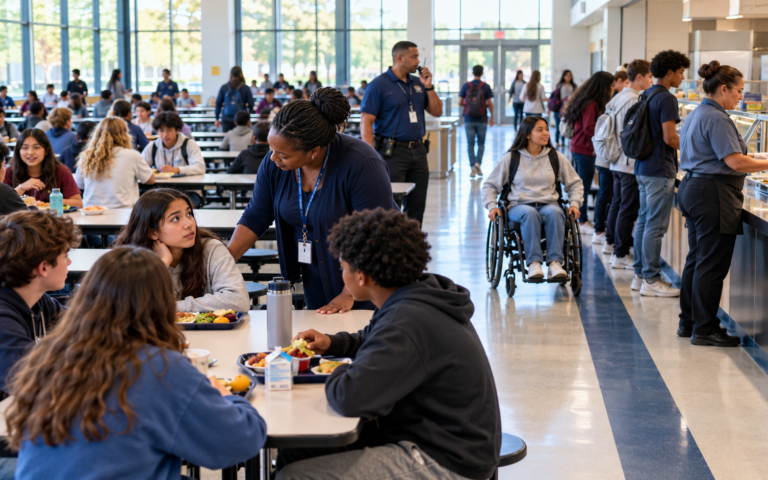
Is it normal for us to walk around our schools and workplaces – spaces where we spend the majority of our waking hours — without knowing the people around us? Let’s be real; sometimes we don’t even take a moment to acknowledge another human being’s existence with a glance or a smile because we are so focused on the job that needs to be done.
Relationships as the Foundation of Safer Schools
When I worked at the Center for Safe & Supportive Schools at Vanderbilt with Dr. Maury Nation, we provided support to schools across the state of Tennessee around issues of safety and climate. We researched issues that schools are facing and then consulted with them in their buildings about solutions and successful implementation. When it comes to gun violence, is the solution for creating safer places metal detectors and surveillance cameras? No, these are not the answer and are not the solution for schools. A focus on relationships is the beginning of any meaningful solution.
When Hendersonville High School was dealing with student suicide, they decided to take a preventative approach by instituting Advisory Period, a dedicated time of the week for students to build relationships with teachers and peers. By changing the culture – what we do, they changed the climate – how it feels.
A Shared Responsibility for Educators and Families
Over the coming days and weeks, there will be much speculation about why the incidents occurred in Kentucky and Texas. There are a multitude of factors that will be difficult, if not impossible, to untangle. The challenge before all of us is not to withdraw from the people and places who need us most: our children in our nation’s schools.
Educators, thank you for your faithful service to our kids, families, and communities. You are on the front lines. Build meaningful relationships with your students and with each other.
Families, get involved. Volunteer at your child’s school throughout their school career, not just in the elementary grades. Attend their sporting events and other special activities. Communicate with their teachers. Get to know other families – invite them over for dinner.
Together, let’s build strong and healthy communities through intentional relationships. It’s simple, but not always easy. And it starts by looking people in the eye, sharing a smile…even calling them by name. If a pack of wolves can change the landscape of Yellowstone National Park, I believe we can bring hope and healing to the kids in our schools and communities.
Building relationships for safer schools: what the evidence supports
Building relationships for safer schools is the idea at the center of Tamara Fyke’s article above, and later research gives it both support and limits. This section looks at what the U.S. Secret Service learned from past attacks, what the Centers for Disease Control and Prevention (CDC) says about students feeling connected to school, and what a principal or teacher can do with that information. The topic is hard to read about, and nothing here replaces the judgment of a school’s own safety team.
What the Secret Service found about attackers
In November 2019 the Secret Service’s National Threat Assessment Center published Protecting America’s Schools, an analysis of 41 attacks on K-12 schools between 2008 and 2017. It found no profile of a student attacker and no profile of a targeted school, so it advises against checklists of traits. Every attacker had shown concerning behavior, most had worried other people, and most had told someone of their intent. In many cases someone saw a threatening communication or behavior and did not act, out of fear, because the person was not believed, because the immediacy or location was misjudged, or because the observer thought the attacker had been talked out of it.
The report also found that every attacker had faced at least one social stressor involving peers or romantic partners, often bullying, and that most attackers had been bullied in ways others observed. Its recommendations are about people noticing and responding: set up a multidisciplinary threat assessment team, give students a way to report concerns anonymously, train all staff to recognize a student in crisis, and run programs that promote safe and positive school climates where students support one another. It adds that punitive measures are not preventative, since two of the attackers were suspended when they attacked.
This evidence does not say that friendly schools never experience violence, and it does not blame students who were bullied. It shows that the warning signs were usually visible to the people around a student, which is where relationships matter: a student or teacher who knows someone well notices a change, and a school where students trust adults is a place where a worried student is more likely to speak up.
What connectedness means and what is known about it
The CDC calls the sense of being cared for at school “school connectedness,” defined, as Perry quotes it, as the belief held by students that adults and peers in the school care about their learning. In a 2018 article for the Brookings Institution, Andre M. Perry reports on a 2009 CDC study (the CDC’s own pages could not be opened) in which more connected students had higher grades and test scores, less substance use, better attendance and a lower likelihood of violence, and lists the CDC’s four pillars: adult support, positive peer groups, a welcoming school environment and student commitment to education. Those are associations from a survey, so they suggest, rather than prove, that raising connectedness would change the outcomes. Perry also argues for relationships over armed staff and more security guards, which is a view some school leaders will weigh differently.
The Secret Service report points the same direction on one point: in a survey of about 16,000 students in grades 10 to 12 that the report cites, 38 percent chose more mental health services as the thing most likely to make them feel safer at school.
What a school can do with this
- Give every student a regular adult contact. Fyke describes the advisory period at Hendersonville High School, set aside for building relationships with teachers and peers, as one approach.
- Make reporting easy and safe, including anonymous options, and teach students and families what is worth reporting.
- Respond to bullying that adults and students can see, since the Secret Service found that bullying of attackers was often observed.
- Train staff to recognize a student in crisis, and keep a threat assessment team that gathers information about behavior and circumstances rather than relying on a profile.
- Treat discipline as a moment to keep a relationship with the student and family, not only to remove the student.
Fyke’s article also mentions student suicide in the Hendersonville example. Anyone in the United States who is thinking about suicide or self-harm, or who is worried about someone else, can call or text the 988 Suicide and Crisis Lifeline at 988 at any hour. Schools wanting a wider view can start with the edCircuit school safety guide and the social-emotional learning guide.
Subscribe to edCircuit to stay up to date on all of our shows, podcasts, news, and thought leadership articles.
Related reading
More on School Safety