

edCircuit
  • Start Here
    • Login
    • Register
    • Subscribe
    • Submit a Press release
    • Advertise or Sponsor
    • Contribute
    • Get Interviewed
  • On The Wire
  • EdTech
    • All EdTech
    • Online Learning
    • Hybrid and Remote Learning
    • Augmented and Virtual Reality
    • ESports
    • Gamification and Game-Based Learning
    • Digital Citizenship
    • EdTech Entrepreneurs
    • Market Trends
    • Future of Education
  • K-12 Education
    • All K-12
    • K-12 Teachers
    • Teaching Strategies
    • Special Education and IEPs
    • Dyslexia
    • Gifted and Advanced Learning
    • Early Childhood, Pre-K and Kindergarten
    • School Calendar
    • Tutoring and Homework Help
    • Attendance and Absenteeism
    • After-School Programs
    • School Counselors
    • Homeschooling
    • School Models
    • Teacher Retention
    • Parents
    • Students
    • STEM and STEAM Education
  • Teaching and Learning
    • Literacy and Reading
    • Math Education
    • Civics and History Education
    • Financial Literacy
    • Assessment and Testing
    • Curriculum and Instruction
    • Personalized Learning
    • Project-Based Learning
    • Social-Emotional Learning
    • Executive Function
    • Creativity
    • Diversity, Equity, Inclusion
  • Professional Development
    • All Professional Development
    • Educators
    • Administrators
    • edLeaders
  • Higher Education
    • All Higher Education
    • College Admissions
    • Career and Technical Education (CTE)
    • Graduation
    • FAFSA and Financial Aid
    • Student Loans
  • Artificial Intelligence
  • Cybersecurity
  • School Safety
    • All School Safety
    • Science and Lab Safety
    • School Design and Facilities
    • Bullying
    • Duty of Care and School Liability
  • Continuing Education
    • All Continuing Education
    • Online Certificate Programs
    • Teaching Jobs and Careers
    • Teacher Appreciation
  • Education Policy and Government
    • All Education Policy
    • Department of Education
    • School Choice
    • Global
    • Advocates
  • EDU Shows
    • All EDU Shows
    • Safer Ed
    • Mind the Gap
    • EdTech Questions
    • CoffeEd
    • InFocus
  • EDU Podcasts
    • All EDU Podcasts
    • Author Chats
    • CoSN The Podcast
    • Education Today
    • Building the Bridge
    • Students Speak
  • Education Industry Guides and Reports
  • Archived Media
    • Future of School: The Podcast
    • Equity Everywhere
  • About edCircuit
  • Subscribe
edCircuit
  • LOGIN
Home Tags Posts tagged with "Headline"
Tag:

Headline

This if for posts to be in the featured/top section of site
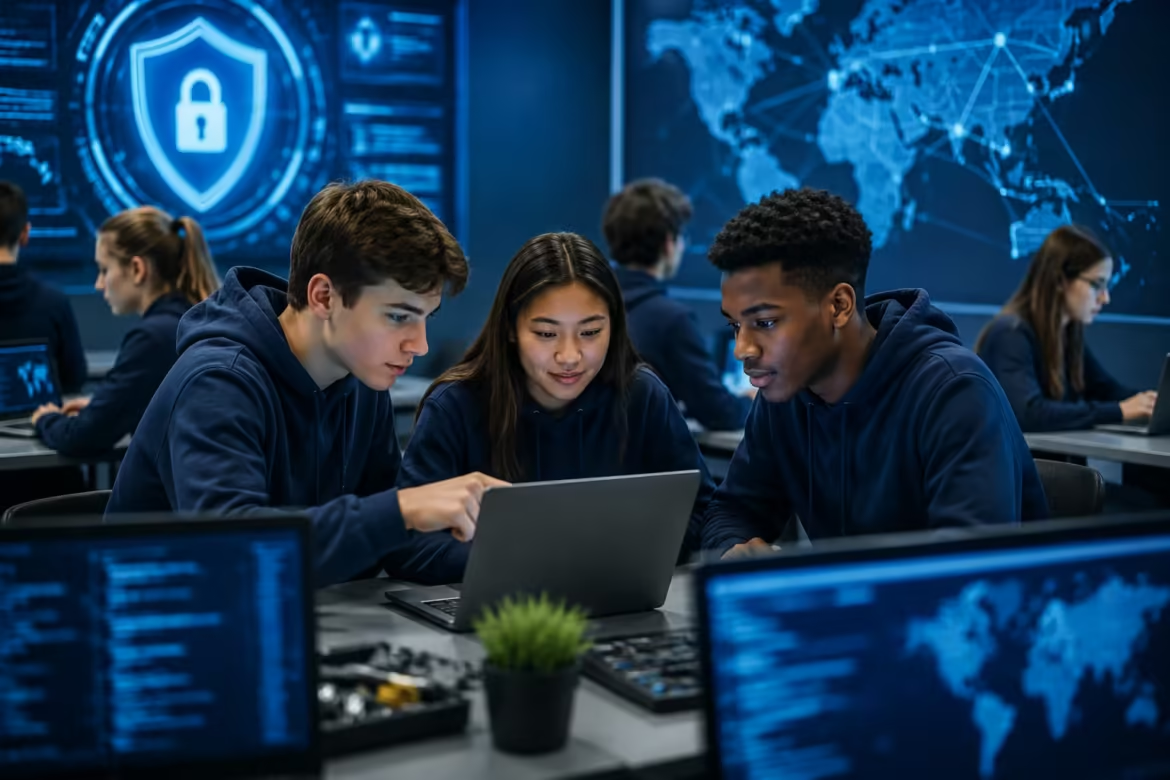
Three students collaborate on a laptop in a blue-lit cybersecurity classroom with a world map display in the background.
K-12Hot Topics - controversialCybersecurity

Student Cybersecurity Teams Are Shaping the Future

by EdCircuit Staff July 13, 2026
written by EdCircuit Staff 10 minutes read

Student cybersecurity teams are rapidly becoming one of the most impactful cybersecurity and career-readiness initiatives in K-12 education, helping schools prepare students for a future where digital security touches every profession, industry, and community.

At 6:15 on a Tuesday morning, a district technology director receives the call every school leader dreads.

A staff member clicked a suspicious email.

Several accounts appear compromised.

The technology team immediately begins investigating whether sensitive systems have been affected.

While the incident is eventually contained, it serves as another reminder of a reality facing school districts nationwide: cybersecurity is no longer simply an IT issue. It is a districtwide responsibility that affects students, teachers, administrators, families, and entire communities.

Every day, schools rely on technology to deliver instruction, manage transportation, process payroll, maintain student records, support special education services, communicate with families, and operate safely. The modern school district runs on interconnected digital systems.

At the same time, cyber threats continue to grow in frequency and sophistication.

Ransomware attacks disrupt learning.

Phishing campaigns target employees.

Data breaches expose sensitive information.

Artificial intelligence is creating both new opportunities and new risks.

Yet amid these challenges, a remarkable movement is quietly emerging in schools across America.

Students are stepping forward.

What began years ago as computer clubs and technology groups has evolved into something far more significant. Student cybersecurity teams are appearing in middle schools, high schools, career centers, and district programs nationwide. These students are not simply learning about cybersecurity. They are developing technical expertise, leadership skills, communication abilities, and problem-solving strategies that will serve them throughout their lives.

For school leaders searching for meaningful STEM opportunities, authentic career pathways, and innovative ways to prepare students for the future, student cybersecurity teams may represent one of the most promising educational movements of the decade.

A Challenge Schools Can No Longer Ignore

Cybersecurity has become one of the defining educational challenges of the modern era.

School districts manage enormous amounts of sensitive information, including student records, employee information, transportation systems, financial data, health records, and operational infrastructure. Every year, the digital footprint of schools continues to expand.

At the same time, technology leaders are being asked to do more than ever before.

Support instruction.

Protect data.

Manage thousands of devices.

Maintain networks.

Deploy new technologies.

Respond to incidents.

Train staff.

And do it all while navigating budget pressures and staffing shortages.

The challenge extends beyond education.

Across virtually every sector of the economy, organizations are struggling to find qualified cybersecurity professionals. Industry workforce studies continue to show hundreds of thousands of cybersecurity positions remain unfilled across the United States, with millions of openings worldwide.

For schools, this reality creates both a challenge and an opportunity.

The challenge is protecting increasingly complex digital environments.

The opportunity is helping students enter one of the fastest-growing and most important career fields in the world.

The New Robotics Movement

Fifteen years ago, robotics programs began appearing in schools across America.

Initially, many educators viewed robotics clubs as specialized activities that would appeal to only a small group of students interested in engineering and technology.

Then something unexpected happened.

Robotics programs flourished.

Students became engaged.

Communities rallied around competitions.

Business partnerships formed.

Career pathways emerged.

Thousands of students discovered interests that shaped their futures.

Today, cybersecurity appears to be following a remarkably similar path.

What robotics was to engineering education in the early 2010s, cybersecurity may become to digital security, artificial intelligence, and technology leadership in the late 2020s.

The comparison matters because cybersecurity affects every industry.

Hospitals depend on cybersecurity.

Banks depend on cybersecurity.

Manufacturers depend on cybersecurity.

Government agencies depend on cybersecurity.

School districts depend on cybersecurity.

Every organization that relies on technology relies on cybersecurity.

The students competing on cybersecurity teams today may become the professionals protecting critical infrastructure tomorrow.

Real Programs Are Already Making an Impact

The growth of student cybersecurity teams is not a future prediction.

It is already happening.

Across the country, students are participating in programs such as CyberPatriot, where teams learn to secure operating systems, identify vulnerabilities, defend networks, and respond to simulated cyber incidents.

Programs such as GenCyber have introduced thousands of students and educators to cybersecurity through immersive camps and hands-on learning experiences.

Organizations, including the National Cyber League, provide opportunities for students to test their knowledge through realistic cybersecurity scenarios that mirror challenges faced by professionals.

These experiences are doing more than teaching technical skills.

They are helping students discover purpose.

Students gain confidence.

They learn teamwork.

They develop resilience.

They experience success and failure in environments that encourage growth.

Most importantly, they begin to see themselves as future cybersecurity professionals.

A Story Playing Out in Schools Nationwide

In districts across the country, a familiar story is unfolding.

A student joins a cybersecurity club because a friend encourages them to attend a meeting.

Perhaps they enjoy gaming.

Maybe they build computers.

Maybe they simply enjoy solving puzzles.

Initially, cybersecurity seems interesting.

Then they participate in a simulated cyber defense challenge.

Working alongside teammates, they investigate suspicious activity, identify vulnerabilities, and protect systems from mock attacks.

Something changes.

Technology becomes more than entertainment.

It becomes purpose.

Over time, that student earns certifications, competes in events, develops leadership skills, and begins exploring career opportunities.

By graduation, they have something many students are still searching for.

Direction.

Educators frequently report seeing students thrive in cybersecurity programs because the learning feels authentic. Students are not simply memorizing concepts for a test. They are solving problems that resemble challenges professionals encounter every day.

That authenticity creates engagement.

And engagement creates opportunity.

Students as Cybersecurity Ambassadors

One of the most overlooked benefits of student cybersecurity teams is their ability to strengthen cybersecurity culture throughout an entire district.

Technology departments often spend countless hours educating users about cybersecurity best practices.

Yet students frequently learn best from other students.

When student leaders discuss password security, phishing awareness, social engineering, digital citizenship, and responsible technology use, the message often resonates differently.

Some districts have empowered student cybersecurity teams to create awareness campaigns, produce educational videos, support digital citizenship initiatives, and present information to school boards and community organizations.

The students gain leadership opportunities.

The district gains advocates.

The community gains awareness.

Cybersecurity becomes part of the culture rather than simply another policy.

That shift can be transformative.

Why Superintendents Should Pay Attention

For superintendents, student cybersecurity teams represent much more than another extracurricular activity.

These programs align directly with priorities district leaders discuss every day.

Career readiness.

Student engagement.

Workforce development.

Community partnerships.

Innovation.

Future-focused learning.

Student cybersecurity teams create opportunities to collaborate with businesses, colleges, workforce development organizations, government agencies, and military partners.

They provide authentic experiences that help students connect classroom learning to future careers.

In an increasingly competitive educational landscape, cybersecurity programs can become visible examples of how schools are preparing students for a rapidly changing world.

Parents notice.

Community leaders notice.

Business partners’ notice.

Most importantly, students notice.

From the Classroom to the Security Operations Center

One of the most exciting aspects of student cybersecurity teams is how closely the experience mirrors the real world.

In professional environments, cybersecurity experts often work within Security Operations Centers, commonly known as SOCs. These teams monitor networks, investigate suspicious activity, identify vulnerabilities, and respond to threats before they become major incidents.

While student teams are not defending enterprise-level systems, many are developing the same mindset.

They investigate anomalies.

They analyze evidence.

They collaborate under pressure.

They create response strategies.

They learn to think like defenders.

The similarities are striking.

A student participating in a cybersecurity competition this year may spend an afternoon responding to simulated threats. Ten years from now, that same student could be protecting a hospital system, financial institution, government agency, manufacturing facility, or school district.

That journey often begins with a single after-school meeting and an educator willing to create an opportunity.

Artificial Intelligence Is Changing the Conversation

Artificial intelligence is creating an entirely new dimension for cybersecurity education.

Today’s students will enter a workforce where AI and cybersecurity are deeply interconnected.

AI-powered tools can identify suspicious activity, automate investigations, detect anomalies, and strengthen security operations.

At the same time, cybercriminals are using AI to generate sophisticated phishing campaigns, create convincing deepfakes, automate attacks, and enhance social engineering efforts.

The threats are evolving rapidly.

The defenses are evolving just as quickly.

Tomorrow’s cybersecurity professionals will need to understand both.

Student cybersecurity teams provide ideal environments for exploring these emerging realities.

Students can discuss ethics.

Evaluate risks.

Explore responsible innovation.

And learn how powerful technologies can be used both positively and negatively.

These conversations prepare students for careers that will look dramatically different from those of today’s technology leaders.

Building the Workforce Pipeline of Tomorrow

Few industries face workforce shortages as significant as cybersecurity.

Demand continues to grow across healthcare, education, finance, manufacturing, defense, government, and technology sectors.

This creates a tremendous opportunity for schools.

Every student who discovers cybersecurity through a district program represents potential future talent entering a field where demand continues to outpace supply.

Some students will pursue college degrees.

Others will enter technical training programs.

Some will earn certifications and begin careers shortly after graduation.

Regardless of their path, exposure to cybersecurity during middle school and high school can influence future decisions in meaningful ways.

The workforce pipeline does not begin in college.

It begins in schools.

Starting Small Can Lead to Something Big

One of the most encouraging aspects of student cybersecurity programs is how often they begin with simple ideas.

A teacher notices student interest.

A technology director volunteers to help.

A local company offers mentorship.

A librarian provides meeting space.

A handful of students gather after school.

That is often enough.

Momentum builds.

Students recruit friends.

Competitions generate excitement.

Partnerships emerge.

School leaders recognize the value.

What begins as a club can become a pathway.

What begins as a pathway can become a workforce development initiative.

The biggest barrier is rarely funding.

It is simply taking the first step.

The Next Generation of Digital Defenders

Every generation has opportunities that help define its future.

For previous generations, those opportunities may have been manufacturing, aviation, engineering, or computer science.

For today’s students, cybersecurity is emerging as one of those defining opportunities.

Schools that invest in student cybersecurity teams today are doing more than creating extracurricular activities.

They are helping shape the workforce, leaders, innovators, and digital defenders that communities will depend upon for decades to come.

The student participating in a cybersecurity competition today may someday stop a ransomware attack targeting a school district.

The student learning about phishing awareness after school may eventually protect a hospital network.

The student exploring cybersecurity through a career-tech pathway may one day defend financial institutions, government agencies, military operations, or critical infrastructure.

Every student cybersecurity team represents more than an extracurricular activity.

It represents opportunity.

It represents innovation.

It represents leadership.

It represents the future.

The future of cybersecurity is not being built solely in corporate offices, government agencies, or university laboratories.

In many cases, it is already being built in classrooms, media centers, career-tech programs, and after-school clubs across America.

The next generation of digital defenders is already here.

The question is no longer whether student cybersecurity teams belong in K-12 education.

The question is how many students will have the opportunity to participate before the rest of the world realizes just how important they have become.

Play video: National Youth Cyber Defense competition (1 minute 25 seconds)1:25
National Youth Cyber Defense competition1 min 25 sFirst Alert 6 on YouTube

First Alert 6 – National Youth Cyber Defense Competition (Play video)

Subscribe to edCircuit to stay up to date on all of our shows, podcasts, news, and thought leadership articles.
July 13, 2026 0 comments
0 FacebookTwitterPinterestLinkedinWhatsappCopy LinkEmail
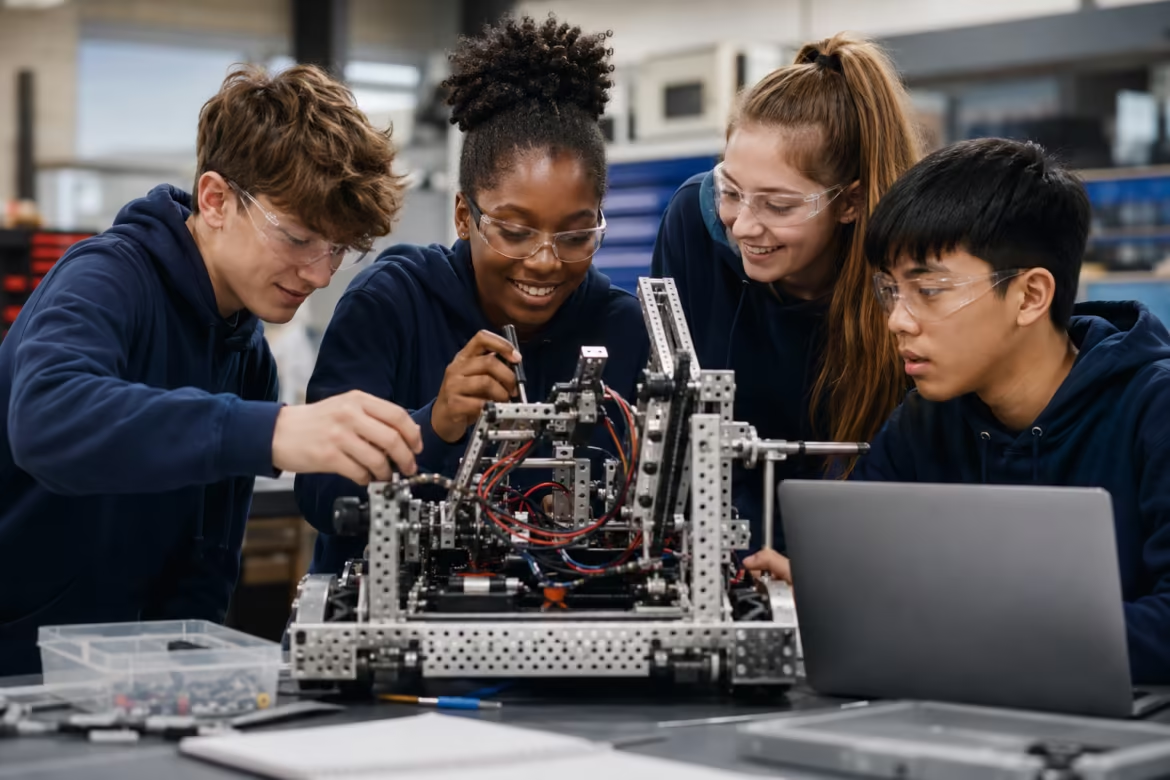
Four students wearing safety goggles assemble a metal robotics chassis with wires in a workshop, a laptop nearby on the table of a labbench.
Hot Topics - controversialSTEM and STEAM EducationK-12After-School Programs

Robotics Clubs in Schools Are Shaping Future Innovators

by EdCircuit Staff July 10, 2026
written by EdCircuit Staff 8 minutes read

Robotics clubs in schools are becoming one of the most powerful Safer STEM opportunities in K–12 education, helping students develop technical skills, confidence, leadership abilities, and career readiness while preparing them for a future increasingly shaped by automation, artificial intelligence, and advanced technology.

The robot stopped moving with less than thirty seconds remaining in the match.

A group of students rushed around a laptop searching for the problem. One student checked the code. Another inspected the wiring. A mentor pointed toward a loose connection. The fix took only seconds, but it felt like an eternity. As the robot came back to life and completed its task before the buzzer sounded, the crowd erupted in cheers.

Scenes like this are unfolding every week in schools across America.

What outsiders often see as students simply building robots is actually something much larger. Robotics clubs have become incubators for innovation, teamwork, creativity, resilience, and problem-solving. They provide opportunities for students to apply classroom knowledge in authentic ways while exposing them to careers and technologies that will define the future workforce.

As districts search for ways to engage students, strengthen Safer STEM pathways, and create meaningful learning experiences, robotics clubs are emerging as one of the most impactful investments schools can make.

A Club That Extends Learning Beyond the Classroom

Educators have long searched for ways to answer a common student question:

“When am I ever going to use this?”

Robotics clubs answer that question almost immediately.

Mathematics suddenly becomes essential when students need to calculate movement distances, gear ratios, or navigation paths. Science concepts become tangible as students explore forces, energy transfer, and mechanical systems. Coding transforms from lines of text on a screen into commands that bring machines to life.

Students quickly discover that robotics is not a single subject.

It is the intersection of many subjects working together.

Engineering, computer science, mathematics, design, communications, business, project management, and even public speaking all play important roles.

This interdisciplinary approach mirrors how real-world organizations operate. Rarely does a professional engineer work in isolation. Success often depends on collaboration, communication, and the ability to solve problems as part of a team.

Robotics clubs allow students to experience those realities long before they enter college or the workforce.

Learning Through Failure

One of the greatest lessons robotics teaches has nothing to do with robots.

It teaches students how to fail.

In traditional academic settings, mistakes are often viewed as something to avoid. In robotics, mistakes are expected.

Robots break.

Sensors malfunction.

Programs crash.

Designs fail.

Competition strategies fall apart.

Students learn that setbacks are not signs of failure but opportunities for improvement.

That lesson is increasingly valuable in a world where innovation depends upon experimentation and continuous improvement.

Employers consistently rank adaptability, resilience, and problem-solving among the most desirable workplace skills. Robotics naturally develops those qualities because students encounter challenges that cannot be solved simply by looking up an answer in a textbook.

They must think critically, collaborate, troubleshoot, and try again.

Those experiences create confidence that extends far beyond robotics competitions.

Why Robotics Matters More Than Ever

The timing of robotics growth in schools is not accidental.

The world is changing rapidly.

Artificial intelligence is transforming industries. Advanced manufacturing facilities are expanding across the country. Automation is reshaping logistics, transportation, healthcare, agriculture, and countless other sectors.

Today’s students will enter a workforce dramatically different from the one their parents experienced.

According to workforce development experts, many of the fastest-growing careers involve technology, automation, engineering, cybersecurity, data analysis, and advanced manufacturing systems.

Robotics clubs provide an early introduction to these fields.

Students begin understanding how machines operate, how software controls systems, and how technology can solve complex problems. They learn the fundamentals that serve as building blocks for future careers in engineering, computer science, artificial intelligence, aerospace, cybersecurity, industrial automation, and robotics itself.

For many students, robotics becomes the first step toward discovering a passion they never knew existed.

National Organizations Creating Pathways for Success

One reason robotics programs continue to flourish is the extensive support available through national organizations dedicated to student innovation.

Among the most recognized is FIRST. Founded to inspire young people to pursue science and technology careers, FIRST has built a comprehensive ecosystem of programs that span elementary school through high school.

Programs such as FIRST LEGO League, FIRST Tech Challenge, and FIRST Robotics Competition allow students to engage in age-appropriate challenges while developing engineering and leadership skills.

Another major player is VEX Robotics, whose competitions have expanded into thousands of schools worldwide. VEX offers accessible entry points for beginners while providing advanced opportunities for experienced teams.

Organizations such as SkillsUSA and Technology Student Association also provide robotics-related competitions that connect students with broader career and technical education experiences.

These organizations offer much more than competitions.

They provide curriculum resources, teacher training, mentor networks, grant opportunities, and proven frameworks that help schools launch successful programs.

For educators considering a robotics club, the good news is that they do not have to start from scratch.

An entire support system already exists.

Building a Robotics Program Without an Engineering Degree

One of the most common concerns educators express is simple:

“I don’t know enough about robotics.”

The reality is that many successful robotics programs were started by teachers who had little or no engineering experience.

Science teachers.

Math teachers.

Technology teachers.

Media specialists.

Career counselors.

Librarians.

Administrators.

In many cases, the advisor’s role is not to be the expert.

The advisor’s role is to create opportunities.

Students often become researchers, problem-solvers, and innovators themselves. They watch tutorials, read documentation, collaborate with mentors, and learn through experimentation.

Robotics clubs frequently become environments where teachers and students learn together.

That collaborative culture can be incredibly powerful.

The willingness to start is often far more important than having all the answers.

Connecting Schools With Local Industry

Perhaps one of the most exciting aspects of robotics programs is their ability to create authentic partnerships between schools and local businesses.

Across the country, employers are facing workforce shortages in engineering, manufacturing, skilled trades, cybersecurity, information technology, and advanced technical fields.

Business leaders increasingly recognize that workforce development must begin long before students enter college or apply for jobs.

Robotics clubs provide a natural bridge.

Local manufacturers may sponsor equipment purchases.

Engineering firms often provide mentors.

Technology companies can offer software, internships, or technical guidance.

Community colleges frequently partner with schools to provide facilities, dual-enrollment opportunities, and workforce certifications.

Universities may host competitions, workshops, or summer camps.

These partnerships benefit everyone involved.

Students gain access to expertise and career exploration opportunities.

Businesses develop relationships with future talent.

Schools gain resources that may otherwise be unavailable.

Communities strengthen their educational and economic ecosystems.

A robotics club can become far more than a student activity.

It can become a community-wide investment in the future.

Creating Opportunities for Every Student

While robotics is often associated with engineering and coding, successful robotics teams depend upon a wide range of talents.

Students may serve as programmers, designers, builders, marketers, videographers, photographers, public speakers, social media coordinators, fundraisers, project managers, or team leaders.

This diversity of roles creates opportunities for students with varying interests and strengths.

Not every student wants to write code.

Not every student wants to design mechanical systems.

Some excel at communications.

Others thrive in leadership roles.

Some enjoy organizing logistics or managing budgets.

Robotics teams demonstrate an important lesson:

Innovation requires diverse perspectives.

Students learn that meaningful contributions come in many forms.

That sense of belonging often attracts students who may not see themselves reflected in traditional extracurricular activities.

The Parent Perspective

Parents are increasingly searching for activities that provide meaningful experiences while helping students prepare for future opportunities.

Robotics checks many boxes.

Students develop technical skills.

They build leadership abilities.

They strengthen collaboration and communication skills.

They create portfolios that can support college applications.

Many students also gain access to scholarships offered through robotics organizations, universities, and industry partners.

Perhaps most importantly, robotics allows students to demonstrate initiative.

Colleges and employers increasingly value applicants who have engaged in authentic projects, solved real problems, and shown the ability to work as part of a team.

A robotics club provides those experiences in abundance.

Preparing Students for an AI-Powered Future

The conversation surrounding education increasingly centers on artificial intelligence.

While AI continues to generate headlines, robotics offers something equally important: hands-on engagement with the technologies shaping tomorrow’s world.

The students participating in robotics clubs today may one day design autonomous vehicles, develop smart manufacturing systems, secure critical infrastructure, build healthcare technologies, or create innovations that have not yet been imagined.

They are learning how technology works rather than simply consuming it.

That distinction matters.

Schools have an opportunity to move students from passive users of technology to active creators of technology.

Robotics clubs help make that transformation possible.

Building More Than Robots

At first glance, a robotics club appears to be about machines.

Look closer, however, and something much more meaningful is happening.

Students are learning how to collaborate.

They are learning how to lead.

They are learning how to solve problems.

They are learning how to recover from setbacks.

They are learning how to turn ideas into reality.

Most importantly, they are beginning to see themselves as innovators.

As schools seek ways to prepare students for an increasingly complex and technology-driven future, robotics clubs offer a compelling model for what modern learning can look like.

The robots may be what attract students initially.

But the confidence, skills, relationships, and opportunities they gain along the way are what truly change lives.

And for many students, that journey begins with a single after-school meeting, a curious mind, and the courage to build something that has never existed before.

Play video: What's It Like To Be On A High School Robotics Team? (5 minutes 5 seconds)5:05
What's It Like To Be On A High School Robotics Team?5 min 5 sMission Unstoppable on YouTube

Mission Unstoppable – What’s It Like To Be On A High School Robotics Team? (Play video)

Subscribe to edCircuit to stay up to date on all of our shows, podcasts, news, and thought leadership articles.

July 10, 2026 0 comments
0 FacebookTwitterPinterestLinkedinWhatsappCopy LinkEmail
AI-proof skills: a student stands calm inside a glowing golden dome holding symbols of communication, creativity, empathy, critical thinking and adaptability while a storm of AI data swirls outside
EducatorsHot Topics - controversialArtificial IntelligenceK-12

AI-Proof Skills Every Student Needs

by EdCircuit Staff July 9, 2026
written by EdCircuit Staff 8 minutes read

AI-proof skills are rapidly becoming one of the most important priorities in K-12 education as artificial intelligence reshapes the future of work, learning, and human interaction.

For generations, schools have prepared students for a world that was largely predictable. Students learned foundational academic subjects, earned diplomas, pursued college or careers, and entered professions that often remained relatively stable for decades.

Today’s students face a very different reality.

Artificial intelligence is transforming industries at a pace few could have imagined just a decade ago. AI can write reports, generate images, analyze data, create software code, answer questions, and automate tasks that once required significant human effort. Entire industries are beginning to rethink workflows, productivity, and workforce needs because of these emerging capabilities.

As a result, educators, employers, policymakers, and families are asking an increasingly important question:

What skills will matter most in a world where machines can perform many routine cognitive tasks?

The answer may ultimately define the future of education.

Surprisingly, the conversation is leading many experts back to something deeply human. While technical knowledge remains important, communication, creativity, adaptability, leadership, emotional intelligence, and critical thinking are emerging as some of the most valuable skills students can develop.

The future may be powered by artificial intelligence, but it will still be shaped by people.

A Different Kind of Workforce Is Emerging

Throughout history, technological innovation has transformed the nature of work.

The Industrial Revolution reshaped manufacturing. Computers transformed office environments. The internet changed communication, commerce, and information access.

Artificial intelligence represents another major shift, but unlike previous technological advancements, its influence is reaching nearly every profession simultaneously.

A future nurse may use AI-assisted diagnostic tools.

An engineer may collaborate with generative design systems.

A lawyer may leverage AI to analyze legal documents.

A teacher may use intelligent tutoring systems to personalize instruction.

A business leader may rely on predictive analytics to guide strategic decisions.

In each case, technology becomes a powerful tool. Yet the most important decisions still require human judgment.

A machine may generate recommendations.

A human must determine whether they are correct.

A machine may identify patterns.

A human must understand context.

A machine may provide answers.

A human must decide what actions to take.

That distinction is becoming increasingly important as schools prepare students for careers that may not even exist today.

Schools Are Already Redesigning for the AI Era

Across the country, schools are beginning to rethink what student success should look like in an age of artificial intelligence.

Many districts have adopted Portrait of a Graduate frameworks that emphasize communication, collaboration, problem-solving, creativity, citizenship, and adaptability alongside academic achievement. Others are expanding project-based learning, career pathways, internships, entrepreneurship programs, and competency-based education models that focus on real-world application rather than memorization alone.

The shift is significant.

For years, education discussions often centered on content knowledge and standardized assessments. While those remain important, many education leaders now recognize that students must also develop durable skills that can transfer across careers, industries, and life experiences.

The conversation is no longer simply about teaching students how to use AI.

It is increasingly about helping students develop the human capabilities that artificial intelligence cannot easily replicate.

In many ways, schools are rediscovering a truth that has always existed: education is ultimately about developing people, not simply delivering information.

Employers Are Looking for More Than Technical Skills

One of the most consistent messages coming from business and industry leaders is that technical knowledge alone is not enough.

Organizations need employees who can collaborate effectively, communicate clearly, adapt to change, solve complex problems, and lead diverse teams.

A graduate may know how to use AI tools.

Can they explain their findings to a client?

Can they navigate disagreement during a team project?

Can they recognize ethical concerns when technology presents conflicting information?

Can they think critically when an AI-generated response appears convincing but contains errors?

These are the skills employers increasingly value because they complement technology rather than compete against it.

The future workforce will likely reward individuals who understand how to work alongside artificial intelligence while bringing uniquely human strengths to the table.

Communication Is Becoming a Superpower

As information becomes easier to access, the ability to communicate effectively becomes even more valuable.

Communication extends far beyond writing papers or delivering presentations.

It includes listening.

It includes empathy.

It includes asking thoughtful questions.

It includes understanding different perspectives.

It includes adapting messages for different audiences.

Consider a student leading a robotics competition, presenting findings during a science fair, participating in student government, or collaborating on a multimedia project. The success of those experiences often depends as much on communication as on technical expertise.

These same skills become essential in virtually every profession.

Whether students become educators, healthcare professionals, engineers, cybersecurity specialists, entrepreneurs, or public servants, communication remains one of the strongest predictors of success.

Critical Thinking Matters More Than Information Access

For much of modern education, helping students find information was a primary goal.

Today, information is everywhere.

Search engines provide instant access to millions of resources. Artificial intelligence can generate answers in seconds. Social media delivers a constant stream of content.

The challenge is no longer finding information.

The challenge is evaluating it.

Students must learn how to verify sources, identify misinformation, recognize bias, analyze evidence, and ask meaningful questions.

This is especially important in an era where AI-generated content can appear highly credible even when it contains inaccuracies.

The future may belong less to students who memorize answers and more to students who know how to question them.

Critical thinking allows students to move beyond consuming information and toward understanding it.

Creativity Remains a Human Advantage

Some people assume artificial intelligence will diminish the importance of creativity.

The opposite may be true.

As routine tasks become increasingly automated, originality becomes more valuable.

Creativity is not simply producing content.

It is imagining possibilities.

It is solving problems in new ways.

It is making connections others fail to see.

The world’s greatest innovations rarely emerge from following established patterns. They emerge from curiosity, experimentation, and a willingness to think differently.

Schools that encourage design thinking, inquiry-based learning, makerspaces, innovation labs, entrepreneurship programs, and creative problem-solving experiences are helping students develop skills that will remain relevant regardless of technological advances.

Creativity fuels discovery.

And discovery drives progress.

Adaptability May Become the New Job Security

Many of today’s students will work in careers that do not yet exist.

Some professions will evolve dramatically.

Others may disappear.

New opportunities will emerge.

The ability to adapt may become one of the most valuable career skills students can possess.

Adaptability means more than accepting change.

It means embracing continuous learning.

It means remaining resilient when circumstances shift.

It means developing confidence in unfamiliar situations.

Schools increasingly support adaptability through interdisciplinary projects, emerging technology programs, collaborative learning experiences, internships, and authentic problem-solving opportunities.

Students who learn how to learn may be better prepared than students who simply learn how to memorize.

Emotional Intelligence Is Becoming a Competitive Advantage

Technology continues to evolve, but empathy remains uniquely human.

Emotional intelligence includes self-awareness, empathy, relationship-building, communication, resilience, and social awareness.

These skills influence leadership, teamwork, customer service, collaboration, and workplace culture.

Employers consistently seek individuals who can work effectively with others, build trust, and navigate interpersonal challenges.

Schools that prioritize social-emotional learning are not moving away from academic achievement.

They are strengthening the foundation that supports it.

Students who understand themselves and others are often better equipped to navigate both personal and professional challenges.

In a world increasingly influenced by technology, human connection becomes even more valuable.

Leadership Is No Longer Reserved for Adults

Leadership development no longer begins after graduation.

Across the country, students are already leading.

They are captains of athletic teams, officers in student organizations, founders of clubs, leaders of community service projects, participants in student cybersecurity teams, peer mentors, and ambassadors for technology initiatives.

These experiences teach responsibility, accountability, communication, teamwork, and decision-making.

Leadership opportunities help students understand that influence is not determined by age.

It is determined by action.

Schools that intentionally create opportunities for leadership are preparing students not only for careers, but for citizenship and community engagement as well.

The Importance of Starting Early

AI-proof skills are not developed during a single high school course.

They begin forming in elementary classrooms.

A student collaborating during a STEM challenge develops teamwork.

A child presenting a project to classmates builds communication skills.

A young learner navigating a disagreement practices emotional intelligence.

A makerspace activity fosters creativity and problem-solving.

A classroom discussion develops critical thinking.

These experiences may seem small, but they create the foundation for future growth.

The development of AI-proof skills is not a high school initiative.

It is a K-12 journey.

Education’s Greatest Opportunity

Artificial intelligence is changing the world.

But it is not reducing the importance of education.

In many ways, it is increasing it.

Schools remain uniquely positioned to help students develop the skills, habits, mindsets, and character traits that will shape future success.

The goal is not to compete with artificial intelligence.

The goal is to prepare students to use it wisely, ethically, and effectively.

Twenty years from now, employers may not ask graduates how well they memorized information.

They may ask how effectively they solved problems.

How clearly they communicated.

How successfully they collaborated.

How quickly they adapted.

How thoughtfully they led.

Artificial intelligence will continue to evolve.

But the future will still belong to people.

The students who thrive will not simply be those who know how to use AI. They will be the ones who can lead teams, solve complex challenges, communicate with empathy, adapt to change, and imagine possibilities that technology alone cannot see.

As schools prepare students for an uncertain future, the most important lesson may be one of the oldest: human potential remains our greatest advantage.

Subscribe to edCircuit to stay up to date on all of our shows, podcasts, news, and thought leadership articles.
July 9, 2026 0 comments
0 FacebookTwitterPinterestLinkedinWhatsappCopy LinkEmail
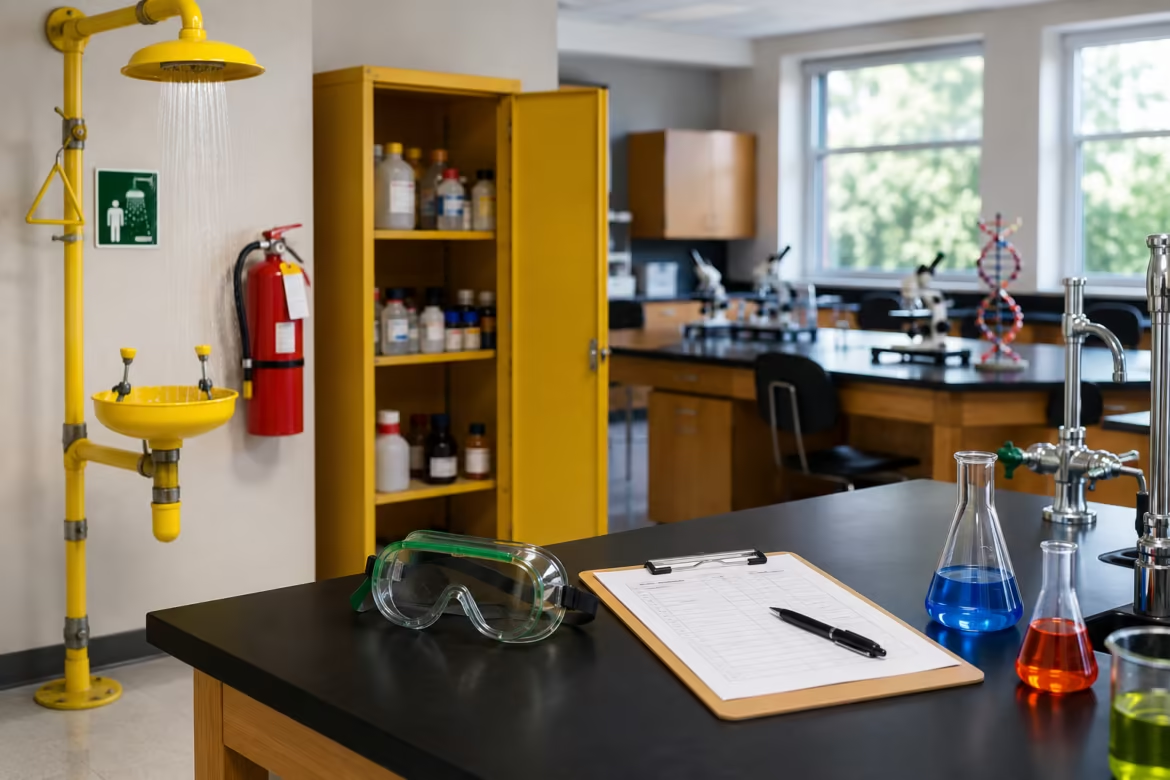
Laboratory bench with safety gear: yellow eyewash station, shower, fire extinguisher, goggles on the counter, clipboard and pens, and beakers with blue and red liquids nearby.
Hot Topics - controversialHiddenSTEM and STEAM EducationSchool SafetyScience and Lab SafetyK-12

Science Lab Safety Inspections Save Lives

by EdCircuit Staff July 8, 2026
written by EdCircuit Staff 9 minutes read

Science lab safety inspections are among the most important yet overlooked responsibilities in K–12 education. Every day, students conduct experiments, handle laboratory equipment and work with chemicals in the hands-on learning that brings science to life. That learning is essential to a well-rounded education, and it creates responsibilities that cannot be ignored.

Educators devote significant time to curriculum, instruction and assessment, while the physical learning environment often receives less attention, even though a laboratory’s condition directly affects student safety, staff well-being, district liability and the success of a science program. Laboratories are dynamic: equipment ages, chemical inventories grow, new staff arrive, procedures evolve and storage areas become crowded. Small issues develop gradually and often go unnoticed until an inspection reveals them, which is why annual science lab safety inspections are essential rather than merely recommended.

The safest laboratories are not necessarily the newest facilities or those with the largest budgets. They are the laboratories where safety is intentionally evaluated, documented, discussed and improved year after year.

What Risks Do Science Lab Safety Inspections Find?

Science lab safety inspections find hazards that rarely announce themselves. Major incidents are often preceded by a series of small problems that seemed insignificant at the time: a bottle label becomes difficult to read, a chemical cabinet becomes overcrowded, an eyewash station is partly blocked by stored materials, a teacher inherits chemicals from a predecessor and assumes they are still safe to use, or a fire extinguisher ends up behind classroom equipment. None of these appears dramatic or creates immediate concern, yet together they increase risk.

Safety professionals routinely find conditions that have existed for months or even years unnoticed, usually through familiarity rather than negligence. In a room seen every day, small concerns blend into the background, while an outside inspector notices them at once. An annual inspection supplies that fresh set of eyes and an objective view in place of routine.

Why Is Lab Safety Not a One-Time Achievement?

Lab safety is a process rather than a destination, so a single effort cannot secure it. Some schools approach safety as a project: a cleanup, new equipment, updated documentation and confidence that the laboratory is safe. A laboratory that met every expectation last year, however, may not meet them today. Eyewash stations require regular maintenance, safety showers must remain accessible and functional, and fume hoods require evaluation. Chemical inventories change, emergency plans evolve, personal protective equipment wears out, and new curriculum brings new materials and procedures.

Safety systems drift over time, and annual inspections find that drift before it leads to an accident, a near miss or a compliance issue. That shift from reaction to prevention is one of the most valuable outcomes of an inspection program.

How Often Should School Science Labs and Their Safety Equipment Be Inspected?

A school science lab should receive a full inspection at least once a year, with weekly and monthly checks of its emergency equipment in between. As a lab inspection checklist, the usual intervals are:

  • Weekly: activate every plumbed eyewash station and safety shower, and walk the room for blocked exits, hidden extinguishers and other conditions that change between formal inspections.
  • Monthly: visually inspect every portable fire extinguisher.
  • Annually: carry out the full laboratory inspection, inspect each eyewash station and shower, complete the extinguisher maintenance check, have each fume hood’s face velocity tested and update the chemical inventory.

For plumbed eyewash stations and showers, the consensus standard ANSI/ISEA Z358.1 calls for weekly activation and a yearly inspection, as Washington State’s Department of Labor & Industries summarizes on its emergency washing facilities page. An OSHA InfoSheet (2015) explains why the weekly flush matters: water in poorly maintained eyewash stations is more likely to carry organisms such as Acanthamoeba, Pseudomonas and Legionella. OSHA requires portable fire extinguishers to be visually inspected monthly and given an annual maintenance check (29 CFR 1910.157(e)). National Science Teaching Association (NSTA) safety columnist Ken Roy’s lab safety and security list (2020) calls for an annual fume hood face-velocity inspection by a certified technician under NFPA 45, and the federal School Chemistry Laboratory Safety Guide (CPSC and NIOSH, 2006) asks teachers to update the chemical inventory at least annually and give a copy to local emergency responders. Where state rules, fire codes or district policy set shorter intervals, the shorter interval applies.

Who Inspects a School Science Lab?

Several people share the inspection work, each at a different interval. Roy has noted that the custodian usually activates the eyewash and shower each week and that a written record of those checks should be kept. The 2006 federal guide asks teachers to inspect safety and first-aid equipment as often as the administration requests, to record the date and their initials on the equipment’s inspection tag, and to report hazardous conditions to the administration in writing. NSTA’s weekly inspection checklist (October 2026) is written for safety compliance officers, chemical hygiene officers and instructors, and gives each finding a priority, a named owner and a target date. The annual inspection benefits most from someone who does not work in the room every day. For the room itself, its exits, ventilation, utilities and storage, see physical safety inspections in science labs.

How Do Small Problems Become Big Incidents?

Small problems become big incidents when several of them line up at the same moment. History has repeatedly demonstrated that a single failure rarely causes a major incident. In a chemical splash, a student whose eyes are exposed to a hazardous material is sent at once to the eyewash station; if the unit has not been tested in years, the water pressure may be inadequate and valuable seconds are lost. In a minor fire, a teacher may reach for an extinguisher and find that stored materials block access to it. A spill may involve incompatible materials that should never have been stored together.

Each of these situations begins long before the emergency. The true cause is the unnoticed condition that existed beforehand, and that is why inspections save lives: they find those conditions before they have an opportunity to cause harm.

Are Lab Safety Inspections Only About Compliance?

Lab safety inspections serve compliance, but their larger purpose is protecting people. Many educators hear the word “inspection” and think of documentation, regulations, checklists and requirements. Compliance matters, but compliance asks whether a requirement has been met, safety asks whether people are protected, and the two are not always the same.

A school may own equipment that technically satisfies a requirement, but if staff do not know how to use it, or access is obstructed during an emergency, its practical value is much reduced. Effective inspections therefore move beyond paperwork to ask whether safety systems truly work and whether students and staff would be protected if an emergency occurred tomorrow, which makes them risk-management tools rather than administrative tasks.

Why Does Chemical Management Need Close Inspection?

Chemical management needs close inspection because it is the area where inspections most consistently uncover concerns, and chemical management problems accumulate quietly. Over time, science departments naturally collect chemicals. Some remain from previous instructors, others were purchased for curriculum units that no longer exist, and some exceeded their recommended shelf life years ago. Without routine review, inventories quickly become difficult to manage, and inspectors frequently encounter:

  • Unlabeled containers
  • Deteriorating labels
  • Unknown substances
  • Overcrowded storage cabinets
  • Improper segregation of incompatible chemicals
  • Expired materials
  • Outdated inventory records

These issues often remain hidden behind closed cabinet doors, so a laboratory that appears organized may still have its greatest risks sitting quietly on a shelf. Comprehensive inspections show schools exactly what they possess, where it is stored and whether storage practices support current safety standards.

Why Does Every School Need a Safety Champion?

Every school needs a safety champion because the most successful inspection programs depend on someone who owns safety throughout the year, not on a single annual review. In many organizations, that responsibility falls to a Chemical Hygiene Officer (CHO), laboratory manager, science supervisor or designated safety leader.

These individuals bridge annual inspections and daily operations: they coordinate training, monitor corrective actions, review inventories, support documentation and keep safety visible all year. Without a designated champion, even well-intentioned programs lose momentum. Safety improves when someone owns the process, and the annual inspection is far more effective as part of a broader commitment to continuous improvement.

Why Is Lab Safety a Leadership Responsibility?

Lab safety is a leadership responsibility because leaders control the priorities, resources and expectations that inspections depend on, even though it is often viewed as a teacher’s responsibility. Principals, district leaders, facilities personnel, risk managers and school boards all play important roles in supporting safe laboratory environments. Leadership determines priorities, allocates resources, establishes expectations and ultimately decides whether safety is treated as an investment or an expense.

Schools that prioritize inspections show staff, students and families that safety receives attention before problems occur. Prevention is less costly than response, and the cost of inspections, training, maintenance and corrective actions is small beside the financial, legal and human consequences of a serious incident.

How Do Inspections Build a Culture of Safety?

Inspections build a culture of safety by starting conversations, which may be their most important result. Teachers begin discussing procedures, administrators gain visibility into laboratory conditions, facilities teams learn science-specific needs, and corrective actions create opportunities for improvement.

In healthy safety cultures, inspections are not viewed as interruptions or as evaluations designed to assign blame. They are viewed as opportunities to learn, to improve and to protect people, and that mindset makes safety part of daily decision-making rather than an annual event. For why that culture begins with school and district leaders, see Science Lab Safety Culture Starts With Leadership.

Why Does the Future of Science Education Depend on Safe Laboratories?

The future of science education depends on safe laboratories because more advanced programs bring new hazards. Classrooms increasingly include biotechnology, engineering design, robotics, advanced chemistry, environmental science and other STEM work that prepares students for future careers, so laboratory safety systems must evolve alongside them. Annual science lab safety inspections provide the foundation for that growth by identifying emerging risks, strengthening safeguards, improving preparedness and supporting environments where innovation and safety work together.

Every student who enters a science laboratory deserves a safe place to explore, question, investigate and discover. Annual inspections help ensure that curiosity is supported by preparation, innovation by protection, and learning by a culture that values safety as much as achievement. The safest laboratories are not the newest or most expensive but the ones where safety is examined, evaluated and improved year after year, and schools that commit to that work are doing far more than checking boxes. They are protecting lives.

Subscribe to edCircuit to stay up to date on all of our shows, podcasts, news, and thought leadership articles.
July 8, 2026 0 comments
0 FacebookTwitterPinterestLinkedinWhatsappCopy LinkEmail
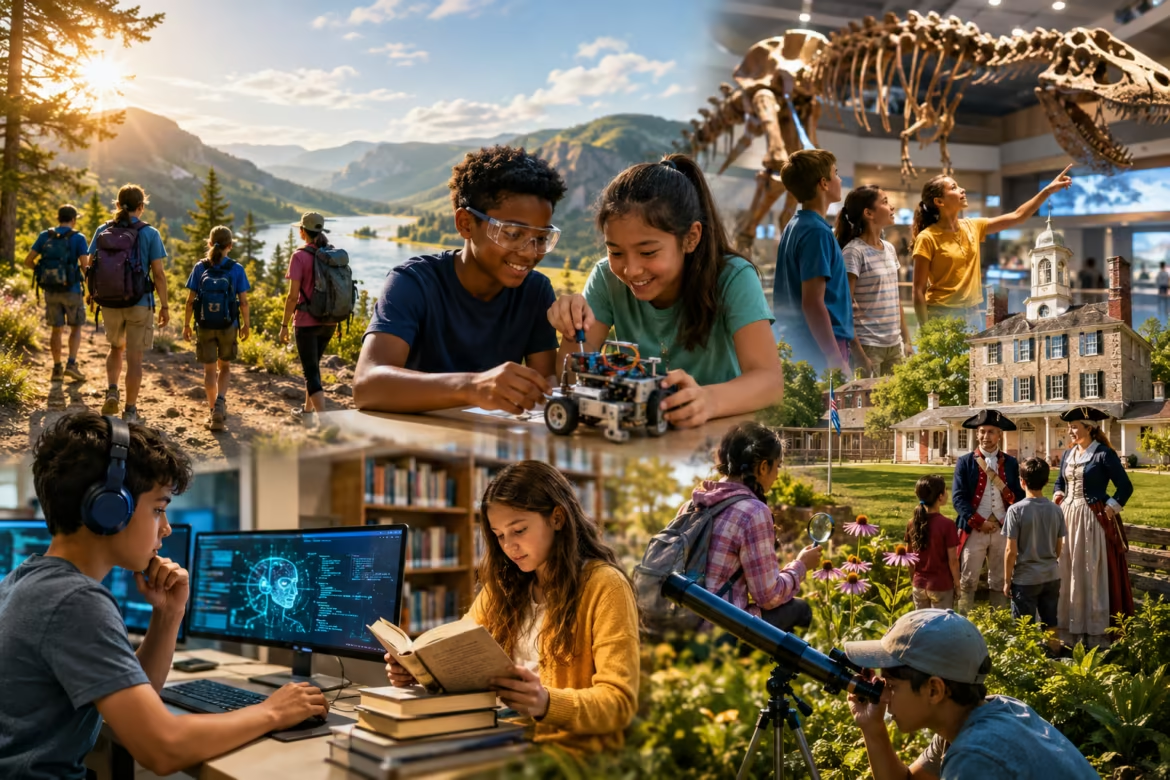
Collage of students learning science: hiking in mountains, building a robot, reading, stargazing, and a museum with a dinosaur skeleton.
School CalendarK-12After-School ProgramsHot Topics - controversial

Summer Learning Adventures Beyond the Classroom

by EdCircuit Staff July 7, 2026
written by EdCircuit Staff 8 minutes read

Summer learning adventures are becoming one of the most powerful ways students can explore new interests, develop future-ready skills, and create lifelong memories beyond the classroom.

For many families, the final school bell signals the start of something special.

Backpacks are set aside. Alarms are silenced. Schedules loosen. Students trade classrooms for sunshine, hallways for hiking trails, and school buses for family road trips.

Summer has always represented freedom.

But increasingly, it also represents opportunity.

Across the country, families are redefining what summer can be. They are discovering that some of the most meaningful learning experiences happen not within the walls of a school building, but in museums, libraries, science camps, national parks, historical landmarks, makerspaces, and community events.

The reality is that today’s students live in a world where learning never truly stops. New technologies emerge daily. Artificial intelligence is transforming careers. Cybersecurity has become a critical workforce need. The nation is preparing for the historic America250 celebration. At the same time, educators, libraries, museums, and community organizations are creating more opportunities than ever for students to explore their passions.

The best summer classroom may not have walls at all.

A New Era of Summer Learning

Not long ago, summer learning was often associated with avoiding the “summer slide.”

Today, the conversation is changing.

Families are increasingly viewing summer as a season of exploration rather than remediation. Instead of simply trying to preserve academic skills, many parents are looking for opportunities that inspire curiosity, creativity, problem-solving, and real-world experiences.

The shift reflects a growing understanding that some of the most important lessons students learn occur outside traditional academic environments.

A student attending a robotics camp is learning engineering principles.

A teenager volunteering in a community garden is learning environmental science and civic responsibility.

A family visiting a historical site is strengthening historical literacy and civic understanding.

A child participating in a library reading challenge is developing literacy skills while discovering a lifelong love of reading.

These experiences often feel less like school and more like adventure. Yet their impact can be profound.

Many educators recognize this reality. Teachers across the country spend their summers leading STEM camps, facilitating outdoor education programs, volunteering at museums, coaching robotics teams, and creating enrichment opportunities that help students continue learning in exciting new ways.

The classroom may close in June, but learning continues everywhere.

America250 Creates a Summer of Discovery

Few educational opportunities are as timely or exciting as the preparations underway for America’s 250th birthday.

The nationwide America250 initiative is creating opportunities for students and families to explore history, civics, citizenship, and community engagement in meaningful ways. Across the country, museums, historical societies, libraries, parks, and civic organizations are preparing special programs, exhibits, celebrations, and educational experiences that help tell the story of America while inspiring future generations. America250

For students, history comes alive when they experience it firsthand.

Imagine a family standing at a Revolutionary War battlefield where pivotal moments unfolded.

Imagine visiting a presidential home, a historic courthouse, or a museum exhibit that showcases the innovations and struggles that helped shape the nation.

Imagine attending a local America250 celebration where students can interact with historians, community leaders, veterans, and civic organizations.

These experiences help transform history from a chapter in a textbook into a living story.

More importantly, America250 presents an opportunity to ask an important question:

What role will today’s students play in America’s next 250 years?

The answer may begin with a summer adventure.

STEM Camps Are Inspiring Future Innovators

Walk through a modern STEM camp and you will likely see students doing things that would have seemed impossible just a decade ago.

Students are programming robots.

Designing drones.

Building rockets.

Creating mobile apps.

Exploring engineering challenges.

Developing video games.

Conducting scientific research.

Experimenting with renewable energy technologies.

The explosion of STEM-focused summer programs reflects the growing demand for future scientists, engineers, programmers, researchers, and innovators.

These experiences are powerful because they move beyond theory.

Students are not simply reading about science.

They are doing science.

They are testing ideas, making mistakes, solving problems, collaborating with peers, and experiencing the excitement that comes with discovery.

For many students, a single STEM camp becomes the spark that influences a future career path.

An aspiring engineer may discover a passion for robotics.

A future environmental scientist may become fascinated by ecosystems.

A student who has never considered technology as a career may suddenly find themselves building their first successful program.

Sometimes all it takes is one experience to open an entirely new world of possibilities.

AI and Cybersecurity Are the New Summer Skills

While sports camps and traditional summer activities remain popular, another category of summer learning is rapidly expanding.

Artificial intelligence.

Cybersecurity.

Digital innovation.

These fields are no longer reserved for college students or technology professionals.

Students of all ages are gaining access to age-appropriate programs that teach them how emerging technologies work and how they can be used responsibly.

A middle school student might spend a week learning prompt engineering and AI creativity.

A high school student may participate in a cybersecurity challenge that teaches ethical hacking concepts and digital defense strategies.

Others may explore coding, machine learning, data science, or robotics.

These opportunities matter because the workforce students will enter looks dramatically different than the workforce of even a decade ago.

Technology literacy is becoming as important as traditional literacy.

Understanding AI, digital citizenship, cybersecurity, and responsible technology use is quickly becoming part of being an informed citizen.

For families looking ahead, summer can be the perfect time to begin exploring these skills.

Libraries Are Community Learning Powerhouses

Few places offer as much educational value as a local library.

For generations, libraries have served as summer destinations for curious minds.

Today, they are doing even more.

Modern libraries have evolved into innovation hubs that provide access to technology, makerspaces, coding workshops, author visits, creative projects, career exploration opportunities, and STEM activities.

Many libraries offer free summer reading programs that encourage students to keep reading while school is out.

Others host robotics demonstrations, AI workshops, art programs, science activities, and community events.

Libraries remain one of the few places where curiosity can lead almost anywhere.

A student interested in space exploration can discover astronomy.

A future entrepreneur can explore business and leadership.

An aspiring artist can find inspiration.

A curious reader can stumble upon a book that changes the course of their life.

Best of all, many of these opportunities are free.

Museums Continue to Spark Wonder

There is something powerful about standing in front of a real artifact, a scientific exhibit, or a piece of art.

Museums create moments of wonder.

They help students connect ideas across subjects while encouraging observation, inquiry, and critical thinking.

Science museums turn complex concepts into hands-on experiences.

Art museums inspire creativity and expression.

History museums bring the past to life.

Children’s museums encourage exploration through play.

The best museums do more than display information.

They invite students to interact with it.

Those experiences often stay with learners for years.

A single visit can inspire new interests, career aspirations, or simply a deeper appreciation for the world around them.

Nature Remains the Ultimate Classroom

Not every summer learning experience requires admission tickets, registration forms, or organized programming.

Some of the most impactful opportunities exist just outside the front door.

Nature remains one of the greatest classrooms ever created.

A hike becomes a lesson in ecology.

A camping trip becomes an exploration of environmental science.

Bird watching teaches observation.

Gardening introduces biology.

Fishing demonstrates patience and ecosystems.

Stargazing creates wonder while introducing astronomy.

Students who spend time outdoors often develop a stronger connection to the natural world and a deeper appreciation for conservation and stewardship.

In an age dominated by screens, outdoor exploration offers something increasingly valuable: presence.

The ability to slow down, observe, reflect, and connect.

The Memories That Last Long After Summer Ends

Years from now, students may not remember every worksheet they completed or every assessment they took.

But they often remember experiences.

They remember launching a rocket for the first time.

They remember standing beside a historic monument.

They remember building a robot that finally worked.

They remember discovering a favorite book at the library.

They remember the family hike, the museum trip, the science camp, and the conversations that happened along the way.

One day, parents realize that their children no longer ask to visit the museum.

One day, students outgrow summer camps.

One day, the family road trip becomes a memory.

That is precisely why these experiences matter.

They are educational.

But they are also deeply personal.

They build confidence.

They strengthen families.

They create stories that are retold for years.

The Best Summer Classroom Has No Walls

As communities prepare for America250 celebrations, as STEM opportunities continue expanding, and as AI and cybersecurity become part of everyday life, families have more opportunities than ever to transform summer into a season of discovery.

The best summer learning experiences do not require perfection.

They simply require curiosity.

A trip to a museum.

An afternoon at the library.

A cybersecurity course.

A STEM camp.

A historical landmark.

A community event.

A hike through a local park.

A conversation sparked by wonder.

Together, these moments remind students that learning is not confined to a classroom calendar.

The most meaningful education often happens when curiosity leads the way.

And sometimes, the most important classroom of all is the one without walls.

Play video: Summer Adventures Booklets 2026 | Raleigh County Schools Summer Learning & Activities (2 minutes 25 seconds)2:25
Summer Adventures Booklets 2026 | Raleigh County Schools Summer Learning & Activities2 min 25 sRaleigh County Schools on YouTube

Raleigh County Schools – Summer Adventures Booklets 2026 | Raleigh County Schools Summer Learning & Activities (Play video)

Subscribe to edCircuit to stay up to date on all of our shows, podcasts, news, and thought leadership articles.

July 7, 2026 0 comments
0 FacebookTwitterPinterestLinkedinWhatsappCopy LinkEmail
Two professionals collaborating on a project using a digital tablet in
edLeadersHot Topics - controversialK-12

K-12 Leadership Depends on Superintendent-CTO Alignment

by EdCircuit Staff July 6, 2026
written by EdCircuit Staff 6 minutes read

K-12 leadership increasingly depends on strong superintendent-Chief Technology Officer (CTO) alignment as districts navigate cybersecurity, artificial intelligence, innovation, school safety, and the growing expectations of modern education.

Not long ago, the relationship between a superintendent and a district technology leader looked very different than it does today.

Technology departments were often viewed as operational support teams. Their responsibilities revolved around maintaining networks, managing devices, troubleshooting technical issues, and keeping systems running. Superintendents appreciated their expertise, but technology leadership was rarely viewed as a central component of district strategy.

Today, that reality has changed.

Technology is no longer a department that supports schools. Technology is embedded in nearly every aspect of school operations and student learning. From cybersecurity and artificial intelligence to transportation systems, parent communication platforms, instructional resources, emergency notifications, and data analytics, technology has become inseparable from the educational mission.

As a result, one of the most important shifts in K-12 leadership over the past decade has been the evolution of the superintendent-CTO relationship.

Increasingly, the districts that are thriving in today’s educational landscape are those where the superintendent and chief technology officer operate as strategic partners rather than separate leaders.

Their alignment influences innovation. It affects school safety. It strengthens cybersecurity. It impacts budget decisions. Most importantly, it helps districts create better outcomes for students.

The Evolution of K-12 Leadership

The superintendent focused on academics, personnel, finances, community relations, and board governance. The technology leader focused on infrastructure, hardware, software, and support.

While those responsibilities occasionally intersected, they often remained separate.

The rise of digital learning began changing that dynamic.

One-to-one device programs required significant collaboration. Learning management systems required instructional planning. Online assessments required reliable infrastructure. Parent communication platforms required coordinated messaging.

Technology was no longer supporting instruction from the sidelines. It was becoming part of the instructional strategy itself.

The superintendent and CTO suddenly found themselves solving many of the same challenges.

That trend has only accelerated.

Today, nearly every major district initiative has a technology component. Whether the goal is improving literacy outcomes, expanding career pathways, strengthening school safety, enhancing family engagement, or implementing artificial intelligence, technology is involved.

As technology becomes more integrated into district operations, K-12 leadership increasingly requires strong collaboration between educational and technology leaders.

COVID Changed Everything

If there was a defining moment in the evolution of the superintendent-CTO relationship, it was the COVID-19 pandemic.

Virtually overnight, districts were forced to rethink how education could be delivered.

Technology leaders became responsible for deploying devices, expanding connectivity, implementing virtual learning systems, supporting teachers, and maintaining operational continuity.

At the same time, superintendents were managing unprecedented challenges involving instruction, staffing, communication, public health guidance, and community expectations.

Many districts discovered that success depended heavily on the strength of their superintendent-CTO partnership.

The districts that adapted most effectively often shared a common characteristic: trust already existed between leadership teams.

Decisions could be made quickly.

Communication remained consistent.

Problems were solved collaboratively.

Innovation occurred rapidly.

The pandemic elevated technology leadership from an operational role to a strategic leadership role almost overnight.

Many superintendents emerged from the experience with a deeper appreciation for the expertise and leadership capabilities of their CTOs.

That shift remains visible today.

Why Alignment Matters More Than Ever

Strong superintendent-CTO alignment creates organizational clarity.

When leadership teams share a common vision, district priorities become easier to communicate and execute.

Teachers receive consistent messaging.

Principals understand expectations.

Boards gain confidence in strategic decisions.

Community members see a unified leadership team.

Technology investments become more intentional.

Innovation becomes more sustainable.

Without alignment, even promising initiatives can struggle.

A district may invest in a new platform, launch an AI initiative, or implement a major digital learning strategy, but if leadership teams are not aligned around goals, implementation often becomes fragmented.

What appears to be a technology problem is frequently a leadership problem.

The most successful districts understand that technology strategy and district strategy must operate together.

Neither can succeed independently.

Cybersecurity Is No Longer an IT Issue

Few areas highlight the importance of superintendent-CTO alignment more than cybersecurity.

School districts continue to face increasing threats from ransomware attacks, phishing campaigns, credential theft, and data breaches.

A cybersecurity incident can affect every part of a district.

Learning can be interrupted.

Operations can be disrupted.

Sensitive information can be compromised.

Community trust can be damaged.

For this reason, cybersecurity can no longer be viewed solely as a technology responsibility.

The CTO may understand technical controls such as network segmentation, multi-factor authentication, endpoint protection, and backup strategies.

The superintendent understands district operations, public communication, stakeholder expectations, and organizational risk.

Together, they provide the leadership necessary to build a culture of cybersecurity.

The strongest districts recognize that cybersecurity is not simply a technology initiative.

It is a leadership initiative.

Artificial Intelligence Requires Shared Leadership

Artificial intelligence is creating another major opportunity for superintendent-CTO collaboration.

Districts across the country are exploring how AI can support teaching, learning, productivity, communication, and operational efficiency.

At the same time, concerns remain regarding student privacy, data security, ethics, bias, transparency, and academic integrity.

These issues cannot be solved by a single department.

The superintendent brings educational vision.

The CTO brings technical expertise.

Together, they can establish governance structures that balance innovation with responsibility.

When superintendents and CTOs work together, AI becomes an opportunity to improve outcomes while maintaining trust.

When they operate separately, districts often find themselves reacting to AI rather than leading it.

The future of AI in education will depend heavily on the strength of leadership partnerships.

The Boardroom Has Changed

Technology discussions are now board-level discussions.

A decade ago, technology reports often focused on equipment purchases, software updates, or infrastructure projects.

Today’s conversations are very different.

School boards are asking questions about:

  • Artificial intelligence
  • Cybersecurity preparedness
  • Student data privacy
  • Digital equity
  • School safety technology
  • Long-term technology planning
  • Strategic investments
  • Community communication

As these conversations become more strategic, the superintendent and CTO increasingly appear side-by-side during board presentations.

That partnership sends a powerful message.

Technology is not a separate initiative.

It is part of the district’s vision.

The strongest leadership teams present technology decisions through the lens of student success, operational excellence, and long-term sustainability.

The CTO of Today Looks Different

The modern CTO bears little resemblance to the traditional technology director of the past.

Today’s technology leaders often serve as cabinet members, strategic advisors, and innovation leaders.

They help shape district vision.

They guide risk management.

They support instructional transformation.

They advise on policy development.

They lead conversations around AI, cybersecurity, and future readiness.

The role has expanded because the needs of K-12 leadership have expanded.

Districts need leaders who understand both technology and education.

They need professionals who can translate complex technical concepts into strategic decisions.

And they need leaders who can help superintendents navigate an increasingly digital future.

The Most Successful Districts Share One Common Trait

Visit high-performing school districts, and a pattern begins to emerge.

Their superintendent and CTO trust one another.

They communicate regularly.

They share responsibility.

They solve problems together.

Most importantly, they remain focused on the same mission.

Student success.

The strongest superintendent-CTO partnerships are not built around devices, software, or infrastructure.

They are built around vision.

They are built around trust.

They are built around a shared commitment to creating opportunities for students.

As districts continue to navigate cybersecurity threats, artificial intelligence, changing community expectations, and ongoing digital transformation, one thing is becoming increasingly clear:

K-12 leadership depends on superintendent-CTO alignment.

The districts that recognize this reality will be better positioned to innovate, manage risk, support educators, and prepare students for the opportunities and challenges that lie ahead.

Subscribe to edCircuit to stay up to date on all of our shows, podcasts, news, and thought leadership articles.

July 6, 2026 0 comments
0 FacebookTwitterPinterestLinkedinWhatsappCopy LinkEmail
Newer Posts
Older Posts

Participate

  • Contribute
  • Sponsor
  • Submit Release
  • Subscribe
  • Get Interviewed

We value your privacy

We use cookies to enhance your browsing experience, serve personalized ads or content, and analyze our traffic. By clicking "Accept All", you consent to our use of cookies.

Customize
  • Needed for the site to work: signing in, the cart, your consent choice. Always on.

    8 cookies
    • ss_consent 1 yearYour cookie choice on this site, so you are not asked again.
    • wordpress_logged_in_* 2 days, or 14 days with "remember me"Keeps you signed in as you move between pages.
    • wordpress_sec_* 2 days, or 14 days with "remember me"The secure half of your sign-in.
    • wordpress_test_cookie SessionChecks that your browser accepts cookies when you sign in.
    • wp-settings-* 1 yearYour display settings when signed in.
    • wp_woocommerce_session_* 2 daysYour shopping session: the cart and the checkout.
    • woocommerce_cart_hash SessionTells the site whether your cart has changed.
    • woocommerce_items_in_cart SessionWhether your cart holds anything.
  • Remembers choices you make, such as a language or a region, and supports features like live chat.

    1 cookie
    • woocommerce_recently_viewed SessionThe products you looked at, so the site can show them again.
  • Helps us understand how visitors use the site: which pages are read, and for how long.

    2 cookies
    • _ga 2 yearsGoogle Analytics: tells one visitor from another. Set only after you allow analytics.
    • _ga_* 2 yearsGoogle Analytics: keeps your session state. Set only after you allow analytics.
  • Measures how fast pages load so we can make them faster.

  • Used to show you content and offers that match your interests, on this site and elsewhere.

    1 cookie
    • sbjs_* SessionWooCommerce order attribution: where you came from, so a purchase can be credited to the campaign or site that sent you.

Your browser asks us not to sell or share your information (Global Privacy Control), so advertising cookies stay off.

Do not sell or share my personal information

Some cookies from other companies help show you offers on other sites. Tick the box and save your preference to opt out of that sharing; untick it to opt back in at any time.

Your browser sends Global Privacy Control, so this preference is set for you and cannot be changed here.

Sign In

Keep me signed in until I sign out

Forgot your password?

Password Recovery

A new password will be emailed to you.

Have received a new password? Login here

Shopping Cart

Close

No products in the cart.

Close
-
00:00
00:00

Queue

Update Required Flash plugin
-
00:00
00:00

Your cart (items: 0)

Products in cart

Product Details Total
Subtotal $0.00
Shipping and discounts calculated at checkout.
View cart
Go to checkout

Your shopping cart is empty

Return to shop

Notifications