


edCircuit
  • Start Here
    • Login
    • Register
    • Subscribe
    • Submit a Press release
    • Advertise or Sponsor
    • Contribute
    • Get Interviewed
  • On The Wire
  • EdTech
    • All EdTech
    • Online Learning
    • Hybrid and Remote Learning
    • Augmented and Virtual Reality
    • ESports
    • Gamification and Game-Based Learning
    • Digital Citizenship
    • EdTech Entrepreneurs
    • Market Trends
    • Future of Education
  • K-12 Education
    • All K-12
    • K-12 Teachers
    • Teaching Strategies
    • Special Education and IEPs
    • Dyslexia
    • Gifted and Advanced Learning
    • Early Childhood, Pre-K and Kindergarten
    • School Calendar
    • Tutoring and Homework Help
    • Attendance and Absenteeism
    • After-School Programs
    • School Counselors
    • Homeschooling
    • School Models
    • Teacher Retention
    • Parents
    • Students
    • STEM and STEAM Education
  • Teaching and Learning
    • Literacy and Reading
    • Math Education
    • Civics and History Education
    • Financial Literacy
    • Assessment and Testing
    • Curriculum and Instruction
    • Personalized Learning
    • Project-Based Learning
    • Social-Emotional Learning
    • Executive Function
    • Creativity
    • Diversity, Equity, Inclusion
  • Professional Development
    • All Professional Development
    • Educators
    • Administrators
    • edLeaders
  • Higher Education
    • All Higher Education
    • College Admissions
    • Career and Technical Education (CTE)
    • Graduation
    • FAFSA and Financial Aid
    • Student Loans
  • Artificial Intelligence
  • Cybersecurity
  • School Safety
    • All School Safety
    • Science and Lab Safety
    • School Design and Facilities
    • Bullying
    • Duty of Care and School Liability
  • Continuing Education
    • All Continuing Education
    • Online Certificate Programs
    • Teaching Jobs and Careers
    • Teacher Appreciation
  • Education Policy and Government
    • All Education Policy
    • Department of Education
    • School Choice
    • Global
    • Advocates
  • EDU Shows
    • All EDU Shows
    • Safer Ed
    • Mind the Gap
    • EdTech Questions
    • CoffeEd
    • InFocus
    • InformED Report
  • EDU Podcasts
    • All EDU Podcasts
    • Author Chats
    • CoSN The Podcast
    • Education Today
    • Building the Bridge
    • Students Speak
  • Education Industry Guides and Reports
  • Archived Media
    • Future of School: The Podcast
    • Equity Everywhere
  • About edCircuit
  • Subscribe
edCircuit
  • LOGIN
Home Tags Posts tagged with "Headline"
Tag:

Headline

This if for posts to be in the featured/top section of site
AI policy in education and equity: a top-down view of a model school district where one glowing policy sends equal beams of light to every school
Diversity, Equity, InclusionArtificial IntelligenceK-12Hot Topics - controversial

AI Policy in Education Drives Equity Outcomes

by EdCircuit Staff June 11, 2026
written by EdCircuit Staff 4 minutes read

AI policy in education is quickly becoming the most important decision school systems are not making fast enough.

Right now, in districts across the country, students are using AI every day—
with or without permission, with or without guidance.

The difference is not whether AI is being used.

The difference is whether schools have decided how it should be used.

Artificial intelligence is already embedded in how students learn, research, and produce work. The question is no longer whether AI belongs in education.

The question is whether schools are leading it—or reacting to it.

The Reality: Policy Is All Over the Place

Across K–12 education, AI policy is inconsistent at best—and nonexistent at worst.

Some districts have:

  • Developed clear guidelines for student and teacher use
  • Integrated AI into instruction with guardrails
  • Begun training staff on responsible implementation

Others are:

  • Blocking tools entirely
  • Leaving decisions up to individual teachers
  • Avoiding the conversation altogether

And many fall somewhere in between.

This inconsistency is not just a leadership challenge—it is an equity issue.

Because when policy varies from district to district—or even classroom to classroom—students receive fundamentally different experiences with the same technology.

The Risk of No Policy: Inequity by Default

When schools fail to define how AI should be used, the result is not neutrality.

It is chaos.

Without clear policy:

  • Teachers create their own rules, leading to inconsistency
  • Students navigate AI without guidance
  • Misuse increases—not always out of intent, but out of confusion
  • Opportunities to use AI for learning are unevenly distributed

In some classrooms, students are learning how to use AI to deepen thinking, refine work, and explore new ideas.
In others, students are told to avoid it entirely—or worse, left to figure it out on their own.

The result is not just different outcomes.

It is different levels of preparation for the future.

Policy is not about control.
It is about clarity.

And without clarity, inequity grows.

The False Choice: Ban It or Embrace It

Many districts are approaching AI as a binary decision:

  • Allow it
  • Or restrict it

But that framing misses the point.

AI is not a trend that can be paused or postponed. Students already have access to it—on personal devices, at home, and outside of school systems.

Blocking AI in school does not prevent its use.
It simply removes the opportunity to teach students how to use it well.

This creates a dangerous dynamic:

  • Students who explore AI independently gain an advantage
  • Students who follow school restrictions fall behind

What appears to be a protective decision can quickly become an inequitable one.

What Strong AI Policy Actually Looks Like

If policy is the lever for equity, then it must be intentional, practical, and aligned across the system.

Strong AI policy in education should include:

1. Clear Use Guidelines

Define when and how AI can be used by students and teachers. Remove ambiguity so expectations are consistent.

2. Instructional Integration

AI should not sit outside the classroom—it should be part of how students write, research, problem-solve, and think.

3. Data Privacy and Security

Ensure student data is protected and that approved tools meet district standards.

4. Professional Development

Teachers need ongoing support—not just initial training—to confidently guide students.

5. Consistency Across Schools

Students should not have entirely different AI experiences based on their classroom or building.

Policy must move beyond documents and into practice.

The Leadership Responsibility

AI policy is not an IT decision.

It is not a one-time document.

And it is not something districts can afford to delay.

This is a leadership issue—one that sits at the intersection of:

  • Instruction
  • Technology
  • Equity
  • Risk management

In many districts, AI use is already happening—but without policy, without training, and without alignment.

That is where inequity takes hold.

If your district does not have a clear AI policy, you do not have a neutral position—you have an inconsistent one.

The longer districts wait to define AI policy,
the more they allow inconsistency to become the system.

And once that happens, closing the gap becomes significantly harder.

The Urgency: This Is Already in Motion

The most important reality for school leaders is this:

AI is already shaping student outcomes.

Students are:

  • Using it to complete assignments
  • Exploring it independently
  • Learning from it—whether guided or not

And they are doing so at different levels, with different support systems.

There is no pause button.
There is no slow rollout.

There is only a rapidly evolving landscape where:

  • Some students are being prepared
  • And others are not

The Path Forward: Lead, Don’t React

Districts that take a proactive approach to AI policy have an opportunity to:

  • Create consistent expectations
  • Support teachers with clarity and confidence
  • Ensure equitable access and use
  • Prepare students for a future where AI is embedded in nearly every field

Those who do not risk falling into a familiar pattern:
Technology arrives, adoption varies, and inequity widens before systems respond.

AI policy is the moment where that pattern can be broken.

Final Thought

AI is already shaping how students learn.

Policy will determine whether schools shape that impact—
or simply react to it after the gap has already formed.

Subscribe to edCircuit to stay up to date on all of our shows, podcasts, news, and thought leadership articles.

June 11, 2026 0 comments
0 FacebookTwitterPinterestLinkedinWhatsappCopy LinkEmail
A teacher supports three young students with a Learning Design activity at a classroom table, while other children work in the background.
Hot Topics - controversialCreativityK-12

Rethinking Learning Design in Elementary Schools

by EdCircuit Staff June 10, 2026
written by EdCircuit Staff 6 minutes read

Rethinking learning design in elementary schools is no longer optional—it is becoming the defining decision that will shape how students learn in the decade ahead.

Over the past decade, classrooms have steadily integrated more technology. Devices are now standard. Digital platforms guide instruction. Artificial intelligence is beginning to influence how students write, read, and solve problems.

But amid this rapid evolution, a critical question remains:

Have we redesigned learning—or simply layered new tools onto old models?

Because while classrooms have changed, the structure of learning often has not.

And that disconnect is beginning to show.

A System Under Pressure

Elementary education is now operating under a convergence of forces that are reshaping the classroom experience in real time.

Screen time has accelerated the pace of learning. AI is changing how tasks are completed. And attention is revealing the consequences of both.

Students are increasingly:

  • Expecting immediate responses
  • Moving quickly through tasks
  • Struggling to sustain focus over time

These are not isolated challenges.

They are signals.

Signals that how students experience learning is shifting—and that the systems designed to support that learning must evolve with it.

The Problem Isn’t the Tools—It’s the Design

Technology is not the problem.

AI is not the problem.

The problem is how they are being used within the structure of learning.

In many cases, schools have:

  • Adopted tools before defining their purpose
  • Focused on access rather than application
  • Prioritized efficiency over the learning process

We didn’t just change the tools in classrooms.

We changed the conditions under which students learn.

And yet, the design of learning has not kept pace.

Tools do not automatically improve outcomes.

Design does.

Without intentional design, even the most advanced tools can:

  • Accelerate shallow thinking
  • Reduce opportunities for productive struggle
  • Fragment attention instead of building it

This is not a failure of innovation.

It is a gap in intentionality.

What Learning Design Actually Means

Learning design is often reduced to lesson planning or curriculum alignment.

In reality, it is far more foundational.

It is the deliberate structuring of:

  • Time
  • Attention
  • Cognitive demand
  • Student experience

It determines:

  • How long students stay with a task
  • When they are expected to struggle
  • When support is introduced
  • What role technology plays in the process

Strong learning design does not simply deliver content.

It shapes how students think while engaging with that content.

And in elementary education, that distinction matters.

Because this is where habits of thinking are formed.

The Cost of Designing for Speed

Modern classrooms have become faster.

Digital tools and AI allow students to:

  • Move quickly through content
  • Receive immediate feedback
  • Complete tasks with greater efficiency

These capabilities are powerful.

But they come with trade-offs.

When speed becomes the priority, something else begins to shift.

Students start to associate learning with completion rather than understanding.

They move through tasks—but may not stay with ideas long enough to fully process them.

When we design for speed, we don’t just move faster—we change what students value.

Depth gives way to efficiency.

Reflection becomes secondary.

And over time, the learning process itself begins to change.

Designing for Thinking, Not Just Doing

At its core, learning design must shift from task completion to thinking development.

This requires creating environments where students:

  • Spend time processing ideas
  • Work through confusion without immediate answers
  • Build persistence through challenge

It also requires clarity around the role of technology.

Technology should:

  • Extend thinking
  • Provide meaningful feedback
  • Support exploration

It should not:

  • Replace effort
  • Short-circuit reasoning
  • Eliminate productive struggle

The goal is not to reduce technology use.

It is to ensure that students remain the ones doing the thinking.

The Role of AI in Learning Design

AI introduces both opportunity and risk into elementary learning environments.

When used effectively, it can:

  • Personalize instruction
  • Support differentiation
  • Provide timely feedback

But without intentional boundaries, it can also:

  • Complete tasks for students
  • Reduce cognitive effort
  • Shift the learning process away from the learner

This is where design becomes essential.

AI should be positioned as:

  • A support after thinking has occurred
  • A tool for refinement—not replacement
  • A resource that enhances learning without bypassing it

Because once students begin to rely on AI too early, the habits they develop can shape how they approach learning long-term.

And those habits are not easily reversed.

Teachers as Designers, Not Just Implementers

No shift in learning design can occur without teachers at the center.

They are not simply delivering instruction.

They are designing the learning experience in real time.

Every decision—how long to wait before offering help, when to introduce a tool, how to structure a task—shapes how students engage and think.

Yet too often, teachers are placed in a reactive position:

  • Adapting to tools they did not select
  • Navigating expectations that are not clearly defined
  • Balancing innovation with classroom reality

To move forward, districts must:

  • Trust teacher expertise
  • Provide clear design frameworks
  • Invest in professional development focused on instructional decision-making

Because tools do not teach.

Teachers do.

And their ability to design meaningful learning experiences determines whether those tools create impact—or noise.

Leadership Must Drive the Shift

Rethinking learning design is not a classroom-level initiative.

It is a leadership responsibility.

District leaders must move beyond questions of access and adoption and focus on:

  • What high-quality learning looks like in a digital environment
  • How attention and thinking are shaped by instructional choices
  • Where balance is needed between speed and depth

This requires:

  • Clear expectations
  • Aligned policies
  • Ongoing evaluation of instructional impact

Without leadership direction, learning design will remain inconsistent.

And inconsistency leads to uneven outcomes.

From Engagement to Attention to Understanding

For years, education has prioritized engagement.

And engagement matters.

But engagement alone is not enough.

A student can be engaged with a tool and still struggle to:

  • Sustain attention
  • Process information deeply
  • Retain and apply knowledge

Learning design must move beyond engagement and focus on a more complete progression:

Attention → Thinking → Understanding

Each stage builds on the one before it.

And when attention is weak, the entire process is affected.

Because attention is not incidental.

It is built—and it must be designed for.

A Defining Moment for Elementary Education

Elementary education is at a turning point.

The tools available today are more advanced than ever. The opportunities for innovation are real. But so are the risks.

The decisions being made now—about how learning is designed, how technology is used, and how students engage—will shape the future of education in lasting ways.

The schools that lead will not be the ones that adopt the most technology.

They will be the ones that use it with clarity and purpose.

They will design learning experiences that:

  • Build attention
  • Develop thinking
  • Support deep, lasting understanding

Because in the end, the future of education will not be defined by how quickly students complete tasks.

It will be defined by how deeply they can think.

And no tool can do that for them.

Because the moment we design learning as if it can, we risk changing what learning actually is.

Subscribe to edCircuit to stay up to date on all of our shows, podcasts, news, and thought leadership articles.

June 10, 2026 0 comments
0 FacebookTwitterPinterestLinkedinWhatsappCopy LinkEmail
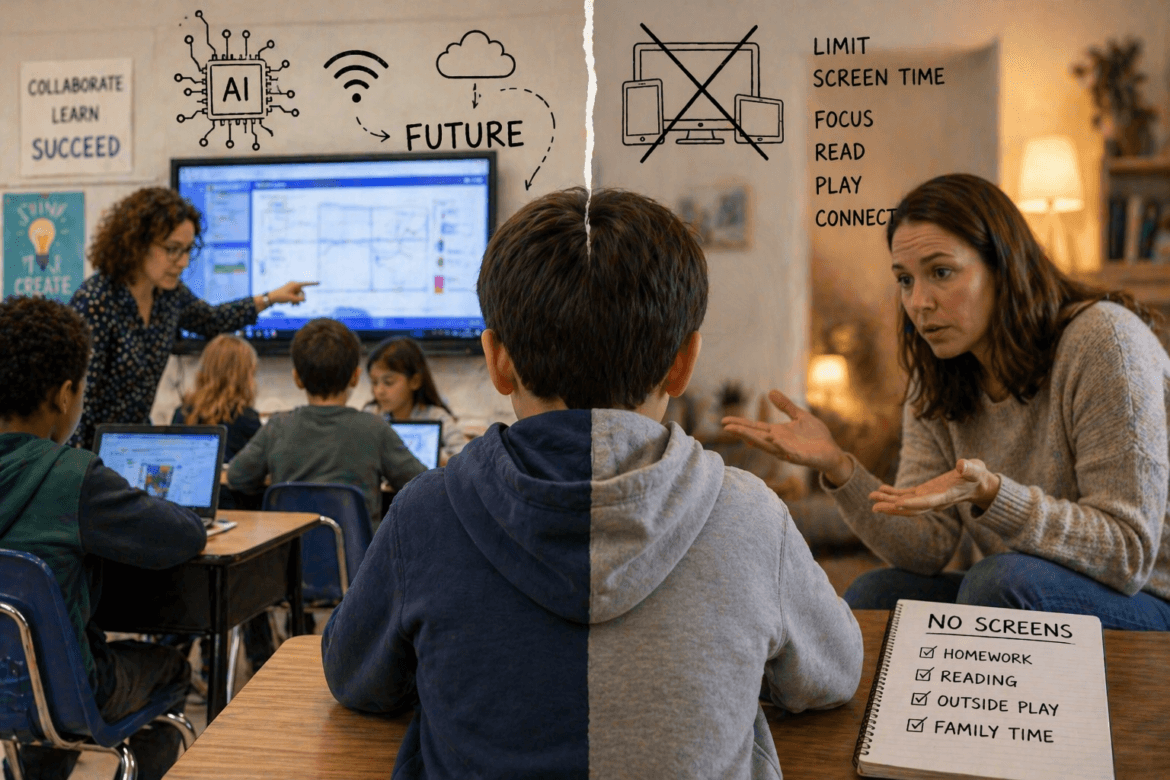
A classroom split in half shows students using laptops with a teacher on one side, and a woman discussing limited screen time with a child on the other, illustrating the Parent-School Divide in views on technology use.
Digital CitizenshipArtificial IntelligenceK-12ParentsHot Topics - controversial

The Parent-School Divide on Screen Time and AI

by EdCircuit Staff June 9, 2026
written by EdCircuit Staff 6 minutes read

The parent-school divide on screen time and AI is no longer subtle—it is growing in real time, and students are caught in the middle.

In classrooms, students are engaging with digital platforms, interactive tools, and increasingly, artificial intelligence. These technologies are being introduced to enhance learning, personalize instruction, and prepare students for a rapidly changing future.

At home, however, a different conversation is taking place.

Parents are limiting screen time. Monitoring device use. Raising concerns about attention, behavior, and development. They are asking whether children are spending too much time on devices—and not enough time thinking, interacting, and engaging in the real world.

And in the middle of these two environments is the student.

Navigating two very different expectations about how learning should happen.

Two Environments, Two Philosophies

For schools, technology represents opportunity.

It offers:

  • Access to resources
  • Personalized learning pathways
  • New ways to engage students
  • Tools to prepare learners for a digital future

Districts are making intentional decisions to integrate technology and AI into instruction—not as an add-on, but as a core component of modern learning.

For parents, technology often represents concern.

They are observing:

  • Increased device dependency
  • Shorter attention spans
  • Changes in behavior and social interaction
  • A growing reliance on screens for both learning and entertainment

These observations are not unfounded.

But they are often disconnected from how schools are framing technology use.

What schools see as innovation, families may see as overexposure.

The Mismatch Students Are Living In

The tension between school and home is not theoretical—it is lived out by students every day.

The same student being told to limit screen time at home is often required to depend on it at school.

A child may be:

  • Encouraged to use digital tools throughout the school day
  • Asked to limit or avoid those same tools at home

At school, speed and efficiency are often emphasized through technology.

At home, parents may encourage slower, more deliberate activities.

At school, AI may support writing and problem-solving.

At home, parents may want their child to develop those skills independently.

In some households, parents are asking children to complete homework without digital assistance—only to find that the assignment itself was designed to be completed on a device.

These differences are not just philosophical.

They are shaping how students understand effort, independence, and learning itself.

And when expectations are not aligned, confusion follows.

This divide is no longer theoretical—it is playing out in real districts across the country.

In the video below, parents are asking schools to limit the use of AI and classroom technology, while district leaders explain their approach—highlighting the growing gap in expectations around how students should learn.

Play video: Parents ask school district to limit AI and technology use, school responds (1 minute 51 seconds)1:51
Parents ask school district to limit AI and technology use, school responds1 min 51 sCentral Oregon Daily News on YouTube

Central Oregon Daily News – Parents ask school district to limit AI and technology use, school responds (Play video)

Why This Divide Matters More Than Ever

The parent-school divide is not just about screen time.

It is about alignment.

When families and schools are not aligned:

  • Communication begins to break down
  • Policies are questioned
  • Trust becomes harder to sustain

And in a time when schools are asking communities to support decisions around AI, device use, and digital learning strategies, that trust is essential.

This is not simply a communication issue.

It is a leadership issue.

The Silence Around Purpose

One of the most significant gaps in this conversation is not disagreement—it is clarity.

Many districts have implemented technology effectively.

Fewer have clearly communicated:

  • The purpose behind its use
  • The expected outcomes
  • The boundaries in place to protect student development

Parents are often left to interpret what they see:

  • Devices coming home
  • Increased screen time
  • New tools they may not fully understand

Without context, concern fills the gap.

Because when purpose is not clearly defined, technology can feel excessive—even when it is being used thoughtfully.

Moving From Assumption to Alignment

Closing the gap between schools and families does not require eliminating technology.

It requires alignment.

And alignment begins with transparency.

Schools must move from assuming understanding to actively building it.

This means:

  • Clearly explaining how and why technology is used
  • Defining what productive screen time looks like
  • Communicating where limits and boundaries exist
  • Involving families in the conversation—not just the outcome

Parents do not need to agree with every decision.

But they do need to understand it.

Because understanding builds trust.

Reframing the Role of Technology

Part of this alignment requires a shift in how technology is positioned.

It cannot simply be presented as necessary.

It must be presented as intentional.

Technology in elementary classrooms should be framed as:

  • A tool to support thinking—not replace it
  • A resource used at specific moments—not constantly
  • A component of learning—not the entire experience

This distinction changes the conversation.

It moves from:

  • “Why are students on screens so much?”

To:

  • “How is this supporting learning?”

And that shift matters.

The Role of AI in the Divide

AI introduces a new level of complexity.

Unlike traditional digital tools, it does more than deliver content.

It can:

  • Generate responses
  • Guide thinking
  • Complete parts of the learning process

For schools, this represents opportunity.

For parents, it often raises concern.

Questions around:

  • Academic independence
  • Skill development
  • Over-reliance on technology

Are becoming more common.

And in many cases, families are asking these questions before schools have fully answered them themselves.

This is where proactive leadership becomes critical.

Because if schools do not clearly define the role of AI, families will define it for themselves—and often with caution.

A Shared Responsibility

Neither schools nor families can solve this alone.

Students do not experience learning in isolation.

Their habits, expectations, and behaviors are shaped across environments.

Which means alignment is not optional.

It is necessary.

Schools must:

  • Lead with clarity
  • Communicate with purpose
  • Design learning with intention

Families must:

  • Engage in the conversation
  • Seek understanding
  • Partner in supporting student development

Because the goal is not full agreement.

It is a shared direction.

A Defining Moment for Trust

The parent-school divide on screen time, and AI is not just about technology.

It is about trust in how learning is being shaped.

The decisions being made today—about how students use technology, how they engage with AI, and how learning is structured—will have long-term implications.

And those decisions cannot exist in isolation.

They must be understood, supported, and aligned across the environments students move through every day.

Because when schools and families are not aligned, students don’t just experience different expectations.

They experience different definitions of what learning is supposed to be.

And in the end, the future of education will not be defined solely by what happens in classrooms.

It will be defined by whether schools and families can come together around a shared vision of how students learn—and what they truly need to succeed.

Subscribe to edCircuit to stay up to date on all of our shows, podcasts, news, and thought leadership articles.

June 9, 2026 0 comments
0 FacebookTwitterPinterestLinkedinWhatsappCopy LinkEmail
A woman sits at a desk taking notes in a notebook while watching an AI Lesson Planning educational video on her laptop; books, stationery, and a mug are also on the desk.
K-12 TeachersHot Topics - controversialArtificial IntelligenceTeaching StrategiesK-12

AI Lesson Planning: A Teacher’s Summer Guide

by EdCircuit Staff June 8, 2026
written by EdCircuit Staff 10 minutes read

AI lesson planning is quickly becoming one of the most important conversations in education as teachers, administrators, and school leaders explore how artificial intelligence can support instruction without replacing the human connection that defines great teaching.

For many educators, summer offers something the school year rarely provides: time to think. The rush of bells, grading, hallway duty, parent emails, intervention meetings, testing schedules, and daily classroom management finally slows down. That breathing room creates an opportunity for teachers to experiment, reflect, redesign lessons, and explore how AI can help them become more effective educators before students return in the fall.

But this conversation is bigger than technology.

It is about teacher workload. It is about instructional quality. It is about differentiation. It is about helping educators reclaim time while maintaining the creativity, empathy, and professional judgment that students need most.

The U.S. Department of Education has emphasized that AI should enhance teaching and learning while keeping educators at the center of instructional decision-making. UNESCO has similarly urged schools to approach AI with human-centered and ethical practices that prioritize privacy, equity, and responsible implementation. The message is becoming increasingly clear across K-12 education: AI should support teachers, not replace them.

Why Teachers Are Exploring AI Lesson Planning

Teachers are carrying enormous instructional expectations.

Today’s classrooms require differentiation, data analysis, social-emotional awareness, parent communication, technology integration, intervention planning, formative assessment, behavior management, and curriculum alignment — often simultaneously. At the same time, educators are being asked to personalize instruction for students with vastly different academic, emotional, and social needs.

Many teachers spend evenings rebuilding lessons, searching for engagement strategies, modifying assignments, creating accommodations, and preparing resources long after the school day ends.

That reality is one reason AI has captured the attention of educators.

For the first time, teachers have access to tools capable of helping them brainstorm ideas, generate instructional materials, organize content, simplify reading passages, draft assessments, and build differentiated supports in minutes rather than hours.

The key is understanding how to use those tools responsibly and intentionally.

AI should not become a shortcut that removes teacher thinking from the planning process. Instead, it should act more like an instructional assistant — helping educators move faster while still relying on professional expertise to guide the final decisions.

AI Lesson Planning Must Begin With Purpose

One of the biggest mistakes educators can make is asking AI to create an entire lesson before clarifying what students actually need.

A weak prompt sounds like this:

“Create a lesson on fractions.”

A stronger prompt sounds like this:

“I teach fourth-grade math. My students understand basic fractions but struggle comparing fractions with unlike denominators. I need a 45-minute lesson with visual modeling, guided practice, partner discussion, and an exit ticket that checks for misconceptions.”

That difference matters.

The second prompt reflects instructional thinking. The teacher has already identified:

  • the learning gap,
  • the grade level,
  • the classroom structure,
  • the time frame,
  • and the desired outcome.

AI performs best when teachers first define the instructional purpose.

This is an important guideline for educators moving into AI-supported planning: the teacher should always do the critical thinking before the technology does the generating.

A Real Classroom Example: Rebuilding a Science Unit Over Summer

Consider a middle school science teacher preparing for the upcoming school year.

Last year, her ecosystems unit struggled. Students memorized vocabulary but had difficulty explaining energy transfer and environmental balance. Classroom discussions felt flat, and many students failed to connect the concepts to the real world.

During summer break, she decides to use AI to redesign the unit.

Instead of asking AI to “create an ecosystems unit,” she approaches the process strategically.

First, she asks:

“My seventh-grade students struggled connecting food webs to real-world ecosystems. Suggest engaging phenomena-based lesson ideas connected to local environments.”

AI provides several ideas, including:

  • analyzing a pond ecosystem,
  • examining invasive species,
  • and studying how pollution impacts local waterways.

One suggestion sparks an idea. The teacher builds a lesson around an algae bloom affecting nearby lakes students recognize from their own community.

Next, she asks AI to:

  • generate vocabulary supports,
  • create differentiated reading passages,
  • develop discussion questions,
  • suggest misconceptions students may have,
  • and draft an exit ticket.

The teacher does not simply copy and paste the results.

She reviews everything carefully. She rewrites sections in her own voice. She removes examples that do not fit her students. She adjusts the reading level. She adds hands-on activities and classroom discussion strategies based on her own experience.

By August, she has not replaced her planning process with AI.

She has strengthened it.

This is what responsible AI lesson planning looks like.

Using AI to Differentiate Instruction

Differentiation remains one of the most time-consuming parts of lesson planning.

Teachers are expected to support students reading below grade level, English learners, advanced learners, students with IEPs, and students who simply learn differently — often within the same classroom period.

AI can help educators create multiple entry points into learning.

For example, a teacher might ask:

“Rewrite this reading passage at three different reading levels while preserving the same core concepts.”

Or:

“Create scaffolded discussion questions for students who struggle participating in class conversations.”

Or:

“Generate extension activities for advanced learners who finish early.”

This allows teachers to spend less time formatting and more time focusing on instructional delivery and student relationships.

However, educators must remain thoughtful when using AI-generated differentiation.

Supports should never feel watered down or isolating. Students should still feel connected to the same essential learning goals as their peers. AI can help widen access to learning, but teachers must ensure that rigor, dignity, and inclusivity remain intact.

AI Can Help Teachers Anticipate Student Misconceptions

Experienced teachers often predict where students will struggle before instruction even begins.

AI can strengthen that process.

A teacher preparing a lesson on the water cycle might ask:

“What misconceptions do fifth-grade students commonly have about evaporation and condensation?”

AI may identify misunderstandings such as:

  • students believing evaporated water disappears completely,
  • or assuming clouds are made from smoke rather than water droplets.

This allows teachers to proactively address confusion during instruction instead of waiting until after an assessment reveals learning gaps.

In this way, AI becomes less about replacing teacher expertise and more about enhancing reflective instructional planning.

AI and Teacher Burnout

One of the most important aspects of this conversation is teacher burnout.

Across the country, educators are navigating growing responsibilities while trying to maintain meaningful learning experiences for students. Many teachers arrive early, stay late, and continue planning from home well into the evening.

AI will not solve every challenge facing education.

But it may help teachers reclaim valuable time.

Instead of spending two hours creating leveled reading supports, a teacher may spend twenty minutes refining AI-generated drafts.

Instead of building every review question from scratch, a teacher can focus energy on improving discussion quality, feedback, and student interaction.

That time matters.

The goal should not be efficiency for efficiency’s sake. The goal should be creating more space for the parts of teaching that matter most:

  • relationships,
  • feedback,
  • creativity,
  • mentoring,
  • encouragement,
  • and instructional responsiveness.

Students rarely remember perfectly formatted worksheets.

They remember the teacher who helped them believe they could succeed.

AI Can Strengthen Assessment Design

Assessment is another area where AI can support teachers effectively.

Educators can ask AI to:

  • generate exit tickets,
  • create practice questions,
  • draft rubric language,
  • build discussion prompts,
  • or suggest project-based learning ideas.

For example:

“Create three exit ticket questions for a high school history lesson on the Industrial Revolution. One question should assess factual understanding, one should identify misconceptions, and one should require critical thinking.”

This kind of prompt helps teachers move beyond recall-based assessment and encourages deeper learning.

Teachers can also use AI to improve feedback systems by generating:

  • self-reflection prompts,
  • peer review sentence starters,
  • or student conferencing questions.

Still, assessment design should always remain grounded in teacher judgment. AI-generated questions may sometimes lack nuance, alignment, or age appropriateness. Teachers must review all materials carefully before classroom use.

Responsible AI Use Means Protecting Student Privacy

One of the most important responsibilities schools face is protecting student data.

Teachers should never input confidential student information into AI platforms unless the district has specifically approved the tool and verified its privacy protections.

That includes:

  • student names,
  • grades,
  • disability information,
  • discipline records,
  • family situations,
  • health information,
  • or personally identifiable data.

Instead of writing:

“Create accommodations for John Smith who has ADHD and struggles emotionally.”

A safer approach would be:

“Suggest strategies for supporting a middle school student who struggles maintaining attention during independent work.”

Districts must provide clear guidance regarding approved platforms, acceptable use, and student privacy expectations. Organizations like TeachAI continue to emphasize the importance of transparent policies and ethical implementation as schools adopt AI technologies. (teachai.org)

District Leaders Must Prepare Teachers for AI

This conversation cannot fall entirely on classroom teachers.

Principals, curriculum directors, technology leaders, and superintendents must help establish clear expectations for AI implementation.

That means districts should provide:

  • approved AI platforms,
  • professional development,
  • privacy guidance,
  • prompt-writing training,
  • instructional examples,
  • and ethical use policies.

Without support, schools risk creating inconsistent AI practices from classroom to classroom.

Some districts are already creating summer AI cohorts where teachers collaborate, test tools, share successful prompts, and redesign lessons together. This approach positions AI as a professional learning opportunity rather than simply another technology initiative.

Parents also need to be included in the conversation.

Families deserve transparency regarding:

  • how AI is being used,
  • how student data is protected,
  • and how schools are teaching ethical AI use.

The future of AI literacy will require partnership between schools and families.

AI Should Never Flatten Teacher Creativity

One concern many educators share is that AI-generated lessons can sometimes feel generic.

A polished lesson is not always a meaningful lesson.

AI may create a technically organized sequence:

  • objective,
  • warm-up,
  • guided practice,
  • independent work,
  • closure.

But great teaching involves more than structure.

Students respond to passion, storytelling, humor, local examples, relationships, and authenticity. A classroom lesson becomes memorable because of the teacher delivering it.

That is why educators should use AI to expand creativity rather than replace it.

Teachers can ask AI to:

  • generate role-play ideas,
  • create simulations,
  • suggest debate formats,
  • develop inquiry questions,
  • or connect lessons to current events and student interests.

The teacher then shapes those ideas into something personal and meaningful for their own classroom culture.

The Best AI Lesson Planning Still Feels Human

The future of AI in education will not be determined by how quickly schools adopt technology.

It will be determined by whether educators use these tools to strengthen learning while preserving the human relationships at the center of teaching.

A great lesson still depends on a teacher who knows:

  • when students need encouragement,
  • when confusion is building,
  • when to slow down,
  • when to challenge deeper thinking,
  • and when a conversation matters more than the lesson plan itself.

AI cannot replace empathy.

It cannot replace classroom presence.

It cannot replace trust.

What it can do is help teachers prepare more efficiently, differentiate more effectively, communicate more clearly, and spend more energy on students instead of repetitive planning tasks.

That is why summer may be the ideal time for educators to explore AI lesson planning.

Not because schools should rush toward replacing traditional teaching methods, but because thoughtful experimentation now may help teachers enter the next school year more prepared, more supported, and more empowered to focus on what matters most: helping students learn, grow, and succeed.

Subscribe to edCircuit to stay up to date on all of our shows, podcasts, news, and thought leadership articles.

June 8, 2026 0 comments
0 FacebookTwitterPinterestLinkedinWhatsappCopy LinkEmail
A person wearing headphones uses a computer with cybersecurity careers graphics on the screen, surrounded by gaming equipment and digital security icons in a dark, illuminated room.
K-12Hot Topics - controversialCybersecurity

Cybersecurity Careers Started With Video Games

by EdCircuit Staff June 5, 2026
written by EdCircuit Staff 9 minutes read

Cybersecurity careers are beginning in places many adults never expected — inside gaming headsets, online multiplayer lobbies, Discord servers, esports arenas, and bedrooms lit by glowing monitors long after midnight.

For one student, it started with frustration.

At 14 years old, he logged into his favorite online game only to discover his account had been stolen. Years of saved progress, unlocked content, online friendships, and competitive rankings were suddenly gone. Panic quickly turned into anger. Then curiosity.

How did someone gain access to the account?

Why was the password compromised?

What was phishing?

How were hackers targeting gamers?

That moment changed everything.

Instead of walking away from technology, the student became obsessed with understanding how digital systems worked and how they could be protected. What started as hours spent gaming transformed into late nights researching password security, malware, online scams, two-factor authentication, and ethical hacking.

His parents initially believed gaming was becoming a distraction. Teachers worried he was spending too much time behind a screen. But over time, something unexpected happened: the same student who once rushed home to play online games began talking about cybersecurity certifications, network defense, and future careers in digital security.

Today, stories like this are becoming increasingly common.

Across K-12 education, educators and cybersecurity professionals are beginning to recognize that video games are doing far more than entertaining students. Gaming environments are quietly developing technical curiosity, resilience, collaboration, strategic thinking, and digital awareness — all skills deeply connected to cybersecurity careers.

In many ways, the next generation of cybersecurity professionals may already be training for the future without even realizing it.

Cybersecurity Careers Often Start With Digital Curiosity

The journey into cybersecurity rarely follows a straight line.

Some professionals enter through military experience. Others discover cybersecurity in college computer science programs or IT departments. Increasingly, however, students are discovering cybersecurity organically through gaming culture and online digital communities.

Modern video games are incredibly complex digital ecosystems.

Students interact daily with:

  • Online servers
  • Voice communication platforms
  • Account authentication systems
  • Digital marketplaces
  • Anti-cheat software
  • Cloud storage
  • Moderation systems
  • Network connections
  • Live updates and patches

Whether they realize it or not, gamers are constantly interacting with cybersecurity concepts.

Students begin asking questions naturally:

  • Why did my account get hacked?
  • How does two-factor authentication work?
  • Why do phishing scams target gamers?
  • How do anti-cheat systems detect cheaters?
  • What causes lag or packet loss?
  • How do VPNs protect connections?
  • How are online transactions secured?

Those questions become gateways into deeper technical exploration.

For the student in this story, gaming slowly evolved from competition into fascination with technology itself. After helping friends recover compromised accounts and warning classmates about suspicious Discord links, he began exploring cybersecurity content online.

At first, it was simple YouTube tutorials.

Then it became:

  • Learning basic coding
  • Watching ethical hacking demonstrations
  • Building a gaming PC
  • Experimenting with networking concepts
  • Researching malware protection
  • Exploring cybersecurity competitions

Without realizing it, gaming had already become a launchpad for a career pathway.

Video Games Build Skills Cybersecurity Professionals Need

For years, gaming conversations in education often focused on screen time and distraction. While balance remains important, that conversation is beginning to evolve.

Cybersecurity professionals increasingly recognize that gaming develops many of the same cognitive and interpersonal skills required in cybersecurity environments.

Gaming teaches students how to:

  • Solve problems under pressure
  • Analyze patterns quickly
  • Adapt to changing situations
  • Communicate in teams
  • Learn through failure
  • Manage limited resources
  • Think strategically
  • Respond rapidly to threats

Those skills directly mirror real cybersecurity work.

Security analysts must identify vulnerabilities quickly. Incident response teams must communicate effectively during crises. Ethical hackers must think creatively and adapt constantly.

Competitive gaming environments reinforce many of those same mental habits.

The student who once spent hours coordinating multiplayer strategies in games like Call of Duty, managing Discord communities, and troubleshooting connection problems eventually discovered he enjoyed solving technical challenges more than simply winning matches.

That realization mattered.

Instead of viewing technology only as entertainment, he began seeing it as a system to understand, improve, and protect.

Gaming Communities Introduce Students To Online Risk

Gaming communities also expose students to cybersecurity risks earlier than many adults realize.

Young gamers regularly encounter:

  • Phishing scams
  • Fake giveaways
  • Malware downloads
  • Account theft attempts
  • Social engineering tactics
  • Identity impersonation
  • Suspicious links
  • Credential theft

In many cases, students experience cybersecurity threats firsthand before schools formally teach cybersecurity concepts.

For this student, one phishing scam became a turning point.

A fake login page promising free in-game rewards nearly compromised multiple accounts. After researching how phishing worked, he became fascinated by how attackers manipulate trust and exploit human behavior online.

That experience sparked something deeper than fear — it sparked purpose.

He started helping friends secure their accounts. He encouraged classmates to stop reusing passwords. He taught younger gamers how to identify suspicious messages.

The student who once simply consumed technology was now helping others navigate digital safety responsibly.

That transformation reflects a larger shift happening among today’s students.

Many young people are developing cybersecurity awareness not through textbooks alone, but through lived digital experiences.

Esports And Cybersecurity Are Becoming Connected

Schools across the country are beginning to recognize the overlap between esports and cybersecurity education.

Esports programs are no longer viewed solely as extracurricular gaming clubs. Many districts now see them as opportunities to teach:

  • Collaboration
  • Leadership
  • Communication
  • Technology operations
  • Digital citizenship
  • Broadcasting
  • Hardware management
  • Network awareness
  • Cybersecurity fundamentals

Students participating in esports often become highly comfortable with digital systems and troubleshooting environments.

Some districts are now intentionally pairing esports initiatives with cybersecurity programs because the student interest naturally overlaps.

That connection makes sense.

Students managing private game servers, moderating Discord channels, streaming gameplay, configuring PCs, or maintaining tournament systems are already developing valuable technical experience.

For the student in this story, joining an esports team exposed him to even more technical learning opportunities. He began helping manage equipment, optimize network performance, and troubleshoot hardware issues before competitions.

Those experiences built confidence.

Teachers who once struggled to engage him in traditional classroom discussions suddenly saw him become a leader when technology problems needed solving.

That is one of the most important lessons schools are beginning to learn: students often reveal their strengths when learning feels connected to authentic interests.

Cybersecurity Requires Hands-On Learning

One reason gaming aligns so naturally with cybersecurity is because both environments reward hands-on experimentation.

Cybersecurity cannot be learned entirely through memorization.

Students learn best when they:

  • Explore systems
  • Test solutions
  • Troubleshoot problems
  • Simulate attacks
  • Analyze failures
  • Experiment safely
  • Think critically

Gaming naturally encourages this mindset.

Gamers constantly tweak settings, optimize performance, research solutions, and adapt strategies. They are comfortable learning through trial and error.

That willingness to experiment is essential in cybersecurity.

The student eventually moved beyond gaming into cybersecurity labs, online simulations, and beginner capture-the-flag competitions. What excited him most was not simply “hacking,” but understanding systems deeply enough to defend them.

That distinction matters.

Strong cybersecurity education emphasizes ethics, responsibility, and protection — not exploitation.

Gaming culture helped him develop persistence, but mentorship and education helped shape that curiosity into responsible cybersecurity learning.

Parents Often Misunderstand The Opportunity

One of the emotional realities surrounding gaming is that many families initially struggle to see its long-term value.

This student’s parents worried constantly about screen time.

Like many families, they questioned:

  • Was gaming hurting academics?
  • Was too much time being spent online?
  • Would gaming become a distraction from future goals?

Those concerns were understandable.

But over time, they noticed something changing.

Their son was no longer only playing games. He was:

  • Researching cybersecurity careers
  • Building technical skills
  • Watching educational cybersecurity videos
  • Exploring certifications
  • Talking about digital safety
  • Helping others solve technology issues

Gaming had become a doorway into meaningful learning.

That realization changed family conversations entirely.

Instead of only limiting technology use, they began guiding it toward productive opportunities.

That shift is important for educators and parents alike.

Students are more likely to thrive when adults help channel their passions into career exploration rather than dismissing those interests outright.

Cybersecurity Needs Students Like This

The cybersecurity workforce shortage continues to grow nationally and globally.

Organizations desperately need skilled professionals capable of defending schools, hospitals, businesses, and critical infrastructure from increasingly sophisticated cyber threats.

At the same time, schools are searching for ways to engage students in future-ready careers.

Gaming may be one of the most overlooked pathways available.

Students who thrive in gaming environments often demonstrate:

  • Technical curiosity
  • Persistence
  • Adaptability
  • Rapid problem-solving
  • Digital literacy
  • Communication skills
  • Leadership potential

Those are valuable workforce traits.

Cybersecurity careers also provide opportunities across many different interests, including:

  • Threat intelligence
  • Ethical hacking
  • Cloud security
  • AI security
  • Digital forensics
  • Cyber law
  • Security operations
  • Risk management
  • Cyber education and training

For students who may not connect with traditional academic pathways immediately, cybersecurity offers hands-on, purpose-driven opportunities that feel relevant and engaging.

Artificial Intelligence Is Expanding The Need For Cybersecurity

As artificial intelligence rapidly transforms digital systems, cybersecurity careers are becoming even more critical.

AI is helping organizations detect threats faster, automate security monitoring, and analyze massive amounts of data. At the same time, cybercriminals are using AI to create more advanced phishing attacks, scams, and misinformation campaigns.

Today’s students are growing up in highly digital environments shaped by:

  • AI-powered systems
  • Cloud platforms
  • Online gaming ecosystems
  • Smart devices
  • Social media
  • Streaming platforms

Gamers are often highly comfortable navigating these environments already.

That digital fluency gives many students a natural foundation for future cybersecurity and AI-related careers.

The combination of cybersecurity knowledge and AI literacy may become one of the most important workforce skillsets of the next decade.

Schools Must Recognize Passion-Driven Learning

One of the biggest takeaways from stories like this is that learning does not always begin inside traditional academic structures.

Sometimes it begins with curiosity.

Sometimes it begins with frustration.

And sometimes, it begins with a video game.

For this student, gaming was never simply entertainment. It became a bridge into technology, digital responsibility, cybersecurity awareness, and eventually a career goal filled with purpose.

The teenager who once stayed up late competing in online matches may someday help protect hospitals from ransomware attacks, secure school networks, defend financial systems, or prevent large-scale cyber incidents.

That possibility matters.

As schools continue preparing students for future careers, educators and families may need to rethink how they view gaming entirely.

Because behind many gaming screens today may be future cybersecurity analysts, ethical hackers, network defenders, digital investigators, and technology leaders already learning how to think critically in the digital world.

And for some students, the journey toward protecting the future may begin with simply pressing “Start Game.”

Subscribe to edCircuit to stay up to date on all of our shows, podcasts, news, and thought leadership articles.

June 5, 2026 0 comments
0 FacebookTwitterPinterestLinkedinWhatsappCopy LinkEmail
Stunning aerial night view of an illuminated university tower in Wichi
Hot Topics - controversialHigher Education

Tech Sprawl Is Higher Ed’s Real Security Story, Not the Breach Making Headlines

by Dr. Jason Nairn June 4, 2026
written by Dr. Jason Nairn 5 minutes read

Every few months, a cyberattack in higher education generates a news cycle. The recent disruption to Canvas during finals week is the latest example. These incidents are wake-up calls. They make abstract risk concrete, accelerate budget conversations, and give CIOs leverage to move stalled security investments forward. They are not, on their own, the most important signal.

The more important signals are in the data. A recent LayerX Security report found that nearly half of enterprise employees are using generative AI tools at work, with 22% pasting personally identifiable information into them. A January 2026 study from Educause, conducted in partnership with AIR, NACUBO, and CUPA-HR, found that 94% of higher education professionals have used AI tools for work in the past six months — but only 54% are aware of their institution’s AI policies. More than 70% are using AI tools daily or weekly.

Those numbers describe shadow AI. The pattern is broader. The number of platforms, tools, vendors, and integrations a typical college or university depends on to operate has grown faster than the governance, security, and continuity infrastructure designed to oversee them. Shadow AI is a prime example. It is not the only one.

What tech sprawl actually looks like inside an institution

Higher education environments are structurally exposed to sprawl in ways most other sectors are not. Institutions operate fragmented IT environments with inconsistent security controls across colleges, departments, and research operations, layered atop legacy infrastructure that resists patching and modernization. Attack surfaces have expanded with remote and hybrid work, as well as AI. Internal cybersecurity staffing remains thin relative to the risk surface. And the data institutions hold — subject to FERPA, HIPAA, GLBA, PCI, and an expanding patchwork of state privacy laws — is exactly the data attackers want.

Add a campus culture that has historically prized openness and academic autonomy, and new tools, platforms, and integrations spread laterally across departments faster than any governance function can keep up with. A single academic unit can stand up a research data pipeline, a faculty productivity tool, and an AI-assisted grading workflow in a semester. Multiply that across colleges, schools, and administrative units, and most CIOs and CISOs cannot fully describe where their institutional data is flowing, through whom, or under what contractual terms.

Why “we have a policy” is no longer an answer

The institutional response to the expanding threat surface has often been a policy memo. When nearly all higher ed professionals use AI tools at work but only half know the rules, the policy is not the problem to solve. It’s evidence that the underlying governance work has not been established.

The Canvas incident illustrates why continuity planning specifically matters. When a core platform goes offline — for any reason, through any vector — the institution’s ability to continue operating is set in advance, not in the moment. Most colleges and universities have continuity plans for their own infrastructure. Far fewer have continuity plans for the SaaS platforms that now run admissions, financial aid, learning management, research data, and student services. That gap is what makes visible incidents so disruptive. The disruption is not the attack. It is the absence of a credible alternative.

What modernization actually requires

A modern security and governance posture has to assume that sprawl is the baseline, not the exception. The work spans visibility, third-party risk, governance, and continuity simultaneously — and the institutions ahead of the curve are treating these as connected disciplines rather than separate projects.

First, nothing can be governed that cannot be seen. That means network-level monitoring tuned to detect SaaS and generative AI traffic, endpoint visibility into browser-based tools, and a current inventory of which platforms hold which categories of institutional data. Most institutions have inventories that describe what they procured. Far fewer have inventories that describe what their people are actually using.

Third-party risk management has to become a discipline, not a procurement checkbox. Every core vendor relationship needs documented answers to five questions: what data the vendor holds and under what classification, what breach-notification timeline applies, what evidence-of-deletion standards apply, and what continuity looks like if the vendor is offline for a week.

Detection has to operate continuously, with managed detection and response paired with 24/7 monitoring as the floor, not the ceiling. Incident response playbooks built before 2024 need a refresh — most do not account for AI-mediated exfiltration, deepfake-driven social engineering, or third-party platform compromise. And governance has to be cross-functional: sprawl worsens when each function decides in isolation, and improves when decisions are made together and revisited as tooling changes.

For institutions without the internal capacity to stand up this kind of program, the gap is increasingly being closed through specialized IT partners that can layer third-party risk management, monitoring, and incident response onto existing campus infrastructure. The model matters less than the outcome.

The institutional case for moving now

Cybersecurity has historically been framed as a cost center. When the institutional inventory of platforms and tools is genuinely difficult to describe, that framing undermines resilience. A cyber incident does not stay in IT — it stalls admissions cycles, slows financial aid processing, locks faculty out of course materials, and erodes the trust prospective students and families place in the institution.

Higher education has spent the last decade hardening its perimeters, only for modern attackers, AI tools, and third-party integrations to walk around them. The discipline of preventing remote control is now the discipline of governing it — authorizing vetted agents, for specific tasks, under documented terms.

Modernizing the institutional foundation means accepting that the perimeter is no longer the right unit of analysis. The data flow is. The vendor relationship is. The platform inventory is. The question facing higher ed IT leaders now is not whether to respond to the next headline, but whether the institution is structurally ready for the much larger, less visible exposure that occurs between headlines.

Subscribe to edCircuit to stay up to date on all of our shows, podcasts, news, and thought leadership articles.

June 4, 2026 0 comments
0 FacebookTwitterPinterestLinkedinWhatsappCopy LinkEmail
Newer Posts
Older Posts

Participate

  • Contribute
  • Sponsor
  • Submit Release
  • Subscribe
  • Get Interviewed

We value your privacy

We use cookies to enhance your browsing experience, serve personalized ads or content, and analyze our traffic. By clicking "Accept All", you consent to our use of cookies.

Customize
  • Needed for the site to work: signing in, the cart, your consent choice. Always on.

    8 cookies
    • ss_consent 1 yearYour cookie choice on this site, so you are not asked again.
    • wordpress_logged_in_* 2 days, or 14 days with "remember me"Keeps you signed in as you move between pages.
    • wordpress_sec_* 2 days, or 14 days with "remember me"The secure half of your sign-in.
    • wordpress_test_cookie SessionChecks that your browser accepts cookies when you sign in.
    • wp-settings-* 1 yearYour display settings when signed in.
    • wp_woocommerce_session_* 2 daysYour shopping session: the cart and the checkout.
    • woocommerce_cart_hash SessionTells the site whether your cart has changed.
    • woocommerce_items_in_cart SessionWhether your cart holds anything.
  • Remembers choices you make, such as a language or a region, and supports features like live chat.

    1 cookie
    • woocommerce_recently_viewed SessionThe products you looked at, so the site can show them again.
  • Helps us understand how visitors use the site: which pages are read, and for how long.

    2 cookies
    • _ga 2 yearsGoogle Analytics: tells one visitor from another. Set only after you allow analytics.
    • _ga_* 2 yearsGoogle Analytics: keeps your session state. Set only after you allow analytics.
  • Measures how fast pages load so we can make them faster.

  • Used to show you content and offers that match your interests, on this site and elsewhere.

    1 cookie
    • sbjs_* SessionWooCommerce order attribution: where you came from, so a purchase can be credited to the campaign or site that sent you.

Your browser asks us not to sell or share your information (Global Privacy Control), so advertising cookies stay off.

Do not sell or share my personal information

Some cookies from other companies help show you offers on other sites. Tick the box and save your preference to opt out of that sharing; untick it to opt back in at any time.

Your browser sends Global Privacy Control, so this preference is set for you and cannot be changed here.

Sign In

Keep me signed in until I sign out

Forgot your password?

Password Recovery

A new password will be emailed to you.

Have received a new password? Login here

Shopping Cart

Close

No products in the cart.

Close
-
00:00
00:00

Queue

Update Required Flash plugin
-
00:00
00:00

Your cart (items: 0)

Products in cart

Product Details Total
Subtotal $0.00
Shipping and discounts calculated at checkout.
View cart
Go to checkout

Your shopping cart is empty

Return to shop

Notifications