


edCircuit
  • Start Here
    • Login
    • Register
    • Subscribe
    • Submit a Press release
    • Advertise or Sponsor
    • Contribute
    • Get Interviewed
  • On The Wire
  • EdTech
    • All EdTech
    • Online Learning
    • Hybrid and Remote Learning
    • Augmented and Virtual Reality
    • ESports
    • Gamification and Game-Based Learning
    • Digital Citizenship
    • EdTech Entrepreneurs
    • Market Trends
    • Future of Education
  • K-12 Education
    • All K-12
    • K-12 Teachers
    • Teaching Strategies
    • Special Education and IEPs
    • Dyslexia
    • Gifted and Advanced Learning
    • Early Childhood, Pre-K and Kindergarten
    • School Calendar
    • Tutoring and Homework Help
    • Attendance and Absenteeism
    • After-School Programs
    • School Counselors
    • Homeschooling
    • School Models
    • Teacher Retention
    • Parents
    • Students
    • STEM and STEAM Education
  • Teaching and Learning
    • Literacy and Reading
    • Math Education
    • Civics and History Education
    • Financial Literacy
    • Assessment and Testing
    • Curriculum and Instruction
    • Personalized Learning
    • Project-Based Learning
    • Social-Emotional Learning
    • Executive Function
    • Creativity
    • Diversity, Equity, Inclusion
  • Professional Development
    • All Professional Development
    • Educators
    • Administrators
    • edLeaders
  • Higher Education
    • All Higher Education
    • College Admissions
    • Career and Technical Education (CTE)
    • Graduation
    • FAFSA and Financial Aid
    • Student Loans
  • Artificial Intelligence
  • Cybersecurity
  • School Safety
    • All School Safety
    • Science and Lab Safety
    • School Design and Facilities
    • Bullying
    • Duty of Care and School Liability
  • Continuing Education
    • All Continuing Education
    • Online Certificate Programs
    • Teaching Jobs and Careers
    • Teacher Appreciation
  • Education Policy and Government
    • All Education Policy
    • Department of Education
    • School Choice
    • Global
    • Advocates
  • EDU Shows
    • All EDU Shows
    • Safer Ed
    • Mind the Gap
    • EdTech Questions
    • CoffeEd
    • InFocus
    • InformED Report
  • EDU Podcasts
    • All EDU Podcasts
    • Author Chats
    • CoSN The Podcast
    • Education Today
    • Building the Bridge
    • Students Speak
  • Education Industry Guides and Reports
  • Archived Media
    • Future of School: The Podcast
    • Equity Everywhere
  • About edCircuit
  • Subscribe
edCircuit
  • LOGIN
Home Tags Posts tagged with "Headline"
Tag:

Headline

This if for posts to be in the featured/top section of site
A group of students and two teachers look at tablets around a table, with a digital brain hologram and technology icons projected above them, highlighting the impact of AI in education.
Artificial IntelligenceHot Topics - controversialK-12

AI in Education: When to Introduce It

by EdCircuit Staff May 27, 2026
written by EdCircuit Staff 6 minutes read

AI in education is no longer a future conversation, it is a present reality, and the question is no longer if students should learn it, but when and how we introduce it responsibly.

Across classrooms, homes, and devices, students are already interacting with artificial intelligence—often without even realizing it. From recommendation engines to adaptive learning platforms, AI is embedded in their daily experiences. The reality is simple: students are already engaging with AI. Education systems are now tasked with ensuring that engagement is meaningful, appropriate, and grounded in understanding.

Moving Beyond the “Right Grade” Debate

The search for a single “right grade level” to introduce AI is understandable—but ultimately misguided. Education leaders and researchers are increasingly aligned around a more nuanced perspective: AI should be introduced through a developmental progression, not a fixed entry point.

Young learners are capable of understanding foundational ideas long before they are ready to use advanced tools. In early elementary classrooms, students can begin to explore concepts like patterns, sorting, and decision-making—core ideas that underpin how AI systems function. At this stage, the goal is not technical skill, but cognitive awareness.

As students grow, so too should the complexity of their understanding. Upper elementary learners can begin questioning how AI arrives at decisions and where those systems may fall short. By middle school, students are ready to grapple with responsibility, academic integrity, and the implications of using AI to complete tasks. High school students, in turn, should be positioned not just as users, but as critical thinkers and creators—capable of applying AI in meaningful, real-world contexts.

This progression reflects a simple truth: the introduction of AI is not a moment—it is a continuum.

The Case for Early, Intentional Exposure

Introducing AI at a young age is not about accelerating technology use—it is about shaping how students think.

When done correctly, early exposure builds a foundation for critical thinking, digital literacy, and ethical awareness. Students begin to understand that technology is not neutral, that outputs are shaped by inputs, and that human decision-making remains central to how tools are used. These are not advanced concepts—they are essential ones.

However, early exposure without guidance introduces risk. Without clear expectations, students may begin to rely on AI as a shortcut rather than a support. The difference between assistance and replacement can quickly blur, particularly when students are not explicitly taught how to engage with these tools responsibly.

That is why intentionality matters. AI should not simply be present in the classroom—it should be framed, discussed, and continuously examined.

Why This Must Be a Team Approach

One of the most overlooked realities in this conversation is that AI in education does not stop at the classroom door. Students move fluidly between school and home, often using the same tools in both spaces. When expectations are inconsistent, confusion follows.

A successful approach to AI integration requires alignment between educators, families, and district leadership. Schools must clearly communicate how AI is being used, why it is being introduced, and what responsible use looks like across grade levels. This includes developing transparent policies that guide both instruction and student behavior, while also establishing a shared language around ethics that parents can reinforce at home.

For families, the conversation is equally important. Parents are navigating many of the same uncertainties as educators, often without the same level of access to information or guidance. When schools proactively engage families—through communication, resources, and ongoing dialogue—they create a unified approach that supports students more effectively.

Within classrooms, educators play a critical role in modeling appropriate use. This means designing learning experiences that prioritize thinking over output, asking students to explain their reasoning, and using AI as a tool for exploration rather than completion. When students see AI used thoughtfully, they are more likely to mirror that behavior.

Alignment is not optional—it is foundational. Without it, even the best-designed initiatives will struggle to gain traction.

Ethics Must Lead, Not Follow

If AI is introduced without a strong ethical framework, the consequences will surface quickly—and often quietly.

Students must be guided to understand how AI systems can reflect bias, how data shapes outcomes, and why human oversight is essential. They need to recognize the difference between using AI to support learning and using it to bypass the learning process entirely. They must also develop an awareness of data privacy and the long-term implications of their digital choices.

These are not abstract ideas reserved for older students. Even at the upper elementary level, students can begin to explore how AI decisions are made and why those decisions are not always fair or accurate. These early conversations lay the groundwork for more sophisticated thinking in later years.

Ethics cannot be treated as an add-on or a final step. It must be embedded into every stage of AI education, shaping not only what students do, but how they think about what they do.

The Right Time Is Now—With the Right Approach

So, when is the right time to introduce AI in the classroom?

The answer is not a grade level—it is a mindset.

The right time is when schools are prepared to introduce AI with intention, when educators are supported with clear guidance, and when families are included as partners in the process. It is when instruction is developmentally appropriate, expectations are clearly defined, and ethics are placed at the center of the conversation.

Schools that approach AI in this way are not simply reacting to change—they are shaping it.

As districts across the country wrestle with these decisions, real-world examples are beginning to emerge. In the video below, one school system explores a critical question: Are students falling behind without AI—and what does responsible integration actually look like?

Play video: AI in the Classroom: Are Kids Falling Behind Without It? (2 minutes 54 seconds)2:54
AI in the Classroom: Are Kids Falling Behind Without It?2 min 54 sWKMG News 6 ClickOrlando on YouTube

WKMG News 6 ClickOrlando – AI in the Classroom: Are Kids Falling Behind Without It? (Play video)

A Defining Leadership Moment

AI in education represents more than a shift in tools; it represents a shift in how students learn, think, and engage with the world. The decisions made today—by educators, administrators, and policymakers—will influence how an entire generation understands technology.

Handled with purpose, AI can become a powerful force for creativity, innovation, and deeper learning. It can challenge students to think critically, solve complex problems, and engage with content in new ways.

Handled without intention, it risks becoming something far less impactful—a shortcut that replaces thinking rather than enhancing it.

This is a leadership moment for education. Not because of the technology itself, but because of what it demands from us: clarity, alignment, and a commitment to doing what is right for students.

The question is no longer whether AI belongs in the classroom.

The question is whether we are ready to lead the introduction in the way our students deserve.

Subscribe to edCircuit to stay up to date on all of our shows, podcasts, news, and thought leadership articles.


May 27, 2026 0 comments
0 FacebookTwitterPinterestLinkedinWhatsappCopy LinkEmail
A group of 25 adults, both men and women, posing and smiling for a photo indoors at a conference or professional event.
Hot Topics - controversialCOSNK-12edLeaders

CoSN 2026: Building Cultures of Belonging

by EdCircuit Staff May 26, 2026
written by EdCircuit Staff 5 minutes read

At the 2026 CoSN Conference, the sixth annual “Network Meetup” brought together district leaders to tackle one of the most pressing mandates in modern education: moving beyond simple inclusion to foster a genuine culture of belonging.

While inclusion often refers to being “invited to the room,” belonging is the feeling of being valued, heard, and essential to the fabric of the community.

As technology continues to reshape the educational landscape, leaders at the meetup focused on three critical pillars: students, staff, and the broader community. The goal was clear: clarify what belonging looks like, surface effective strategies, and develop actionable steps for inclusive leadership.

1. Students: From Compliance to Connection

The conversation regarding students centered on the idea that accessibility is the baseline, but connection is the goal. A recurring theme was the distinction between “providing access” and “ensuring belonging.”

The Power of Inclusive Tech

For students with disabilities, technology is often their primary bridge to learning. However, Christine Fox from CAST noted that adaptive technology can unintentionally “other” a student if not implemented seamlessly. With federal Title II ADA requirements approaching in April 26, 2028 (per a recent deadline extension from the Justice Department),  leaders emphasized that EdTech departments must work hand-in-hand with Special Education departments. The goal is a universal design approach where tools are available to everyone, reducing the stigma of “special” equipment.

Elevating Student Voice

Belonging is intrinsically linked to representation. Leaders discussed:

  • Curriculum Representation: Building a curriculum that reflects all ethnic groups and identities so students see themselves in their daily work.
  • Active Participation: Moving students from passive learners to active contributors by including them on school boards and committees.
  • Holistic Recognition: Shifting the spotlight to include student achievements beyond just sports, celebrating arts, community service, and niche interests (like the student-led “Lemon/Lime Club”).

Small Gestures, Large Impact

Practices like greeting students at the door and ensuring teachers use correct name pronunciations were highlighted as foundational. These actions signal to a student that they are seen as an individual from the moment they enter the building.

2. Staff: Building Resilience and “The Why”

A culture of belonging for staff is the engine that drives student success. If educators and tech teams do not feel they belong, they cannot effectively model that environment for their students.

Visibility and Shared Purpose

For technical staff who often work behind the scenes, belonging comes from understanding the “why.” Some districts have implemented community bus tours and school visits for tech teams, allowing them to see their impact in the classroom firsthand. This bridges the gap between hardware and heart.

Collaborative Decision-Making

Belonging is fostered when staff are included in the trajectory of the district.

  • Pilot Groups: Moving away from top-down mandates, districts are using multi-phase pilots to test new initiatives, ensuring that even those with dissenting opinions are heard, provided they are passionate about the work.
  • Professional Wellness: One district shared a “Deep Work” initiative that shifted focus from productivity to wellness, offering programs like chair yoga and grief counseling. These programs acknowledge the staff’s humanity, especially during times of collective loss or stress.

Recognition and Mentorship

Formal recognition such as student-nominated teacher awards and informal community builders like food trucks or departmental lunches create a supportive ecosystem. For newer staff, veteran leaders emphasized a mentor mindset, modeling inclusive culture as a core professional responsibility.

3. Community: Navigating Politics with Purpose

Fostering belonging for the community is perhaps the most complex challenge, particularly in a politically charged climate. Leaders at the meetup agreed that transparency and “holding space” are the most effective tools for engagement.

Intentional Communication

Communication must be strategic and accessible.

  • Multilingual Outreach: Ensuring all district information is translated into multiple languages is non-negotiable for international communities to feel welcome.
  • Demystifying Tech: With screen time becoming a national talking point, districts are hosting Parent Tech Nights to explain exactly how applications are used and how parents can support learning at home.

Strategic Partnerships

Building a culture of belonging requires looking outside the school walls. Partnering with city planners, mayors, and local business leaders ensures the district is not an island. Engaging local service organizations—like the Rotary or Lions Club—and inviting them into the school building helps the broader community see the positives of the daily work taking place in schools.

The All Kids Mandate

In times of division, district leadership must remain anchored. The consensus at the meetup was a commitment to the “All Kids” principle: making decisions based on what is best for each student, not just the most vocal or influential parents. By maintaining high standards and soliciting feedback through annual Climate and Culture surveys, leaders can act on data rather than assumptions.

The Path Forward

The 2026 CoSN Network Meetup served as a reminder that belonging is not a destination but a continuous practice. It requires inclusive leadership that is visible, empathetic, and data-driven. Whether it is ensuring a visually impaired student has seamless access to high school tech or hosting a “Coffee with the Superintendent,” the goal remains the same: creating a space where every stakeholder can say, “I am seen, I am safe, and I belong.”

This article was originally published on CoSN. Check out the entire article Fostering a Culture of Belonging for All: Insights from the 2026 CoSN Network Meetup

Published: May 6, 2026

CoSN is vendor-neutral and does not endorse products or services. Any mention of a specific solution is for contextual purposes.

Subscribe to edCircuit to stay up to date on all of our shows, podcasts, news, and thought leadership articles.

May 26, 2026 0 comments
0 FacebookTwitterPinterestLinkedinWhatsappCopy LinkEmail
A child transitions from a dim, old classroom to a bright, modern one enriched by digital technology, guided by holographic hands that symbolize support, opportunity, and AI equity in education.
Hot Topics - controversialDiversity, Equity, InclusionArtificial IntelligenceK-12

AI Equity in Education Starts with Access

by EdCircuit Staff May 26, 2026
written by EdCircuit Staff 5 minutes read

AI equity in education is no longer a future conversation—it is a present reality shaping classrooms, policies, and student outcomes across K–12 systems.

In one district, students are being taught how to use AI to think, write, and solve problems.
In another, students are being told not to use it at all.

Both believe they are preparing students for the future.
Only one is.

This is the defining tension of artificial intelligence in education:
AI has the potential to close equity gaps—and at the same time, widen them faster than any technology before it.

The Promise: AI as an Equity Accelerator

At its best, AI represents one of the most powerful tools educators have ever had to personalize learning.

For decades, equity in education has been limited by scale. Teachers, no matter how skilled, can only differentiate instruction to a certain extent within the constraints of time, class size, and resources. AI changes that equation.

Students can now:

  • Receive real-time feedback on writing and problem-solving
  • Access tutoring support beyond the school day
  • Translate content instantly into their home language
  • Engage with content adapted to their pace and level

For multilingual learners, AI-powered translation tools remove barriers that once isolated them from instruction. For students with learning differences, AI can scaffold content in ways that feel personalized rather than standardized. For those who lack access to traditional tutoring, AI offers a form of academic support that is immediate and consistent.

In theory, AI creates a classroom where every student has a support system, not just those who can afford one.

The Risk: A New Digital Divide

But equity in education has never been about tools alone—it has always been about who gets to use them effectively.

The introduction of AI is exposing a new layer of inequity:

Access Gaps

Not all students have reliable devices or internet access at home. Even within well-resourced districts, disparities exist between schools, neighborhoods, and families.

AI Literacy Gaps

Knowing how to use AI effectively is quickly becoming as important as having access to it. Students who understand how to prompt, refine, and evaluate AI-generated content gain a significant advantage over those who do not.

Policy Gaps

Some districts encourage responsible AI use. Others restrict or ban it. The result is inconsistency—not just between states or districts, but sometimes between classrooms in the same building.

Bias in AI Systems

AI tools are only as unbiased as the data they are trained on. Without careful oversight, these systems can reinforce existing inequities rather than eliminate them.

The outcome is a new kind of divide:

Not just who has access to information—but who knows how to leverage intelligence.

And in many districts, this divide is already forming.

In some classrooms, students are being taught how to use AI to deepen thinking. In others, they are navigating it alone—or not at all.
In some schools, teachers are supported with training and clear expectations. In others, they are left to figure it out on their own.

This is not a future problem.
It is already happening.

The Leadership Challenge: Where Equity Is Won or Lost

This is where the conversation shifts from technology to leadership.

Equity in the age of AI will not be determined by the tools themselves—it will be determined by the decisions made by:

  • Superintendents
  • CIOs and CTOs
  • Principals
  • School boards
  • Classroom teachers

District leaders are now facing questions that didn’t exist just a few years ago:

  • Should AI tools be open, restricted, or monitored?
  • How do we ensure consistent access across all schools?
  • What professional development do teachers need to guide students effectively?
  • How do we protect student data while still allowing innovation?

In many districts, AI use is already happening—but without policy, without training, and without consistency.

That is where inequity takes hold.

The greatest risk is not adopting AI too quickly.
It is allowing inequity to grow quietly while decisions are delayed.

When one school integrates AI meaningfully and another does not, inequity expands—not because of intent, but because of inaction.

What AI Equity in Education Actually Looks Like

If equity is the goal, then access alone is not enough. True AI equity in education requires a coordinated, intentional approach.

1. Universal Access to AI Tools

Districts must ensure that all students—not just some—have access to approved AI platforms, both in school and, when possible, at home.

2. AI Literacy as a Core Skill

Students need to be taught how to:

  • Ask effective questions
  • Evaluate AI-generated responses
  • Recognize bias and misinformation
  • Use AI ethically and responsibly

AI literacy is quickly becoming as fundamental as digital literacy.

3. Professional Development for Educators

Teachers cannot guide what they do not fully understand. Ongoing training is essential—not just on how AI works, but how it fits into instruction, assessment, and classroom management.

4. Clear, Inclusive Policy Development

AI policies should not be written in isolation. Including student voice, teacher input, and community perspectives ensures that policies reflect real-world use, not just theoretical concerns.

5. Consistency Across Classrooms and Schools

Equity requires alignment. Students should not have vastly different experiences with AI based solely on the classroom they are assigned to.

The Classroom Reality: Already in Motion

The most important thing to understand is this:

Students are already using AI.

Some are using it to enhance their learning. Others are navigating it without guidance. And some are not using it at all—either because they lack access or because they have been told not to.

This uneven landscape is where inequity grows.

Educators are not starting from scratch—they are catching up to a reality that is already unfolding in real time.

The Path Forward: Intentional, Not Accidental

AI will not wait for education systems to fully catch up. The pace of innovation is too fast, and student adoption is already widespread.

The question is not whether AI will be part of education.
The question is whether it will be implemented intentionally or unevenly.

Districts that approach AI with a clear focus on equity—through access, literacy, policy, and leadership—have an opportunity to redefine what equitable education looks like in the modern era.

Those that do not risk repeating a familiar pattern:
New technology arrives, early adopters benefit, and gaps widen before systems catch up.

Final Thought

AI won’t decide who succeeds.

But it will expose—faster than ever—which systems were built for equity… and which were not.

Subscribe to edCircuit to stay up to date on all of our shows, podcasts, news, and thought leadership articles.

May 26, 2026 0 comments
0 FacebookTwitterPinterestLinkedinWhatsappCopy LinkEmail
Elementary school students use tablets at their desks in a classroom, with a teacher assisting a student in the background, promoting balanced screen time for learning.
Artificial IntelligenceDigital CitizenshipHot Topics - controversialK-12

Screen Time in Elementary Schools: Finding Balance

by EdCircuit Staff May 25, 2026
written by EdCircuit Staff 6 minutes read

Screen time in elementary schools is no longer a debate about limits—it’s a defining decision about how young students will learn, think, and develop in an increasingly digital and AI-driven world.

For years, educators and families asked a simple question: How much screen time is too much? Today, that question feels outdated. Devices are embedded in instruction. AI tools are entering classrooms. Digital platforms shape how content is delivered, consumed, and assessed.

The real question now is far more complex—and far more important:

What kind of screen time are students experiencing, and what is it doing to their ability to think, focus, and learn?

Because the risk is no longer just too much screen time.

The risk is meaningless screen time.

From Limiting Screen Time to Designing Learning

In the early days of classroom technology, screen time was treated as something to manage or restrict. Devices were supplemental—used for specific tasks or enrichment.

That model no longer reflects reality.

Today’s elementary classrooms are increasingly structured around digital tools:

  • Literacy platforms guide reading instruction
  • Math programs adapt in real time
  • Interactive content replaces static materials
  • AI tools assist with writing, feedback, and exploration

This shift has fundamentally changed the role of screen time.

We didn’t just add screens to classrooms.
We changed how students experience learning.

For education leaders, this requires a critical shift in thinking:

Screen time is not a usage issue.
It is a learning design decision.

And like any design decision, it must be intentional.

Passive vs. Productive: The New Divide

Not all screen time carries the same weight.

Passive screen time—watching videos, clicking through low-level tasks, consuming pre-packaged content—requires little cognitive effort. It may keep students occupied, but it does not consistently deepen understanding.

Productive screen time, by contrast, demands engagement. It asks students to:

  • Create
  • Problem-solve
  • Collaborate
  • Reflect

It transforms screens from delivery systems into thinking tools.

This distinction is becoming one of the most important—and most overlooked—factors in elementary education.

Because in many classrooms, screen time isn’t being designed.
It’s being defaulted.

Districts have invested heavily in devices and platforms. But far fewer have defined what high-quality digital learning actually looks like in practice.

Without that clarity, technology becomes noise instead of impact.

The Attention Problem We Can’t Ignore

Ask elementary teachers what they’re seeing, and a consistent pattern emerges:

  • Students struggle to sustain focus
  • Transitions between tasks are harder
  • Patience for complex or slower-paced work is decreasing

These are classroom observations rather than measured national data, but they deserve attention.

Students are growing up in an attention economy where digital experiences are designed to capture and hold engagement. Fast-paced visuals, constant feedback, and immediate rewards shape expectations long before students enter the classroom.

When those same patterns appear in school-based technology, the line between learning and stimulation begins to blur.

This creates a critical tension:

Are digital tools supporting deep thinking—or training students to expect constant engagement?

For young learners, this distinction matters.

Because attention is not just a classroom behavior.
It is a foundational learning skill.

And if screen time is not designed carefully, it can work against the very outcomes schools are trying to achieve.

AI Changes the Equation

The rise of artificial intelligence doesn’t just expand screen time—it transforms it.

AI-powered tools promise:

  • Personalized instruction
  • Instant feedback
  • Differentiation at scale
  • Increased efficiency for teachers

These are powerful advantages. But they also introduce new risks—especially in elementary settings.

Because AI doesn’t just support learning.
It can replace parts of the thinking process.

When students rely on AI to generate ideas, structure responses, or solve problems, an important question emerges:

Are we accelerating learning—or bypassing it?

For older students, this is already a challenge. For younger learners—still developing foundational skills in reading, writing, and reasoning—the implications are even greater.

Early exposure to AI-driven tools must be handled with care.

Not because AI doesn’t belong in elementary classrooms—but because it changes the role of the learner.

And if that role shifts too far, too early, students risk becoming:

  • More dependent than independent
  • More reactive than reflective
  • More efficient—but less developed

AI doesn’t just increase screen time.
It raises the stakes of how that time is used.

The Teacher Tension: Innovation vs. Reality

Teachers are being asked to navigate this shift in real time.

They are expected to:

  • Integrate technology meaningfully
  • Prepare students for a digital future
  • Use AI tools responsibly
  • Maintain engagement and classroom control

At the same time, they are seeing the consequences of poorly designed screen use:

  • Decreased attention
  • Behavioral challenges
  • Reduced stamina for non-digital tasks

In some classrooms, teachers are quietly pulling back—not because they reject innovation, but because they are responding to what they see in front of them every day.

This is not resistance.

It’s professional judgment.

And it highlights a critical gap:

We are asking teachers to implement technology at scale—without always giving them the framework to do it well.

If districts want meaningful integration, they must provide:

  • Clear expectations for screen use
  • Professional development focused on design, not just tools
  • Flexibility for teachers to adapt based on student needs

Technology should support instruction.
It should not dictate it.

Parents Are Paying Attention

Outside the classroom, the conversation is just as intense.

Parents are asking:

  • How much time are students spending on devices?
  • What are they actually doing during that time?
  • How is it impacting behavior, sleep, and social development?

In many cases, families are trying to limit screen time at home—while schools are increasing it during the day.

This creates a disconnect.

And when that disconnect isn’t addressed, it can erode trust.

Districts that lead in this space are not avoiding the conversation—they are owning it.

They are:

  • Communicating clearly about how technology is used
  • Defining expectations for quality screen time
  • Engaging families as partners, not observers

Because screen time doesn’t stop at the school door.

And alignment matters.

Leadership and Policy: Moving Beyond Reaction

For policymakers and district leaders, the path forward requires more than guidelines—it requires strategy.

Screen time must be addressed as part of a broader instructional vision.

That includes:

  • Defining what productive screen use looks like in K–5
  • Establishing age-appropriate expectations
  • Setting boundaries around AI integration
  • Ensuring balance between digital and hands-on learning

But more importantly, it requires a shift in mindset.

The goal is not to reduce screen time at all costs.
The goal is to make screen time worth it.

That means asking harder questions:

  • Does this technology deepen learning—or replace it?
  • Are students thinking more—or just interacting more?
  • Would this learning experience be better without a screen?

The districts that ask—and answer—these questions will lead.

The Balance That Matters

The future of screen time in elementary schools will not be defined by minutes or limits.

It will be defined by intention.

The most effective classrooms will not be those with the most technology, but those that understand when and why to use it.

Because balance is not about equal time.

It’s about the right experience at the right moment.

  • Hands-on when it matters
  • Digital, when it enhances
  • AI when it supports—not replaces—thinking

In the end, this is not a conversation about screens.

It’s a conversation about students.

And the districts that get this right will not be the ones that use technology the most.

They will be the ones who understand when not to use it at all.

Play video: Reevaluating screen time in schools and children using technology (5 minutes 54 seconds)5:54
Reevaluating screen time in schools and children using technology5 min 54 sCBS LA on YouTube

CBS LA – Reevaluating screen time in schools and children using technology (Play video)

Subscribe to edCircuit to stay up to date on all of our shows, podcasts, news, and thought leadership articles.

May 25, 2026 0 comments
0 FacebookTwitterPinterestLinkedinWhatsappCopy LinkEmail
Collage of diverse school staff and students interacting in classrooms, cafeteria, office, and hallway, highlighting teamwork, teaching, and a supportive school community.
Hot Topics - controversialK-12

Celebrating the School Community Behind Every Student

by EdCircuit Staff May 22, 2026
written by EdCircuit Staff 5 minutes read

The school community is the heartbeat of every school building, and as another school year comes to a close, this is a moment to celebrate the people who make learning possible every single day.

When families think about schools, the first image that often comes to mind is the classroom teacher standing in front of students. Teachers deserve enormous appreciation for the work they do, but a successful school year is built by far more than what happens inside a single classroom. Behind every hallway, classroom, cafeteria, office, library, lab, and gymnasium is an entire team of people working together to support students.

The Many Roles Behind a School Day

Schools are living communities powered by relationships, teamwork, sacrifice, and care.

It is the teacher aide sitting beside a struggling student, patiently helping them regain confidence during a difficult lesson. It is the assistant principal handling discipline situations, transportation concerns, student conflicts, parent communication, and emergencies while still finding time to encourage students in the hallway between meetings.

It is the secretary answering nonstop phone calls while greeting parents with a smile, organizing schedules, helping students who forgot assignments, calming nervous families, and somehow keeping the building running smoothly all at once.

It is the cafeteria staff arriving before sunrise to prepare breakfasts and lunches for hundreds of students each day. It is the custodian resetting classrooms late at night after concerts, games, science labs, and school events so students walk into a clean, safe, welcoming building the next morning.

It is the guidance counselor helping students navigate anxiety, friendships, academic pressure, family struggles, college applications, career planning, and moments of uncertainty that may never appear on a report card but shape a child’s future forever.

It is the science teacher staying after school to reset lab stations and organize materials for the next day. The music teacher preparing students for concerts and performances. The intervention specialist modifying lessons late into the evening. The librarian helping students discover books that spark imagination. The technology department rushing to fix devices during testing season. The school nurse caring for students who walk through the office needing far more than just a bandage.

One school building contains hundreds of responsibilities and countless acts of care that often go unnoticed.

That is what makes a strong school community so extraordinary.

Long Hours and Continued Commitment

The end of the school year is often described as exhausting, and rightfully so. Schools run on long hours and emotional investment. Staff members arrive before sunrise for bus duty, tutoring, supervision, rehearsals, practices, meetings, and preparation. Many remain long after students leave, entering grades, answering emails, planning lessons, calling parents, organizing events, reviewing data, preparing reports, or simply making sure tomorrow is ready before finally heading home.

And even then, the work often continues at kitchen tables, on laptops late at night, and during weekends spent preparing for the next school day.

Yet despite the exhaustion, school communities continue showing up for students.

That commitment is what makes education different from almost any other profession. Schools are built on human connection. A student’s day can be changed by encouragement from a cafeteria worker who remembers their name, a bus driver greeting them every morning, a counselor helping them through a difficult moment, or a secretary offering kindness during a stressful day.

Students may never fully realize how many adults are quietly working behind the scenes for their success, but those moments shape the culture and heart of a school building every single day.

Moments That Matter

This year likely brought moments of stress, uncertainty, deadlines, and difficult conversations. But it also brought moments that remind educators and staff members why they continue doing this work.

A student finally understanding a difficult concept.

A shy child gaining confidence.

A senior opening an acceptance letter.

A hallway filled with laughter after spirit week.

A successful concert, science fair, theater production, or championship game.

A parent sending a simple email saying thank you.

A student who felt seen, supported, and cared for because someone inside that building took the time to make a difference.

Those moments matter.

At a time when conversations around education often focus on politics, staffing shortages, funding concerns, testing, and burnout, it is equally important to pause and recognize the incredible humanity inside every school community.

Schools are filled with people who consistently give more of themselves than what is written in a job description. They celebrate student victories, support families through challenges, mentor young people, solve problems, manage crises, and create spaces where students can learn, grow, and belong.

That work deserves recognition.

As summer begins, many educators and staff members will finally have an opportunity to pause, recharge, and reflect. Some will spend time with family. Others will coach, teach summer programs, attend professional development, or already begin preparing for next year.

Because even after the final bell rings, school communities continue building toward the future.

A Thank You to the Entire School Community

So, as the school year comes to a close, this is a thank you to the entire school community.

Thank you to the teachers who inspired curiosity and growth.

Thank you to the aides and paraprofessionals who provided patience and support.

Thank you to the assistant principals and administrators who carried enormous responsibility behind the scenes.

Thank you to the cafeteria workers who made sure students were fed and cared for every day.

Thank you to the secretaries who became communicators, organizers, problem-solvers, and welcoming faces for families.

Thank you to the counselors, nurses, custodians, librarians, bus drivers, intervention specialists, technology teams, coaches, and every staff member whose work helped students feel safe, supported, and valued.

Your long hours mattered.

Your patience mattered.

Your kindness mattered.

Your presence mattered.

And while students may leave the building for summer break, the impact of what you helped create this year will continue long after the hallways grow quiet and the final bell fades away.

Because the true strength of a school community has never been found in the building itself.

It has always been found in the people inside it.

Play video: Social media loving the heartfelt videos for the end of the school year (1 minute 28 seconds)1:28
Social media loving the heartfelt videos for the end of the school year1 min 28 sGood Morning America on YouTube

Good Morning America – Social media loving the heartfelt videos for the end of the school year (Play video)

Subscribe to edCircuit to stay up to date on all of our shows, podcasts, news, and thought leadership articles.

May 22, 2026 0 comments
0 FacebookTwitterPinterestLinkedinWhatsappCopy LinkEmail
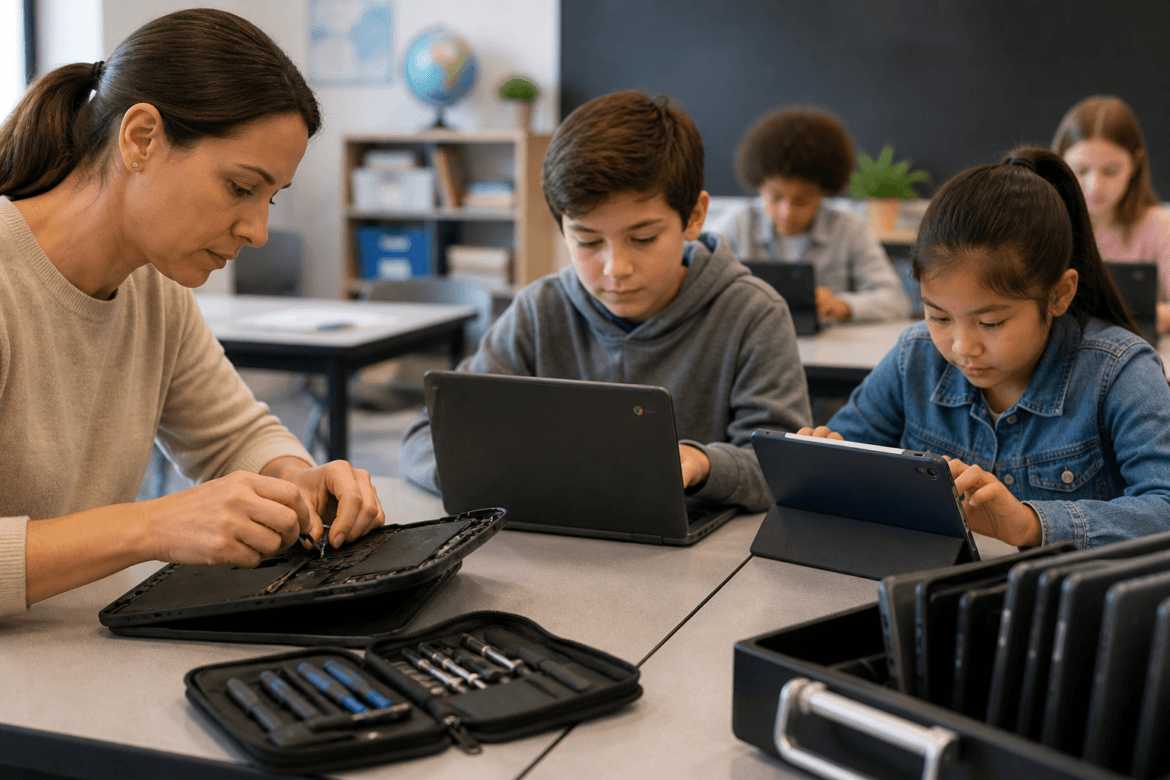
A teacher handles device maintenance by repairing a tablet as students work on their own tablets at their desks in a classroom setting.
K-12EdTechHot Topics - controversial

Device Maintenance in K-12 Schools Matters

by EdCircuit Staff May 22, 2026
written by EdCircuit Staff 5 minutes read

Device maintenance in K-12 schools is no longer a technical afterthought. It is a core part of how schools support learning, protect investments, and ensure students have reliable access to digital tools every day.

The shift to 1:1 devices in schools

Over the past decade, K-12 education has undergone a major digital transformation. Many districts have adopted 1:1 device programs, placing a Chromebook or iPad in the hands of every student. This shift accelerated during the COVID-19 pandemic, when remote and hybrid learning made devices essential rather than optional.

What received far less attention was what happens after rollout.

In many schools, device maintenance is still treated as a back-end IT task instead of a core part of instructional continuity. The result shows up quickly. Devices begin to fail, tickets pile up, and classroom momentum slows down.

That gap is no longer easy to ignore.

Devices break. Batteries degrade. Software becomes outdated. And when maintenance is reactive instead of planned, the impact is felt across classrooms.

Why maintenance gets overlooked

There are a few common reasons schools underestimate device maintenance:

  • Initial focus is on procurement, not sustainability
  • IT teams are understaffed or stretched thin
  • Budgets prioritize new purchases over upkeep
  • Responsibility for care is unclear between students, teachers, and IT

The result is predictable: devices fail faster, support tickets increase, and instructional time is disrupted.

The real cost of poor device maintenance

When device maintenance is not prioritized, the consequences show up in classrooms almost immediately.

Instructional disruption

Picture a classroom where five students cannot log in, three devices will not hold a charge, and one has a cracked screen that makes it unusable. The lesson does not stop, but those students are already behind.

In a 1:1 environment, even small failure rates create real gaps in participation.

Increased IT workload

Without preventive maintenance, IT teams spend most of their time reacting. Instead of improving systems, they are stuck clearing backlogs, triaging urgent issues, and managing frustrated staff.

This is where burnout starts to show.

Higher long-term costs

Reactive maintenance is expensive. Emergency repairs, rushed replacements, and lost devices add up quickly. Districts often end up paying more over time because they delayed small, manageable upkeep.

Schools that invest in structured maintenance programs regularly extend device lifespan by one to two years. At scale, that is a major budget difference.

Equity breaks down quickly

When device maintenance is inconsistent, equity breaks down fast. The students who lose access are often the ones who rely on school devices the most.

Maintenance is not just operational. It directly impacts who gets to fully participate in learning.

What effective device maintenance looks like

Strong device maintenance programs are proactive, structured, and shared across the school community.

1. Preventive maintenance routines

Routine checks and updates reduce the likelihood of major failures. This includes regular OS updates, battery health checks, and physical inspections.

Preventive care is far less disruptive than emergency fixes, and far less expensive.

2. Clear ownership and accountability

One of the most common gaps in schools is unclear responsibility. When no one owns device care, everyone assumes someone else does.

Effective programs define roles clearly:

  • Students take responsibility for daily handling
  • Teachers reinforce expectations in real time
  • IT teams manage systems, repairs, and tracking

Small habits, like proper storage and charging, reduce damage more than most schools expect.

3. Student education and digital responsibility

Students need to see devices as tools, not temporary equipment.

Simple habits matter:

  • Carrying devices correctly
  • Keeping food and liquids away
  • Reporting issues early instead of ignoring them

Schools that invest even a small amount of time in this see measurable drops in damage rates.

4. Streamlined repair and support systems

When something does go wrong, response time matters.

Efficient systems include:

  • Clear ticketing workflows
  • Defined repair timelines
  • Access to loaner devices

The goal is not zero issues. The goal is minimal disruption.

5. Lifecycle planning

Every device has a lifespan, and ignoring that reality leads to budget surprises.

Lifecycle planning allows districts to:

  • Forecast replacement cycles
  • Spread costs over time
  • Avoid large, reactive purchases

This is where maintenance connects directly to financial planning.

The role of leadership in device maintenance

School and district leaders play a critical role in shifting maintenance from reactive to proactive.

Budget alignment

Maintenance must be built into technology budgets, not treated as an optional expense.

This includes funding for:

  • Repairs and parts
  • IT staffing
  • Device management tools

Policy development

Clear policies help set expectations for device use and care. These policies should be communicated to students, staff, and families.

Culture shift

Maintenance should be seen as part of the learning environment, not just a technical function.

When schools treat devices as essential learning tools, care and responsibility follow.

Moving from reactive to proactive maintenance

Many schools are now recognizing the need to rethink their approach.

A proactive strategy includes:

  • Tracking device performance data
  • Identifying common failure points
  • Addressing issues before they escalate

This shift reduces costs, improves reliability, and supports better learning outcomes.

Moving from reactive to proactive maintenance

Many schools are starting to recognize that their current approach is not sustainable.

A proactive strategy is built on visibility and planning. That includes tracking device performance, identifying repeat issues, and addressing patterns before they escalate.

This shift changes how IT teams operate. It also changes how classrooms function. When devices are reliable, teachers can plan with confidence and students can stay engaged.

Final thoughts

Device maintenance in K-12 schools is not just about fixing what breaks. It is about protecting instructional time, supporting equity, and making technology investments last.

Schools have already committed to digital learning. The devices are in students’ hands.

The real question now is whether those devices will continue to support learning consistently or slowly become a source of disruption.

Without a clear maintenance strategy, even the strongest 1:1 program starts to break down. With one, it becomes sustainable.

Subscribe to edCircuit to stay up to date on all of our shows, podcasts, news, and thought leadership articles.
May 22, 2026 0 comments
0 FacebookTwitterPinterestLinkedinWhatsappCopy LinkEmail
Newer Posts
Older Posts

Participate

  • Contribute
  • Sponsor
  • Submit Release
  • Subscribe
  • Get Interviewed

We value your privacy

We use cookies to enhance your browsing experience, serve personalized ads or content, and analyze our traffic. By clicking "Accept All", you consent to our use of cookies.

Customize
  • Needed for the site to work: signing in, the cart, your consent choice. Always on.

    8 cookies
    • ss_consent 1 yearYour cookie choice on this site, so you are not asked again.
    • wordpress_logged_in_* 2 days, or 14 days with "remember me"Keeps you signed in as you move between pages.
    • wordpress_sec_* 2 days, or 14 days with "remember me"The secure half of your sign-in.
    • wordpress_test_cookie SessionChecks that your browser accepts cookies when you sign in.
    • wp-settings-* 1 yearYour display settings when signed in.
    • wp_woocommerce_session_* 2 daysYour shopping session: the cart and the checkout.
    • woocommerce_cart_hash SessionTells the site whether your cart has changed.
    • woocommerce_items_in_cart SessionWhether your cart holds anything.
  • Remembers choices you make, such as a language or a region, and supports features like live chat.

    1 cookie
    • woocommerce_recently_viewed SessionThe products you looked at, so the site can show them again.
  • Helps us understand how visitors use the site: which pages are read, and for how long.

    2 cookies
    • _ga 2 yearsGoogle Analytics: tells one visitor from another. Set only after you allow analytics.
    • _ga_* 2 yearsGoogle Analytics: keeps your session state. Set only after you allow analytics.
  • Measures how fast pages load so we can make them faster.

  • Used to show you content and offers that match your interests, on this site and elsewhere.

    1 cookie
    • sbjs_* SessionWooCommerce order attribution: where you came from, so a purchase can be credited to the campaign or site that sent you.

Your browser asks us not to sell or share your information (Global Privacy Control), so advertising cookies stay off.

Do not sell or share my personal information

Some cookies from other companies help show you offers on other sites. Tick the box and save your preference to opt out of that sharing; untick it to opt back in at any time.

Your browser sends Global Privacy Control, so this preference is set for you and cannot be changed here.

Sign In

Keep me signed in until I sign out

Forgot your password?

Password Recovery

A new password will be emailed to you.

Have received a new password? Login here

Shopping Cart

Close

No products in the cart.

Close
-
00:00
00:00

Queue

Update Required Flash plugin
-
00:00
00:00

Your cart (items: 0)

Products in cart

Product Details Total
Subtotal $0.00
Shipping and discounts calculated at checkout.
View cart
Go to checkout

Your shopping cart is empty

Return to shop

Notifications