edCircuit
  • Start Here
    • Login
    • Register
    • Subscribe
    • Submit a Press release
    • Advertise or Sponsor
    • Contribute
    • Get Interviewed
  • On The Wire
  • EdTech
    • All EdTech
    • Online Learning
    • Hybrid and Remote Learning
    • Augmented and Virtual Reality
    • ESports
    • Gamification and Game-Based Learning
    • Digital Citizenship
    • EdTech Entrepreneurs
    • Market Trends
    • Future of Education
  • K-12 Education
    • All K-12
    • K-12 Teachers
    • Teaching Strategies
    • Special Education and IEPs
    • Dyslexia
    • Gifted and Advanced Learning
    • Early Childhood, Pre-K and Kindergarten
    • School Calendar
    • Tutoring and Homework Help
    • Attendance and Absenteeism
    • After-School Programs
    • School Counselors
    • Homeschooling
    • School Models
    • Teacher Retention
    • Parents
    • Students
    • STEM and STEAM Education
  • Teaching and Learning
    • Literacy and Reading
    • Math Education
    • Civics and History Education
    • Financial Literacy
    • Assessment and Testing
    • Curriculum and Instruction
    • Personalized Learning
    • Project-Based Learning
    • Social-Emotional Learning
    • Executive Function
    • Creativity
    • Diversity, Equity, Inclusion
  • Professional Development
    • All Professional Development
    • Educators
    • Administrators
    • edLeaders
  • Higher Education
    • All Higher Education
    • College Admissions
    • Career and Technical Education (CTE)
    • Graduation
    • FAFSA and Financial Aid
    • Student Loans
  • Artificial Intelligence
  • Cybersecurity
  • School Safety
    • All School Safety
    • Science and Lab Safety
    • School Design and Facilities
    • Bullying
    • Duty of Care and School Liability
  • Continuing Education
    • All Continuing Education
    • Online Certificate Programs
    • Teaching Jobs and Careers
    • Teacher Appreciation
  • Education Policy and Government
    • All Education Policy
    • Department of Education
    • School Choice
    • Global
    • Advocates
  • EDU Shows
    • All EDU Shows
    • Safer Ed
    • Mind the Gap
    • EdTech Questions
    • CoffeEd
    • InFocus
    • InformED Report
  • EDU Podcasts
    • All EDU Podcasts
    • Author Chats
    • CoSN The Podcast
    • Education Today
    • Building the Bridge
    • Students Speak
  • Education Industry Guides and Reports
  • Archived Media
    • Future of School: The Podcast
    • Equity Everywhere
  • About edCircuit
  • Subscribe
edCircuit
  • LOGIN
Home Tags Posts tagged with "Headline"
Tag:

Headline

This if for posts to be in the featured/top section of site
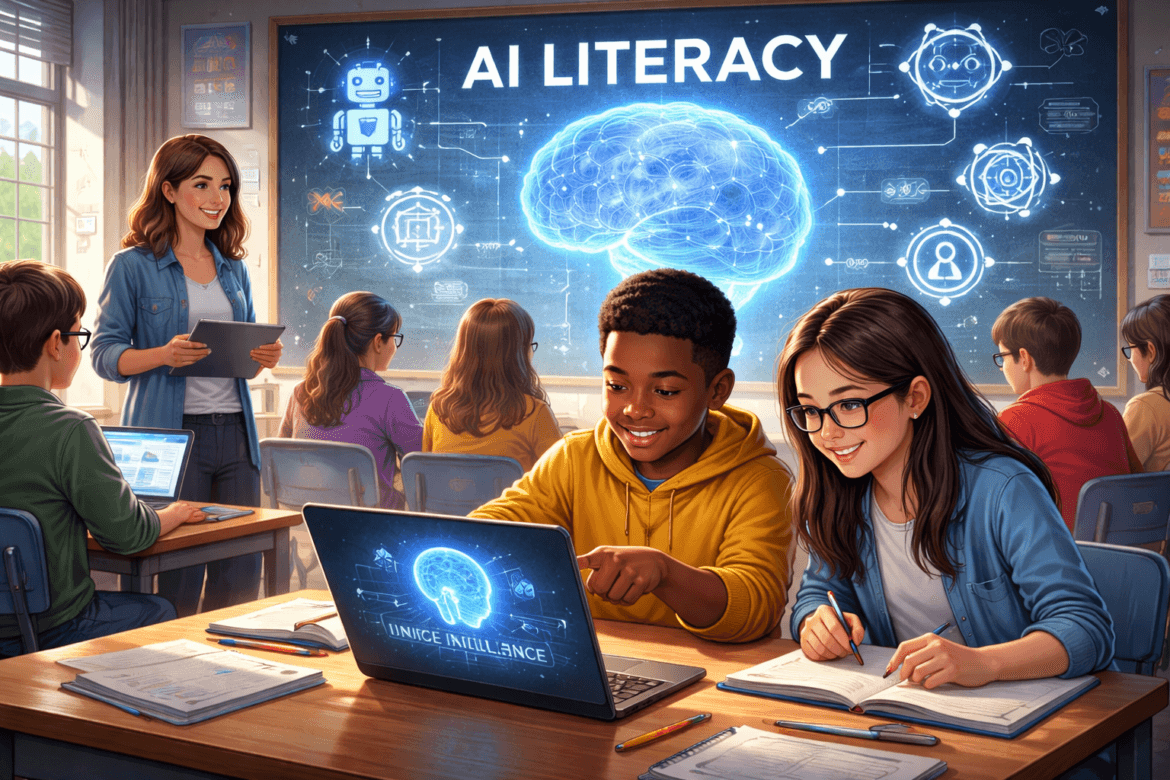
Students in a classroom use laptops to boost their AI literacy, with digital graphics of a brain and technology icons displayed on the screen at the front of the room.
Hot Topics - controversialArtificial IntelligenceK-12

AI Literacy in Schools: Preparing Students for an AI World

by EdCircuit Staff May 6, 2026
written by EdCircuit Staff 5 minutes read

AI literacy in schools is rapidly becoming a priority for educators as artificial intelligence tools reshape how students access information, complete assignments, and interact with technology. While early conversations about AI in education focused largely on preventing misuse, many districts are now recognizing that the more sustainable approach is to teach students how these tools work and how to use them responsibly.

From elementary classrooms to high school career programs, artificial intelligence is increasingly part of the learning environment. Students encounter AI through search engines, writing tools, recommendation algorithms, and digital assistants long before educators formally introduce the concept in the classroom.

For teachers, administrators, and policymakers, the challenge is clear: students must learn not only how to use AI tools but also how to understand their capabilities, limitations, and ethical implications.

Why AI Literacy Is Becoming Essential

Just as digital literacy became essential during the rise of the internet, AI literacy is emerging as the next critical competency for students. Artificial intelligence already influences the information students encounter daily, from social media feeds and streaming recommendations to academic research tools.

Without a basic understanding of how AI works, students may struggle to recognize when algorithms are shaping the information they see or when automated tools are generating content.

Educators increasingly believe that AI literacy should include an understanding of several key concepts:

  • How AI systems generate responses and predictions

  • The limitations and potential inaccuracies of AI-generated content

  • The importance of verifying information produced by AI tools

  • Ethical considerations surrounding automation and data use

  • Responsible ways to incorporate AI into research and learning

Teaching these concepts helps students become informed users rather than passive consumers of artificial intelligence systems.

Students Are Already Using AI

One reason AI literacy is becoming urgent is that students are already interacting with AI tools—often without fully understanding them.

Generative AI writing platforms, coding assistants, and automated research tools have become widely accessible. Many students experiment with these technologies when studying, completing homework, or exploring ideas.

In some cases, educators initially responded by attempting to limit or detect AI use. However, many schools now recognize that banning or ignoring AI may not be practical.

Instead, the focus is shifting toward helping students understand when and how AI can be used productively. Just as calculators eventually became accepted tools in mathematics education, artificial intelligence may become a common support tool across many subject areas.

The difference is that AI tools generate information, which requires students to evaluate accuracy and reliability more carefully.

What AI Literacy Actually Means

AI literacy is not simply about learning how to use AI tools. Instead, it involves developing a deeper understanding of how artificial intelligence systems function and how they affect decision-making in society.

In practical terms, AI literacy can include:

Understanding How AI Works

Students learn the basics of machine learning, algorithms, and data training in accessible ways appropriate to their grade level.

Evaluating AI-Generated Content

Students practice identifying when AI output may contain errors, bias, or incomplete information.

Responsible AI Use

Students explore when AI can support learning and when independent thinking is necessary.

Ethical Awareness

Students discuss issues such as privacy, bias in algorithms, and the societal impact of automation.

These skills help students move beyond simply using technology and toward understanding its broader implications.

How Schools Are Beginning to Integrate AI Literacy

Across the country, school systems are experimenting with different ways to introduce AI literacy into existing curricula.

Some districts are incorporating AI topics into digital citizenship or computer science courses. Others are embedding discussions of AI tools directly into writing, research, and project-based learning assignments.

Examples of emerging approaches include:

  • Elementary classrooms: introducing basic concepts about how computers “learn” from data

  • Middle school lessons: exploring how recommendation algorithms influence online content

  • High school courses: examining AI ethics, bias in algorithms, and real-world applications

Professional development is also becoming an important part of the process. Many teachers did not encounter artificial intelligence in their own training, so districts are investing in workshops and resources that help educators feel comfortable teaching AI concepts.

Teaching Responsible AI Use

One of the most important aspects of AI literacy is helping students develop responsible habits when using artificial intelligence tools.

Educators emphasize that AI should support learning rather than replace it. For example, AI tools might help students brainstorm ideas, summarize information, or explore alternative perspectives—but students must still engage critically with the material.

Teachers often encourage students to:

  • verify AI-generated information with trusted sources

  • use AI as a starting point rather than a final answer

  • acknowledge when AI tools contributed to their work

  • maintain original thinking and analysis

By emphasizing these principles, schools aim to preserve academic integrity while acknowledging that AI tools are becoming part of the modern learning landscape.

Preparing Students for an AI-Driven Future

Beyond classroom assignments, AI literacy also prepares students for a workforce increasingly influenced by automation and intelligent systems.

Artificial intelligence is already transforming industries ranging from healthcare and finance to engineering, agriculture, and media. Students entering these fields will likely encounter AI tools as part of their daily work.

Developing AI literacy, therefore, helps students build the critical thinking and adaptability needed to navigate an evolving technological environment.

Employers are increasingly seeking workers who can collaborate with technology, interpret data, and evaluate automated systems rather than rely on them.

Schools that introduce AI literacy today may therefore be helping students build foundational skills for future careers.

A New Chapter in Digital Education

The conversation about artificial intelligence in education is still evolving. Early debates often focused on whether AI should be restricted or detected in student work. Increasingly, however, educators are recognizing that the long-term challenge is not preventing AI from entering classrooms but ensuring that students understand it.

AI literacy in schools represents an important step in that direction.

By helping students explore how artificial intelligence works, how it influences information, and how it should be used responsibly, schools can prepare learners to navigate a world where AI systems are increasingly present.

Just as previous generations learned to use the internet responsibly, today’s students must learn to engage thoughtfully with artificial intelligence.

For educators and school leaders, the goal is not simply to keep pace with technological change but to ensure that students develop the knowledge and judgment needed to use these powerful tools wisely.

Subscribe to edCircuit to stay up to date on all of our shows, podcasts, news, and thought leadership articles.


May 6, 2026 0 comments
0 FacebookTwitterPinterestLinkedinWhatsappCopy LinkEmail
A woman sits at a cluttered desk with a laptop and documents, looking stressed, while digital icons representing emails and notifications highlight the growing issue of digital exhaustion in schools.
EducatorsK-12 TeachersHot Topics - controversialK-12

Digital Exhaustion in Schools: The Hidden Teacher Crisis

by EdCircuit Staff May 5, 2026
written by EdCircuit Staff 6 minutes read

Digital exhaustion in schools is rapidly emerging as one of the most pressing challenges facing educators as technology expands across every aspect of teaching and learning. In many schools, teachers are no longer just planning lessons—they are managing platforms, responding to constant communication, and adapting to new tools in real time.

A typical day may include navigating multiple systems, responding to messages across several channels, updating digital platforms, and adjusting instruction to align with new tools—all before the final bell rings.

For many educators, the issue is not technology itself—it is the accumulation of expectations that come with it.

Over time, this constant digital demand is creating a new form of fatigue that is distinct from traditional burnout.

It is digital exhaustion—and it is quietly reshaping the teaching profession.

What Is Digital Exhaustion?

Digital exhaustion is not simply about being overworked. It is the result of continuous interaction with digital systems, constant notifications, and the expectation of immediate response.

Unlike traditional workload challenges, digital exhaustion does not have a clear endpoint. The school day may end, but the communication cycle often does not.

Emails continue to arrive. Messages remain unread. Platforms require updates, grading, and monitoring.

Teachers are not just managing classrooms—they are managing a digital ecosystem.

This creates a sense of always being “on,” where the boundaries between work and personal time become increasingly blurred.

The Explosion of Tools and Platforms

Over the past decade, the number of digital tools used in schools has grown significantly. What was once a limited set of platforms has expanded into a complex network of systems.

Teachers are often expected to use:

  • learning management systems (LMS)

  • grading and assessment platforms

  • communication tools for parents and students

  • instructional apps and subject-specific tools

  • data dashboards and reporting systems

  • emerging AI tools

Each platform may serve a purpose, but together they create a fragmented experience.

More tools have not simplified teaching—they have often complicated it.

Multiple logins, overlapping features, and inconsistent expectations add to the cognitive load. Teachers are not just learning one system—they are managing many at once.

And in many cases, new tools are introduced without removing old ones.

Communication Without Boundaries

Technology has made communication easier—and more constant.

Teachers now receive messages through:

  • email

  • parent communication apps

  • learning platforms

  • school messaging systems

While increased communication can strengthen relationships, it also creates an expectation of availability.

Parents may expect quick responses. Students may reach out late in the evening. Administrators may send updates outside of traditional hours.

The school day may end, but the communication cycle often does not.

Over time, this leads to a feeling that communication is never complete—and that responsiveness is always expected.

The Shift from Teaching to Managing Systems

Increasingly, teachers are not just delivering instruction—they are managing systems.

Logging into platforms, tracking data, responding to messages, and navigating tools are becoming a significant part of the role. Time that was once spent planning lessons or working directly with students is now divided across multiple digital responsibilities.

This raises an important question:

How much of a teacher’s time should be spent managing technology versus engaging with students?

As digital expectations increase, the balance between instruction and system management is becoming harder to maintain.

AI: Support or Added Pressure?

Artificial intelligence is adding a new layer to this evolving landscape.

On one hand, AI offers tools that can:

  • assist with lesson planning

  • generate assessments

  • provide feedback

  • streamline administrative tasks

On the other hand, it introduces new expectations.

Teachers are now expected to:

  • understand how AI tools work

  • evaluate which tools are appropriate

  • guide students in responsible use

  • adapt instruction in response to AI capabilities

AI is being introduced as a solution—but for many teachers, it initially feels like another expectation to manage.

The promise of efficiency is real, but the transition requires time, learning, and adaptation—resources that are already limited.

The Impact on Teachers

Digital exhaustion has real consequences for educators and schools.

Teachers experiencing digital fatigue may notice:

  • reduced focus and concentration

  • difficulty managing multiple systems

  • increased stress levels

  • less time for meaningful instructional planning

  • challenges maintaining work-life balance

Over time, this constant digital demand can make even experienced educators feel like they are always catching up.

Importantly, digital exhaustion is not always visible. It does not always appear as disengagement or frustration. Often, it manifests as quiet fatigue—teachers continuing to meet expectations while feeling increasingly stretched.

What Schools Are Beginning to Recognize

As awareness grows, some schools and districts are beginning to recognize digital exhaustion as a systemic issue rather than an individual challenge.

This shift is critical.

Rather than asking teachers to “manage their time better,” schools are starting to examine the structures and expectations that contribute to digital overload.

Emerging responses include:

Tool Consolidation

Reducing the number of platforms used across the district to create a more streamlined experience.

Clear Communication Expectations

Establishing guidelines around response times and after-hours communication.

Intentional Technology Adoption

Evaluating whether new tools truly add value before introducing them.

Focused Professional Development

Providing training that is practical, relevant, and directly applicable to classroom needs.

Protecting Teacher Time

Recognizing the importance of uninterrupted planning time and reducing unnecessary digital demands.

These efforts reflect a growing understanding that technology should support teaching—not complicate it.

A Shift Toward Intentional Technology Use

The conversation around digital exhaustion is prompting a broader shift in how schools think about technology.

For years, the focus has been on adoption—bringing new tools into classrooms to enhance learning. Now, the focus is shifting toward intentional use.

This means asking:

  • Does this tool improve learning outcomes?

  • Does it simplify or complicate teacher workflows?

  • Does it align with instructional goals?

Not every tool that is available needs to be used.

In many cases, less may be more.

What Comes Next

Digital exhaustion in schools is unlikely to disappear on its own. As technology continues to evolve, the demands on educators will continue to grow unless systems and expectations evolve alongside it.

Moving forward, schools will need to balance innovation with sustainability.

This includes:

  • prioritizing simplicity over complexity

  • aligning technology use with clear instructional goals

  • setting realistic expectations for communication and responsiveness

  • supporting teachers as they navigate new tools

Technology has the potential to transform education in meaningful ways—but that transformation must be designed with educators in mind.

A Defining Challenge for Modern Education

Digital exhaustion represents a defining challenge for modern education—not because technology is inherently problematic, but because of how it is implemented and experienced.

Teachers remain at the center of the learning experience. Their ability to focus, engage, and connect with students is critical.

If digital systems begin to detract from that focus, the impact extends beyond teachers to students, classrooms, and entire school communities.

Moving Forward

As schools continue to integrate technology into every aspect of learning, one thing is becoming clear: more technology does not always lead to better outcomes.

The future of education will not be defined by how much technology schools can add—but by how effectively it is used.

In the end, the question is not how much technology schools can implement—but how much teachers can realistically sustain.

Because when teachers are overwhelmed by systems, the impact is felt where it matters most: in the classroom.

Subscribe to edCircuit to stay up to date on all of our shows, podcasts, news, and thought leadership articles.

May 5, 2026 0 comments
0 FacebookTwitterPinterestLinkedinWhatsappCopy LinkEmail
Teacher appreciation week ideas: a classroom display with a Thank You, Teachers chalkboard, notes, gifts, coffee and flowers
EducatorsK-12 TeachersHot Topics - controversialTeacher AppreciationK-12

Teacher Appreciation Week Ideas for Schools

by EdCircuit Staff May 4, 2026
written by EdCircuit Staff 5 minutes read

Updated October 2026 for Teacher Appreciation Week 2027.

Teacher Appreciation Week ideas for schools should do more than check a box. Done well, the week lifts morale, strengthens school culture and reminds teachers that their work is seen and valued. This guide covers when Teacher Appreciation Week 2027 takes place, what teachers say makes them feel appreciated, and day-by-day ideas schools can use.

When is Teacher Appreciation Week 2027?

National PTA lists Teacher Appreciation Week 2027 as May 2–8, 2027; the school days that week are Monday, May 3, through Friday, May 7. National Teacher Day falls on the Tuesday of that week: since 1985 the National Education Association has celebrated it on the Tuesday of the first full week of May, which in 2027 is May 4. For comparison, in 2026 the week was May 4–8 and National Teacher Day was May 5.

The tradition dates to 1953, when former First Lady Eleanor Roosevelt proposed that Congress set aside a day to honor educators, according to NEA. National PTA offers a free celebration toolkit, thank-you cards, certificates and social media graphics.

What teachers say makes them feel appreciated

Before planning, it helps to know what teachers actually value. When NEA asked 1,000 educators in 2026 what would make them feel truly appreciated, more than a third said better pay, followed by greater respect and support; 77 percent said higher pay would make the biggest difference in their daily lives, and more than half said they work more than one job. A school cannot set salaries during one week in May, but the finding is a useful reminder: the most valued gestures give teachers time, respect and real support, not just treats.

Start with a theme that sets the tone

A theme makes planning easier and gives the week a sense of purpose. Try:

  • “Teachers Are MVPs,” with sports-style decorations and shout-outs;
  • “Recharge Week,” focused on rest and wellness, with calming music in the lounge, tea stations and short breaks built into the day;
  • “Around the World,” featuring global snacks and student contributions.

Teacher Appreciation Week ideas by day

Monday: a strong start. Set up a welcome table at the entrance with coffee and breakfast, and leave handwritten notes in each classroom.

Tuesday (National Teacher Day): student voices. Have students write specific thank-you notes or record short videos. “You helped me understand math when I was stuck” means far more than a generic thank you.

Wednesday: a midweek boost. A snack cart in the halls, a dessert bar or a popcorn station during planning periods can reset the mood.

Thursday: time to recharge. Offer what teachers rarely get enough of: time and calm. Cover a class for 20 minutes, open a quiet lounge or declare a no-meeting day.

Friday: celebrate and recognize. Share standout moments, give lighthearted awards or host a short gathering that highlights each teacher’s impact.

Make recognition personal

General appreciation is easy to forget; specific recognition is not. Create “Why We Appreciate You” posters for each teacher filled with student comments, and hang them on classroom doors or in hallways. NEA also offers e-cards families and students can send.

Give teachers time and support

Given what teachers told NEA, the most meaningful ideas are often the practical ones:

  • extra planning time or class coverage;
  • a duty-free lunch or a day without meetings;
  • a quiet space to work or rest without interruption;
  • preferred parking or casual dress passes for the week.

Bring the community and families in

  • Ask local coffee shops, restaurants and businesses to donate drinks, lunch or gift cards.
  • Invite the PTA to organize a staff lunch or thank-you notes from families.
  • Share teacher shout-outs on social media, in newsletters and on the school website.

Create experiences, not just gifts

  • A morning “clap-in,” with students lining the halls to cheer as teachers arrive.
  • Music playing at arrival, or a hallway “red carpet.”
  • A short assembly with student performances.
  • An appreciation wall filled with notes and drawings, and door decorations made by students.

Involve students in the planning

Let students help choose the theme, design decorations and plan small surprises. When students take part, the appreciation feels more genuine, and they learn how to express gratitude.

End with a moment that feels complete

Bring everyone together, even briefly, on the last day: share a collective thank-you, hand out small keepsakes and a short photo or video recap of the week.

Frequently asked questions

When is Teacher Appreciation Week 2027? National PTA lists May 2–8, 2027, so the school week is May 3–7.

When is National Teacher Day 2027? Tuesday, May 4, 2027, following NEA’s practice of marking it on the Tuesday of the first full week of May.

What do teachers want for Teacher Appreciation Week? In NEA’s 2026 survey, teachers ranked better pay first, followed by respect and support. At school level, time, coverage and personal recognition are among the most valued gestures.

Who started Teacher Appreciation Week? National Teacher Day traces to Eleanor Roosevelt’s 1953 proposal; NEA and National PTA promote the week today.

Why Teacher Appreciation Week matters

Teacher Appreciation Week is more than a tradition; it is a chance to strengthen a school’s culture. The most effective ideas are not the most expensive. They are the ones that feel real, personal and consistent, and that show respect for teachers’ time.

Subscribe to edCircuit to stay up to date on all of our shows, podcasts, news, and thought leadership articles.

May 4, 2026 0 comments
0 FacebookTwitterPinterestLinkedinWhatsappCopy LinkEmail
A group of children sit at control panels in a futuristic spaceship classroom, watching a robot teacher present a holographic galaxy. Spaceships and stars are visible through the windows.
Artificial IntelligenceHot Topics - controversialK-12

How Star Wars Inspires AI in Education Today

by EdCircuit Staff May 4, 2026
written by EdCircuit Staff 5 minutes read

Star Wars inspires AI in education by showing how technology can support, guide, and adapt to human needs in real time. That idea, first imagined in Star Wars, is no longer theoretical. It’s already showing up in classrooms.

Students are using AI to draft essays, get instant feedback, and explore ideas faster than ever. Teachers are leaning on AI to personalize instruction and reduce time spent on repetitive tasks.

This is not science fiction anymore. It’s a daily practice.

And whether we realize it or not, many of these expectations were shaped decades ago by the world George Lucas created.

The Shift: From Tools to Learning Companions

The biggest change happening in AI right now is not just capability. It’s behavior.

Early edtech tools delivered content. Today’s AI interacts.

Think about how students are using tools like ChatGPT. They don’t just search for answers. They ask follow-up questions, refine ideas, and iterate in real time. The experience feels more like a conversation than a lookup.

That’s a direct echo of what made droids in Star Wars so compelling. They weren’t just machines. They responded, adapted, and built trust over time.

This shift matters because learning is not just about information. It’s about engagement. AI that behaves like a partner keeps students in the process longer and more actively.

The Jedi Model Is Finally Scalable

For years, education has talked about personalized learning. Star Wars showed us what that looks like long before we had the tools to build it.

Jedi training is adaptive. It’s responsive. It meets the learner where they are.

Now, AI is making that model real.

In classrooms today, students can:

  • Get step-by-step guidance instead of static answers
  • Receive targeted feedback based on their mistakes
  • Move at their own pace without holding others back

Districts are piloting AI tutors that adjust in real time. Platforms are analyzing student behavior, not just performance, to refine how content is delivered.

This is not just personalization as a feature. It’s personalization as the foundation.

Simulation Is Becoming a Core Learning Strategy

One of the most overlooked ideas in Star Wars is how often characters learn by doing, not listening.

Training happens in simulated environments. Mistakes are expected. Feedback is immediate.

That model is gaining traction fast.

AI-powered simulations are now being used across subjects:

  • Science students run virtual experiments
  • Medical learners practice procedures safely
  • Business students navigate scenario-based decision making

These environments allow for something traditional classrooms struggle with. Safe failure.

Students can try, fail, adjust, and try again without real-world consequences. AI makes these simulations smarter by adapting difficulty and responding to decisions in real time.

That’s a major shift from passive learning to active participation.

AI Is Changing the Role of the Teacher, Not Replacing It

There’s still a persistent fear that AI will replace educators. That’s not what’s happening in practice.

What’s actually happening is a redistribution of time.

Teachers are using AI to:

  • Generate lesson plans faster
  • Provide quicker feedback on student work
  • Identify learning gaps earlier

That frees up time for what matters most. Discussion, mentorship, and critical thinking.

In many ways, the role of the teacher is moving closer to what we saw in Star Wars. Less lecturer, more guide.

And that shift is long overdue.

The Ethics Conversation Is No Longer Optional

Star Wars always carried an underlying message about power and responsibility. That theme feels especially relevant now.

AI in education raises real questions:

  • How is student data being used?
  • Are AI systems reinforcing bias?
  • Who is accountable for AI-driven decisions?

These are not future concerns. They’re current ones.

Schools and edtech companies are now being pushed to prioritize transparency and fairness. There’s growing demand for AI systems that educators can understand and trust.

The takeaway is simple. Building powerful tools is not enough. They have to be responsible.

What EdTech Leaders Are Doing Differently Now

The influence of Star Wars is not always direct, but it shows up in how leaders think.

There’s a noticeable shift toward building technology that feels:

  • More human
  • More intuitive
  • More supportive

Leaders are asking better questions:

  • Does this tool reduce friction for learners?
  • Does it empower teachers instead of replacing them?
  • Does it adapt, or does it just deliver?

That mindset is shaping product design, classroom integration, and long-term strategy.

It’s less about adding AI and more about using it well.

Why This Still Matters in 2026

It’s easy to dismiss Star Wars as entertainment, but its real impact is conceptual.

It gave people a language for imagining technology that feels natural. Technology that works with us, not against us.

That vision is still guiding decisions today.

AI is moving fast. Faster than most systems are ready for. In that kind of environment, having a clear philosophy matters.

Star Wars offered one early on. Technology should enhance human potential, not overshadow it.

A Better Way to Think About the Future of AI in Education

The real lesson here is not about specific technologies. It’s about direction.

We don’t need classrooms full of futuristic gadgets. We need systems that:

  • Support how people actually learn
  • Adapt to individual needs
  • Keep humans at the center

AI can help us get there, but only if it’s built with intention.

That’s where edtech has an opportunity to lead.

May the 4th, With Purpose

Star Wars Day is fun. But it’s also a useful moment to reflect.

We’re no longer imagining what AI in education could look like. We’re building it in real time.

The question now is not can we do this. It’s how should we do this.

And that’s where the influence of stories like Star Wars still matters.

They remind us that technology, at its best, is not just powerful. It’s purposeful.

The Force Behind What Comes Next

Somewhere right now, a student is using AI to solve a problem faster, explore an idea deeper, or express themselves more clearly.

That moment matters.

Because it represents a shift in how learning happens.

And in a small but meaningful way, it connects back to a vision that started with Star Wars.

Not just a story about space, but a story about possibility.

That’s what continues to inspire edtech.
And that’s what will shape what comes next.

May the 4th be with you.

Play video: Happy Star Wars Day 2025 (1 minute 31 seconds)1:31
Happy Star Wars Day 20251 min 31 sStar Wars on YouTube

Star Wars – Happy Star Wars Day 2025 (Play video)

Subscribe to edCircuit to stay up to date on all of our shows, podcasts, news, and thought leadership articles.

May 4, 2026 0 comments
0 FacebookTwitterPinterestLinkedinWhatsappCopy LinkEmail
Ohio AI policy for schools: a map of Ohio made of glowing AI network light with every district connected, a gold seal pressed at the centre and a gavel beside it
Hot Topics - controversialArtificial IntelligenceK-12

Ohio AI Policy Schools: A New Mandate for K–12

by EdCircuit Staff May 4, 2026
written by EdCircuit Staff 7 minutes read

Ohio AI Policy Schools are no longer navigating hypothetical conversations about artificial intelligence—they are now operating under one of the most significant policy shifts in modern K–12 education.

Walk into a classroom today, and the shift is already happening.

A student drafts an essay outline using AI before class even begins. Another uses it to check math reasoning, not just answers. In the back of the room, a teacher pauses—not to stop the use of AI, but to ask a different question: Did the tool help you think, or did it think for you?

This is the new instructional reality.

For the past two years, most districts have responded in fragments. Some blocked tools. Others ignored them. A few leaned in.

Ohio has chosen a different path entirely.

With House Bill 96, the state is forcing a moment of clarity. By July 1, 2026, every public, community, and STEM school district must adopt a formal, board-approved AI policy. This is not guidance or best practice—it is a requirement that shifts AI from an optional conversation to a defined system within education.

This is the moment AI stops being experimental.

And starts becoming institutional.

From Patchwork Decisions to Statewide Direction

What makes Ohio’s approach unique is not just the mandate—it’s the structure behind it.

Rather than leaving districts to navigate AI independently, the Ohio Department of Education and Workforce has built a centralized framework designed to bring consistency to an otherwise fragmented landscape. Through its official AI in Education hub and model policy, the state is giving districts a starting point grounded in safety, ethics, and instructional purpose.

The model policy does not attempt to control every decision. Instead, it establishes a foundation—one that districts can adapt based on their size, community, and instructional priorities. That flexibility is critical. A rural district, a suburban system, and a large urban district will not implement AI in the same way.

But they will now be working from the same playbook.

At its core, the policy reframes AI from a tool students might misuse into a system schools must intentionally design around. It emphasizes that AI use should be transparent, purposeful, and aligned to learning outcomes. It also makes clear that ignoring AI is no longer an option—districts must define how it fits into teaching and learning.

This is where Ohio’s leadership becomes evident.

The state is not reacting to AI.

It is structuring it.

Moving Beyond Fear: Redefining Academic Integrity

One of the most profound shifts within Ohio’s approach is how it reframes the conversation around academic integrity.

For many educators, AI first entered the classroom as a threat. Concerns about plagiarism, shortcut learning, and authenticity dominated early discussions. And those concerns are valid—AI can absolutely be misused.

But Ohio’s policy direction challenges schools to move beyond fear-based responses.

Instead of asking, “How do we stop students from using AI?” districts are being pushed to ask, “What does responsible AI use actually look like in learning?”

That question is already reshaping instruction.

In one Ohio classroom, a teacher redesigned a traditional research assignment. Instead of banning AI, students were required to use it—but with guardrails. They had to document prompts, evaluate the accuracy of responses, and explain where the AI fell short. The final product wasn’t just the assignment—it was the thinking behind it.

That shift changes the role of both student and teacher.

AI becomes visible. Thinking becomes measurable. And learning becomes harder to fake.

In this way, AI is doing something education has needed for years.

It is forcing a deeper look at what meaningful learning actually requires.

Where Policy Meets Practice: The Role of Denison University

Policy alone does not change classrooms. Implementation does.

That is where partnerships—particularly with institutions like Denison University—are becoming critical to Ohio’s success.

Through its AI initiatives and K–12 engagement efforts, Denison is helping districts translate abstract policy into real-world practice. Educators participating in these programs are not just reviewing guidelines—they are actively building frameworks, testing ideas, and redefining what AI looks like in their schools.

What’s emerging from this work is a shift in mindset.

Teachers who initially approached AI with skepticism are beginning to see its instructional potential. District leaders are recognizing that AI is not just a classroom issue, but a workforce readiness issue. And schools are starting to align their policies with the skills students will need beyond graduation.

This connection between K–12 education and higher education is significant.

It ensures that AI policy is not developed in isolation—but informed by the realities of college, careers, and a rapidly evolving digital economy.

AI Literacy: From Exposure to Understanding

If there is one theme that runs through Ohio’s approach, it is this: students must understand AI, not just use it.

AI literacy is quickly becoming as essential as digital literacy once was—but far more complex. Students must learn how to question outputs, recognize bias, evaluate accuracy, and understand the limitations of the tools they are using.

This is where Ohio’s AI Toolkit becomes more than a resource—it becomes infrastructure.

Developed in partnership with aiEDU, the seven-part toolkit is designed to support not just teachers, but students and families as well. It provides guidance on instruction, ethics, and real-world application, helping districts build a shared understanding of AI across their communities.

This matters because AI does not stop at the classroom door.

Students are using it at home. Parents are trying to understand it. Educators are being asked to lead it.

Ohio’s approach acknowledges that reality and builds support around it.

This is not about creating future programmers.

It is about developing informed thinkers who can navigate an AI-driven world with awareness, responsibility, and confidence.

Trust, Data, and the Responsibility of Schools

As AI becomes more integrated into education, trust becomes the foundation for everything.

Families want to know how student data is being used. Educators want clarity on which tools are safe. District leaders need assurance that the systems they adopt meet legal and ethical standards.

Ohio’s model policy addresses these concerns directly, emphasizing compliance with federal and state privacy laws while setting expectations for transparency in how AI tools operate. It reinforces that schools are not just adopting technology—they are responsible for protecting the students who use it.

This responsibility extends beyond data.

It includes how AI is used to communicate, assess, and represent student work. It includes ensuring that AI does not amplify bias or create inequities. And it includes building systems where technology enhances learning rather than undermines it.

In many ways, this is the hardest part of AI integration.

Not the tools—but the trust.

A Timeline That Demands Action

The July 2026 deadline may seem distant, but for districts, the work has already begun.

Developing an AI policy is not a one-meeting task. It requires collaboration across departments, input from educators, alignment with curriculum, and clear communication with families. It also requires ongoing professional development—because policies are only as effective as the people implementing them.

Districts like Columbus City Schools have already begun taking action, establishing early guidelines that limit AI use to teacher-directed scenarios while building toward a broader, more comprehensive framework.

Across the state, approaches will vary.

But the expectation will not.

Why the Nation Is Watching

Ohio’s decision to mandate AI policies has positioned it as a national leader in education innovation.

While other states continue to debate AI’s role in schools, Ohio has created a structure that balances urgency with flexibility. It acknowledges the realities educators are facing while providing a path forward that is both practical and scalable.

This is not about having all the answers.

It is about asking the right questions—and requiring schools to answer them.

How should AI be used in learning?
What does responsible use look like?
How do we protect students while preparing them for the future?

Ohio is not just exploring these questions.

It requires every district to confront them.

The Future Is Already in the Classroom

The most important takeaway from Ohio’s AI mandate is not the policy itself.

It is what the policy represents.

A recognition that education can no longer afford to lag behind the technologies shaping the world that students are entering.

AI is not coming.

It is already here—sitting in classrooms, on student devices, and inside the workflows of teachers.

Ohio’s approach ensures that schools are not simply reacting to that reality.

They are designing for it.

And in doing so, they are preparing students not just to use AI—but to think, question, and lead in a world that will be shaped by it.

Play video: Columbus City Schools approves new artificial intelligence policy (1 minute 54 seconds)1:54
Columbus City Schools approves new artificial intelligence policy1 min 54 sWBNS 10TV on YouTube

Columbus City Schools approves new artificial intelligence policy (Play video) – WBNS 10TV

Subscribe to edCircuit to stay up to date on all of our shows, podcasts, news, and thought leadership articles.

May 4, 2026 0 comments
0 FacebookTwitterPinterestLinkedinWhatsappCopy LinkEmail
A teacher walks down a school hallway smiling and giving high-fives to a group of students carrying backpacks, celebrating National Principals’ Day with contagious school spirit.
EducatorsHot Topics - controversialK-12

National Principals’ Day: The Impact of School Leaders

by EdCircuit Staff May 1, 2026
written by EdCircuit Staff 5 minutes read

National Principals’ Day is a reminder that every successful school relies on a principal who is quietly holding everything together.

Before the first bell rings, decisions are already being made. During the day, principals move from classrooms to conversations to unexpected challenges. After dismissal, they are still answering emails, attending events, and preparing for tomorrow.

It is not just a role. It is a constant responsibility.

The Center of School Leadership

Strong school principals shape more than schedules and policies. They shape the entire feel of a building.

You notice it right away. A school either feels calm and focused, or it doesn’t. Teachers either feel supported or they don’t. Students either understand expectations, or they are left guessing.

That difference starts with leadership.

On National Principals’ Day, it is worth noticing how often principals show up in the moments that matter. Sitting in the audience at a musical performance. Standing on the sidelines at an athletic event. Walking table to table at a science fair, asking students about their work.

These are not extra tasks. They are part of how principals build trust and visibility across the school.

More Than Management

It is easy to think of principals as managers. Schedules, staffing, budgets.

But that view misses the reality of the job.

A principal might start the day resolving a student issue, shift into supporting a teacher through a difficult situation, and end by communicating with families about something that affects the entire school.

Decisions are rarely simple. Information is often incomplete. And the stakes are always real.

Good school principals bring consistency to environments that can change by the hour. They create stability when things feel uncertain.

The Duty of Care: Where the Buck Stops

At the core of school leadership is Duty of Care.

Inside a school building, responsibility for safety and well-being does not spread evenly. It lands with the principal.

This is what people mean when they say the buck stops at the principal’s office.

If a serious situation unfolds, the principal leads. If a safety decision needs to be made, the principal makes it. If families need answers, the principal provides them.

That responsibility shows up in real ways:

  • Responding immediately to student safety concerns
  • Supporting staff during high-pressure situations
  • Making judgment calls that affect hundreds of students at once
  • Communicating clearly when something goes wrong

These decisions are not theoretical. They happen in real time, often with no perfect answer.

On National Principals’ Day, this is one of the most important truths to recognize. The role carries weight that does not pause at the end of the school day.

The Ripple Effect on Students

A principal’s impact on students is often quiet, but it is consistent.

A greeting in the hallway. A quick check-in. Showing up to events again and again. Recognizing effort, not just outcomes.

Students notice patterns.

They notice fairness. They notice who shows up. They notice when expectations are clear and support is real.

Over time, those small moments shape how students experience school. Whether they feel safe. Whether they stay engaged. Whether they believe they belong.

That influence lasts longer than any single school year.

Supporting Teachers So Students Can Succeed

Behind every strong classroom is a teacher who feels supported. And behind that support is often a principal.

Principals set expectations, but they also provide backup when challenges arise. They help teachers navigate difficult situations, improve their practice, and stay focused on students.

When teachers know their leadership is steady, they can do their best work.

This is one of the less visible impacts of school principals, but it is one of the most important. Strong leadership strengthens teaching, and strong teaching drives student success.

Building Trust Beyond the School Walls

Schools do not operate in isolation. Families and communities are part of the equation.

Principals are often the bridge.

They answer questions, address concerns, and communicate decisions that affect students and families. They represent the school at events and in conversations that shape public trust.

That trust is built slowly, through consistency and clarity.

When it is strong, schools are more resilient. When it is missing, even small challenges can grow quickly.

Why National Principals’ Day Matters More Than Ever

National Principals’ Day is not just about appreciation. It is about the recognition of complexity.

The role of school principals has expanded. Expectations are higher. Challenges are more visible. And the margin for error is small.

At the same time, burnout is real. Retaining strong leaders depends in part on whether their work is acknowledged and supported.

Taking a moment to recognize principals is not just a gesture. It shows that the work they do every day is seen and valued.

A short message. A genuine thank you. A note from a student or teacher.

These signals matter more than they seem.

A Responsibility That Carries Forward

The influence of a principal does not end when the school year does.

It shows up in the systems they build, the culture they create, and the people they support.

Years later, students may not remember every lesson. But they remember how their school felt. Whether it was structured or chaotic. Supportive or distant. Encouraging or indifferent.

Principals help define that experience.

Closing Thought

On National Principals’ Day, it is worth looking beyond the title and focusing on the reality of the work.

School leadership is not just about running a building. It is about carrying responsibility for people, decisions, and outcomes every single day.

Long after the last bell rings and the building empties, the work is not really finished. Plans are already forming for the next day. Problems are still being solved. Responsibility is still there.

And when the doors open again in the morning, it all starts over.

Play video: Happy National Principals' Day! (1 minute 22 seconds)1:22
Happy National Principals' Day!1 min 22 sOfficialTPSD on YouTube

OfficialTPSD – Happy National Principals’ Day! (Play video)

Subscribe to edCircuit to stay up to date on all of our shows, podcasts, news, and thought leadership articles.

May 1, 2026 0 comments
0 FacebookTwitterPinterestLinkedinWhatsappCopy LinkEmail
Newer Posts
Older Posts

Participate

  • Contribute
  • Sponsor
  • Submit Release
  • Subscribe
  • Get Interviewed

We value your privacy

We use cookies to enhance your browsing experience, serve personalized ads or content, and analyze our traffic. By clicking "Accept All", you consent to our use of cookies.

Customize
  • Needed for the site to work: signing in, the cart, your consent choice. Always on.

    8 cookies
    • ss_consent 1 yearYour cookie choice on this site, so you are not asked again.
    • wordpress_logged_in_* 2 days, or 14 days with "remember me"Keeps you signed in as you move between pages.
    • wordpress_sec_* 2 days, or 14 days with "remember me"The secure half of your sign-in.
    • wordpress_test_cookie SessionChecks that your browser accepts cookies when you sign in.
    • wp-settings-* 1 yearYour display settings when signed in.
    • wp_woocommerce_session_* 2 daysYour shopping session: the cart and the checkout.
    • woocommerce_cart_hash SessionTells the site whether your cart has changed.
    • woocommerce_items_in_cart SessionWhether your cart holds anything.
  • Remembers choices you make, such as a language or a region, and supports features like live chat.

    1 cookie
    • woocommerce_recently_viewed SessionThe products you looked at, so the site can show them again.
  • Helps us understand how visitors use the site: which pages are read, and for how long.

    2 cookies
    • _ga 2 yearsGoogle Analytics: tells one visitor from another. Set only after you allow analytics.
    • _ga_* 2 yearsGoogle Analytics: keeps your session state. Set only after you allow analytics.
  • Measures how fast pages load so we can make them faster.

  • Used to show you content and offers that match your interests, on this site and elsewhere.

    1 cookie
    • sbjs_* SessionWooCommerce order attribution: where you came from, so a purchase can be credited to the campaign or site that sent you.

Your browser asks us not to sell or share your information (Global Privacy Control), so advertising cookies stay off.

Do not sell or share my personal information

Some cookies from other companies help show you offers on other sites. Tick the box and save your preference to opt out of that sharing; untick it to opt back in at any time.

Your browser sends Global Privacy Control, so this preference is set for you and cannot be changed here.

Sign In

Keep me signed in until I sign out

Forgot your password?

Password Recovery

A new password will be emailed to you.

Have received a new password? Login here

Shopping Cart

Close

No products in the cart.

Close
-
00:00
00:00

Queue

Update Required Flash plugin
-
00:00
00:00

Your cart (items: 0)

Products in cart

Product Details Total
Subtotal $0.00
Shipping and discounts calculated at checkout.
View cart
Go to checkout

Your shopping cart is empty

Return to shop

Notifications