

edCircuit
  • Start Here
    • Login
    • Register
    • Subscribe
    • Submit a Press release
    • Advertise or Sponsor
    • Contribute
    • Get Interviewed
  • On The Wire
  • EdTech
    • All EdTech
    • Online Learning
    • Hybrid and Remote Learning
    • Augmented and Virtual Reality
    • ESports
    • Gamification and Game-Based Learning
    • Digital Citizenship
    • EdTech Entrepreneurs
    • Market Trends
    • Future of Education
  • K-12 Education
    • All K-12
    • K-12 Teachers
    • Teaching Strategies
    • Special Education and IEPs
    • Dyslexia
    • Gifted and Advanced Learning
    • Early Childhood, Pre-K and Kindergarten
    • School Calendar
    • Tutoring and Homework Help
    • Attendance and Absenteeism
    • After-School Programs
    • School Counselors
    • Homeschooling
    • School Models
    • Teacher Retention
    • Parents
    • Students
    • STEM and STEAM Education
  • Teaching and Learning
    • Literacy and Reading
    • Math Education
    • Civics and History Education
    • Financial Literacy
    • Assessment and Testing
    • Curriculum and Instruction
    • Personalized Learning
    • Project-Based Learning
    • Social-Emotional Learning
    • Executive Function
    • Creativity
    • Diversity, Equity, Inclusion
  • Professional Development
    • All Professional Development
    • Educators
    • Administrators
    • edLeaders
  • Higher Education
    • All Higher Education
    • College Admissions
    • Career and Technical Education (CTE)
    • Graduation
    • FAFSA and Financial Aid
    • Student Loans
  • Artificial Intelligence
  • Cybersecurity
  • School Safety
    • All School Safety
    • Science and Lab Safety
    • School Design and Facilities
    • Bullying
    • Duty of Care and School Liability
  • Continuing Education
    • All Continuing Education
    • Online Certificate Programs
    • Teaching Jobs and Careers
    • Teacher Appreciation
  • Education Policy and Government
    • All Education Policy
    • Department of Education
    • School Choice
    • Global
    • Advocates
  • EDU Shows
    • All EDU Shows
    • Safer Ed
    • Mind the Gap
    • EdTech Questions
    • CoffeEd
    • InFocus
    • InformED Report
  • EDU Podcasts
    • All EDU Podcasts
    • Author Chats
    • CoSN The Podcast
    • Education Today
    • Building the Bridge
    • Students Speak
  • Education Industry Guides and Reports
  • Archived Media
    • Future of School: The Podcast
    • Equity Everywhere
  • About edCircuit
  • Subscribe
edCircuit
  • LOGIN
Home Tags Posts tagged with "Headline"
Tag:

Headline

This if for posts to be in the featured/top section of site
School safety resilience and emergency response: a principal in a reflective vest runs incident command by radio during a school evacuation while teachers hold class markers and take roll call at the assembly point
K-12School SafetySafer Ed

School Safety Resilience: Moving Beyond Response

by EdCircuit Staff March 30, 2026
written by EdCircuit Staff 5 minutes read

School safety resilience is not built in the moment an incident occurs—it is built in what happens after.

A student bumps a lab table during cleanup. A container tips, and liquid spreads across the surface. The situation is controlled quickly. No one is hurt. The class resets, and the day continues.

But later, questions begin to surface.

The workspace was crowded. Materials were staged too closely. Cleanup time was rushed. What looked like a small moment begins to reveal a larger pattern.

And that is where resilience begins.

In the latest episode of the Safer Ed Podcast, “From Response to Resilience: How Safety Systems Evolve Over Time,” we explore what separates schools that simply respond from those that continuously improve. The difference is not in whether incidents happen—it is in how schools interpret and act on them.
Safer EdSchool Safety Resilience: Moving Beyond ResponseMarch 30, 2026 · 8 min 41 sPlay episode: School Safety Resilience: Moving Beyond Response (8 minutes 41 seconds)0:00-8:41Follow on SpotifyApple

Response Is the Beginning—Not the Outcome

Most school safety conversations focus on response. Did staff act quickly? Were procedures followed? Was the situation contained?

These questions matter. They measure readiness and immediate effectiveness. But they only tell part of the story.

Response answers: Did we manage the moment?
Resilience asks: What did the moment teach us?

When schools stop at response, they close the event. When they move into resilience, they open the system.

The Hidden Risk of “Returning to Normal”

Schools are built on routine. After a disruption, there is a natural—and necessary—push to restore stability. Students need structure. Teachers need continuity. Leaders need reassurance.

But there is a hidden risk in returning to normal too quickly.

When the focus is solely on restoration, reflection becomes compressed. Conversations become surface-level. The deeper conditions that contributed to the incident remain unexamined.

The system resets—but it does not improve.

Resilient schools recognize that the moment after an incident is not a return point. It is an entry point for learning.

From Events to Signals

Incidents rarely occur in isolation. They are often preceded by smaller, less visible signals:

  • A crowded workspace that hasn’t yet caused an issue
  • A delayed response that didn’t escalate
  • Equipment that feels slightly unstable but remains in use
  • Transitions that feel rushed but still function

These are not minor inconveniences—they are early indicators of system stress.

In resilient schools, near misses are not dismissed. They are analyzed, connected, and used to identify patterns before they result in harm.

This shift—from viewing incidents as isolated events to recognizing them as part of a broader system—is foundational to building resilience.

Looking Beyond the Individual

One of the most common barriers to system growth is the tendency to focus on individual behavior.

A spill becomes a student mistake.
A delay becomes a teacher oversight.
A miscommunication becomes a one-time error.

While individual actions matter, resilient schools ask a different question:

What conditions made this outcome more likely?

Was the environment too crowded?
Were expectations unclear?
Was supervision stretched across multiple tasks?
Was communication too complex in real time?

By shifting from individual blame to system analysis, schools uncover opportunities for meaningful improvement.

Reflection as a System, Not a Moment

Many schools reflect after incidents—but often informally.

A quick conversation.
A hallway discussion.
A brief mention in a meeting.

While well-intentioned, this approach lacks consistency and depth.

Resilient schools treat reflection as a structured process. They take time to reconstruct the moment:

  • What was observed first?
  • What actions were taken—and when?
  • Where was there hesitation or confusion?
  • What environmental or procedural factors played a role?

This level of reflection transforms experience into usable insight.

Just as importantly, it includes the voices closest to the event—teachers, staff, and others who understand how the environment functions in real time.

Culture Determines What Gets Shared

After an incident, people are not only processing what happened—they are watching how leadership responds.

If the tone is defensive, communication narrows.

If the tone is open and curious, communication expands.

This distinction shapes culture.

In environments where incidents are treated as failures, individuals become cautious. Information is filtered. Concerns go unspoken.

In environments where incidents are treated as learning opportunities, transparency increases. Staff contribute insights. Patterns become visible.

Resilience depends on this openness—because systems can only improve based on the information they receive.

Turning Insight Into Action

Reflection alone does not create resilience. Change does.

The most effective schools connect what they learn to what they do next.

Sometimes the adjustments are small:

  • Reorganizing storage to reduce congestion
  • Clarifying communication expectations
  • Adjusting supervision during transitions

Other times, they are more structural:

  • Redesigning room layouts
  • Updating procedures
  • Refining training priorities

What matters is not the size of the change—it is the consistency.

Over time, these intentional adjustments reshape how a system operates. They reduce friction, improve clarity, and strengthen response.

Designing for Resilience

Resilience is not a trait—it is a design outcome.

It emerges when systems are intentionally aligned:

  • Environments support safe movement and supervision
  • Communication is clear and actionable
  • Expectations are reinforced consistently
  • Reflection leads to visible improvement

Tools like the Science Safety Occupancy Load Calculator help schools move from reactive thinking to proactive alignment—giving leaders visibility into how space, capacity, and layout impact safety before systems are tested.

A Continuous Process

School safety is not static. It evolves as programs expand, spaces change, and new challenges emerge.

Resilient schools do not ask, “Did we fix the problem?”
They ask, “How are we continuing to improve?”

That mindset transforms safety from a compliance task into an ongoing process of alignment and growth.

Final Thought

School safety is often measured by what doesn’t happen.

But its true strength is revealed in what happens after something does.

Because in every school, something will eventually go wrong.
The difference is whether your system resets—
or gets better because of it.

Subscribe to edCircuit to stay up to date on all of our shows, podcasts, news, and thought leadership articles.

March 30, 2026 0 comments
0 FacebookTwitterPinterestLinkedinWhatsappCopy LinkEmail
Two students use MIDI keyboards and music software on laptops while their teacher stands behind them with a tablet
Hot Topics - controversialArtificial IntelligenceK-12

The Evolution of Music Education in Today’s Classroom

by EdCircuit Staff March 30, 2026
written by EdCircuit Staff 5 minutes read

Music education has changed a great deal over the past 15 years, and technology in music education is a big part of why. Walk into a modern music classroom and you may see students building a beat on a laptop, layering digital instruments into a soundtrack or working on a shared composition online, while a jazz ensemble rehearses across the room. Rehearsal, notation and performance remain at the heart of the subject. What has grown around them is a set of tools that let students compose, record and produce music, and now artificial intelligence as well.

Access is the starting point. The Arts Education Data Project’s first national study found that 92 percent of U.S. public school students had access to music education, leaving about 3.6 million students without it. Those figures are from the 2018–19 school year and are the most recent national estimate. As schools mark Music In Our Schools Month each March, the evolution of the music room is a reminder of how much music teachers have taken on.

From music rooms to creative studios

Fifteen years ago, most school music programs centered on band, orchestra and choir: reading notation, practicing scales and rehearsing for concerts. A teacher might have used notation software or an electronic keyboard lab, but digital production tools were rare. Today many music teachers also use digital audio workstations (DAWs), MIDI keyboards and production software. Students can layer sounds, change tempo, add effects and build complete pieces with tools similar to those used in professional studios.

Performance and ensemble playing remain essential. What has changed is that composition, recording, editing and production are now realistic parts of a school music course, not only extras for students who take lessons outside school.

Students as composers and producers

Online platforms make it possible for any student with a device to create music layer by layer:

  • Soundtrap for Education is an online platform for creating music and podcasts.
  • BandLab offers an online studio, with a version designed for schools.
  • Noteflight is an online notation editor; its Noteflight Learn edition gives a class a private site with assignments and links to Google Classroom and other learning platforms.

These tools connect school music to the music students already know from streaming, video games and social media. Students who do not see themselves as performers may find their way into music through composition, beat-making or sound design.

Collaboration beyond the classroom

Cloud-based tools let students start a project in class, continue it at home and share it with classmates who add their own parts. That mirrors how much professional music is made today, by artists working together across cities. It also changes the teacher’s role: music teachers can listen to drafts, leave comments and guide revisions, turning composition into a cycle of trying, listening and improving.

Artificial intelligence in the music room

AI tools can now suggest melodies, chord progressions and rhythm patterns, or produce a backing track from a short description. The National Association for Music Education’s AI Task Force published guiding principles for AI in music education in July 2025, grounded in the national music standards. It describes ways AI tools can enhance creativity, support performance and deepen student reflection, and it addresses assessment and the ethical responsibilities of teachers and students.

In practice, AI is most useful when students use it to test ideas and then make the musical decisions themselves: why one chord progression works better than another, how a melody should develop, what the piece is trying to express. A student who struggles with notation can still explore composition this way, while an advanced student can try more complex arrangements. Teachers should be clear about when AI may be used, and students should credit it, just as they would credit a sample or someone else’s melody.

Preparing students for music careers today

Many working musicians now combine roles: performer, composer, producer and sound engineer. Careers in film and game scoring, podcast production and audio for media all combine musical skill with technology. Students who learn both in school gain skills that carry beyond music, including creative problem solving, collaboration and confidence in sharing their work.

What school leaders can do

  • Protect the core. Keep ensembles and musicianship strong while adding technology, rather than replacing one with the other.
  • Fund equipment and software. Headphones, MIDI keyboards, devices and licenses need a budget line, not only donations.
  • Support teacher learning. Music teachers need time to learn production tools and to plan how AI fits their program.
  • Set clear AI rules. Use NAfME’s guidance to decide when students may use AI and how they credit it.
  • Close access gaps. Check which of your schools offer music at all, and which offer composition and production as well as ensembles.

The modern music classroom shows that tradition and technology in music education can work together. Students still learn to listen, play and perform, and many now also learn to compose and produce. For the wider picture of AI in schools, see edCircuit’s guide to AI in education.

Related reading

  • From the Band Room to the Cloud: How AI and EdTech Are Transforming High School Music Programs
  • Art and AI: A New Era of Student Creativity
  • AI in Education: A Guide for Schools and Colleges

Subscribe to edCircuit to stay up to date on all of our shows, podcasts, news, and thought leadership articles.

March 30, 2026 0 comments
0 FacebookTwitterPinterestLinkedinWhatsappCopy LinkEmail
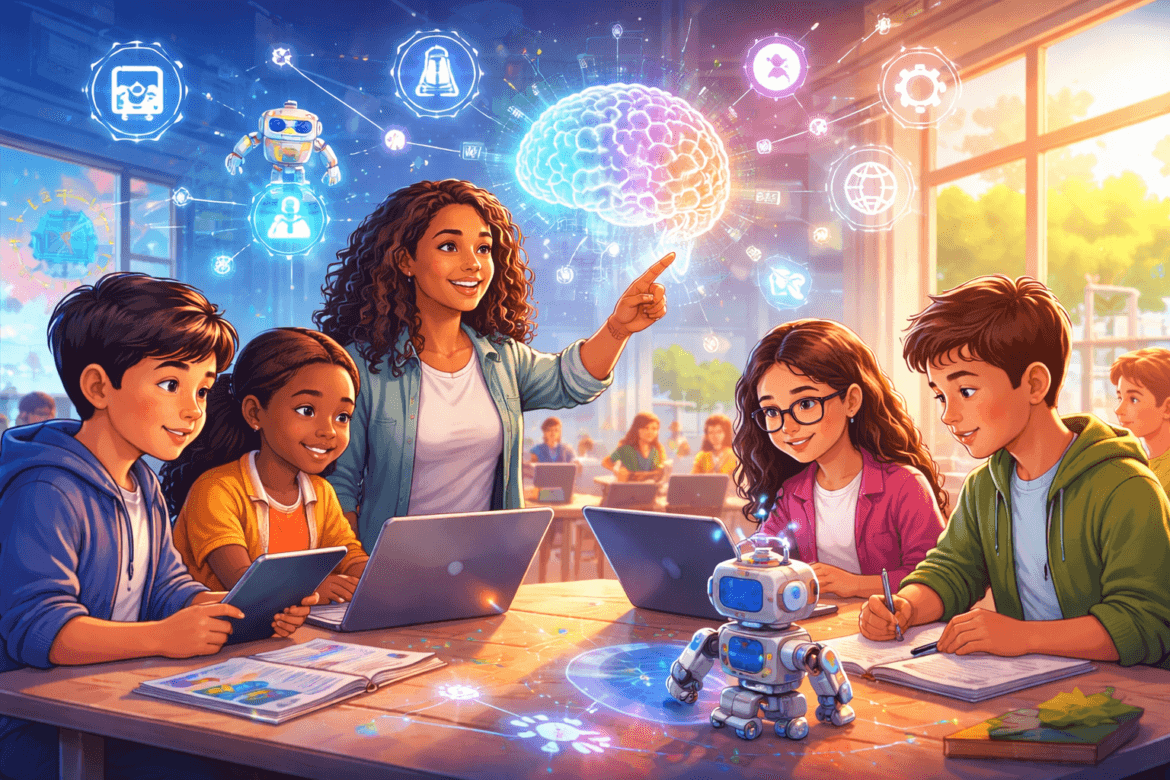
A teacher and four students use laptops and tablets at a classroom table with books, a robot, and glowing digital icons—celebrating AI Literacy Day with a vibrant brain illustration overhead.
Hot Topics - controversialArtificial IntelligenceK-12

AI Literacy Day: Preparing Students for an AI Future

by EdCircuit Staff March 27, 2026
written by EdCircuit Staff 7 minutes read

AI literacy is quickly becoming one of the most important new priorities in modern education, and AI Literacy Day, celebrated on March 27, 2026, highlights why schools across the country are beginning to treat understanding of artificial intelligence as a foundational skill for students.

Organized through the national initiative AI Literacy Day, the day encourages educators, students, parents, and communities to explore one of the most pressing questions facing education today:

How do we prepare learners for an AI-enabled world?

Artificial intelligence has moved rapidly from a niche area of computer science into everyday classroom tools. Students are already encountering AI in search engines, writing assistants, tutoring platforms, recommendation systems, and creative applications. Yet many young learners—and adults—still lack a clear understanding of how these systems work, what their limitations are, and how they should be used responsibly.

AI Literacy Day provides schools with an opportunity to slow down and explore those questions together. It is a celebration of curiosity, learning, and thoughtful discussion about a technology that is reshaping education, work, and society.

Rather than focusing solely on technical programming skills, the initiative emphasizes understanding, ethics, and critical thinking—the skills students will need to navigate a world where AI systems are increasingly present in everyday life.

AI Literacy Is the Next Evolution of Digital Literacy

For more than two decades, schools have focused on digital literacy—teaching students how to use computers, navigate the internet, evaluate online information, and interact responsibly in digital spaces.

Today, education leaders are recognizing that AI literacy is the next evolution of that concept.

Artificial intelligence is no longer a distant or specialized technology. It is embedded in the systems students use daily:

  • Search engines that predict information needs

  • Adaptive learning platforms that personalize instruction

  • Writing assistants that generate or revise text

  • Image and video tools that create digital media

These tools offer tremendous educational potential, but they also introduce new challenges.

Students must understand:

  • How AI systems learn from data

  • Why AI models sometimes make mistakes

  • How bias can appear in automated systems

  • When human judgment should override machine output

AI Literacy Day encourages educators to help students develop this deeper understanding. By doing so, schools ensure that students are not simply users of technology, but informed thinkers capable of questioning and interpreting the tools around them.

Moving Beyond Coding: Understanding AI in Real Life

One of the most important ideas behind AI Literacy Day is that AI education should not be limited to computer science classrooms.

Artificial intelligence touches nearly every discipline, and educators are increasingly weaving AI discussions into a variety of subjects.

In English and language arts, students analyze how AI generates text and explore how to critically evaluate machine-produced writing.

In science classes, students examine how machine learning is used in climate research, medical imaging, and data analysis.

In social studies, discussions explore how AI influences economic systems, government decision-making, and global policy.

In art and design, students experiment with generative tools while also examining questions about creativity, authorship, and originality.

By approaching AI literacy through multiple subjects, schools help students understand that artificial intelligence is not simply a technical tool—it is a societal force shaping the modern world.

Teaching Responsible and Ethical AI Use

As AI adoption expands in schools, educators are also grappling with an important challenge: How do we teach students to use AI responsibly?

AI Literacy Day encourages educators to address this question directly by incorporating ethical conversations into classroom discussions.

Students explore topics such as:

  • Bias in algorithms and datasets

  • Privacy concerns surrounding data collection

  • Ownership of AI-generated content

  • Responsible use of AI in academic work

These discussions help students understand that artificial intelligence systems are created by humans and reflect human decisions.

Understanding those decisions—and questioning them—is a critical skill for the next generation.

Rather than banning AI tools entirely, many schools are moving toward a more productive strategy: teaching students when and how to use AI responsibly.

This approach mirrors how schools addressed earlier technologies such as calculators, internet research tools, and smartphones. Instead of ignoring technology, educators teach students how to use it thoughtfully and effectively.

AI Literacy and the Future Workforce

Beyond classroom instruction, AI literacy is also closely tied to workforce readiness.

Students entering the workforce over the next decade will encounter artificial intelligence in nearly every field.

Industries across the economy are already integrating AI systems:

  • Healthcare professionals use AI to assist with diagnostics and medical research

  • Engineers rely on machine learning simulations during design processes

  • Journalists analyze large datasets with AI-supported tools

  • Businesses use predictive algorithms to forecast trends and optimize operations

Even careers traditionally considered non-technical are beginning to integrate AI-powered systems.

For students, this means that understanding artificial intelligence is not just about technology—it is about career readiness and adaptability.

AI Literacy Day highlights this connection by helping students see how AI literacy can prepare them for the evolving job market they will enter after graduation.

Empowering Educators to Lead the Conversation

While students may quickly adopt new technologies, educators play a vital role in helping them interpret and understand those tools.

AI Literacy Day provides teachers with lesson ideas, resources, and professional learning opportunities designed to support classroom discussions about artificial intelligence.

These resources help educators:

  • Introduce foundational AI concepts without advanced technical training

  • Facilitate thoughtful discussions about ethics and responsibility

  • Encourage students to explore real-world AI applications

  • Design projects that promote inquiry and experimentation

Importantly, the initiative recognizes that educators do not need to become AI experts overnight.

Instead, teachers are encouraged to learn alongside their students, modeling curiosity, exploration, and critical thinking.

This collaborative learning approach reflects a broader transformation in education—one in which teachers guide exploration and help students interpret complex technological systems.

How Schools Can Participate in AI Literacy Day

Across the country, schools are finding creative ways to celebrate AI Literacy Day and introduce students to artificial intelligence concepts.

Some classrooms organize AI exploration lessons in which students learn how machine learning systems recognize patterns in data.

Others host student debates examining ethical questions surrounding AI decision-making and privacy.

Many districts use the day as an opportunity for professional development, helping educators better understand emerging AI tools and their classroom implications.

Schools may also invite community members or local technology professionals to speak with students about how artificial intelligence is being used in real-world careers.

By engaging students, teachers, families, and community leaders, AI Literacy Day transforms a single day of learning into the beginning of a broader conversation about technology and the future of education.

Engaging Families and Communities

AI Literacy Day also encourages schools to extend the conversation beyond classroom walls.

Parents and community members often have questions about artificial intelligence—how it works, how it affects education, and how it may influence the future of work.

Events such as parent information nights, student project showcases, and community discussions help build a shared understanding of AI technology.

These conversations are particularly important because artificial intelligence will influence nearly every aspect of society, from healthcare and transportation to media, business, and government.

Helping families understand AI ensures that discussions about technology remain inclusive, transparent, and grounded in shared learning.

Preparing Students for an AI-Enabled World

Artificial intelligence will continue to transform how information is created, shared, and evaluated.

For educators, the challenge is not simply keeping pace with technological change—it is helping students develop the skills needed to think critically in a world increasingly influenced by intelligent machines.

Students who develop strong AI literacy will be better prepared to:

  • Evaluate information and identify misinformation

  • Recognize bias in automated systems

  • Use AI tools responsibly and creatively

  • Participate in informed discussions about technology policy and innovation

These skills will become essential for civic participation, workforce readiness, and lifelong learning.

A Celebration of the Future of Learning

The growing recognition of AI Literacy Day reflects a broader shift happening throughout education.

Schools are no longer simply adopting new technologies—they are helping students understand the systems shaping the world around them.

Artificial intelligence will influence nearly every aspect of modern life. By introducing students to AI concepts early and encouraging thoughtful discussions about its impact, educators are ensuring that the next generation is prepared not only to use AI but to shape how it is used.

On March 27, 2026, classrooms across the country will pause to explore one simple but profound question:

What does it mean to be literate in the age of artificial intelligence?

The answers students begin to discover may shape the future of education, the future of work, and ultimately the future of the world they will inherit.

Play video: National AI Literacy Day at The Tech Interactive 2025: Fireside Chat with Sal Khan (36 minutes 32 seconds)36:32
National AI Literacy Day at The Tech Interactive 2025: Fireside Chat with Sal Khan36 min 32 sThe Tech Interactive on YouTube

The Tech Interactive – National AI Literacy Day at The Tech Interactive 2025: Fireside Chat with Sal Khan (Play video)

Subscribe to edCircuit to stay up to date on all of our shows, podcasts, news, and thought leadership articles.

March 27, 2026 0 comments
0 FacebookTwitterPinterestLinkedinWhatsappCopy LinkEmail
Collage of business professionals in meetings, analyzing graphs, collaborating in office settings, with a central image of a digital brain graphic symbolizing data, AI technology, and the impact of AI Certification for Educators.
Continuing EducationOnline Certificate ProgramsProfessional DevelopmentHot Topics - controversialArtificial IntelligenceK-12

AI Certification for Educators: What Counts in 2026

by EdCircuit Staff March 26, 2026
written by EdCircuit Staff 7 minutes read

AI certification for educators is quickly moving from a résumé enhancer to a career differentiator. In a field where professional learning has traditionally been measured in seat hours and workshop attendance, artificial intelligence is forcing a fundamental shift toward demonstrated, visible, and strategically aligned expertise. Districts are no longer asking whether their teachers have been introduced to AI. They are asking who can lead implementation, who understands the ethical and instructional implications, and who has the verified capacity to help others navigate a rapidly changing learning environment.

That distinction—between exposure and expertise—is where certification enters the conversation.

For the first time since the rise of instructional technology integration, educators are facing a professional learning movement that is not tied to a single tool, platform, or pedagogical model. AI touches assessment design, feedback cycles, differentiation, accessibility, data privacy, academic integrity, curriculum development, and workforce readiness. A credential in this space does not simply signal that an educator has learned something new. It signals that they are prepared to operate in a different school model.

And that has real career implications.

From Professional Development to Professional Positioning

For decades, educators accumulated professional learning in ways that were largely invisible outside their own districts. Certificates were filed. Hours were logged. Knowledge stayed local. AI credentials are changing that dynamic because they exist in a connected, digital, and highly networked professional ecosystem.

When an educator earns a recognized AI certification and makes it visible, it becomes a form of professional positioning. It communicates readiness for emerging roles that did not exist five years ago, such as AI integration specialist, innovation coach, digital learning leader, curriculum redesign facilitator, and data ethics team member. These roles are already appearing in forward-thinking systems, and they are being filled by educators who can demonstrate—not just describe—their capacity.

This is why the question “Should I get an AI certification?” is no longer about personal interest. It is about a professional trajectory.

The Hiring Table Has Already Changed

In district hiring rooms across the country, a new kind of conversation is beginning to take shape. Two candidates sit at the table for an instructional innovation role. One brings years of strong teaching, deep relationships, and a transcript filled with professional development hours. The other brings slightly less experience but has led an AI pilot in their building, earned a recognized AI educator certification, and designed professional learning for colleagues on AI-supported feedback and assessment redesign.

The discussion shifts.

It is no longer about who has attended more workshops. It becomes a question of who can help the system move forward.

In that moment, the credential is not a badge. It is evidence of capacity.

Principals are looking for staff who can guide their buildings through change. Curriculum directors are looking for educators who understand how AI reshapes assessment and feedback. Superintendents are looking for internal leaders who can scale implementation without relying entirely on outside consultants. Hiring is no longer just about past performance. It is about future readiness.

Why Districts Are Moving from Curiosity to Urgency

Most districts are currently in one of three phases: exploration, early implementation, or system integration. Devices are in place. Access exists. Guidance documents are being written. Pilot groups are experimenting.

But when superintendents sit in cabinet meetings and ask a simple question—“How many people in our system can evaluate an AI tool for instructional alignment, bias, and data privacy?”—the answer often reveals a critical gap.

The challenge is not access to technology.

The challenge is human capacity.

Without a trained and credentialed cohort of educators:

Implementation remains isolated in pockets.
Early adopters become overextended.
Equity gaps between classrooms widen.
Innovation slows under the weight of uncertainty.

This is why AI certification is moving from optional to strategic. It provides a structured way to build internal expertise at scale. It creates a shared language across buildings. It allows districts to move from experimentation to coherent implementation.

Districts that fail to define what AI readiness looks like for their workforce will not remain neutral. They will fall behind the systems that are deliberately being built.

Tool Training Is Not System Readiness

One of the most important distinctions in this conversation is the difference between learning a tool and earning a credential.

Tool training answers the question:
How do I use this?

Certification answers the question:
How does this change teaching, learning, assessment, leadership, and student agency?

That shift is why this movement is gaining traction as states release AI guidance and national organizations publish frameworks. The need is no longer for isolated workshops. The need is for educators who can interpret, implement, and lead.

A New Leadership Pathway for Educators

For years, one of the most persistent challenges in education has been the limited number of growth pathways that allow exceptional educators to remain connected to instruction while expanding their influence. AI credentials are beginning to create exactly that.

An educator who develops recognized expertise in this space becomes the person colleagues turn to for redesigning learning experiences, for rethinking assessment practices, and for navigating responsible use with students. They are asked to lead professional learning. They are invited into district planning conversations. They present at conferences. They move into hybrid roles that did not previously exist.

Not because they left the classroom behind—but because they developed a capacity the system urgently needs.

In a time when retention is a national concern, this matters. It creates a future inside the profession for educators who want to grow without stepping away from impact.

The Reputation Economy of School Systems

Communities, potential hires, and partner organizations are paying close attention to how districts respond to artificial intelligence. Systems with AI-literate educators will attract different kinds of talent. Schools that can demonstrate that they have trained staff will build greater trust with families. Leadership teams that can point to credentialed cohorts will move faster and communicate with greater confidence.

This is not about branding.

It is about credibility.

Just as districts once became known for 1:1 implementation or STEM pathways, they are now becoming known for whether their educators are prepared for an AI-integrated world.

What This Means for the Future of Professional Learning

AI certification is part of a broader shift away from time-based professional development toward competency-based growth. For years, education has asked students to demonstrate their learning through performance, application, and visible evidence. That same model is now being applied to educators.

This is the modernization of professional learning.

It is no longer enough to attend.
The expectation is to apply, to lead, and to make expertise visible.

The Strategic Decision Facing Every Educator

For individual educators, pursuing an AI credential is a decision about relevance, influence, and longevity in a rapidly evolving profession. It is about gaining access to emerging leadership opportunities, participating in system-level transformation, and ensuring that their instructional practice reflects the realities students are already living in.

Those who move early will not simply hold a certificate.

They will help define what responsible, powerful, and human-centered AI use looks like in their schools.

The Real Question for Districts

The most forward-thinking districts are no longer asking whether they should offer AI professional learning. They are asking:

What does it mean for an educator in our system to be AI-ready?
How do we recognize that?
How do we scale it across every building?

Because in the end, artificial intelligence is not a technology initiative.

It is a human capacity strategy.

The Closing Reality

AI will not replace educators.

But educators who can demonstrate AI fluency—through visible, trusted, and applied credentials—will shape hiring conversations, lead instructional redesign, influence policy, and guide their districts through one of the most significant shifts in modern education.

Certification is not the end goal.

It is the visible evidence of readiness.

And in a profession where the future is arriving faster than the structures designed to support it, that visibility may be one of the most valuable professional assets an educator can have.

Subscribe to edCircuit to stay up to date on all of our shows, podcasts, news, and thought leadership articles.

March 26, 2026 0 comments
0 FacebookTwitterPinterestLinkedinWhatsappCopy LinkEmail
Two women sit at a classroom table reviewing literacy books and notes, with children and a teacher in the background and school supplies on the table.
Professional DevelopmentHot Topics - controversialK-12Literacy and Reading

10 Reasons to Pair Literacy Programs With Professional Development

by Carey Sweet March 25, 2026
written by Carey Sweet 5 minutes read

Reading scores remain a stubborn challenge for schools and districts, even after years of new programs, mandates and reform efforts. Too many students move through the early grades without strong foundational skills, leaving teachers to address gaps that build over time. Everyone agrees improvement is needed, but not everyone agrees on why progress has been so uneven.

A big part of the answer lies in the classroom. Teaching reading is a complex instructional endeavor that requires deep expertise and many educators are not fully prepared for its full complexity when they enter the classroom. Educators are expected to identify skill gaps, deliver targeted instruction and adjust quickly when students struggle. Yet many enter the classroom without deep training in how reading and language develop in children or how to turn that knowledge into daily instruction.

District leaders see this challenge firsthand: curricula shift, professional learning is delivered, yet once classroom doors close, instruction often remains unchanged. Meaningful gains in reading achievement rarely come from adding one more program or offering another round of workshops alone. They emerge from a shared understanding of effective practice, sustained support for educators, and a clear, consistent vision of what strong reading instruction looks like in daily classroom practice.

These challenges highlight a core issue that districts can’t ignore: raising reading achievement comes down to what educators know and how they teach. Here are 10 reasons that gap persists and why addressing it matters: 

  1. Prior coursework didn’t prepare teachers for effective literacy instruction. Higher education teacher preparation courses often teach only some of the essential components of reading recommended by major consensus reports like the National Reading Panel. Most teacher preparation programs don’t offer courses that thoroughly prepare teachers to build all of the essential skills involved in reading.
  2. Teachers matter more than programs. Adopting a strong, research-based curriculum isn’t enough. If teachers don’t understand why they’re using it or how it’s meant to work, it won’t change what happens in the classroom. Programs succeed or fail based on how well educators understand the content and how to use it day to day. Simply adopting or requiring a curriculum doesn’t ensure strong implementation. Teachers are far more likely to teach foundational reading and writing skills alongside comprehension when they themselves have solid preparation in explicit, code-based instruction.
  3. Teachers need compatible coaching and peer support. Even when educators understand research-based reading instruction, they’re more likely to use it in schools where teams, coaches and leaders share the same goals. Programs like Lexia’s Language Essentials for Teachers of Reading and Spelling (LETRS) help establish a common language and shared understanding rooted in the science of reading, strengthening coherence across coaching, instructional practice, and the daily application of evidence-based literacy instruction.
  4. Teaching reading is rocket science. Most students do not learn to read simply through exposure to books; reading develops through intentional, explicit instruction. Teaching a student who struggles with reading demands skill, precision, and a deep understanding of how language, cognition, and instruction interact to support literacy growth.
  5. Language is the missing foundation. Language is a critical piece of reading instruction that’s often missing from teacher preparation. Many educators haven’t had coursework in language structure or development, even though reading and writing depend on both at every stage. Teachers need to understand how English spelling connects sounds, syllables and meaning, including how speech sounds differ, how letters and letter patterns represent those sounds and how words are built from meaningful parts. They also need to teach the language of text itself, from how sentence structure shapes meaning to how ideas are organized across a passage.
  6. Phoneme awareness and phonics require deeper preparation. Concepts about speech sounds and spelling don’t come naturally to many adults, even though children are expected to learn them early. As a result, many educators enter reading instruction without a clear understanding of how sounds map to letters or why words are spelled the way they are. Those gaps show up in the classroom, where teachers who lack strong phonemic knowledge are more likely to struggle with accurate instruction.
  7. Clarity doesn’t happen on its own. Because reading instruction is highly complex, educators do not always have a full view of where their preparation is strongest or where additional learning may be needed. Structured professional learning helps bring that into focus by building on existing strengths, clarifying areas for growth, and strengthening the knowledge base that supports consistent, research-aligned classroom practice.
  8. There are no shortcuts. Building expertise in reading instruction takes time. Teachers need time to learn core components, practice new approaches and change habits and methods they’ve used for years. Short courses and one-off workshops don’t provide enough practice or feedback. Teachers bring varying levels of preparation to the classroom and develop expertise over time at different rates. Sustained professional learning, combined with targeted feedback, supports educators in refining their knowledge, strengthening instruction, and continuously improving practice over time.
  9. Knowledge shows up in student results. When teachers have the preparation and support needed to deliver effective instruction, students make stronger gains and the results become evident. Reading achievement improves, fewer students struggle to keep pace, and classrooms become more focused, responsive, and productive learning environments. Those results matter to educators. Seeing students succeed reinforces effective instruction and gives teachers momentum to build on what works.
  10. When reading instruction works, teachers stay. In multi-year work with low-performing schools, teachers helped students move from below basic to on-grade-level reading. As results improved, so did teacher morale. Absences dropped, interest in professional learning increased and burnout eased. Teachers who saw their instruction work stayed engaged and raised expectations for their students and themselves.

Making the Gains Stick

Reading improvement doesn’t hinge on one program or policy. It depends on how well educators understand reading, how consistently they apply that knowledge and how schools support them over time. The challenges outlined here point to a preparation gap that districts can no longer work around.

When teachers receive sustained, aligned learning and clear feedback, instruction improves, results show up and educators stay engaged. The districts seeing steadier gains didn’t rely on quick fixes. They focused on building teacher knowledge and supporting instruction over time, and the results followed.

Subscribe to edCircuit to stay up to date on all of our shows, podcasts, news, and thought leadership articles.

March 25, 2026 0 comments
0 FacebookTwitterPinterestLinkedinWhatsappCopy LinkEmail
A conference room table with stacks of labeled contract folders, laptops displaying spreadsheets related to The Subscription Creep Problem in K–12, charts, a calculator, and paperwork; a wall-mounted planning board is in the background.
Hot Topics - controversialK-12

The Subscription Creep Problem in K–12

by EdCircuit Staff March 25, 2026
written by EdCircuit Staff 4 minutes read

The subscription creep problem in K–12 is quietly reshaping district budgets, renewal cycles, and procurement oversight.

Over the past decade, districts have shifted from one-time purchases to recurring software contracts. Learning platforms. Assessment systems. Communication tools. Security layers. Data dashboards.

Individually, these subscriptions make sense.

Collectively, they are changing the financial structure of district operations.

The challenge is not the existence of subscriptions. It’s the accumulation.

How Subscription Creep Happens

Subscription creep rarely begins with poor intent.

A department pilots a literacy tool. A principal adds a communication platform. IT implements a new security layer. Federal funding opens temporary budget flexibility. A short-term grant supports a new initiative.

Each decision is defensible.

But over time:

  • Renewals stack across fiscal quarters

  • License counts expand without review

  • Auto-renewal clauses trigger quietly

  • Overlapping tools serve similar functions

  • Department-level purchases fragment visibility

What began as targeted innovation becomes a long-term financial commitment.

The creep is gradual. That’s why it’s dangerous.

The Budget Impact Districts Underestimate

Subscription models shift spending from capital to operational budgets.

Ten years ago, a district might purchase textbooks on a multi-year cycle. The expense was visible, concentrated, and time-bound.

Today, software contracts renew annually, often with escalation clauses.

When multiple platforms renew in the same budget window, business offices face concentrated pressure. Decisions become reactive.

In some districts, software renewals are now among the fastest-growing segments of operational spending.

The issue is not overspending on one tool. It is the cumulative effect of dozens.

License Inflation and Underutilization

One of the most common symptoms of subscription creep is license inflation.

Districtwide licenses are purchased for simplicity. But adoption varies.

By renewal season, usage data often reveals:

  • Schools with minimal engagement

  • Departments using only core features

  • Users licensed but inactive

Yet contracts renew at full volume because reducing licenses mid-cycle feels disruptive.

Over time, this creates structural waste.

The challenge is not just financial. It’s cultural. No one wants to be the department that “lost” a tool.

Shadow IT and Decentralized Buying

Another driver of subscription creep is decentralized purchasing.

When departments or schools initiate purchases independently, visibility into purchases is fragmented.

A curriculum team may adopt a tool unaware that IT already licenses a similar platform. A school may renew a subscription without business office review.

This is not necessarily a policy violation. It is operational fragmentation.

Without centralized oversight or consolidated reporting, districts struggle to see the full extent of vendor exposure until invoices accumulate.

By then, most renewals are already committed.

The Renewal Trap

Renewals are often treated as administrative tasks rather than strategic checkpoints.

Auto-renewal clauses activate unless notice is provided within a specific window. Those windows are easy to miss in busy districts.

Once a renewal invoice arrives close to implementation timelines, the practical question becomes:

Can we afford disruption right now?

Often, the answer is no.

That dynamic gives subscriptions inertia.

Why This Problem Is Growing Now

Several trends are accelerating subscription creep:

  • Expansion of EdTech ecosystems

  • Multi-year implementation models

  • Usage-based pricing structures

  • AI-enabled add-on services

  • Increased cybersecurity layering

Vendors are structuring offerings around recurring revenue. That model aligns with innovation cycles.

But district governance has not always evolved at the same pace.

The complexity of managing dozens of recurring agreements requires stronger operational discipline than many districts currently have.

What District Leaders Should Be Doing

Subscription creep is manageable. It requires structure.

Conduct an Annual Subscription Audit

Inventory all recurring software contracts. Document:

  • Renewal dates

  • Escalation clauses

  • License counts

  • Actual usage metrics

  • Funding sources

Visibility is the first control mechanism.

Align Renewals to Strategic Goals

Each renewal should answer a simple question:

Does this tool directly support a defined district priority?

If alignment is unclear, renewal should trigger review.

Consolidate Where Possible

Overlap is common. Districts should evaluate:

  • Redundant communication platforms

  • Assessment tools serving similar purposes

  • Analytics systems duplicating reporting functions

Consolidation improves leverage and reduces noise.

Enforce Centralized Oversight

Even if departments initiate pilots, renewals should route through a centralized review process.

Procurement and finance need visibility before commitments extend another year.

Leverage Data, Not Anecdote

Usage dashboards, license activation rates, and support ticket patterns provide objective indicators.

Renewal decisions should not rely solely on anecdotal enthusiasm.

The Strategic Reality

Subscription models are not going away.

They support continuous updates, security improvements, and scalable services.

The question is not whether districts should use subscription software.

The question is whether they are managing it intentionally.

Unchecked subscription growth reduces budget flexibility, complicates forecasting, and limits strategic agility.

Disciplined subscription governance restores leverage.

The districts that build renewal oversight into their procurement culture will maintain financial control.

Those that do not may discover, too late, that small recurring decisions have created long-term structural constraints.

Subscribe to edCircuit to stay up to date on all of our shows, podcasts, news, and thought leadership articles.

March 25, 2026 0 comments
0 FacebookTwitterPinterestLinkedinWhatsappCopy LinkEmail
Newer Posts
Older Posts

Participate

  • Contribute
  • Sponsor
  • Submit Release
  • Subscribe
  • Get Interviewed

We value your privacy

We use cookies to enhance your browsing experience, serve personalized ads or content, and analyze our traffic. By clicking "Accept All", you consent to our use of cookies.

Customize
  • Needed for the site to work: signing in, the cart, your consent choice. Always on.

    8 cookies
    • ss_consent 1 yearYour cookie choice on this site, so you are not asked again.
    • wordpress_logged_in_* 2 days, or 14 days with "remember me"Keeps you signed in as you move between pages.
    • wordpress_sec_* 2 days, or 14 days with "remember me"The secure half of your sign-in.
    • wordpress_test_cookie SessionChecks that your browser accepts cookies when you sign in.
    • wp-settings-* 1 yearYour display settings when signed in.
    • wp_woocommerce_session_* 2 daysYour shopping session: the cart and the checkout.
    • woocommerce_cart_hash SessionTells the site whether your cart has changed.
    • woocommerce_items_in_cart SessionWhether your cart holds anything.
  • Remembers choices you make, such as a language or a region, and supports features like live chat.

    1 cookie
    • woocommerce_recently_viewed SessionThe products you looked at, so the site can show them again.
  • Helps us understand how visitors use the site: which pages are read, and for how long.

    2 cookies
    • _ga 2 yearsGoogle Analytics: tells one visitor from another. Set only after you allow analytics.
    • _ga_* 2 yearsGoogle Analytics: keeps your session state. Set only after you allow analytics.
  • Measures how fast pages load so we can make them faster.

  • Used to show you content and offers that match your interests, on this site and elsewhere.

    1 cookie
    • sbjs_* SessionWooCommerce order attribution: where you came from, so a purchase can be credited to the campaign or site that sent you.

Your browser asks us not to sell or share your information (Global Privacy Control), so advertising cookies stay off.

Do not sell or share my personal information

Some cookies from other companies help show you offers on other sites. Tick the box and save your preference to opt out of that sharing; untick it to opt back in at any time.

Your browser sends Global Privacy Control, so this preference is set for you and cannot be changed here.

Sign In

Keep me signed in until I sign out

Forgot your password?

Password Recovery

A new password will be emailed to you.

Have received a new password? Login here

Shopping Cart

Close

No products in the cart.

Close
-
00:00
00:00

Queue

Update Required Flash plugin
-
00:00
00:00

Your cart (items: 0)

Products in cart

Product Details Total
Subtotal $0.00
Shipping and discounts calculated at checkout.
View cart
Go to checkout

Your shopping cart is empty

Return to shop

Notifications