Recess Safety: Who Is Watching When Everyone Moves?
Clear supervision, communication, and handoffs make active play a safer part of the school day.

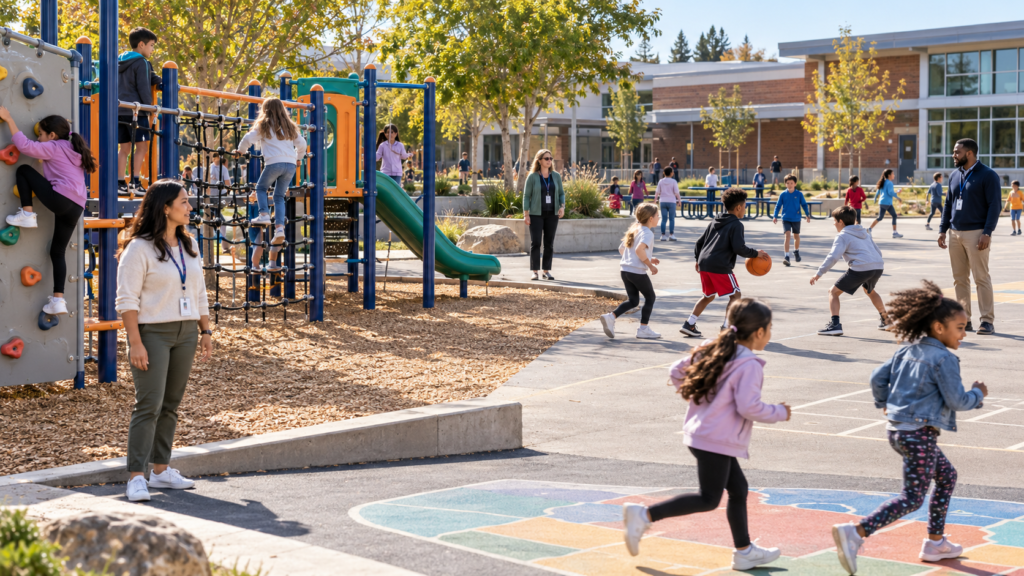
Recess safety depends on more than adults being nearby. Schools need clear zones, active supervision, reliable communication, and planned handoffs.
Recess safety depends on more than placing adults around the playground. It depends on what those adults can see, how responsibilities are divided, and what happens when someone needs help.
 Safer EdRecess Is Not a Break From Safety: Who Is Watching When Everyone Is Moving?Play episode: Recess Is Not a Break From Safety: Who Is Watching When Everyone Is Moving? (11 minutes 59 seconds)Follow on SpotifyApple
A student falls behind a play structure. One supervisor is helping another child. A second adult is watching a crowded game near the field. By the time someone notices the student on the ground, the immediate question is not whether adults were present.
It is whether anyone was responsible for watching that area.
Recess creates a different safety environment from the classroom. Students spread across a larger space, move between activities, test physical limits, and manage social situations with greater independence. Noise increases, sightlines change, and several things can demand attention at once.
That freedom is part of what makes recess valuable. It is also why supervision must be intentional.
Listen to the Episode
In Safer Ed, Season 4, Episode 9, we examine the systems that support safer recess—from active supervision and playground zones to emergency communication, inclusion, weather decisions, and the transition back to the classroom.
Episode: “Recess Is Not a Break From Safety: Who Is Watching When Everyone Is Moving?”
Presence Is Not the Same as Supervision
An adult can be on the playground without actively supervising it.
When supervisors gather in one location, focus on a conversation, or watch the same group of students, other parts of the playground may receive little attention. The problem is rarely that adults do not care. More often, the school has not clearly defined how the space should be covered.
Active supervision means scanning, moving, listening, anticipating problems, and communicating with other adults. It also means understanding where attention is most likely to be divided.
Every supervisor should know their primary area, the blind spots within it, and who will provide backup if they must assist a student or leave the playground.
A short walkthrough can often accomplish more than another written reminder. Staff members can stand in their assigned positions, check what is visible, identify obstructions, and adjust their locations before students arrive.
Give Every Area an Owner
Playgrounds naturally create supervision challenges.
Large equipment may block the view behind slides or climbing structures. Students may gather near fences, benches, doors, or storage areas. Ball games can move beyond their original boundaries. Open fields that seem easy to monitor can become difficult once students spread out.
Schools should divide the play space into clear supervision zones. Those zones should overlap enough to prevent gaps, but each one should still have a primary adult responsible for it.
The plan also needs to account for change.
If one supervisor takes an injured student inside, someone must cover that area. If a staff member is absent, the remaining zones may need to be adjusted. If equipment is closed, students may crowd into another part of the playground.
A plan created for four adults does not work when only three are present unless someone revises it.
Look Beyond the Playground Equipment
Equipment condition and protective surfacing are important, but recess safety is not simply a maintenance issue.
The U.S. Consumer Product Safety Commission’s Public Playground Safety Handbook provides guidance on equipment design, layout, surfacing, inspection, maintenance, and age appropriateness.
Schools should have a consistent process for identifying damaged equipment, displaced surfacing, protruding hardware, debris, standing water, ice, excessive heat, or other hazards. Staff members also need to know how to report a concern and who has the authority to close an area immediately.
If a hazard is discovered before one recess period, it should not remain accessible during the next one while someone waits for a work order to be reviewed.
Temporary closures should be visible, understood, and enforced.
The way students use the space deserves attention too. A walkway may become part of a running game. Students may climb on equipment in unexpected ways. A popular activity may draw more participants than the area can safely support.
Supervisors must watch the environment students are creating—not only the one adults planned.
Make Communication Part of the Plan
Recognizing a problem is only the beginning. Adults must be able to respond without leaving the rest of the playground unprotected.
A supervisor may need to contact the school nurse, provide first aid, separate students, call the office, or direct others away from a hazard. During that response, another adult must take responsibility for the larger group.
Schools should confirm that every supervisor can quickly reach help. Radios, call systems, and backup communication methods are more reliable than assuming someone will have a charged personal phone with a strong signal.
Staff members should also know what information to provide. The exact location, the nature of the concern, the assistance needed, and whether the area remains accessible can all affect the response.
Emergency procedures must be short enough to remember and practical enough to use while dozens of students are still moving nearby.
Watch the Social Environment
Recess is not only a physical environment. It is also where students choose teams, negotiate rules, form friendships, test boundaries, and work through disagreements.
Those interactions can reveal concerns that may be harder to see in the classroom.
A student may repeatedly be excluded from games. Teasing may happen in a less visible area. One activity may consistently produce conflict. A student may return from recess upset several times without explaining why.
Active supervision includes noticing those patterns.
Adults do not need to control every interaction or solve every disagreement. Students need opportunities to develop independence and problem-solving skills. But supervisors should understand when to observe, when to help students resolve a conflict, and when repeated behavior requires documentation or follow-up.
Recess should give students more freedom—not less access to adult support.
Build Inclusion Into the Space
A playground can be open to every student without being equally usable by every student.
Mobility, sensory, communication, behavioral, and medical needs can shape how students experience recess. Noise, heat, uneven surfaces, crowded equipment, and unclear boundaries may prevent some students from participating safely or comfortably.
An inclusive recess plan considers accessible routes, equipment choices, quiet spaces, communication supports, medical response needs, and alternative ways to participate.
The adults supervising recess should understand the relevant student plans and know which supports may be needed. That information should remain appropriately protected, but the responsible staff members cannot be left unprepared.
Inclusion cannot begin after the student reaches the playground.
Decide When Outdoor Recess Is No Longer Safe
Weather decisions should not depend on which adult happens to be outside.
Schools need clear standards for heat, cold, wind, precipitation, lightning, air quality, and surface conditions. Staff members should know who monitors conditions, who has the authority to move recess indoors, and how the decision will be communicated.
The National Weather Service recommends moving to safe shelter when thunder is heard and waiting at least 30 minutes after the last thunder before resuming outdoor activity. AirNow also provides guidance for adjusting school activities based on the Air Quality Index.
Indoor recess should be planned with the same care. Moving students inside changes the available space, noise level, activities, and supervision needs. A poor-weather plan should identify where students will go, what they may do, and who will supervise them.
Recess Ends With a Handoff
The whistle does not end the school’s responsibility.
Students still need to be gathered, accounted for, and returned to classroom supervision. During that transition, a student may remain near the equipment, visit the restroom, report an injury, or become separated from the group.
Recess supervisors should communicate injuries, behavioral concerns, medical issues, or other events that require follow-up. Classroom staff should know if a student has gone to the nurse or office rather than assuming the student is still outside.
Responsibility has not transferred until the next adult knows which students are present and what happened during the transition.
Learn From Patterns
A single playground incident may appear unpredictable. Several similar incidents usually tell a story.
Repeated falls in one location may point to a surface or traffic-flow problem. Frequent conflict during one game may reflect limited space or unclear expectations. Injuries near the end of recess may indicate that students are rushing or that adult attention has shifted toward lining up too early.
Near misses deserve attention as well. If an adult reaches a student moments before a serious fall, the school should ask what allowed the risk to develop—not simply celebrate the successful intervention.
A brief review can identify where an incident occurred, what activity was involved, what adults could see, how quickly the response began, and whether something similar has happened before.
That information helps schools improve the system instead of treating each incident as an isolated event.
Questions to Ask Before the Next Recess
School leaders and staff members can begin with a few practical questions:
Can adults see every active area?
Does each supervisor know which zone they own?
Who provides coverage when an adult assists a student?
Can every supervisor contact the office or nurse immediately?
Are equipment concerns reported and addressed quickly?
Are students with individual needs fully included?
How are injuries and behavioral concerns communicated during the return to class?
What recurring patterns might the school be overlooking?
Strong planning does not make recess less active or enjoyable. It gives students room to play, explore, and build independence while ensuring that capable adults are ready when support is needed.
Recess may be a break from instruction.
It is never a break from responsibility.
Learn More
Duty of care follows students throughout the school day—including playgrounds, fields, courtyards, and other spaces used for recess.
Explore Science Safety’s free Duty of Care learning module
Additional Resources
Subscribe to edCircuit to stay up to date on all of our shows, podcasts, news, and thought leadership articles.
Related reading
More on Safer Ed