

edCircuit
  • Start Here
    • Login
    • Register
    • Subscribe
    • Submit a Press release
    • Advertise or Sponsor
    • Contribute
    • Get Interviewed
  • On The Wire
  • K-12 Education
    • All K-12
    • K-12 Teachers
    • Teaching Strategies
    • Special Education and IEPs
    • Dyslexia
    • Gifted and Advanced Learning
    • Early Childhood, Pre-K and Kindergarten
    • School Calendar
    • Tutoring and Homework Help
    • Attendance and Absenteeism
    • After-School Programs
    • School Counselors
    • Homeschooling
    • School Models
    • Teacher Retention
    • Parents
    • Students
  • Teaching and Learning
    • Literacy and Reading
    • Math Education
    • Civics and History Education
    • Financial Literacy
    • Assessment and Testing
    • Curriculum and Instruction
    • Personalized Learning
    • Project-Based Learning
    • Social-Emotional Learning
    • Executive Function
    • Creativity
    • Diversity, Equity, Inclusion
  • Professional Development
    • All Professional Development
    • Educators
    • Administrators
    • edLeaders
  • Higher Education
    • All Higher Education
    • College Admissions
    • Career and Technical Education (CTE)
    • Graduation
    • FAFSA and Financial Aid
    • Student Loans
  • Artificial Intelligence
  • Cybersecurity
  • School Safety
    • All School Safety
    • Science and Lab Safety
    • School Design and Facilities
    • Bullying
    • Duty of Care and School Liability
  • Continuing Education
    • All Continuing Education
    • Online Certificate Programs
    • Teaching Jobs and Careers
    • Teacher Appreciation
  • Education Policy and Government
    • All Education Policy
    • Department of Education
    • School Choice
    • Global
    • Advocates
  • EdTech
    • All EdTech
    • Online Learning
    • Hybrid and Remote Learning
    • Augmented and Virtual Reality
    • ESports
    • Gamification and Game-Based Learning
    • Digital Citizenship
    • EdTech Entrepreneurs
    • Market Trends
    • Future of Education
  • STEM and STEAM Education
  • Media
    • EDU Shows
    • EDU Podcasts
    • Education Industry Guides and Reports
  • About edCircuit
Saturday, October 17 2026 - Welcome
  • LOGIN
Home Tags Posts tagged with "Headline"
Tag:

Headline

This if for posts to be in the featured/top section of site
AI literacy for students grade by grade: three glowing steps of AI light holding crayons and a picture book, a magnifying glass over a laptop, and a graduation cap
Artificial IntelligenceK-12Hot Topics - controversial

AI Literacy for Students: A Grade-by-Grade Guide

by EdCircuit Staff August 26, 2026
written by EdCircuit Staff 18 minutes read

AI literacy is the knowledge, skills and habits of judgment that let a person understand how artificial intelligence works, evaluate what it produces, and decide when and how to use it. For students, it has to grow with age: a young child learns that AI is made by people and can be wrong, a middle school student learns to check and disclose, and a high school student learns to weigh evidence, protect information and take responsibility for what they submit. Teaching a student to write a better prompt is a small part of that, and on its own it does not make a student AI literate.

The need is already in the classroom. In a Pew Research Center survey of U.S. teens published in February 2026, 54 percent of 13- to 17-year-olds said they had used AI chatbots for help with schoolwork, and 10 percent said they did all or most of their schoolwork with that help. Fifty-nine percent said students at their school use chatbots to cheat at least somewhat often. Access to the tools has arrived well ahead of instruction in how to judge them.

This guide sets out what AI literacy for students means, which frameworks schools can draw on, and what students should learn in elementary, middle and high school. It then turns to the conditions that make the work possible: teaching across the curriculum, time for teachers to learn, and a role for families. Parents looking for age rules and home routines will find them in edCircuit’s AI for Students: A Parent’s Guide by Age, and the wider picture for schools is in AI in Education: A Guide for Schools and Colleges.

What Is AI Literacy?

The most recent international definition comes from the OECD and the European Union. Their framework, Empowering Learners for the Age of AI: An AI Literacy Framework for Primary and Secondary Education (2026, DOI 10.1787/65cd27d4-en), was approved by the PISA Governing Board on 8 April 2026 and defines AI literacy this way: “AI literacy represents the technical knowledge, durable skills and future-ready attitudes required to thrive in a world influenced by AI. It enables learners to engage, create with, manage and shape AI, while critically evaluating its benefits, risks and ethical implications.”

The framework organizes that definition into four domains. Engage with AI is the foundation: recognizing where AI is present, evaluating its outputs and considering its role in daily life. Create with AI covers using AI as a creative partner while the learner keeps control of the work. Manage AI covers deciding how work is divided between people and AI, including whether to use AI at all for a given task. Shape AI, the culminating domain, asks learners to investigate how AI systems are designed and how they could be improved. The framework contributes to the PISA 2029 Media and Artificial Intelligence Literacy assessment, so the same ideas will be measured internationally.

The framework also draws a distinction schools should take seriously. It states that AI literacy is different from AI tool use, and that simply interacting with AI tools neither develops nor depends on the knowledge and skills it describes. A school can give every student access to a chatbot and still graduate students who cannot tell when it is wrong.

Two other frameworks are widely used. UNESCO’s AI Competency Framework for Students (2024) sets out 12 competencies across four dimensions, a human-centred mindset, the ethics of AI, AI techniques and applications, and AI system design, with students progressing through three levels: understand, apply and create. In the United States, the AI4K12 initiative has developed grade-band progression charts for K-2, 3-5, 6-8 and 9-12, organized around five big ideas: perception, representation and reasoning, learning, natural interaction, and societal impact. The AI4K12 charts are still published as drafts open for public comment.

One caution applies to any grade-by-grade plan. The OECD and EU framework describes learner expectations at basic, intermediate and advanced levels, and states that these levels do not correspond to specific ages or grades, because students arrive with very different exposure to AI. The grade bands below are a reasonable sequence for most schools, not a fixed schedule, and teachers will need to meet students where they are.

Why AI Literacy Is Now a Policy Matter

AI literacy has moved from an enthusiasm of individual teachers into public policy. Executive Order 14277, signed on April 23, 2025, states that it is the policy of the United States to promote AI literacy and proficiency among Americans. It directs federal agencies to work with outside partners on resources for teaching K-12 students foundational AI literacy and critical thinking skills, and to prioritize professional development in computer science and AI within teacher training grants.

States are acting more cautiously. California’s AB 2876 (2024) requires the state’s Instructional Quality Commission to consider AI literacy when it revises curriculum frameworks. The law does not require schools to teach AI literacy, and districts should not read it as a mandate. For most schools, the practical question is how to fit AI literacy into instruction they already provide, which is where the grade bands come in.

Elementary School: Begin With Curiosity and Caution

Elementary students do not need independent access to open-ended chatbots to begin learning about AI, and the companies behind the most common chatbots set age limits that put independent use out of reach for most of them in any case. The parent guide sets out the age rules of the main services. Much of the most valuable early work can happen through teacher-led discussion and activities that need no device at all.

A teacher can show the class two short descriptions of a historical figure, one from an approved classroom source and one generated by AI, and ask students to find the similarities, notice the missing details and check whether the AI version is accurate. The point of such an activity lies less in the chatbot than in the habit of asking how the class knows something is true. At this level, AI literacy can begin with three ideas.

AI Is Made by People

Young children often talk about technology as if it has human knowledge or intentions, saying that a device “knows,” “thinks” or “wants” something. Teachers can explain that AI systems are created by people and work from data, rules and patterns. An AI tool may produce an answer, an image or a recommendation, but it does not understand a child’s feelings, classroom, family or experiences the way a trusted adult does.

The OECD and EU framework treats this as a safety matter as well as a conceptual one: AI systems produce outputs without awareness, understanding or intent, and are incapable of authentic relationships. The idea does not require a technical lecture. Students can compare how a person and an AI tool complete the same simple task, then talk about what each needed to produce the result.

AI Can Sound Right and Still Be Wrong

Elementary students are used to trusting adults, books and educational websites for answers. AI complicates that relationship because it can present incorrect information in a confident voice. When a class asks an AI tool to describe an animal and the response places it in the wrong habitat, the teacher can ask students how they would investigate before correcting the mistake. They might check a library book, consult a trusted website or ask someone with relevant knowledge. The correction matters, but the process of finding it is what students will carry into later grades.

Some Information Stays Private

“Do not share personal information” is too vague for a young child. Students need specific examples: passwords, addresses, school schedules, health details, private photographs, full names connected to personal information, and details about family members. Teachers can present short scenarios and ask whether the information is safe to share. If a game, website or AI tool asks for a photograph or a personal detail, the expected response should be clear: stop and ask a trusted adult.

By the end of elementary school, students do not need to understand the mathematics behind machine learning. They should be able to recognize common examples of AI, explain that people created it, understand that it can make mistakes, protect personal information and ask for help when they are unsure. Teachers looking for classroom tools suited to this age will find options in edCircuit’s review of AI tools for elementary education.

Middle School: Move From Accepting to Investigating

Middle school students are more independent online, but independence does not by itself produce good judgment. This is also the age at which students begin to meet AI through search engines, social media, homework tools, image generators and consumer apps, sometimes without realizing it.

In a seventh-grade science unit on ecosystems, for example, students can ask an AI tool what might happen if a predator disappeared from a food web. Instead of accepting the first response, they compare it with their textbook, identify an unsupported claim and rewrite the answer using evidence. Used this way, the AI output becomes material to investigate rather than an answer to submit.

Explain What Generative AI Is Actually Doing

Middle school students are ready for a basic explanation of how generative AI produces content. The system identifies patterns and predicts what should come next, based on its training data and the user’s instructions. It does not automatically determine whether a claim is true, whether a source exists, or whether an answer suits a particular classroom.

Students can test this themselves by asking the same question several times, changing one phrase in a prompt, or asking for two different perspectives. The responses will often change, and that variation opens a useful discussion about how much responsibility falls on the person using the tool.

Build Three Habits: Verify, Compare and Disclose

Middle school students need routines they can use across subjects. The first is to verify important claims: locate the original source, compare information across credible references, check the date, and decide whether the evidence supports the conclusion. The second is to compare rather than accept, placing an AI-generated answer beside a textbook explanation, a primary source, a data set or a student-written response and identifying what is accurate, what is vague and what is missing.

The third habit is to disclose how AI contributed to the work. A short statement is often enough:

I used an AI tool to create practice questions before the assessment. I completed the graded assignment independently.

Disclosure makes the process visible without treating every use of AI as misconduct. A clear record also protects a student whose work is wrongly suspected of being written by AI.

Talk Honestly About Bias

AI systems learn from data created and collected in the real world, and that data may reflect stereotypes, unequal representation, historical patterns and gaps in whose experiences were recorded. A teacher might ask an image generator several times to depict a scientist, an executive, a family or a successful student, and the class can examine the patterns across the images: who appears most often, who is missing, and what assumptions seem to repeat. Students do not need to conclude that every output is deliberately unfair. They need to become comfortable noticing patterns and asking why they exist.

Clarify Assistance Versus Substitution

Middle school students are also ready to discuss a difficult boundary: when AI supports learning and when it replaces the work. Generating practice questions, asking for another explanation or receiving feedback on organization may help a student learn. Asking AI to complete the assignment may remove the thinking the assignment was designed to develop. The answer depends on the learning objective, which is why teachers need to state clearly when AI is allowed and what kind of help is acceptable. edCircuit’s AI Rules for Schools: A Back-to-School Guide covers how schools are setting those expectations.

By the end of middle school, students should treat an AI response as information to examine rather than an answer to collect. Teachers can find age-appropriate options in edCircuit’s review of AI tools for middle school classrooms.

High School: Build Independence and Accountability

High school AI literacy prepares students for decisions that extend well beyond a single assignment, into college, work and civic life. In a government class, students might ask AI to summarize a local policy debate and then compare the summary with meeting minutes, local reporting, public documents and statements from people affected by the proposal. Such a comparison can surface an omitted community concern or a cited source that does not support the claim attached to it, and students learn how technology can shape public understanding of an issue as well as how to check a fact.

Look Beyond the Surface of a Polished Answer

High school students should be able to evaluate the reasoning behind an AI-generated response. They should ask whether the evidence is relevant, whether assumptions are being presented as facts, whether an important counterargument is missing, whether the citations exist, and whether the wording is more confident than the evidence justifies. Annotating AI outputs, identifying logical gaps, replacing weak evidence and explaining why a revision is needed build this skill far better than asking whether an answer is simply good or bad.

Understand Data and Different Types of AI

Not every AI system is a chatbot. Students encounter recommendation systems, facial recognition, predictive models, automated screening, image generators, voice systems and the algorithms that help decide which information they see. The OECD and EU framework separates generative AI, which creates new content from patterns in its training data, from predictive AI, which forecasts what is likely to happen next and sits inside recommendation engines, spam filters and personalized learning applications. These systems work differently and create different risks, including synthetic images and audio that can be used to harm classmates; edCircuit has covered AI deepfakes as a school safety threat.

High school students should understand that AI systems depend on data and that data can contain errors, exclusions, copyrighted material and historical inequalities. The framework’s Shape AI domain asks learners to investigate how a system is intended to work, whom it is designed for and what its limitations are. Students do not need to become programmers to ask those questions well.

Examine Ownership, Voice and Originality

Generative AI raises questions that a traditional definition of plagiarism cannot settle on its own. If AI restructures an essay, how much of the final voice still belongs to the student? If an image generator imitates the style of a living artist, is the result original? If an AI system produces a false accusation or a harmful recommendation, who is accountable? Students need to discuss these questions in school before they meet them in college, the workplace or public life.

For substantial AI-assisted work, a short process record can help. Students might note the tool they used, the prompts they gave, what they accepted, what they rejected, how they verified the output and what they contributed independently. Such a record makes accountability concrete for the student and gives the teacher something to discuss besides a suspicion.

Know When AI Is the Wrong Tool

One of the most mature decisions a student can make is to choose not to use AI. The OECD and EU framework lists this as the first competence in its Manage AI domain: deciding whether to use AI systems based on the nature of the task. A personal reflection may lose its meaning if a machine writes it. A student practicing algebra may need the struggle of working through the steps. Uploading a scholarship essay, a private record or original creative work may create privacy or ownership problems the student did not anticipate. A student who turns to AI for every task is showing dependence on the tool, whatever the quality of the result.

Before graduation, students should be able to:

  • Explain the basic operation and limitations of common AI systems
  • Evaluate claims, evidence, reasoning and sources
  • Recognize bias and investigate where it may come from
  • Protect personal, academic and organizational information
  • Document and disclose meaningful AI assistance
  • Preserve their own voice and intellectual contribution
  • Consider the social and civic effects of automated decisions
  • Decide when human work is the better choice
  • Accept responsibility for anything they submit or publish

These skills do not depend on any one generation of tools, and students will rely on them long after the current products have changed. edCircuit’s review of AI tools shaping high school learning describes what students at this level are likely to use.

How Can Schools Teach AI Literacy Across the Curriculum?

AI literacy cannot sit only inside the technology department. English teachers can address authorship, evidence, voice and source verification. Science teachers can examine models, data quality and the difference between prediction and proof. Social studies teachers can explore power, representation and automated decision-making. Art teachers can discuss creative ownership and imitation, and mathematics teachers can help students understand data, probability and patterns.

Career and technical education programs can examine how AI is changing specific industries, and librarians can lead work on research, credibility, citation and verification. Computer science remains important, especially for students who want to understand or design AI systems in depth, but AI literacy belongs wherever students meet information, create work or make decisions, which is nearly every classroom. The OECD and EU framework makes the same point, noting that AI literacy does not rest on a single educator or a single subject area.

Teachers Need Time to Learn

Students cannot develop sound judgment about AI if their teachers receive only a list of approved tools and a short demonstration. Guidance is still thin. In a Gallup and Walton Family Foundation survey of 2,069 public K-12 teachers published in May 2026, only 18 percent said they received any formal guidance from school administrators on how AI tools should be used; 48 percent received only informal guidance and 34 percent none.

UNESCO’s AI Competency Framework for Teachers (2024) sets out 15 competencies across five dimensions: a human-centred mindset, the ethics of AI, AI foundations and applications, AI pedagogy, and AI for professional learning. Professional learning built on it needs time for teachers to test tools, find errors, examine privacy concerns, discuss ethical questions and redesign assignments. Teachers also need shared language for explaining when AI is permitted and what students must disclose. A product demonstration can show an educator how to generate a lesson plan, but whether that lesson is accurate, appropriate and worth teaching remains a matter of professional judgment.

Families Need a Place in the Conversation

Students’ use of AI does not stay inside the school day. They meet it while doing homework, using social media, playing games, searching online and creating content. Families do not need to become experts on every platform, but they do need enough information to ask useful questions:

  • What tool are you using?
  • What did you ask it to do?
  • How do you know the answer is accurate?
  • Did you share any personal information?
  • Is AI allowed for this assignment?
  • What part of the work is still yours?

The OECD and EU framework describes parents and caregivers as trusted adults who support AI literacy by attending to how AI shapes children’s well-being, relationships and decision making, and suggests families use the framework as a starting point for conversations at home. Schools can support those conversations with plain-language guidance, examples of appropriate home use, privacy reminders, information about approved tools and consistent expectations for academic honesty.

Build a Progression, Not a One-Time Lesson

A school assembly about AI may raise awareness, but literacy takes repeated practice as students’ independence and access grow. Elementary students begin by recognizing AI and asking for help. Middle school students investigate outputs, verify claims and disclose assistance. High school students evaluate systems, examine consequences and take responsibility for their choices.

Schools do not need to create a separate course before beginning. They can map AI literacy onto work already under way in digital citizenship, research skills, media literacy, computer science, academic integrity and subject-area instruction; edCircuit’s coverage of teaching students about their digital footprint shows how closely the two fit. The TeachAI Guidance for Schools Toolkit (2025) makes educating staff and students about AI one of its core principles, covering how AI works, its limitations and its ethical implications, alongside principles on academic integrity and on keeping students and teachers in charge of their own decisions.

A practical first step is to select a small number of outcomes for each grade band, drawing on the OECD and EU domains, the UNESCO competencies or the AI4K12 progressions, and then identify where those outcomes already fit within existing lessons and where new instruction is needed. The tools students recognize today may be replaced before they graduate. The habits of questioning, verifying, protecting information, acknowledging assistance and accepting responsibility will still serve them, and those habits are what allow young people to use powerful technology without giving up their privacy, honesty, creativity or capacity to think for themselves.

Related reading

  • AI for Students: A Parent’s Guide by Age
  • AI in Education: A Guide for Schools and Colleges
  • AI Rules for Schools: A Back-to-School Guide
  • Digital Footprint: Why Schools Must Teach It Now
  • AI Deepfakes: The New School Safety Threat

Subscribe to edCircuit to stay up to date on all of our shows, podcasts, news, and thought leadership articles.


August 26, 2026 0 comments
0 FacebookTwitterPinterestLinkedinWhatsappCopy LinkEmail
Teacher smiles and talks with a student at a desk in a bright classroom
EducatorsStudentsHot Topics - controversialK-12Attendance and Absenteeism

Why Students Need Relationships Before Rigor

by EdCircuit Staff August 26, 2026
written by EdCircuit Staff 7 minutes read

Why students need relationships before rigor begins with a simple but powerful reality.

A student sits quietly in the back of a classroom on the first day of school.

No one noticed the anxiety they carried through the doors that morning.

No one sees the uncertainty behind their smile.

No one hears the questions running through their mind.

Will I fit in?

Will I make friends?

Will my teachers care about me?

Will I succeed here?

Before that student can focus on a lesson, solve a problem, write an essay, or participate in a discussion, they must answer a much more important question:

Do I belong here?

For decades, educators have focused on curriculum, instruction, assessment, and accountability. These elements remain essential to student success. Yet growing research and everyday experience continue to reinforce a truth that many educators have always understood instinctively: learning is deeply connected to relationships.

Students learn best when they feel connected.

They learn best when they feel valued.

They learn best when they feel that they belong.

Relationships are not separate from learning.

They are the foundation of learning.

Every Student Wants to Be Seen

One of the most powerful questions educators can ask is deceptively simple:

Does every student feel known?

Students arrive at school carrying different experiences, challenges, strengths, and dreams. Some enter the building eager to engage. Others arrive carrying burdens that classmates and teachers may never fully understand.

For many students, school may be the most stable environment in their lives. It may be the place where they encounter caring adults, supportive peers, and opportunities to succeed. For others, school may represent uncertainty or anxiety.

Regardless of circumstance, every student wants to know that they matter.

A teacher greeting students at the classroom door, a counselor checking in after a difficult week, a principal attending extracurricular activities, or a bus driver remembering a student’s name may seem like small gestures. Yet these moments communicate something powerful.

You belong here.

Students rarely remember every lesson they receive.

They remember how people made them feel.

Belonging Drives Engagement

Engagement is often discussed as a goal in education, but engagement does not happen by accident.

Students who feel connected to their school community are more likely to participate in class, attend regularly, complete assignments, and seek support when needed. They are more likely to join activities, develop friendships, and view themselves as valued members of the school community.

Belonging creates investment.

When students believe they are part of something larger than themselves, they become more willing to contribute, collaborate, and challenge themselves academically.

The opposite is also true.

Students who feel disconnected often withdraw. They may stop participating, avoid opportunities, or disengage entirely. In many cases, what appears to be an academic issue is actually a relationship issue.

Before schools can improve outcomes, they must first ensure students feel connected.

Students Show Up for People

Schools across the country continue to focus on improving attendance, reducing chronic absenteeism, and increasing student engagement. While attendance data often highlights the problem, relationships frequently reveal the solution.

Students are more likely to show up when they know someone is expecting them.

They are more likely to attend when they feel connected to a teacher, coach, counselor, advisor, or support staff member who genuinely cares about their success.

For many students, the motivation to come to school is not a schedule, a program, or even a class.

It is a person.

A trusted adult can become the difference between engagement and withdrawal, participation and isolation, persistence and giving up.

Students show up where they feel connected.

And connection begins with relationships.

Relationships Create Safe Places to Learn

Learning can be uncomfortable.

Students are asked to solve unfamiliar problems, express new ideas, take academic risks, and confront concepts they do not immediately understand. These experiences require courage.

Students are far more willing to embrace those challenges when they trust the adults guiding them.

A classroom built on strong relationships becomes a place where mistakes are viewed as part of growth rather than evidence of failure. Students become more willing to ask questions, share ideas, and persevere through difficult tasks because they know they will be supported along the way.

Psychological safety is not a luxury.

It is a prerequisite for learning.

The most effective educators understand that creating safe learning environments begins long before instruction starts.

It begins with relationships.

Teachers Are the Difference

Few people influence a student’s experience more than a teacher.

Teachers have the opportunity to create classrooms where students feel respected, encouraged, and challenged. They establish the tone, shape expectations, and often become the adults students trust most within the school setting.

The strongest teachers understand that relationships and rigor are not competing priorities.

They are complementary.

Students are more likely to embrace high expectations when they know those expectations come from someone who genuinely believes in their potential. Trust creates the confidence necessary to tackle difficult work and overcome obstacles.

Great teachers do not lower standards to build relationships.

They build relationships that allow students to meet high standards.

Support Staff Strengthen Connections

The adults who impact students extend far beyond classroom teachers.

Office professionals, paraprofessionals, counselors, cafeteria employees, bus drivers, custodians, coaches, and countless others contribute to the relationships that shape student experiences.

Many students develop meaningful connections with adults they encounter outside the classroom. A counselor may help a student navigate a personal challenge. A bus driver may provide a consistent source of encouragement. A cafeteria employee may offer a smile that changes the trajectory of a difficult day.

These interactions matter because belonging is built throughout the school, not just inside classrooms.

Every adult contributes to the culture students experience.

And every adult has the potential to become the trusted person a student needs.

Student Voice Matters

Students are more likely to feel connected when they believe their voices matter.

Schools that actively seek student input often discover valuable insights about culture, engagement, and learning. Students want opportunities to contribute ideas, share perspectives, and participate in decisions that affect their daily experiences.

Listening to students communicates respect.

It demonstrates that schools view learners not simply as recipients of education but as active members of the community.

When students feel heard, they become more invested.

When they become more invested, they become more engaged.

And engagement leads to growth.

Families Help Build the Bridge

Relationships do not stop at the school doors.

Families play a critical role in helping students feel connected to their learning environments. Strong partnerships between schools and families create consistency, trust, and shared expectations.

Parents and guardians want to know that educators care about their children as individuals. Communication that focuses on strengths, progress, and partnership helps build confidence and trust.

When schools and families work together, students benefit.

They receive a powerful message that the adults in their lives are united in supporting their success.

Rigor Still Matters

The argument for relationships before rigor is not an argument against academic excellence.

In fact, it is the opposite.

Strong relationships create the conditions necessary for rigorous learning. Students who trust their teachers are more likely to embrace challenges. Students who feel connected are more likely to persevere through setbacks. Students who believe they belong are more likely to engage fully in the learning process.

Relationships do not replace rigor.

They make rigor possible.

The most successful schools are not forced to choose between academic excellence and meaningful relationships.

They understand that the two are inseparable.

Great Schools Start With Belonging

Schools will continue to evolve.

Technology will change.

Curriculum will change.

Assessment models will change.

Educational initiatives will come and go.

Yet one truth remains remarkably consistent.

Students learn best when they know someone cares.

They learn best when they feel safe enough to take risks.

They learn best when they believe they belong.

Long after the lessons are forgotten, and the grades fade into memory, students remember the adults who saw potential in them before they saw it in themselves.

They remember the teacher who believed in them.

The counselor who listened.

The coach who encouraged them.

The bus driver who greeted them.

The cafeteria employee who knew their name.

The adults who helped them feel seen.

Because relationships leave lasting impressions.

Relationships create belonging.

Relationships build confidence.

Relationships unlock potential.

And relationships are not an obstacle to academic achievement.

They are the pathway to it.

Subscribe to edCircuit to stay up to date on all of our shows, podcasts, news, and thought leadership articles.
August 26, 2026 0 comments
0 FacebookTwitterPinterestLinkedinWhatsappCopy LinkEmail
Diverse team around a conference table discussing strategy, with a glowing central target and connected goal icons.
Hot Topics - controversialK-12

Technology Strategy Must Align With District Goals

by EdCircuit Staff August 25, 2026
written by EdCircuit Staff 6 minutes read

Technology strategy has become increasingly important as school districts navigate artificial intelligence, cybersecurity, budget pressures, and rising expectations from their communities. Yet successful technology strategies rarely begin with devices, software platforms, or infrastructure. Instead, they begin with a clear understanding of what districts are trying to accomplish and how technology can support those priorities.

That distinction has become increasingly important because technology is no longer a separate function operating alongside the rest of the organization. Digital tools are embedded within teaching and learning, communication, operations, school safety, and strategic planning. As a result, technology decisions have become organizational decisions, and technology leaders are increasingly expected to align their work with the broader mission and vision of the district.

The most effective leaders understand that technology should not define strategy.

It should support it.

Technology Should Support the Mission, Not Create Its Own

Technology departments face a constant stream of new products, emerging trends, and promises of transformation. Artificial intelligence platforms, cybersecurity solutions, communication systems, and instructional applications all claim to improve outcomes and solve pressing challenges. With so many options available, it can be tempting to build plans around the technology itself.

But successful districts approach the process differently.

Rather than asking which products they should purchase, they begin by asking what they are trying to accomplish. Their focus remains on students, educators, and organizational priorities rather than features and functionality.

Technology exists to support teaching and learning. It helps districts communicate with families, streamline operations, strengthen cybersecurity, and create opportunities for students. Those goals are not separate from the district’s mission. They are extensions of it.

When technology initiatives become disconnected from organizational priorities, leaders risk investing in tools that create complexity rather than value. Alignment ensures that technology serves a larger purpose and contributes to the long-term success of the district.

Strategic Alignment Creates Understanding and Support

Strategic alignment does far more than improve decision-making.

It creates understanding and support throughout the organization.

When technology initiatives are clearly connected to district priorities, stakeholders are more likely to recognize their importance and understand why investments matter. Alignment provides a common language that allows boards, families, educators, and administrators to see how technology contributes to the larger mission of the district.

Superintendents can explain how initiatives support strategic plans. Boards can see how investments align with community expectations. Teachers understand how new tools connect to instructional priorities. Families gain confidence that resources are being used responsibly.

Without those connections, technology initiatives can appear isolated or disconnected from the larger work of the organization. Stakeholders may view projects as individual purchases rather than components of a broader strategy.

By contrast, technology leaders who consistently connect investments to district goals create trust and build credibility over time. Strategic alignment transforms technology from a collection of projects into a coordinated effort that advances the mission of the district.

Start With Problems, Not Products

One of the most common mistakes organizations make is allowing products to drive conversations.

Emerging technologies naturally generate excitement. New platforms promise efficiency. Artificial intelligence tools promise productivity. Vendors highlight features and capabilities that appear compelling. Yet successful leaders understand that technology planning should begin with problems rather than products.

Instead of asking which artificial intelligence platform to purchase, leaders might begin by asking how they can reduce administrative burdens and create more time for teaching and learning. Rather than focusing on selecting a communication platform, they may start by examining how to strengthen family engagement and improve access to information. Instead of purchasing a dashboard because it offers sophisticated analytics, they may first consider how better information can support decision-making.

The difference may appear subtle, but it fundamentally changes the conversation.

Starting with problems encourages leaders to focus on needs rather than trends. It creates opportunities for collaboration and prevents districts from adopting solutions before fully understanding the challenges they are trying to address.

Technology should always serve the objective.

The objective should never become serving the technology.

When districts begin with purpose, they are far more likely to identify solutions that create lasting value rather than simply adding another tool to an already crowded ecosystem.

Artificial Intelligence Has Made Strategy More Important Than Ever

Few developments have highlighted the importance of strategy more than artificial intelligence.

AI has introduced tremendous opportunities, but it has also raised important questions involving governance, ethics, privacy, professional learning, and responsible use. These are not simply technical issues that can be solved through implementation alone.

They are strategic questions.

District leaders are increasingly asking how artificial intelligence aligns with instructional priorities, what policies are necessary, and how educators should be supported. Parents want reassurance that these tools are being used responsibly. Boards want accountability and transparency. Teachers need guidance and professional learning to understand how AI can enhance rather than replace effective instructional practices.

Artificial intelligence has accelerated a shift that was already underway.

Technology leaders are now helping shape organizational strategy rather than simply managing systems. They are helping districts establish guardrails, navigate uncertainty, and ensure that innovation remains aligned with educational goals.

In many respects, AI has reinforced an important truth.

Technology decisions are leadership decisions.

And leadership decisions require strategy.

Collaboration Produces Better Decisions

Technology strategy is not created in isolation.

The most successful plans are built through collaboration because different stakeholders bring different perspectives to the conversation.

Curriculum leaders focus on instruction and student outcomes. Finance departments emphasize sustainability and long-term costs. Teachers provide practical insights about classroom realities and implementation challenges. Boards focus on accountability and community expectations. Superintendents provide vision and ensure that technology remains aligned with organizational priorities.

Each perspective contributes something valuable.

Technology leaders occupy a unique position because they help bring those perspectives together. Their role is not simply to advocate for tools and systems, but to facilitate conversations that balance competing priorities and create shared understanding.

No single department possesses all the answers.

And the strongest strategies emerge when diverse voices contribute to the process.

Technology strategy, ultimately, is a team effort.

Effective Strategies Require Flexibility

Long-term planning remains essential, but technology evolves too quickly for rigid plans to remain effective indefinitely.

Strong strategies provide direction without creating unnecessary constraints. Leaders need a clear vision, but they also need the flexibility to adapt as circumstances change. New technologies emerge. Cybersecurity threats evolve. Community expectations shift. Artificial intelligence continues to create opportunities that few people could have anticipated just a few years ago.

Successful leaders recognize that strategy is not a static document that sits on a shelf.

It is an ongoing process.

Continuous evaluation, regular communication, and a willingness to adapt help organizations remain responsive without losing sight of their larger goals. Flexibility allows districts to embrace innovation while maintaining focus on what matters most.

The best strategies provide clarity without sacrificing adaptability.

Purpose Must Come Before Technology

Technology will continue to evolve. Artificial intelligence will create new opportunities. Cybersecurity challenges will become more complex. New platforms and applications will emerge, each promising to transform teaching and learning.

But the strongest districts will resist the temptation to allow technology to define their priorities.

Instead, they will begin with purpose.

They will ask what they hope to accomplish, what problems they are trying to solve, and how technology can help them achieve those goals. Those questions shift the conversation from products to priorities and from features to outcomes.

Because successful technology strategies are not built around devices, software, or trends.

They are built around students.

And when purpose leads, technology becomes a powerful tool for advancing the mission that matters most.

Subscribe to edCircuit to stay up to date on all of our shows, podcasts, news, and thought leadership articles.

August 25, 2026 0 comments
0 FacebookTwitterPinterestLinkedinWhatsappCopy LinkEmail
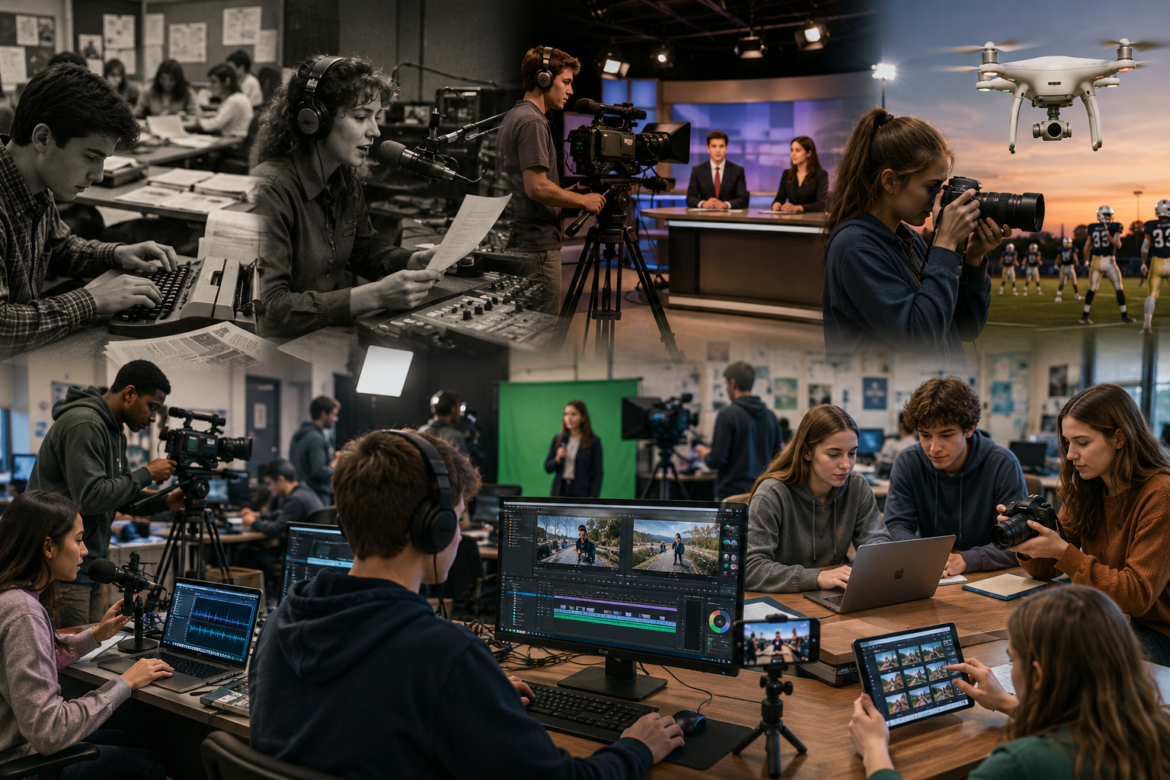
Collage of student reporters and editors filming, editing, and broadcasting in a multi-scene media studio, with a drone overhead and a news desk in the background.
StudentsHot Topics - controversialK-12

How High School Media Programs Prepare Future Creators

by EdCircuit Staff August 24, 2026
written by EdCircuit Staff 7 minutes read

High school media programs are preparing future creators by teaching students how to tell stories, communicate with purpose, and produce content for a rapidly changing digital world.

There was a time when the heartbeat of a high school media department could be heard in the shuffle of paper, the clacking of keyboards, and the urgency of a looming print deadline. In classrooms tucked away near English departments or administrative offices, student journalists hurried to finish articles, finalize layouts, and send the next edition of the school newspaper to print. Reporters chased down quotes in hallways. Editors debated headlines. Photographers rushed to develop film or upload images before the final bell.

By the next morning, stacks of freshly printed newspapers would appear throughout the building. Students grabbed copies between classes, flipping pages to find their friends, read about last night’s game, or catch up on school news. It was simple, tangible, and powerful. The message was clear: stories mattered, and students had a voice in telling them.

From Print to Broadcast: Expanding the Student Voice

That voice did not stay confined to print.

As technology advanced, many schools expanded their media programs to include student-run radio stations. Suddenly, storytelling was no longer just written—it was spoken. Students stepped behind microphones, learned how to script segments, manage sound, conduct interviews, and deliver content with clarity and confidence. The radio booth became a new kind of classroom, one that rewarded preparation, presence, and personality.

Then came another shift.

Television studios began appearing in high schools, transforming morning announcements into full-scale productions. Cameras rolled. The lights turned on. Teleprompters guided student anchors through daily broadcasts. Behind the scenes, production teams managed audio, switching, graphics, and editing. What had once been a simple announcement over a loudspeaker became a polished program watched by an entire school community.

Each step in this evolution added something new, but it never replaced what came before. It expanded it.

Today’s Media Classroom: A Working Production Lab

Today, high school media programs no longer fit into a single category. They are no longer just newspapers, radio stations, or TV studios. They are dynamic, multimedia environments where students learn to create content across platforms. A single media class may include journalism, video production, podcasting, photography, graphic design, livestreaming, and social media strategy—all within the same program.

Walk into a modern media classroom, and the transformation is clear.

One group of students may be editing a highlight reel from last night’s football game, cutting together footage captured from multiple cameras and even drone angles. Another group may be recording a podcast, discussing school events, or interviewing a guest. Across the room, a student is designing graphics for social media, while another writes a feature story for the school website. In a corner, a livestream team prepares to broadcast an upcoming event, checking audio levels and testing connections.

It is not one class. It is a working media lab.

Real-Time Storytelling: Friday Night Lights, Reimagined

On a Friday night, that lab often moves outside the classroom.

At a high school football game, a full student media team may be at work. One student operates the main camera, tracking every play. Another manages a secondary angle, capturing sideline reactions. A third student handles the livestream, ensuring the broadcast reaches families who cannot attend. In the press box, two students call the game, providing play-by-play and analysis. On the sidelines, another student clips highlights in real time, posting key moments to social media before the next drive begins. By Saturday morning, a polished recap video is already live, complete with interviews, graphics, and music.

What once took days now happens in hours.

Schools as Media Companies

This shift reflects a much larger change happening beyond school walls. The way people consume information has transformed dramatically. Audiences no longer rely on a single source or format. They move seamlessly between video, audio, social media, and written content, often within minutes. News is no longer something that arrives once a week or even once a day. It is constant, immediate, and interactive.

Schools have responded to this shift in a powerful way: they have become their own media companies.

Across the country, districts now produce a steady stream of content: videos, newsletters, podcasts, social media updates, livestreams of athletic events and graduations, and features highlighting student achievement. These are not side projects. They are essential tools for communication, transparency, and community engagement.

In many cases, students are at the center of this work.

They are filming games on Friday nights, editing recaps on Saturday mornings, and posting highlights before the weekend ends. They are interviewing principals, teachers, and community leaders. They are producing content that reaches not just their peers, but families, alumni, and the broader community. They are learning, in real time, what it means to communicate with an audience.

Tools of the Trade: Professional Skills in High School

And they are doing it with tools that mirror professional environments.

Today’s media students work with high-quality cameras, audio equipment, lighting setups, editing software, and livestreaming platforms. They learn how to frame a shot, capture clean audio, edit video, design graphics, and analyze engagement. They understand how different platforms require different approaches. A long-form feature story is not the same as a short video clip. A podcast requires a different rhythm than a social post. A livestream demands preparation and adaptability.

AI in the Media Classroom: Power and Responsibility

Increasingly, they are also learning to work with emerging technologies.

Artificial intelligence is becoming part of the modern media classroom in ways that are both practical and powerful. Students use AI tools to generate captions, transcribe interviews, translate content for broader audiences, clean up audio, and organize large amounts of footage quickly. For some students, AI is also helping improve accessibility, making content easier to consume for viewers with different needs. It allows them to produce more content, more efficiently, and with greater reach.

But these tools also introduce important questions.

Just because something can be created faster does not mean it should be published immediately. Students must learn how to balance speed with accuracy, creativity with responsibility, and automation with human judgment. AI can assist with production, but it cannot replace critical thinking, ethical decision-making, or the ability to ask the right questions. Those remain at the core of every strong media program.

From Classroom to Career Pathways

This is where the true value of modern media programs becomes clear.

They are not simply teaching students how to create content. They are teaching them how to communicate with purpose.

That skill extends far beyond the classroom.

Students who participate in media programs graduate with experience that translates directly into real-world opportunities. Some will pursue careers in journalism, broadcasting, filmmaking, or photography. Others will move into marketing, public relations, digital media, or communications. Increasingly, students are entering fields like sports media, social media management, content creation, and brand storytelling. Some launch their own photography or video businesses before they even graduate. Others manage social accounts, produce highlight reels for athletes, or create content that builds a following online.

These are not future skills. They are current ones.

In a world driven by information, communication is no longer a niche skill. It is a universal one.

Confidence, Voice, and Impact

And perhaps most importantly, media programs give students something that cannot be measured on a test: confidence.

There is a unique sense of ownership that comes from creating something for an audience. When students publish a story, produce a video, or host a podcast, they are putting their work into the world. They are learning to take risks, accept feedback, and improve. They are learning that their voice matters.

That lesson stays with them.

The Future of Storytelling Starts Here

Somewhere today, a student is walking into a high school media classroom for the first time. They may think they are there to learn how to edit video, record audio, or operate a camera. What they are really learning is how to tell stories that matter.

The newspaper may have become a podcast. The radio station may have become a livestream. The television studio may now include drones, digital editing, and artificial intelligence.

But the mission has remained remarkably consistent.

Give students a voice. Teach them to use it responsibly. And help them tell the stories that bring a community together.

Every school has stories worth telling.
Every student has a voice worth hearing.
And in today’s world, knowing how to communicate may be just as important as what you know.

Play video: Wake Up Winthrop 6.12.2026 *LAST EPISODE OF THE SCHOOL YEAR* (15 minutes 41 seconds)15:41
Wake Up Winthrop 6.12.2026 *LAST EPISODE OF THE SCHOOL YEAR*15 min 41 sWinthrop High School- Media Department on YouTube

Winthrop High School- Media Department – Wake Up Winthrop 6.12.2026 *LAST EPISODE OF THE SCHOOL YEAR* (Play video)

Subscribe to edCircuit to stay up to date on all of our shows, podcasts, news, and thought leadership articles.

August 24, 2026 0 comments
0 FacebookTwitterPinterestLinkedinWhatsappCopy LinkEmail
A woman presenting to a diverse conference table; glowing data lines connect colleagues in separate scenes.
EducatorsHot Topics - controversialK-12

Leadership Storytelling Builds Support for Technology

by EdCircuit Staff August 21, 2026
written by EdCircuit Staff 6 minutes read

Leadership storytelling has become one of the most important skills for modern technology leaders as districts face increasing expectations around accountability, transparency, and strategic investment. While dashboards and analytics provide valuable insights, numbers alone rarely create understanding. Technology leaders are increasingly discovering that their ability to communicate the story behind their work may be just as important as the work itself.

School systems generate enormous amounts of information. District leaders can measure uptime, application usage, cybersecurity incidents, help desk requests, and countless other metrics. Yet even the most sophisticated reports do not automatically answer the questions stakeholders care about most. Families want to understand how technology supports their children. Board members want to know how investments align with district priorities. Community members want reassurance that resources are being used wisely.

Those questions cannot be answered through charts and spreadsheets alone.

They require leaders who can connect technology decisions to meaningful outcomes and explain why those decisions matter.

Data Does Not Speak for Itself

Technology leaders naturally gravitate toward facts and figures. Data provides evidence, demonstrates accountability, and helps organizations make informed decisions. Yet numbers without context often leave stakeholders with more questions than answers.

A report showing 99.9 percent network uptime may be impressive to information technology professionals, but most board members and parents are unlikely to understand the significance of that number. What they do understand is uninterrupted instruction. They understand that students were able to complete assessments without disruption and that teachers could focus on learning instead of troubleshooting technical problems.

The same principle applies to cybersecurity. A successful year in cybersecurity may produce very little to report. There may be no ransomware attacks, no compromised data, and no interruptions to instruction. To technology leaders, that represents a tremendous accomplishment. To stakeholders, however, the value becomes clear only when leaders explain that prevention itself is success.

Data establishes credibility and provides evidence that leaders are acting responsibly. Stories, however, help stakeholders understand why those numbers matter. Together, evidence and experience create a more complete picture of impact, allowing leaders to connect technical accomplishments with outcomes that resonate with teachers, families, boards, and communities.

Different Audiences Need Different Stories

One of the realities of leadership is that people define value differently.

Teachers often focus on whether technology saves time and improves instruction. Parents prioritize communication and accessibility. Finance departments examine sustainability and efficiency. Board members are concerned with strategic goals, accountability, and long-term impact. Each perspective is valid, and each requires leaders to communicate in ways that are meaningful to that audience.

A presentation centered on bandwidth upgrades, redundancy, and infrastructure improvements may resonate with technical teams, but it may not connect with board members or families. Those audiences are far more likely to respond to conversations about protecting instructional time, supporting assessments, and ensuring students and teachers have reliable access to learning resources.

Effective communication is not about simplifying complex topics or avoiding technical details.

It is about making those details relevant.

That responsibility has increasingly transformed technology leaders into translators. Their role is no longer simply to explain how systems work, but to help others understand why those systems matter.

Stories Create Understanding

People rarely remember statistics.

They remember experiences.

Parents may not recall application usage reports, but they remember receiving timely information from their child’s school. Teachers may not remember the details of infrastructure improvements, but they appreciate fewer disruptions and more time spent focusing on students. Board members may not remember network performance metrics, but they understand how reliable systems protected instructional time and supported district priorities.

Stories provide context that numbers alone cannot.

This does not mean leaders should abandon data. On the contrary, evidence remains essential. Technology leaders need metrics to demonstrate accountability and provide objective measures of success. But numbers become far more powerful when they are connected to experiences people understand.

A network upgrade is not simply about increased bandwidth.

It is about protecting learning.

A communication platform is not simply about message delivery.

It is about strengthening relationships with families.

A cybersecurity investment is not simply about software.

It is about protecting trust.

The most effective leaders understand how to combine evidence with experiences, helping stakeholders see not only what happened, but why it matters.

Technology Leaders Have Become Translators

The role of technology leadership has changed dramatically over the past decade. Technical expertise remains essential, but today’s leaders spend much of their time translating complex topics into language that diverse stakeholders can understand.

Artificial intelligence provides an excellent example.

Questions surrounding AI extend far beyond implementation. Teachers want guidance and professional learning. Parents want reassurance that tools are being used responsibly. Boards want governance and accountability. Superintendents want alignment with district priorities and strategic plans.

Each group approaches the conversation from a different perspective.

Technology leaders are often responsible for bringing those perspectives together and creating a shared understanding. Similar challenges exist with cybersecurity, infrastructure investments, privacy concerns, and digital learning initiatives.

In many respects, modern technology leaders spend as much time communicating as they do managing systems. Increasingly, communication has become a leadership skill rather than a soft skill.

The ability to translate complexity into clarity may be one of the defining characteristics of effective leadership in the years ahead.

Trust Is Built Through Communication

Trust remains one of the most valuable assets any organization possesses.

Communities trust schools to use resources responsibly. Families trust districts to protect student information. Teachers trust leaders to provide reliable systems and meaningful support. Boards trust administrators to make decisions that align with district priorities and community expectations.

Those relationships are strengthened through communication.

When leaders communicate openly and consistently, they create confidence. Stakeholders are more likely to support difficult decisions when they understand the reasoning behind them. Transparency reduces uncertainty and builds credibility over time.

Trust is rarely established through a single presentation or annual report. It develops gradually through conversations, relationships, and a consistent commitment to helping others understand both challenges and opportunities.

In many ways, districts do not invest in technology.

People invest in leaders they trust.

And that trust often determines whether organizations are willing to embrace innovation, support change, and navigate uncertainty together.

Storytelling Helps Leaders Prepare for the Future

As artificial intelligence, cybersecurity threats, and budget pressures continue to reshape education, technology leaders will face increasingly complex conversations. New tools will emerge. Expectations will evolve. Communities will continue to demand accountability and transparency.

Technical expertise will always matter.

But expertise alone will not be enough.

The leaders who thrive in the years ahead will be those who can explain complex ideas with clarity, connect technology investments to organizational goals, and help stakeholders understand how innovation supports the mission of the district.

Leadership has always involved guiding people through change.

Storytelling helps leaders do exactly that.

It creates understanding.

Understanding builds confidence.

Confidence builds trust.

And trust creates support.

The Story Behind the Technology Matters

School systems will continue to generate more data, adopt new technologies, and navigate increasingly complex challenges. Dashboards will become more sophisticated. Artificial intelligence will create new opportunities and new responsibilities. Yet one truth is unlikely to change.

People rarely connect with infrastructure, software platforms, or analytics.

They connect with purpose.

They connect with experiences.

And they connect with leaders who can explain why decisions matter and how those decisions support students and educators.

In the end, technology value does not speak for itself.

Metrics do not speak for themselves.

Innovation does not speak for itself.

Leaders do.

And the stories they tell may ultimately determine the trust they build and the support they receive.

Subscribe to edCircuit to stay up to date on all of our shows, podcasts, news, and thought leadership articles.

August 21, 2026 0 comments
0 FacebookTwitterPinterestLinkedinWhatsappCopy LinkEmail
AI rules for schools: a glowing AI traffic light above three assignment sheets lit red, amber and green on a back-to-school desk
Hot Topics - controversialArtificial IntelligenceSchool CalendarK-12Assessment and Testing

AI Rules for Schools: A Back-to-School Guide

by EdCircuit Staff August 20, 2026
written by EdCircuit Staff 9 minutes read

AI rules for schools should begin with one simple principle: Students should never have to guess whether AI is allowed.

Yet that is exactly what is happening in many classrooms. A student may be encouraged to use AI for brainstorming in one class, prohibited from using it in another, and receive no direction at all in a third. Teachers are often left to establish their own expectations, while families hear conflicting messages about whether AI is a learning tool, a shortcut, or a form of cheating.

That inconsistency is a failure of policy, not of students.

Schools do not need a single rule requiring AI to be used—or banned—in every classroom. They need a shared framework that establishes clear boundaries while allowing teachers to make instructional decisions based on the student’s age, the subject, the assignment, and the learning objective.

The goal is not to remove judgment from the classroom. It is to give educators, students, and families enough clarity to exercise that judgment responsibly.

Begin With Purpose, Not Punishment

A strong school AI policy does not begin with a list of consequences. It begins by explaining why the school is addressing AI at all.

AI can help students brainstorm, practice, ask questions, translate information, receive feedback, and explore difficult concepts. It can also produce inaccurate information, reinforce bias, expose private data, weaken original thinking, and complete work students need to learn how to do independently.

Both realities belong in the policy.

The U.S. Department of Education’s guidance on artificial intelligence in schools emphasizes responsible implementation, privacy, improved learning outcomes, and engagement with teachers and families.

Effective guidance answers five basic questions:

  1. Who may use AI?
  2. When is AI permitted?
  3. Which tools are approved?
  4. How must AI assistance be disclosed?
  5. What happens when expectations are not followed?

If students cannot easily find those answers, the policy is not ready.

Give Every Assignment an AI Status

Districtwide guidance can establish common expectations, but individual teachers still need to define how AI applies to specific assignments.

One practical approach is to place every assignment into one of three categories.

Independent Work

Students may not use generative AI during the assignment.

This category is appropriate when teachers need to assess what students know or can produce independently. Examples may include in-class writing, foundational math practice, reading comprehension checks, vocabulary assessments, laboratory observations, and other demonstrations of individual understanding.

The direction should be explicit: “Complete this assignment without generative AI assistance.”

AI-Assisted Work

Students may use AI for limited support, but not to produce the final response.

Permitted uses might include brainstorming, generating practice questions, receiving feedback, checking organization, translating directions, or asking for another explanation of a difficult concept.

The student remains responsible for the ideas, analysis, evidence, and final product.

AI-Integrated Work

AI is intentionally included in the learning experience.

Students might compare AI-generated answers, identify inaccuracies, improve a weak response, examine bias, develop prompts, create media, or document how their thinking changed after interacting with an AI system.

In these assignments, the ability to question and evaluate AI is part of what the teacher is assessing.

Posting the AI status at the top of an assignment, rubric, or learning management system page eliminates ambiguity before the work begins.

Require Disclosure, Not a Confession

When AI is permitted, disclosure belongs in the learning process. It should not be treated as an admission of wrongdoing.

Students need to be able to explain:

  • Which AI tool they used
  • What they asked it to do
  • Which parts of the work it influenced
  • What they changed or rejected
  • How they verified important claims
  • What thinking remained their own

A simple statement may be enough:

I used an AI tool to brainstorm possible topics and review the organization of my draft. I wrote the final response and verified the supporting information using the assigned sources.

The TeachAI Guidance for Schools Toolkit recommends that AI use be disclosed and explained. Formal citations may be appropriate for research papers, while a short AI-use statement may work better for daily assignments.

The purpose is transparency. Students need to understand that responsible AI use includes being honest about how the work was produced.

Establish Age-Appropriate Expectations

The same AI rules cannot be applied identically from kindergarten through 12th grade.

Elementary School

AI use is most appropriate when it is teacher-directed and connected to a specific learning objective. Students may interact with an approved tool as a class, evaluate an AI-generated story, compare images, or discuss why an answer may be incorrect.

Young children cannot be expected to independently manage open-ended AI platforms, privacy settings, or complex terms of service.

Middle School

Students can begin using approved AI tools within structured activities. Expectations at this level can focus on protecting personal information, checking claims, recognizing bias, distinguishing assistance from answer generation, and telling the teacher when AI was used.

This is also an important age for teaching students that a confident response is not necessarily an accurate one.

High School

Students can develop greater independence while accepting greater responsibility. They can learn to document prompts, cite AI assistance, compare sources, evaluate outputs, analyze bias, and decide when AI improves or weakens their work.

High school students still need AI-free opportunities to demonstrate foundational knowledge, write independently, solve problems, and develop their own voice.

UNESCO’s guidance on generative AI in education calls for a human-centered, age-appropriate approach that protects privacy and preserves human agency. Schools must also follow each platform’s minimum-age requirements and any applicable parental-consent provisions.

Protect Student Information

No AI policy is complete without clear privacy boundaries.

Students and educators must not enter protected or personally identifiable information into an unapproved AI platform. That includes:

  • Full student names connected to school records
  • Grades and confidential assessment results
  • Disability, accommodation, or health information
  • Disciplinary records
  • Counseling information
  • Student login credentials
  • Addresses, schedules, or location information
  • Identifiable photographs, recordings, or student work

Even removing a student’s name may not be enough if the remaining details could identify the individual.

Before approving a tool, districts need to examine vendor terms, data-retention practices, model-training policies, age restrictions, administrative controls, and student data privacy agreements. The U.S. Department of Education’s Student Privacy Policy Office provides resources for evaluating educational technology and understanding FERPA responsibilities.

“Do not enter personal information” is not sufficient guidance. Effective guardrails define what personal information includes and provide realistic examples.

Apply the Rules to Educators, Too

The expectations cannot stop at the student’s desk.

Teachers and administrators need to verify AI-generated information before using it. Instructional materials require review for accuracy, bias, accessibility, and alignment with academic standards. Family communications must be personalized and checked before they are sent.

AI must not independently determine grades, disciplinary consequences, special education services, course placement, student risk levels, or other high-impact decisions.

Educators also need to consider whether disclosure is appropriate when AI substantially contributes to a lesson, assessment, communication, or resource. Modeling transparency is one of the most effective ways to teach it.

If students are expected to explain their AI use, adults must be prepared to do the same.

Do Not Treat AI Detection as Proof

Schools understandably want a reliable way to determine whether AI completed a student’s work. Current AI-detection systems cannot provide that certainty.

A Stanford-led study found that several AI detectors frequently misclassified writing by non-native English writers as AI-generated. The researchers cautioned against using such systems in evaluative educational settings because of concerns about reliability and fairness. The published study found that more than 61% of the tested TOEFL essays were falsely classified by the detectors examined.

A detection score may prompt a closer look, but it cannot automatically produce an accusation or academic penalty.

Teachers need to examine the full body of evidence:

  • Does the work match the student’s established performance?
  • Can the student explain the argument and evidence?
  • Are outlines, notes, drafts, or version histories available?
  • Did the student follow the assignment’s disclosure requirements?
  • Can the student reproduce or defend key parts of the work?

A conversation with the student is more educational and more defensible than a verdict generated by another algorithm.

Design Assessments That Reveal Thinking

AI policy cannot carry the full burden of protecting academic integrity. Instruction and assessment must evolve as well.

Schools need to preserve opportunities for in-class writing, oral explanations, demonstrations, discussions, drafts, problem-solving, and teacher observation. These approaches provide evidence of how students think, not just what they submit.

Teachers can also design assignments that require students to:

  • Connect content to local or personal experiences
  • Use specific classroom discussions or sources
  • Submit notes, drafts, and revisions
  • Explain why they made particular choices
  • Defend their reasoning in a brief conference
  • Critique an AI-generated response
  • Identify and correct inaccurate AI claims
  • Compare independent work with AI-assisted work

The answer is not to make every assignment “AI-proof.” That may be impossible. The better goal is to make student thinking visible.

Bring Families Into the Conversation

Families need a clear explanation of how the school approaches AI before concerns arise.

Communication can identify approved uses, prohibited uses, privacy expectations, disclosure requirements, age restrictions, and whom parents should contact with questions. Families also need to understand that AI expectations may differ across assignments because the learning objectives are different.

Schools can provide examples of productive home use, such as asking AI to generate practice questions, explain a concept in another way, or provide feedback without rewriting the student’s work.

Clear communication helps parents reinforce the same message students hear at school: AI can support learning, but it should not replace it.

A Student AI Agreement

A classroom or school AI agreement can be short enough for students to understand and specific enough to guide their decisions:

  1. I will use AI only when my teacher permits it.
  2. I will use only school-approved tools and accounts.
  3. I will not enter personal or confidential information.
  4. I will explain how AI contributed to my work.
  5. I will verify important facts with reliable sources.
  6. I will not submit AI-generated work as entirely my own.
  7. I will remain responsible for everything I submit.

The agreement must be taught, discussed, and revisited. A checkbox buried inside an acceptable-use policy will not build responsible habits.

Clear Rules Create Confident Users

Schools do not need to wait for a perfect, permanent AI policy. The technology will continue changing, and guidance will require regular review.

They do need a clear starting point.

Establish shared expectations. Label assignments. Protect student information. Require disclosure. Preserve independent learning. Train educators. Communicate with families. Give students a fair process when concerns arise.

The purpose of AI rules for schools is not to catch students using technology. It is to teach them when its use is appropriate, how to remain honest, and why human judgment still matters.

AI may change the tools students use to learn. It does not change the purpose of education: developing knowledge, curiosity, independence, judgment, and the ability to think for oneself.

Subscribe to edCircuit to stay up to date on all of our shows, podcasts, news, and thought leadership articles.

August 20, 2026 0 comments
0 FacebookTwitterPinterestLinkedinWhatsappCopy LinkEmail
Newer Posts
Older Posts

Participate

  • Contribute
  • Sponsor
  • Submit Release
  • Subscribe
  • Get Interviewed

We value your privacy

We use cookies to enhance your browsing experience, serve personalized ads or content, and analyze our traffic. By clicking "Accept All", you consent to our use of cookies.

Customize
  • Needed for the site to work: signing in, the cart, your consent choice. Always on.

    8 cookies
    • ss_consent 1 yearYour cookie choice on this site, so you are not asked again.
    • wordpress_logged_in_* 2 days, or 14 days with "remember me"Keeps you signed in as you move between pages.
    • wordpress_sec_* 2 days, or 14 days with "remember me"The secure half of your sign-in.
    • wordpress_test_cookie SessionChecks that your browser accepts cookies when you sign in.
    • wp-settings-* 1 yearYour display settings when signed in.
    • wp_woocommerce_session_* 2 daysYour shopping session: the cart and the checkout.
    • woocommerce_cart_hash SessionTells the site whether your cart has changed.
    • woocommerce_items_in_cart SessionWhether your cart holds anything.
  • Remembers choices you make, such as a language or a region, and supports features like live chat.

    1 cookie
    • woocommerce_recently_viewed SessionThe products you looked at, so the site can show them again.
  • Helps us understand how visitors use the site: which pages are read, and for how long.

    2 cookies
    • _ga 2 yearsGoogle Analytics: tells one visitor from another. Set only after you allow analytics.
    • _ga_* 2 yearsGoogle Analytics: keeps your session state. Set only after you allow analytics.
  • Measures how fast pages load so we can make them faster.

  • Used to show you content and offers that match your interests, on this site and elsewhere.

    1 cookie
    • sbjs_* SessionWooCommerce order attribution: where you came from, so a purchase can be credited to the campaign or site that sent you.

Your browser asks us not to sell or share your information (Global Privacy Control), so advertising cookies stay off.

Do not sell or share my personal information

Some cookies from other companies help show you offers on other sites. Tick the box and save your preference to opt out of that sharing; untick it to opt back in at any time.

Your browser sends Global Privacy Control, so this preference is set for you and cannot be changed here.

Sign In

Keep me signed in until I sign out

Forgot your password?

Password Recovery

A new password will be emailed to you.

Have received a new password? Login here

Shopping Cart

Close

No products in the cart.

Close
-
00:00
00:00

Queue

Update Required Flash plugin
-
00:00
00:00

Your cart (items: 0)

Products in cart

Product Details Total
Subtotal $0.00
Shipping and discounts calculated at checkout.
View cart
Go to checkout

Your shopping cart is empty

Return to shop

Notifications