Laboratory compliance in a school means meeting the rules that govern its science labs: OSHA’s Laboratory Standard where it applies, hazard communication rules for chemicals, fire and building codes, and the district’s own policies. Educators often hear the term and think of inspections, documentation, inventories, audits, corrective actions and compliance reports, and for many schools compliance becomes a task to complete, a deadline to meet or a requirement to satisfy.
The most successful science programs see it differently. They understand that compliance is not the goal; safety is. The strongest schools rarely spend their time chasing compliance because they have built systems that naturally support it. Their records are organized because safety matters. Their inventories are current because they actively manage laboratory risks. Their training documentation is complete because professional development is ongoing. Their inspections are successful because safety is continuously evaluated rather than periodically reviewed.
Compliance becomes the outcome of strong leadership, strong systems and a strong safety culture, and that distinction separates schools that constantly struggle with compliance from schools that consistently achieve it.
What Does Laboratory Compliance Require in a K–12 School?
For most school science labs, laboratory compliance centers on two OSHA rules. The OSHA Laboratory Standard (29 CFR 1910.1450) requires a written chemical hygiene plan with standard operating procedures, employee training, protective equipment such as fume hoods that work properly, and a designated chemical hygiene officer; the plan must be reviewed at least once a year. The Hazard Communication Standard (29 CFR 1910.1200) requires labels to stay intact and safety data sheets to be readily accessible to the staff who work in the lab.
Both rules protect employees, meaning teachers, lab aides and other staff, and whether they legally bind a public school depends on the state. Federal OSHA covers private schools but not state and local government workers, so public school staff are covered only in states that run an OSHA-approved State Plan. The National Science Teaching Association (NSTA) nevertheless encourages every district, including those not covered by the Laboratory Standard, to follow it. For how coverage works state by state, see OSHA Compliance in Schools; for the full picture of rules, equipment and training, see edCircuit’s lab safety guide for K–12 science labs.
Two Approaches to the Same Inspection
Consider how two kinds of district prepare for a laboratory safety inspection. In the first, preparation begins a few weeks before the inspection date. Science teachers scramble to locate chemical inventories, safety data sheets are reviewed, storage cabinets are reorganized and training records are collected. Corrective actions that should have been addressed months ago suddenly become urgent priorities. Everyone works hard, everyone is stressed, and everyone hopes nothing important was missed.
In the second, chemical inventories are reviewed throughout the year, training occurs on a regular schedule, corrective actions are tracked continuously and safety inspections occur routinely. Laboratory conditions are evaluated long before the official inspection takes place, so when the inspection arrives there is little panic, because preparation never stopped.
The difference between the two is rarely funding, staffing or luck. It is systems. One district treats compliance as an event; the other treats safety as a process, and the second approach almost always produces better results.
What Is the Compliance Trap?
Many organizations fall into what safety professionals often describe as the compliance trap, and the cycle is predictable. An inspection approaches, attention increases, documentation is updated, laboratories receive additional scrutiny and concerns are corrected. Once the inspection is complete, the urgency disappears, and the cycle begins again the following year.
The problem is that laboratory safety does not operate on an inspection schedule. Hazards keep developing, chemical inventories keep changing, equipment keeps aging and training needs keep evolving; risks do not pause because an inspection has ended. Schools that focus solely on inspections often find themselves addressing the same issues again and again. The most successful science programs understand that compliance cannot be sustained through short bursts of activity. It must be supported by systems that operate every day.
Is Compliance the Same as Safety?
Compliance and safety are often discussed together, but they are not the same thing.
Compliance asks:
“Are we meeting requirements?”
Safety asks:
“Are we protecting people?”
The difference may appear subtle, but it fundamentally changes how organizations operate. Schools focused primarily on compliance often concentrate on minimum expectations, while schools focused on safety pursue continuous improvement. They ask different questions: Is emergency equipment accessible? Are inventories accurate? Do staff understand procedures? Have potential hazards been evaluated? Are corrective actions being completed?
Those questions naturally support compliance because they focus on the systems regulations are meant to promote. When safety becomes the priority, compliance often follows. When compliance becomes the only priority, safety can become secondary, and the strongest science programs never allow that to happen.
Who Connects Everything? The Chemical Hygiene Officer
In many school districts, one person quietly influences nearly every aspect of laboratory safety: the Chemical Hygiene Officer. OSHA’s Laboratory Standard requires employers it covers to designate one, and NSTA recommends that every district designate one or more chemical hygiene officers or an equivalent person. The CHO often serves as the connection point between inspections, inventories, documentation, training, risk management and compliance efforts. They may not be the most visible person in the district, yet their influence can be enormous.
A strong CHO helps keep safety active between inspections: coordinating inventory reviews, monitoring corrective actions, supporting teacher training, evaluating laboratory conditions, reviewing safety practices, maintaining documentation, and raising concerns before they become larger problems. When schools struggle with compliance, it is often because these responsibilities have become fragmented. No one owns the process, no one monitors progress, and no one makes sure findings lead to action. The strongest compliance programs have someone connecting all the moving pieces, and the CHO often becomes that person. For why every district needs one, see Chemical Hygiene Officer: Why Every District Needs One.
Why Is Laboratory Compliance a Leadership Responsibility?
Laboratory compliance is frequently viewed as a science department responsibility. In reality, it is a leadership responsibility. Science teachers can identify concerns, chemical hygiene officers can coordinate improvements and facilities teams can address infrastructure issues, but leadership determines whether safety receives the attention it deserves. Principals establish expectations, superintendents allocate resources, school boards influence priorities, and risk managers help coordinate district-wide efforts.
That becomes especially important when inspections reveal concerns that require investment in equipment, facility improvements, professional development or corrective actions. The schools with the strongest safety programs rarely view these findings as inconveniences. They view them as opportunities to strengthen systems, reduce risk and protect students and staff, and leadership ultimately determines whether those opportunities are acted upon.
Compliance Failures Usually Start Small
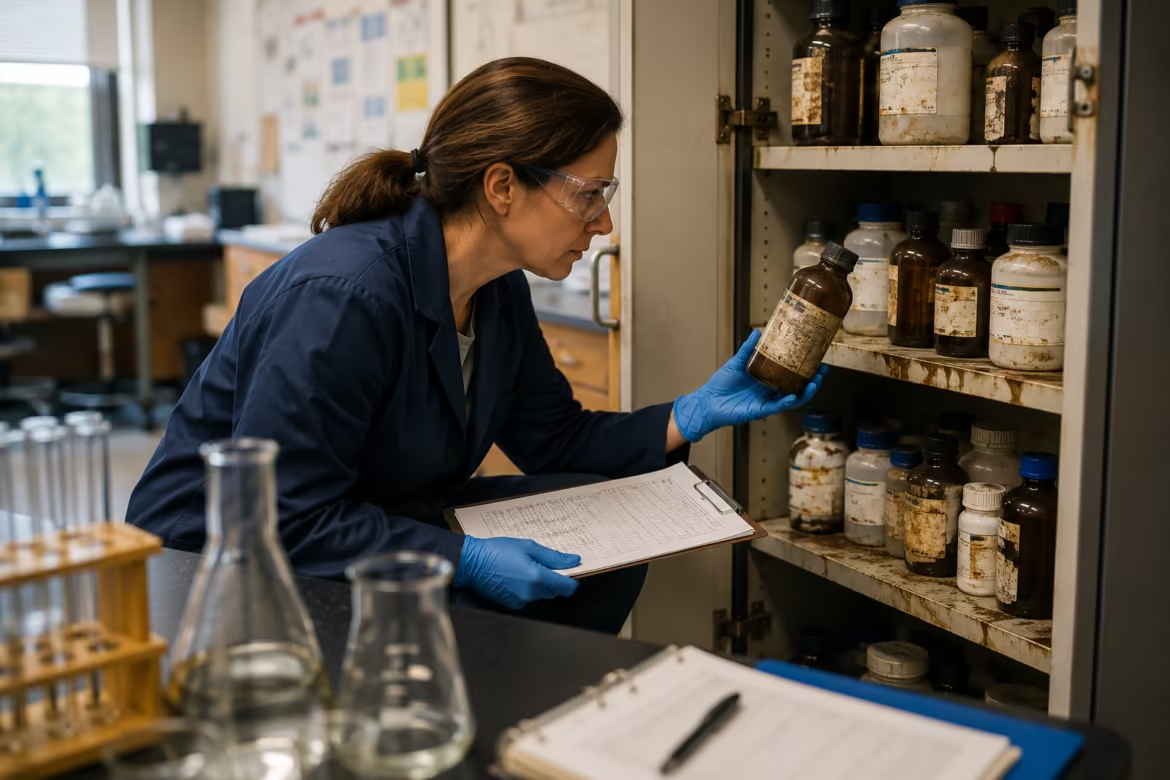
Major compliance issues rarely begin as major issues. They typically start with something small: an inventory review is postponed, a training record is not filed, a chemical disposal project is delayed, a damaged label is not replaced, or an inspection finding receives less attention than intended. None of these seems significant at first.
The challenge is accumulation. Small gaps become larger gaps, minor concerns become recurring concerns, and eventually organizations face problems that could have been addressed much earlier. That is why proactive safety management matters: the earlier a concern is identified, the easier it is to resolve, and the longer it remains unaddressed, the more complicated the solution becomes.
What Does Poor Lab Safety Cost a School?
Student safety should always be the primary motivation for laboratory compliance, but school leaders cannot ignore the practical reality that poor safety management is expensive. Chemical disposal projects cost more when inventories are not maintained, equipment replacement costs more when maintenance is delayed, emergency response consumes resources, investigations require staff time, and facility damage creates unexpected expenditures.
Liability can dwarf all of these. In 2019, a New York City jury awarded a former high school student about $59 million after he was badly burned in a classroom chemistry demonstration. By contrast, preventive safety work, meaning routine inspections, regular training, accurate inventories and ongoing corrective actions, takes effort but frequently reduces long-term costs by preventing larger problems. The strongest districts understand that safety investments are often financial investments as well.
What Documentation Does a School Lab Need?
Few parts of laboratory compliance generate more frustration than documentation: inventories, safety data sheets, training records, inspection reports, maintenance records and emergency procedures. Several are required where OSHA’s rules apply. Safety data sheets must be readily accessible to lab staff, the chemical hygiene plan must be reviewed every year, and OSHA’s guidance recommends an annual physical inventory of chemicals.
Many people view documentation as paperwork; the best safety professionals view it differently. Documentation tells the story of a laboratory safety program. It provides evidence that inspections occurred, training was completed, equipment was evaluated and corrective actions were addressed. Most importantly, it helps schools make informed decisions, because without accurate information leaders are forced to rely on assumptions, and strong documentation turns assumptions into knowledge. The purpose is not to satisfy an inspector. It is to support the people responsible for keeping students safe.
The Best Compliance Programs Are Almost Invisible
One of the most interesting characteristics of highly effective safety programs is that they rarely feel like compliance programs. There is no annual panic, no frantic search for records, no last-minute effort to update inventories and no scramble to address issues that have existed for months. Instead, safety activities occur naturally throughout the year: inspections happen routinely, training remains ongoing, documentation stays current, corrective actions are tracked, leaders receive updates and conversations continue. NSTA’s position statement on safety calls for teachers’ safety training to be repeated every year, and edCircuit’s inspection series covers what to look for.
When safety becomes part of how the organization operates, compliance stops feeling like an obligation and becomes a natural reflection of everyday practice. The best compliance programs are almost invisible because they are fully integrated into the culture. People do not talk about compliance; they simply do the things that support it.
How Do Schools Build Compliance Systems That Last?
One of the greatest challenges facing schools is sustainability. Teachers retire, administrators change, facilities personnel move on and district priorities evolve, so a safety program that depends entirely on one individual will eventually struggle. Strong compliance programs are built on systems rather than personalities: processes are documented, responsibilities are defined, training is consistent and expectations remain clear, so the organization keeps functioning when people change.
That is what separates sustainable safety programs from temporary initiatives. The goal is not a system that works today; it is a system that keeps working years from now.
Compliance Is Really About Trust
At its core, laboratory compliance is not about regulations, audits or paperwork. It is about trust. Every student who enters a laboratory assumes that someone has already asked the important questions. Are chemicals stored properly? Is emergency equipment functioning? Have risks been evaluated? Are procedures current? Have staff been trained? Will the systems designed to protect them work when needed?
Laboratory compliance is ultimately about making sure those questions have been answered before learning begins. The strongest schools understand that compliance is not about satisfying an inspector; it is about honoring the trust students place in the adults responsible for their safety. When safety becomes the foundation of a science program, compliance naturally follows, and when compliance becomes the byproduct of strong leadership, strong systems and a strong safety culture, schools create something far more valuable than regulatory success: environments where students can safely explore, discover and learn with confidence.
Subscribe to edCircuit to stay up to date on all of our shows, podcasts, news, and thought leadership articles.