

edCircuit
  • Start Here
    • Login
    • Register
    • Subscribe
    • Submit a Press release
    • Advertise or Sponsor
    • Contribute
    • Get Interviewed
  • On The Wire
  • K-12 Education
    • All K-12
    • K-12 Teachers
    • Teaching Strategies
    • Special Education and IEPs
    • Dyslexia
    • Gifted and Advanced Learning
    • Early Childhood, Pre-K and Kindergarten
    • School Calendar
    • Tutoring and Homework Help
    • Attendance and Absenteeism
    • After-School Programs
    • School Counselors
    • Homeschooling
    • School Models
    • Teacher Retention
    • Parents
    • Students
  • Teaching and Learning
    • Literacy and Reading
    • Math Education
    • Civics and History Education
    • Financial Literacy
    • Assessment and Testing
    • Curriculum and Instruction
    • Personalized Learning
    • Project-Based Learning
    • Social-Emotional Learning
    • Executive Function
    • Creativity
    • Diversity, Equity, Inclusion
  • Professional Development
    • All Professional Development
    • Educators
    • Administrators
    • edLeaders
  • Higher Education
    • All Higher Education
    • College Admissions
    • Career and Technical Education (CTE)
    • Graduation
    • FAFSA and Financial Aid
    • Student Loans
  • Artificial Intelligence
  • Cybersecurity
  • School Safety
    • All School Safety
    • Science and Lab Safety
    • School Design and Facilities
    • Bullying
    • Duty of Care and School Liability
  • Continuing Education
    • All Continuing Education
    • Online Certificate Programs
    • Teaching Jobs and Careers
    • Teacher Appreciation
  • Education Policy and Government
    • All Education Policy
    • Department of Education
    • School Choice
    • Global
    • Advocates
  • EdTech
    • All EdTech
    • Online Learning
    • Hybrid and Remote Learning
    • Augmented and Virtual Reality
    • ESports
    • Gamification and Game-Based Learning
    • Digital Citizenship
    • EdTech Entrepreneurs
    • Market Trends
    • Future of Education
  • STEM and STEAM Education
  • Media
    • EDU Shows
    • EDU Podcasts
    • Education Industry Guides and Reports
  • About edCircuit
Saturday, October 17 2026 - Welcome
  • LOGIN
Home Tags Posts tagged with "Headline"
Tag:

Headline

This if for posts to be in the featured/top section of site
Two engineers in a lab discuss a large equipment chamber, one gesturing toward controls as the other holds a clipboard/tablet nearby.
Hot Topics - controversialK-12Safer EdScience and Lab Safety

Hierarchy of Controls in Schools: Why PPE Comes Last

by EdCircuit Staff October 5, 2026
written by EdCircuit Staff 8 minutes read

The hierarchy of controls in schools helps educators reduce hazards at the source before relying on personal protective equipment as the final layer of protection.

A science teacher has spent days preparing a laboratory activity. The materials are labeled. Students have goggles, gloves, and aprons. Procedures have been reviewed, and waste containers are ready.

Then the ventilation monitor signals a problem.

Everyone may be wearing the required PPE, but goggles and gloves cannot remove hazardous vapors from the room. The teacher now faces a decision that reveals the difference between being equipped and being protected: continue because students have PPE, or change the lesson because a stronger safety control is unavailable?

That question is at the center of the latest episode of Safer Ed, “Safety by Design: Why PPE Is the Last Line of Defense.” The episode examines why effective safety begins before an activity starts—and why protective equipment should never compensate for a hazard that could have been removed, replaced, or isolated.

PPE Is Visible. Stronger Controls Often Are Not.

When people picture safety in a laboratory, workshop, art room, kitchen, or athletic space, they often picture goggles, gloves, face shields, aprons, or protective footwear.

PPE is visible. It can be counted, distributed, inspected, and added to a supply list. That visibility can make it feel like the foundation of a safety program.

It is not.

PPE reduces exposure when a hazard remains. Its effectiveness depends on selecting the correct equipment, providing the right fit, teaching people how to use it, maintaining it, and ensuring it is worn consistently. Each step introduces another opportunity for failure.

The strongest safety systems control the hazard before it reaches the person.

Understanding the Hierarchy of Controls

The National Institute for Occupational Safety and Health organizes hazard controls into five levels, from generally most effective to least effective:

  1. Elimination

  2. Substitution

  3. Engineering controls

  4. Administrative controls

  5. Personal protective equipment

The model comes from occupational safety, but its logic translates directly to schools. Most activities require several controls working together. The hierarchy helps schools begin with the protections that depend least on perfect human behavior.

1. Eliminate the Hazard

Elimination removes a hazard from the activity or environment.

In a school, that might mean removing an unnecessary chemical, taking damaged equipment out of service, avoiding an open flame when heat is not essential, or discontinuing a demonstration whose instructional value does not justify its risk.

Elimination does not mean removing meaningful challenge. It means asking whether the hazard contributes to the learning. If students can meet the same objective without it, the strongest control may be changing the activity—not adding another warning.

2. Substitute Something Safer

When a hazard cannot be eliminated, a safer material, tool, or process may accomplish the same goal.

A solvent-based product may have a less hazardous alternative. A high-energy tool may be replaced with equipment better suited to students’ experience. A demonstration may be redesigned on a smaller scale to reduce the amount of hazardous material involved.

Substitution still requires evaluation. A product described as “safer” may create a different hazard or require new storage and disposal procedures. The entire activity—not only the replacement product—must be reviewed.

3. Build Protection Into the Space or Equipment

Engineering controls isolate people from hazards through the design of the room, equipment, or process. Examples include local exhaust ventilation, fume hoods, machine guards, splash shields, barriers, safety interlocks, and dust collection.

These controls work at the source. A functioning guard does not depend on a student remembering exactly where to place a hand. Proper ventilation captures contaminants before they spread through the room.

But an engineering control protects people only when it works. The sound of a fan does not prove that a ventilation system is performing correctly. A guard that has been removed, bypassed, or poorly fitted is no longer providing its intended protection.

Maintenance and testing may fall outside a teacher’s direct responsibility. Facilities teams, administrators, department leaders, and safety personnel all influence whether a room can support an activity safely.

4. Establish Procedures People Can Follow

Administrative controls change how people work. They include training, procedures, supervision, scheduling, signage, restricted access, and inspections.

Schools rely on these controls every day. Teachers demonstrate procedures. CTE instructors control access to machinery. Coaches establish practice rules. Custodial teams follow protocols for handling products and equipment.

Administrative controls matter, but they depend on people and conditions. A procedure is less reliable when a room is overcrowded, supervision is divided, materials are poorly placed, or the schedule creates pressure to rush. A rule that cannot be followed under real conditions is not an effective control.

5. Match PPE to the Remaining Risk

PPE protects the person when hazards remain after stronger controls have been applied. It may include goggles, gloves, protective clothing, face shields, hearing protection, or respiratory protection selected for a specific hazard and task.

Calling PPE the last line of defense does not make it optional. It means PPE should not be asked to do the work of a stronger control.

Safety glasses do not replace a machine guard. Gloves do not replace proper chemical handling or containment. A lab coat does not correct a failed ventilation system.

PPE also must fit the people expected to use it. Equipment that is damaged, poorly sized, incompatible with other equipment, or inaccessible to a student may provide less protection than the school assumes. OSHA’s PPE guidance emphasizes proper fit, training, maintenance, and continued program review.

When a Control Fails, the Activity Must Change

Return to the laboratory with the ventilation warning.

Opening a classroom door is not an automatic substitute for functioning local exhaust ventilation. Adding more PPE does not repair the system. Asking students to work quickly only adds time pressure to an already compromised situation.

If an activity depends on a control that is unavailable, the lesson should change or wait until the control is restored.

Teachers need clear authority to make that decision. They also need confidence that pausing an activity will be treated as responsible professional judgment—not poor planning or lost instructional time.

A lesson can be rescheduled. An exposure cannot be undone.

Safety Decisions Begin Before Purchasing

The hierarchy should influence purchasing and program planning, not only classroom procedures.

The least expensive item may not produce the lowest-cost safety decision. A chemical may require specialized storage, ventilation, disposal, training, and PPE. A machine may be difficult to guard, expensive to maintain, or unsuitable for the students expected to use it.

Those conditions should be considered before an order is placed. Educators, facilities staff, and employees who will use or maintain the product should be included in the review. OSHA’s hazard-prevention guidance recommends involving the people who understand the work, selecting controls through the hierarchy, and confirming that the controls remain effective.

Beyond the Science Lab

The hierarchy of controls in schools applies wherever students and staff encounter hazards.

  • In a CTE workshop, guards and dust collection should come before relying on safety glasses alone.

  • In an art room, less hazardous materials and appropriate ventilation are stronger controls than gloves alone.

  • In a culinary program, equipment guards, heat barriers, and workspace design can prevent contact before protective clothing is needed.

  • In athletics, removing damaged equipment or changing an unsafe drill may be more effective than another reminder to “be careful.”

  • In facilities operations, safer products and improved dispensing or ventilation systems can reduce dependence on PPE and procedural reminders.

The setting changes. The central question does not: Can the hazard be controlled before it reaches the person?

Five Questions to Ask Before an Activity

Schools can apply the hierarchy with a short review:

  1. What hazards are present, and can any be removed?

  2. Can a safer material, tool, or process be used?

  3. Can equipment, ventilation, guards, or barriers isolate the hazard?

  4. What procedures, training, supervision, and PPE are still necessary?

  5. What happens if a required control is unavailable or fails?

These questions belong in lesson planning, purchasing, facilities reviews, professional learning, and program design. They are far more useful before students enter the room than while they are waiting for instructions.

Listen to Safer Ed

In “Safety by Design: Why PPE Is the Last Line of Defense,” Safer Ed explores how schools can move beyond visible compliance and build safety into activities, equipment, facilities, and decision-making.

Safer Ed is sponsored by Science Safety and produced in partnership with edCircuit.

Learn More

  • Duty of Care — Explore how educators and school leaders can anticipate foreseeable harm and protect students across school settings.

  • Hazard Control and Safety — Learn more about identifying hazards, reducing exposure, and building effective control programs.

  • Personal Protective Equipment (PPE) — Review the selection, use, care, and limitations of PPE in educational environments.

The strongest safety program is not the one with the longest equipment list. It is the one that asks whether a hazard can be removed, reduced, or contained before anyone must rely on the final line of defense.

Subscribe to edCircuit to stay up to date on all of our shows, podcasts, news, and thought leadership articles.

October 5, 2026 0 comments
0 FacebookTwitterPinterestLinkedinWhatsappCopy LinkEmail
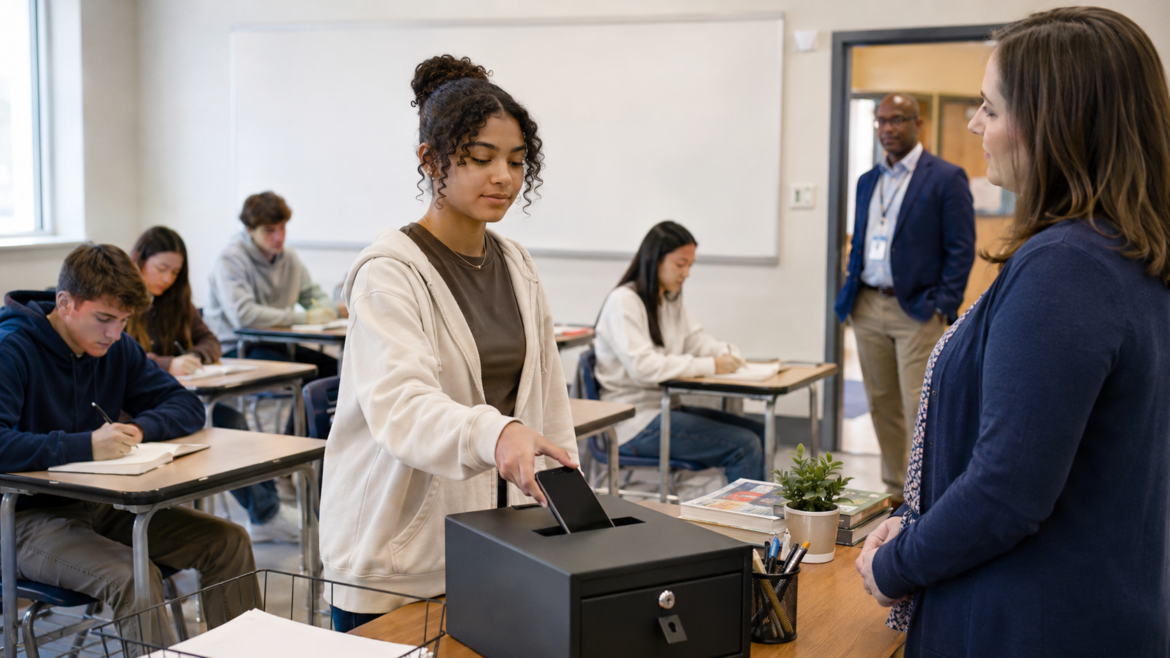
A student drops her phone into a locked collection box on a desk as a teacher watches and an administrator stands by the door
School SafetyK-12Hot Topics - controversial

School Cell Phone Bans: Enforcement That Works

by EdCircuit Staff October 5, 2026
written by EdCircuit Staff 11 minutes read

School cell phone bans become real the first time a student refuses to put a device away. Writing the policy and choosing a storage system are important, but neither answers the question facing a teacher in that moment: What happens next?

The response can determine whether the rule becomes a normal part of the school day or another recurring confrontation between students and adults.

Strong enforcement is not necessarily severe. It is predictable. Students know what is expected, adults respond in roughly the same way, and administrators step in before a disagreement over a phone consumes the class. Families understand when they will be contacted, how a confiscated device will be handled, and why refusing a staff direction is different from an initial violation.

That may sound straightforward. In practice, it is where many phone policies are tested.

When the rule meets resistance

Richmond Public Schools began enforcing its districtwide bell-to-bell policy in January 2025, several months before a Virginia law made smart-device restrictions mandatory. A Richmond school that adopted restrictions early is now looking back on the experience, offering other districts a view of what happens after the first announcements and objections have passed.

By April 2026, Richmond reported that 95.83% of its buildings were strictly enforcing the policy. The figure, included in a district implementation review, suggests that the rule had moved beyond policy language and into the daily operation of most schools.

Consistency matters because students quickly identify differences between adults. If one teacher allows phones between assignments, another confiscates them immediately, and a third avoids the issue, the rule becomes negotiable. The adults who follow it may appear unusually strict even when they are doing exactly what the district requires.

Consistency does not mean treating every incident the same. A first grader whose smartwatch rings and a high school student recording a fight have not committed equivalent violations. A phone vibrating inside a backpack may call for a reminder. A student repeatedly filming classmates in a restroom presents a different safety and privacy concern.

Districts have to define those differences before employees face them. They also need to settle the smaller questions students are likely to test. Does one earbud count as unauthorized use? What if a student checks the time on a smartwatch? Can a student retrieve a phone before leaving for an appointment? At what point does the teacher stop addressing the issue and call an administrator?

Richmond’s approach includes staff training on confiscation, device handling, documentation, family notification, de-escalation and conflict resolution. Its public guidance identifies the steps employees should follow when a device is collected and when a student refuses to surrender it.

That training matters. A policy designed to recover instructional time can easily consume it if every violation becomes a public argument. Once a student refuses a clear direction, teachers need a way to transfer the problem to an administrator while instruction continues.

A violation is not the same as defiance

The most workable policies distinguish among an initial violation, repeated unauthorized use, refusal to follow a staff direction and harmful conduct involving a device.

Richmond uses a tiered response. A first violation brings a verbal warning and documentation. A second may bring a written warning, family contact and temporary confiscation. Continued violations can lead to a restorative-room assignment or other disciplinary action. Misuse involving cheating, cyberbullying or illegal activity can move directly to a stronger response.

Salina Public Schools in Kansas has adopted a similar progression under the state’s new bell-to-bell law. According to the district’s family guidance, a phone found in a student’s possession is confiscated and returned after school. A second violation requires a parent or guardian to retrieve it. Additional violations—or refusing to give the phone to a staff member—can lead to consequences up to suspension for open defiance.

The wording is important. The possible suspension is connected to repeated noncompliance or refusal, not simply to the sight of a phone.

New York drew that distinction in state law. A student cannot be suspended solely for violating a district’s phone policy. New York City schools may use family conferences, classroom removal or confiscation as progressive interventions, but repeated refusal to surrender or store a device may result in suspension. The city’s guidance also prohibits schools from lowering a student’s grade because of a phone violation.

These policies are not identical, but they share an important principle: the purpose is to improve learning, not remove students from it. Suspension may become necessary when behavior escalates, but it should not be the routine mechanism that makes the ban function.

The first weeks of implementation are especially important. Students should be shown where phones go, how approved access works, and when devices may be retrieved. Staff should use the same short response when correcting an ordinary violation. A student reaching instinctively for a phone does not always need an office referral. The first direction can be calm and direct: the phone must be stored now.

The consequence changes when the behavior continues.

Confiscation can create a second problem

Taking a phone may end the immediate violation, but it creates a chain of responsibility for the school.

Richmond instructs employees to place a collected device in a secure classroom or office location and document the student’s name, date, time, device type, and reason for confiscation. The family is notified, and the return process depends on whether the incident is a first or repeated violation.

That record protects both the student and the employee. It matters when a device is reported missing, damaged or returned to the wrong person. It also allows administrators to determine whether a later incident is truly a second or third violation.

An unlocked desk drawer is not a confiscation system. Neither is moving phones among several adults without documenting who has them. Schools need to identify who may collect a device, where it will be secured, who records its return, and how ownership will be verified. The process must also account for early dismissals and claims of damage.

Kansas law states that schools and their employees are not liable for the damage or storage of personal devices brought to school. Districts elsewhere should not assume they have the same protection. Their procedures must reflect state law, insurance requirements, and any employee agreements governing responsibility for student property.

Requiring a caregiver to retrieve a phone can be an effective consequence, but it may also create an unequal burden. Some parents can leave work and reach the school quickly. Others cannot. Districts may need an alternative, such as secure overnight storage or return during a scheduled conference, so that the consequence does not depend on a family’s transportation or job flexibility.

Teachers need backup, not another mandate

Phone policies often weaken when the district’s expectations become an individual teacher’s daily burden.

A teacher may face dozens of small decisions: whether a device is visible, whether an earbud is connected to a personal phone, whether a student has an approved exception, and whether stopping the lesson will cause a larger disruption. If administrative support is slow or inconsistent, staff may decide that reporting violations is not worth the lost time.

School leaders should be visible during arrival, passing periods, lunch, and dismissal, when phone use is most likely. They should also establish a quick response when a student refuses a direction. Teachers should not have to choose between continuing the lesson and enforcing district policy.

The same guidance must reach substitute teachers, coaches, bus drivers, support staff and employees supervising field trips. New York City requires schools sharing a campus to coordinate their policies, reducing the possibility that students in the same building will encounter different rules.

Adult behavior matters, too. A phone-free expectation becomes harder to defend when employees regularly use personal devices in front of students for non-school purposes. Districts do not need identical rules for adults and children, but their professional expectations should support the reason the policy exists.

Exceptions and emergency access must work in real time

Medical, disability, language, and caregiving exceptions are necessary. Poorly designed exceptions, however, can create new enforcement problems.

A student who uses a phone to monitor blood glucose should not have to explain a medical condition whenever a different adult sees the device. A multilingual learner should not lose an approved translation tool because a substitute teacher was unaware of the plan. A student caregiver may need time-sensitive access without disclosing a private family situation to classmates.

Schools need a discreet way to verify authorization. That might be a notation in the student information system, a pass or direct notification to the employees who need to know. The record should identify when access is permitted and whom staff should contact with questions without revealing more information than necessary.

The approval process must also move quickly. If it takes weeks, students may be disciplined while documentation is still pending. Families should know before the school year who can approve an exception, what information is required and where questions should be directed.

Emergency access presents a different challenge. New York requires districts to provide at least one way for families to contact students during the day and permits device use during an emergency. Kansas does not provide a general emergency exception for personal phones. Salina directs families to call the school office and relies on its district communication platform for campuswide updates.

Either model depends on preparation. Families need the correct phone number and a realistic understanding of how quickly a message will reach a student. Schools need current emergency contacts, translation support and accessible phones students can use when necessary.

The procedure should also address lockdowns and evacuations. Students and families need to know whether stored phones remain in place, may be retrieved under staff direction or stay inaccessible while the district communicates through its emergency system. That decision should come from the safety plan—not from hundreds of students acting independently.

Families have a role in everyday enforcement as well. A text from a parent may feel different from a social media alert, but it still prompts the student to reach for the device. Schools should ask caregivers to use the approved communication route and stop expecting immediate replies during the school day.

Data can reveal whether enforcement is working

A phone policy may appear neutral while producing very different disciplinary outcomes across schools or student groups.

Beginning in September 2026, New York districts must publish annual reports containing non-identifiable demographic data on phone-policy discipline and an analysis of disparities. If statistically significant differences appear, the district must publish a plan to address them.

Other states may not require that level of reporting, but districts should still examine who is being disciplined, where violations occur and what consequences follow. First-time violations should be separated from repeated use and refusal. Confiscation, classroom removal and suspension should not be combined into one broad total. Mistaken referrals involving approved exceptions should also be reviewed.

The numbers need context. A school reporting very few violations may have excellent compliance—or inconsistent enforcement. A building with unusually high confiscation totals may need clearer routines or more administrative coverage in common areas. If one student group receives a disproportionate share of defiance referrals, leaders need to determine whether the problem is student behavior, adult discretion or both.

Early reports provide reasons for cautious optimism. Richmond has described better focus and engagement, along with fewer incidents involving bullying and hostile group chats. Spokane Public Schools reported that lunchtime behavior referrals fell 36% in 2024–25 and failure-to-cooperate cases declined by approximately 22%.

Those figures do not prove that phone restrictions alone caused the changes. Spokane introduced its policy alongside Engage IRL, an initiative connecting more students with clubs, sports and other in-person activities. That broader effort points to an important lesson: taking away the phone is only part of the work. Schools also need to rebuild the activities, relationships and routines that fill the space it occupied.

The goal is fewer confrontations

District leaders should review implementation after the opening weeks and again at the end of each quarter. Staff, students and families can identify the problems that policy language misses: delayed office messages, inconsistent enforcement, unclear exceptions, return lines at dismissal or too many referrals coming from one location.

Adjusting those procedures does not weaken the ban. It is how the ban becomes workable.

A large number of confiscations may show that adults are enforcing the rule, but it does not necessarily show that the policy is succeeding. Over time, success should look quieter: fewer reminders, fewer arguments, fewer devices collected and fewer students removed from instruction.

The strongest enforcement system is not the one that produces the harshest consequence. It is the one that makes the consequence less necessary.

Subscribe to edCircuit to stay up to date on all of our shows, podcasts, news, and thought leadership articles.

October 5, 2026 0 comments
0 FacebookTwitterPinterestLinkedinWhatsappCopy LinkEmail
Two mobile phones—a clamshell flip phone on the left and a modern smartphone on the right—sit on a wooden desk with a glowing data stream between them.
EdTechHot Topics - controversialK-12

T9 Texting: The Skill We Mastered and Then Forgot

by EdCircuit Staff October 2, 2026
written by EdCircuit Staff 7 minutes read

If you want to confuse a teenager, hand them an old flip phone and ask them to send a text.

First comes the search for a keyboard that is not there. Then the realization that ABC lives on the 2 key, DEF on 3 and WXYZ on 9. A parent watching nearby may laugh, take the phone and discover that one thumb still remembers what to do.

For a period in the late 1990s and 2000s, T9 texting was a minor superpower. Practiced users could write an entire message without looking down. They knew when to accept the phone’s first suggestion and when an unusual name would confuse the software.

Then, almost without anyone noticing, the skill disappeared from everyday life.

That forgotten habit raises a question schools are confronting again in the age of artificial intelligence: How much time should we spend teaching students to master today’s tools when the interface may be gone tomorrow?

Before T9, Every Letter Took Work

Early mobile phones were designed for calls, not writing. Their 12-button keypads assigned three or four letters to most number keys.

Before predictive text, users relied on “multi-tap.” To type an “S,” they pressed 7 four times. A “C” required three presses on 2. Type too slowly, and the phone might decide the next tap belonged to a new letter. Type too quickly and the wrong character appeared.

Writing “school” could require 18 button presses, plus a pause between the two O’s. It worked, but it was not elegant.

T9—short for “Text on 9 keys”—changed the process. Instead of selecting each letter individually, users pressed the corresponding number once for every letter. “School” became 7-2-4-6-6-5. The software compared that sequence with a built-in dictionary and offered the word it considered most likely.

Sometimes the result felt like magic. Sometimes it was confidently wrong.

The sequence 4-6-6-3, for example, could represent “good,” “home,” “gone” or “hood.” Users learned to press “next” until the intended word appeared. They also learned to proofread the machine—a habit that feels especially relevant now.

A Clever Answer to a Hardware Problem

T9’s origins are more meaningful than its reputation as a flip-phone novelty suggests. The technology grew from work by Martin King, Cliff Kushler, and Dale Grover on communication tools for people with disabilities. King had developed an eye-tracking system, and the team explored how someone could enter language using only a small number of eye positions. That work helped form the foundation for Tegic Communications and T9 in the mid-1990s.

The timing was ideal. Mobile phones were shrinking, text messaging was growing, and manufacturers faced an obvious problem: How could people write on devices built around number keys?

T9 did not eliminate the limitation. It made the limitation manageable.

The software soon appeared on phones made by Nokia, Motorola, Samsung and other major manufacturers. America Online acquired Tegic in 1999 as it tried to bring email and instant messaging to devices beyond the desktop. By 2010, WIRED reported that roughly 4 billion phones worldwide used T9.

That is an extraordinary reach for a technology many students have never seen.

When a Workaround Became a Culture

T9 arrived as the mobile phone was becoming more than a portable telephone. Texting gave people a quieter, more private way to communicate. Teenagers could make plans from a school hallway or continue a conversation after the adults had gone to sleep.

The device shaped the language. Messages were short. Capitalization was inconsistent. Punctuation became optional. “Are you coming?” turned into “r u coming?” The 160-character limit, slow multi-tap entry, and early texting costs all encouraged brevity.

People learned the software’s vocabulary and quirks, while the phone learned some of theirs. A person provided an incomplete signal, a machine guessed the intention, and the person decided whether the machine was right.

We use that same basic pattern every day now.

Why T9 Seemed to Disappear Overnight

T9 did not lose a competition for the best way to type on nine keys. The nine-key keypad lost its place at the center of the phone.

BlackBerry and other devices had already demonstrated the appeal of a small physical QWERTY keyboard. Then, in January 2007, Apple introduced the iPhone with a large multi-touch display and a full keyboard that appeared only when needed. Apple also emphasized that its on-screen keyboard could predict and correct mistakes.

The screen was no longer attached to the phone’s interface. The screen became the interface.

Software keyboards could display all 26 letters, switch languages, suggest words and support swiping or dictation. In 2011, when Pew Research Center first independently measured smartphone adoption, 35% of U.S. adults owned one. By 2015, smartphone ownership had reached 64%.

There was no official farewell to T9. People upgraded their phones, placed the old ones in drawers and stopped practicing a skill they had used every day.

T9 did not disappear completely. Variations remain on some feature phones, accessibility tools and specialized devices. But for most users, it went from daily necessity to technological memory in only a few years.

The Idea Survived the Keypad

What disappeared was the nine-key interface, not the central idea behind it: People do not need to enter every letter perfectly if software can figure out what they mean.

Autocorrect, predictive keyboards, swipe typing, smart replies and voice transcription all continue that bargain. Generative AI extends it further. Instead of predicting a word from several key presses, an AI system can generate sentences, images or code from a short prompt.

The technology is more capable, but users must still decide whether its suggestion is accurate, appropriate, and what they intended to say.

Anyone who ever sent the wrong T9 word understands the danger of accepting a machine’s first answer too quickly.

What Schools Should Take From T9

T9 offers a useful warning about how schools define technology fluency.

At one time, typing quickly with T9 looked like an advanced digital skill. So did mastering a BlackBerry keyboard, burning a CD or creating the perfect MySpace page. Each ability was useful in its moment. None was durable enough to serve as the foundation of a technology curriculum.

Some of the tasks students are learning today will follow the same path. A particular learning platform, AI interface, device menu, or prompting technique may feel indispensable now. In five years, it may be automated, redesigned, or replaced.

Schools should still teach current tools. Avoiding technology because it will eventually change would leave students unprepared for the present. The mistake is treating proficiency with one product as proof of lasting digital literacy.

The durable skills sit underneath the interface: communicating clearly, evaluating automated suggestions, protecting personal information, recognizing bias, solving unfamiliar problems, and transferring knowledge from one tool to another.

This also means schools should be cautious about measuring students primarily by speed or platform-specific proficiency. The fastest T9 typist in 2006 did not automatically become the strongest digital communicator in 2016. Quick thumbs demonstrated adaptation to one system. They did not guarantee judgment, creativity or understanding.

The same will be true of today’s AI tools. Some will merge, some will disappear, and some tasks that currently require special training will soon happen automatically. Students need experience with the technology in front of them, but they also need the confidence to keep learning after the buttons move.

The Thumb Still Remembers

To a student raised on touchscreens, T9 can look painfully inefficient. Why squeeze language through nine number keys when a full keyboard can appear instantly?

That reaction is reasonable. Twenty years from now, students may look at touchscreen typing with the same disbelief. Voice interfaces, wearable devices, gestures, or AI agents could make tapping individual letters seem as dated as pressing 7 four times to create an “S.”

T9 mattered because it made the best of the technology people had. It faded because a new design removed the problem it had been built to solve.

Yet every time a phone suggests the next word or corrects a misspelling, a small piece of T9’s legacy remains. We may have stopped typing on nine keys, but we never stopped letting machines guess what we were trying to say.

Subscribe to edCircuit to stay up to date on all of our shows, podcasts, news, and thought leadership articles.

October 2, 2026 0 comments
0 FacebookTwitterPinterestLinkedinWhatsappCopy LinkEmail
Student Agency Is More Than Giving Students Choice
Hot Topics - controversialK-12StudentsTeaching Strategies

Student Agency Is More Than Giving Students Choice

by EdCircuit Staff October 1, 2026
written by EdCircuit Staff 7 minutes read

Student agency often becomes visible in a small classroom moment. A teacher asks a student why they chose a particular topic, strategy, or source. The student pauses and answers, “Because that is what I was told to do.”

The student may be focused. The assignment may be completed correctly and turned in on time. But the student has made few decisions and has little connection to the work beyond finishing it.

This is the concern behind the growing conversation about student agency. Schools want engaged learners who can set goals, solve problems, respond to setbacks, and take responsibility for their growth. Yet much of the school day still asks students to follow a path that has already been mapped for them.

Student agency offers a different approach. It gives students a meaningful role in the learning process while keeping teachers, standards, and clear expectations firmly in place.

More than participation or choice

A 2024 review of student agency research defines agency as the ability to exercise control over one’s thought processes, motivation, and actions. That includes setting an intention, anticipating what may happen, monitoring progress, and reflecting on the outcome.

In practical terms, students with agency understand what they are working toward and have some say in how they get there. They can make a decision, explain their reasoning, notice when an approach is not working, and make an adjustment.

Choice can help, but the choice needs to matter. Selecting the color of a poster or deciding which worksheet to complete first may make an assignment more pleasant. It does not necessarily give the student greater ownership of the learning.

A meaningful choice affects the work itself. Students might select the question they investigate, decide which strategy fits a problem, choose evidence to support a claim, or determine how to present their understanding to a particular audience.

Student voice is another part of the conversation. Schools frequently ask students to share opinions through surveys, class discussions, councils, and advisory groups. Those opportunities become more meaningful when students can see how their input informed a decision. Collecting feedback without ever responding to it can leave students feeling that their voice was requested but not truly heard.

Agency also does not mean students must work independently. The OECD Learning Compass 2030 describes young people learning to navigate unfamiliar situations instead of waiting for fixed directions. Its framework also recognizes “co-agency,” the idea that students develop this capacity through their relationships with teachers, classmates, families, and communities.

Teachers remain central to the process. They provide knowledge, structure, feedback, and support. The difference is that students are gradually trusted with decisions they will eventually need to make without a teacher beside them.

Why student agency is gaining attention

Schools have invested heavily in programs, technology, incentives, and new instructional models designed to improve engagement. Those efforts often focus on getting students to participate in lessons adults have already planned. Agency raises another question: Do students believe they can influence their own learning?

A 2025 Gallup report examining students in grades five through 12 in Iowa found that 48 percent of middle school students felt able to learn at their own speed. That figure fell to 35 percent among high school students.

The report also found that only 44 percent of high school students felt prepared for life after graduation, while 11 percent felt very prepared. Students who took ownership of learning skills in school that would help them later were 53 percent more likely to feel prepared for what came next.

The findings represent students in one state, but they reflect a broader challenge. Students may complete years of required courses without gaining much experience setting a direction, managing a longer-term goal, or deciding what to do when an answer is not immediately available.

Those abilities matter in a workforce being reshaped by technology and automation. Students will need strong academic knowledge, but they will also need to recognize problems, weigh information, ask for help, and adapt when conditions change.

Artificial intelligence adds another layer. Students can now ask a tool to suggest a topic, generate an outline, revise a paragraph, or solve a problem. A polished final product no longer tells the full story of what a student knows. Educators must also consider who formed the question, made the key decisions, checked the information, and learned from the process.

Student agency helps keep the learner at the center of that work.

What it can look like in a classroom

Building agency does not require teachers to redesign every lesson or turn every unit into an open-ended project. It can begin with ordinary classroom routines.

At the start of a unit, a teacher might explain the required learning goals and ask students to identify what they already understand and where they expect to need support. During the work, students could choose between two legitimate strategies and explain their selection. At a checkpoint, they might compare their progress with the original goal and decide what to change.

In an elementary reading lesson, students could select a response format and explain why it fits the book. In mathematics, they could compare solution strategies and defend which one is most efficient. Science students might design one portion of an investigation while following established safety procedures. In a career and technical education course, students could respond to a client’s needs, receive feedback, and decide how to revise the product.

The academic expectation remains consistent in each example. Students still have to demonstrate their understanding. What changes is their role in reaching that point.

Research on student voice provides additional support for this approach. A study of 1,751 middle and high school students found a strong association between teachers seeking student input and higher levels of engagement. Students’ perceptions that teachers were receptive to their ideas were also associated with greater agency, stronger grades and GPAs, and lower absence rates.

Students notice whether an adult is genuinely interested in what they think. A teacher does not have to accept every suggestion, but explaining what was heard and how it will be used shows that student input carries weight.

Agency still needs structure

Some educators understandably worry that student agency could lower rigor or create classrooms in which students simply do whatever interests them. That is not the goal.

Students need boundaries that reflect their age, experience, and readiness. They also need direct instruction and enough background knowledge to make informed decisions. A student cannot choose an effective research strategy without first learning how credible research works.

Strong agency-centered classrooms may actually ask more of students. Learners must explain their choices, support their conclusions, use feedback, and assess the quality of their own work. They cannot rely entirely on the teacher to identify every problem and prescribe the next step.

Schools must also ensure that these opportunities are available to every student. Agency should not be a reward reserved for students who finish early, earn the highest grades, or already know how to manage complex assignments. Goal-setting, decision-making, and self-regulation are skills that need to be modeled and practiced.

Some students will initially want the teacher to make every decision. That response does not mean they are incapable of ownership. It may simply mean that school has given them little opportunity to develop it.

Preparing students for what comes next

For years, educators have asked how to make students more engaged in school. Student agency encourages schools to examine the other side of that relationship: How often are students trusted to make a decision that matters?

The answer does not require giving students control of every lesson. It requires creating deliberate opportunities for them to set a direction, make a choice, explain their reasoning, and respond when the first approach falls short.

Eventually, every student reaches a point when there is no teacher standing nearby with the next set of directions. Schools can prepare students for that moment by doing more than helping them complete today’s assignment. They can teach students how to decide what comes next.

Subscribe to edCircuit to stay up to date on all of our shows, podcasts, news, and thought leadership articles.

October 1, 2026 0 comments
0 FacebookTwitterPinterestLinkedinWhatsappCopy LinkEmail
Woman helps a teen with homework at a kitchen table, using a laptop and notebook nearby.
K-12Education Policy and GovernmentHot Topics - controversial

E-Rate and School Filtering: Closing the Safety Gap

by EdCircuit Staff September 30, 2026
written by EdCircuit Staff 6 minutes read

E-Rate and school filtering are closely connected, but the relationship is easy to miss.

Put a school-issued laptop next to a student’s personal phone. Both devices can reach the internet, but they may operate under very different protections. A district can configure the laptop so filtering remains active when the student takes it home. A personal phone using cellular service can bypass the school network entirely.

That difference matters as the Federal Communications Commission reviews the future of E-Rate. The program is best known for helping schools and libraries afford internet access and network infrastructure. It also carries responsibilities under the Children’s Internet Protection Act, commonly known as CIPA.

Understanding those responsibilities can help school leaders explain what filtering does, where its protections end, and why internet safety cannot be handed over to one piece of software.

The Federal Baseline

Schools and libraries receiving E-Rate discounts for internet access or internal connections must comply with CIPA. They must adopt an internet safety policy and use technology protection measures to block or filter online images that are obscene, depict child pornography, or are harmful to minors when computers are used by minors.

Those requirements establish a federal baseline. They do not create a national list of every website a school must allow or block.

District leaders and school boards still make many of the practical decisions. They may apply different settings by grade level, restrict categories beyond the federal minimum, establish a process for teachers to request access to blocked resources, or determine when a filter may be disabled for lawful adult use.

Those choices should reflect instructional needs, student age, and community expectations. They also need regular review. An old setting may block a useful academic resource, while a new platform may expose a gap that did not exist when the policy was written.

Why Managed Devices Offer More Protection

CoSN’s CIRCUITS brief, Closing the Digital Safety Gap: E-Rate and the Evolution of School Filtering, draws an important distinction between school-managed technology and personal devices.

Districts can configure school-issued devices and accounts so their protections follow students beyond the school building. Depending on the district’s systems and policies, filtering can remain active when a student connects from home, a public location, or another network. Administrators can apply consistent rules, update settings, and review alerts across the devices they manage.

Personal devices are different. A phone connected to a cellular network does not pass through the school’s internet connection. Even while sitting in a classroom, a student may be able to reach content that is blocked on the school network. A personally owned laptop or tablet may also lack district-managed protections when it is used away from school.

Schools can filter traffic when personal devices connect to district Wi-Fi, but they cannot extend that control to a student’s private cellular service. Families and school communities need to understand that distinction. A blocked site opening on a personal phone does not necessarily mean the school filter failed; the device may never have used the filtered network.

How Filtering Has Changed

Older filters relied heavily on lists of websites placed into approved or blocked categories. Those lists still play a role, but modern systems can consider far more information.

Current tools may evaluate page content, patterns, user behavior, newly registered domains, and other signals. Machine learning can help identify potentially harmful material before a website has been manually categorized, and providers can update protections quickly as new threats appear.

None of that makes a filter perfect. Students may still use proxies, virtual private networks, personal hotspots, or other workarounds. Districts need reporting processes that identify repeated attempts and a clear plan for responding. Sometimes the right response is technical. Other cases call for a conversation with the student, communication with a family, or a review of school expectations.

What a Filter Cannot Do

A filter can restrict access to content that meets the district’s blocking criteria. It cannot supervise every interaction, prevent cyberbullying, judge the credibility of a source, or teach a student how to make a responsible choice. It also cannot protect a personal phone using cellular service.

Technical protections need support from:

  • Clear acceptable-use expectations for students and staff
  • Age-appropriate digital citizenship instruction
  • Staff training on warning signs, reporting, and escalation
  • Family communication about school-managed and personal technology
  • A timely process for reviewing blocked sites and correcting overblocking
  • A defined response when students repeatedly bypass safeguards

The goal is not to block as much of the internet as possible. Overblocking can interfere with research, accessibility, health information, and legitimate instruction. Underblocking can expose students to material that has no place in a school setting. Districts must keep working between those two risks.

Questions School Leaders Should Ask

Filtering decisions should not rest entirely with the technology department. Technology leaders understand the system, but educators, administrators, families, and students experience the results.

A district review should ask:

  • Do protections follow school-issued devices when they leave the building?
  • Are settings appropriate for different grade levels and instructional needs?
  • Who reviews alerts, and what requires an immediate response?
  • Can educators quickly request access when a legitimate resource is blocked?
  • Does the district test for both underblocking and overblocking?
  • Do families and students understand where the school’s protections apply and why they exist?

Why This Conversation Matters Now

In its current rulemaking, the FCC is considering whether its interpretation of CIPA remains the best reading of the law and whether existing protections are sufficient. That review is taking place alongside broader questions about E-Rate, including whether the program should be narrowed, restructured, or potentially ended.

School leaders can help the FCC understand how connectivity and safety work together at the local level. Their comments can explain how E-Rate-supported networks help districts apply protections consistently, what filtering can and cannot accomplish, and why decisions about instructional technology must reflect local needs.

Initial comments are due October 13, 2026. Reply comments are due November 12, 2026.

Take Action

  • Visit the Save Our E-Rate campaign
  • Contact elected officials through CoSN’s Action Center
  • Submit comments through the FCC

For a companion discussion, listen to the CoSN Podcast episode Closing the Digital Safety Gap: E-Rate and the Evolution of School Filtering, produced and distributed in partnership with edCircuit.

School filtering works best when no one mistakes it for a complete solution. It is an important layer of protection tied to the requirements for receiving certain E-Rate discounts and shaped by local decisions. Its value depends on thoughtful settings, regular review, clear expectations, and adults who help students make safe choices online.

Subscribe to edCircuit to stay up to date on all of our shows, podcasts, news, and thought leadership articles.

September 30, 2026 0 comments
0 FacebookTwitterPinterestLinkedinWhatsappCopy LinkEmail
Team of students wearing safety glasses collaborating on a robotic device with a mentor in a workshop setting.
Hot Topics - controversialCareer and Technical Education (CTE)K-12

Why High Schools Need Stronger CTE Pathways

by EdCircuit Staff September 30, 2026
written by EdCircuit Staff 7 minutes read

You can often see the value of strong CTE pathways when something goes wrong.

The code fails. The cabinet door hangs crooked. The simulated patient’s condition changes. There is no answer key to rescue the student. Someone has to diagnose the problem, ask a better question, accept feedback, and try again.

That is hands-on learning at its best: work requiring judgment, persistence, communication, and technical knowledge—the same combination students will need long after high school.

For years, career and technical education was a separate track for students considered unlikely to attend college. Modern CTE can leave that history behind by giving students more ways to enter their future.

The False Choice Between College and Career

The phrase “college or career” still appears in conversations about life after graduation, as if students must choose one side. Actual lives are rarely that tidy.

A healthcare student might earn a nursing assistant credential, work part-time, and continue toward a nursing degree. An engineering student might enter an apprenticeship, complete an associate degree, or pursue a four-year program.

The National Center for Education Statistics found that 80 percent of 2013 public high school graduates who concentrated in CTE had enrolled in post-secondary education by 2021. Most continued learning after graduation, although their routes varied.

A good pathway lets a 16-year-old test an interest before making an expensive decision. Discovering that patient care, construction, cybersecurity, or teaching feels right is valuable. Discovering that it does not can be equally useful.

A Pathway Has to Lead Somewhere

Many high schools offer career-related electives. Fewer have built a fully connected experience.

A pathway should begin with exploration and become more demanding. Academic subjects appear inside the work: geometry in construction, biology in healthcare, chemistry in manufacturing, and writing in business. Advanced courses introduce professional tools and expectations. College credit, recognized credentials, internships, apprenticeships, and client projects extend the learning beyond school.

This is where career-connected learning moves from an appealing idea to an actual sequence.

Families should be able to see where a pathway goes. Which courses come next? Does the credential have value? Will the college credit transfer? What options remain if a student changes direction?

If those answers are unclear, the pathway may be little more than a new label placed on old electives.

Why the Learning Feels Different

Hands-on learning changes the student’s role. Instead of waiting for the teacher to confirm every step, students have to notice, decide, build, revise, and explain.

The work can be powerful for teenagers who have stopped seeing themselves as capable learners. Abstract assignments feel different when accurate measurements determine whether a structure stands square or clear communication helps a team finish safely.

Relevance does not lower expectations. It gives those expectations a visible purpose.

A systematic review highlighted by the U.S. Department of Education’s Institute of Education Sciences found positive effects on academic achievement, high school completion, employability skills, and college readiness. CTE participants were more likely to enroll in two-year colleges, just as likely to enter four-year colleges, and more likely to be employed. Researchers found no statistically significant effect on earnings, a reminder not to promise more than the evidence supports.

A dated curriculum, unsafe equipment, or an internship that amounts to free labor will not deliver those outcomes simply because it carries the CTE name.

The Economy Is Moving, but Schools Must Think Beyond Trends

The U.S. Bureau of Labor Statistics projects the economy to add approximately 5.2 million jobs between 2024 and 2034, with healthcare and social assistance accounting for much of the growth. Computer and mathematical occupations are projected to grow more than three times as fast as employment overall.

Schools should pay attention to those signals without chasing every headline. A pathway built around one employer, one piece of equipment, or one fast-growing occupation can become outdated surprisingly quickly.

Artificial intelligence already influences automotive diagnostics, logistics, healthcare, agriculture, and manufacturing. Students need emerging technology skills alongside abilities that survive a software update: problem-solving, communication, adaptability, safety awareness, and continued learning.

The goal is broader than filling today’s vacancies. High schools should help students develop skills they can carry from one employer, credential, or career stage to another.

CTE Must Not Become Tracking With Better Branding

The expansion of CTE carries a risk that deserves more attention. Schools can unintentionally recreate the old vocational divide by steering certain students toward certain pathways.

A counselor may assume a student with lower test scores is “better suited” for the trades. A young woman may never hear about advanced manufacturing. A student with a disability may be discouraged before anyone discusses accommodations. College-bound students may be told CTE will not fit their schedules, while others are pushed into a pathway without seeing post-secondary options.

None of those decisions may look dramatic on their own. Together, they can turn opportunity into a new form of sorting.

Federal CTE researchers have warned that selective programs can limit equitable access. Districts should examine who applies, who is admitted and completes a pathway, and who receives advanced courses, paid placements, dual credit, and valuable credentials.

Students also need room to change their minds. Career exploration should begin before high school, but specialization should not close off academic courses or future education. The point is to make choices more informed, not more permanent.

Offering a Program Is Not the Same as Providing Access

Even an excellent pathway has limited value if students cannot reach it.

Transportation is a barrier when programs are housed at regional centers or employer sites. Schedules can force students to choose between CTE and advanced academics, music, or athletics. Unpaid internships may be impossible for students supporting their families. Fees, limited seats, and instructor shortages narrow access further.

These are design problems, not student motivation problems.

Districts can respond with paid work, transportation assistance, flexible scheduling, regional programs, and college partnerships. Indianapolis Public Schools, for example, worked with Regional Educational Laboratory Midwest to examine work-based-learning barriers through surveys and process mapping—not simply by posting more internships.

Access has to be built into the pathway from the beginning.

What Every Graduate Should Experience

Not every high school can offer welding, aviation, healthcare, cybersecurity, culinary arts, construction, agriculture, and engineering under one roof. Every district can still establish a minimum expectation for career-connected learning.

Before graduating, students should solve an authentic problem, learn from someone in a field that interests them, understand the education and costs behind different careers, and demonstrate a skill to an employer or college.

Districts should measure more than enrollment: who completes each pathway, whether credentials have value, whether credits transfer, who receives paid experience, and what graduates do next. Student and employer feedback belongs alongside completion rates.

The answers will not always be flattering. That is precisely why they matter.

Giving Students a Better Next Step

Most teenagers will not leave high school with the rest of their lives mapped out. Adults rarely have that certainty either.

Students can leave with the experience of solving a difficult problem, contributing to a team, receiving professional feedback, and using classroom knowledge to accomplish something tangible. They can understand the difference between a job that sounds interesting and work they have actually tried.

That is a more honest promise than telling every student to follow the same route after graduation.

High school should provide young people with time to explore and enough structure to move forward. Strong CTE pathways do both. They do not decide a student’s future. They help the student make a better first decision about it.

Play video: CTE Career Pathways Video for Glendale Unified School District (1 minute 5 seconds)1:05
CTE Career Pathways Video for Glendale Unified School District1 min 5 sSchool Shine on YouTube

School Shine – CTE Career Pathways Video for Glendale Unified School District (Play video)

Subscribe to edCircuit to stay up to date on all of our shows, podcasts, news, and thought leadership articles.

September 30, 2026 0 comments
0 FacebookTwitterPinterestLinkedinWhatsappCopy LinkEmail
Newer Posts
Older Posts

Participate

  • Contribute
  • Sponsor
  • Submit Release
  • Subscribe
  • Get Interviewed

We value your privacy

We use cookies to enhance your browsing experience, serve personalized ads or content, and analyze our traffic. By clicking "Accept All", you consent to our use of cookies.

Customize
  • Needed for the site to work: signing in, the cart, your consent choice. Always on.

    8 cookies
    • ss_consent 1 yearYour cookie choice on this site, so you are not asked again.
    • wordpress_logged_in_* 2 days, or 14 days with "remember me"Keeps you signed in as you move between pages.
    • wordpress_sec_* 2 days, or 14 days with "remember me"The secure half of your sign-in.
    • wordpress_test_cookie SessionChecks that your browser accepts cookies when you sign in.
    • wp-settings-* 1 yearYour display settings when signed in.
    • wp_woocommerce_session_* 2 daysYour shopping session: the cart and the checkout.
    • woocommerce_cart_hash SessionTells the site whether your cart has changed.
    • woocommerce_items_in_cart SessionWhether your cart holds anything.
  • Remembers choices you make, such as a language or a region, and supports features like live chat.

    1 cookie
    • woocommerce_recently_viewed SessionThe products you looked at, so the site can show them again.
  • Helps us understand how visitors use the site: which pages are read, and for how long.

    2 cookies
    • _ga 2 yearsGoogle Analytics: tells one visitor from another. Set only after you allow analytics.
    • _ga_* 2 yearsGoogle Analytics: keeps your session state. Set only after you allow analytics.
  • Measures how fast pages load so we can make them faster.

  • Used to show you content and offers that match your interests, on this site and elsewhere.

    1 cookie
    • sbjs_* SessionWooCommerce order attribution: where you came from, so a purchase can be credited to the campaign or site that sent you.

Your browser asks us not to sell or share your information (Global Privacy Control), so advertising cookies stay off.

Do not sell or share my personal information

Some cookies from other companies help show you offers on other sites. Tick the box and save your preference to opt out of that sharing; untick it to opt back in at any time.

Your browser sends Global Privacy Control, so this preference is set for you and cannot be changed here.

Sign In

Keep me signed in until I sign out

Forgot your password?

Password Recovery

A new password will be emailed to you.

Have received a new password? Login here

Shopping Cart

Close

No products in the cart.

Close
-
00:00
00:00

Queue

Update Required Flash plugin
-
00:00
00:00

Your cart (items: 0)

Products in cart

Product Details Total
Subtotal $0.00
Shipping and discounts calculated at checkout.
View cart
Go to checkout

Your shopping cart is empty

Return to shop

Notifications