
Teacher In-Service Meets Microlearning
Teacher in-service is embracing microlearning, replacing marathon workshops with shorter, focused learning experiences that better match how educators learn and teach today.

Teacher in-service is embracing microlearning, giving educators shorter, focused professional learning that fits busy schedules and improves classroom practice.
Teacher in-service has traditionally been measured in hours.
A full-day workshop before school begins.
A three-hour keynote presentation.
An afternoon filled with breakout sessions.
For decades, schools assumed that meaningful professional learning required setting aside large blocks of time. The longer educators sat in training, the more they were expected to learn.
Today, districts across the country are beginning to challenge that assumption.
It is 3:45 on a Wednesday afternoon.
Students have just left for the day. Parent emails are waiting. Papers still need to be graded. A volleyball game starts in an hour. Tomorrow’s lesson isn’t quite finished.
A teacher doesn’t have three hours for professional development.
She has fifteen minutes.
Increasingly, schools are recognizing that those fifteen minutes may be enough.
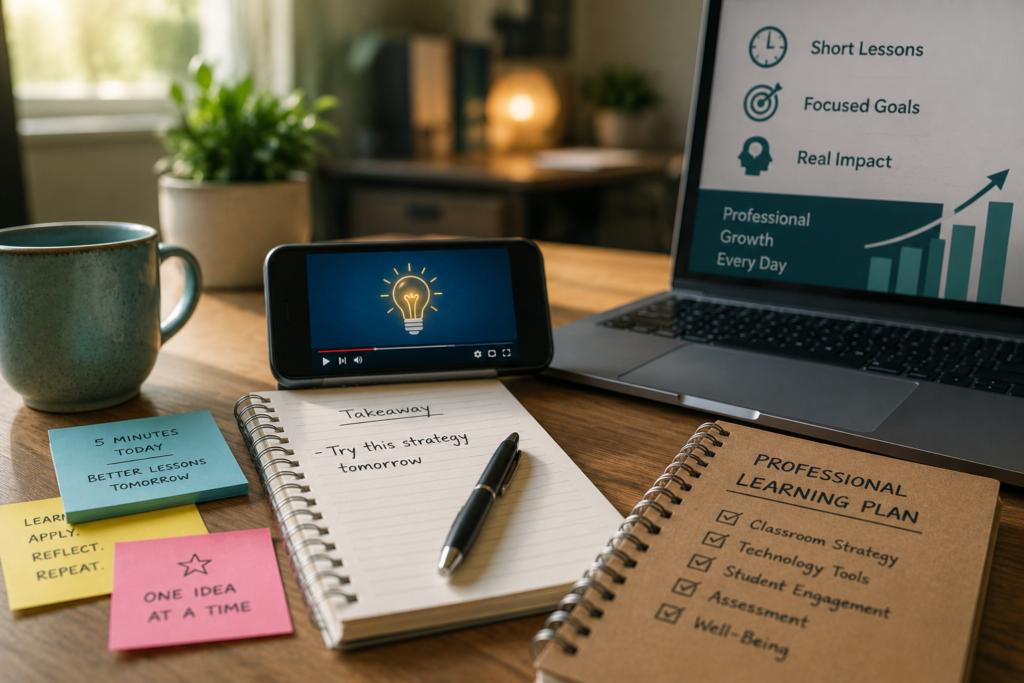
Rather than asking educators to absorb dozens of ideas during lengthy workshops, teacher in-service is evolving toward microlearning—short, focused learning experiences designed to deliver one meaningful idea that educators can immediately apply.
The shift isn’t simply about saving time.
It is about making professional learning more effective.
Great Learning Isn’t Measured in Hours
One of the biggest misconceptions about microlearning is that it lowers expectations.
It doesn’t.
Microlearning changes how learning is delivered—not how much educators are expected to know.
Instead of presenting twenty different ideas during a single workshop, microlearning focuses on one concept, one skill, or one challenge at a time.
A ten-minute lesson introducing a new artificial intelligence tool.
A five-minute refresher on cybersecurity awareness.
A short video explaining updated laboratory safety procedures.
A brief coaching module focused on questioning strategies.
Each learning experience has one clear purpose.
Teachers leave knowing exactly what they can try the next day.
Great professional learning isn’t defined by its length.
It is defined by what educators do differently when they return to their classrooms.
Why Smaller Learning Often Works Better
Anyone who has attended an all-day conference understands what happens by mid-afternoon.
The notebook is still open.
The speaker is still presenting.
But attention begins to fade.
Professional learning works best when educators have time to process new ideas, apply them, reflect on the results, and build upon that experience.
Microlearning supports that natural cycle.
Rather than overwhelming educators with information they may not use for weeks or months, districts increasingly provide smaller learning experiences that connect directly to immediate classroom practice.
Teachers learn one strategy.
They implement it.
They reflect.
Then they learn the next.
Professional growth becomes continuous instead of concentrated.
Learning That Fits the Reality of Teaching
Teaching has never been a profession with extra time.
Today’s educators balance instruction, assessment, technology integration, family communication, meetings, extracurricular activities, and countless unexpected situations throughout every school day.
Finding six uninterrupted hours for professional learning has become increasingly difficult.
Microlearning acknowledges that reality.
A teacher may complete a ten-minute literacy module during a planning period.
A principal listens to a leadership podcast while driving between buildings.
A science teacher reviews laboratory safety procedures moments before introducing new equipment.
An instructional coach watches a short AI demonstration before meeting with faculty.
Professional learning becomes part of the workday instead of competing with it.
That flexibility is one of microlearning’s greatest strengths.
Learning When It Matters Most
Traditional professional development often asked educators to remember information they might not use for months.
Microlearning changes the timing.
Learning happens when educators actually need it.
A teacher exploring artificial intelligence for the first time can watch a short instructional video that evening and begin experimenting with new classroom strategies the next morning.
A counselor preparing for a difficult student conversation can review current mental health guidance before school begins.
A chemistry teacher introducing unfamiliar equipment can complete a brief safety refresher moments before instruction starts.
Knowledge delivered at the moment of need is far more likely to become knowledge applied in practice.
Professional learning becomes timely instead of theoretical.
Technology Is Fueling the Movement
Microlearning would be difficult without today’s technology.
Learning management systems organize short learning modules into searchable libraries.
Podcasts allow educators to learn while commuting or exercising.
Mobile devices place professional learning in educators’ pockets.
Interactive simulations provide immediate practice opportunities.
Artificial intelligence is now beginning to personalize microlearning itself.
Imagine opening your district’s learning platform.
Instead of searching through hundreds of courses, AI recommends a five-minute learning module based on your teaching assignment, previous professional development, current district initiatives, and classroom goals.
Professional learning becomes easier to find because technology understands what educators need.
Rather than replacing teachers, AI is helping remove barriers to learning.
Building a Habit Instead of Hosting an Event
Perhaps the greatest strength of microlearning is that it changes how educators think about professional growth.
Traditional teacher in-service often felt like an event.
Microlearning feels like a habit.
Teachers learn.
They apply.
They reflect.
They improve.
Then they repeat the process.
Professional learning becomes woven into everyday practice rather than reserved for designated days on the school calendar.
Small learning experiences accumulate over time.
Five minutes today.
Ten minutes next week.
Fifteen minutes before a new instructional unit.
Over the course of a school year, those moments represent dozens of meaningful opportunities for growth.
Short Learning Doesn’t Replace Collaboration
Some educators worry that shorter learning experiences might reduce collaboration.
The opposite is often true.
Teachers complete a brief learning module independently, then discuss implementation during grade-level meetings, professional learning communities, or instructional coaching sessions.
The learning begins individually.
The improvement happens collectively.
Microlearning provides the spark.
Collaboration helps sustain the momentum.
The strongest districts are finding ways to combine both.
Looking Ahead
As education continues changing, teacher in-service must evolve alongside it.
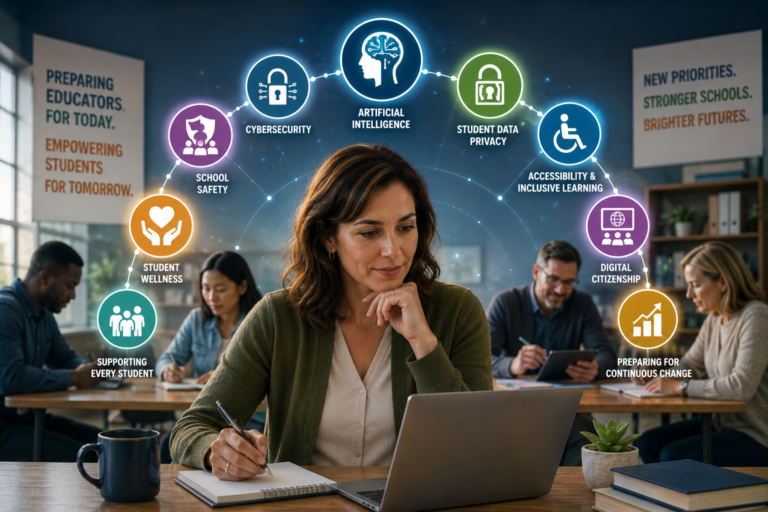
Artificial intelligence.
Cybersecurity.
Instructional technology.
School safety.
New teaching strategies.
Educators need opportunities to continually update their knowledge throughout the year.
Waiting for annual professional development days is no longer enough.
Microlearning provides a model that is flexible, timely, practical, and increasingly personalized.
The future of teacher in-service will not be measured by the number of hours educators spend sitting in professional development.
It will be measured by the number of meaningful learning moments that improve teaching, strengthen schools, and ultimately help students succeed.
Sometimes the most important professional growth begins not with a six-hour workshop…
…but with five focused minutes that change tomorrow’s lesson.
The Future of Professional Learning Series
Part 1: Teacher In-Service Has Changed
Part 2: Teacher In-Service Beyond the Auditorium
Part 3: Teacher In-Service Is No Longer One Size Fits All
Part 4: Teacher In-Service Meets Microlearning (Current Article)
Coming Next: Teacher In-Service and Artificial Intelligence — exploring how AI is personalizing professional learning through adaptive recommendations, coaching, and just-in-time support for educators.
Subscribe to edCircuit to stay up to date on all of our shows, podcasts, news, and thought leadership articles.
Related reading
More on K-12 Teachers