
AI Deepfakes: The New School Safety Threat
As synthetic images, videos, and audio spread across social media, schools are confronting a dangerous new form of cyberbullying and exploitation.

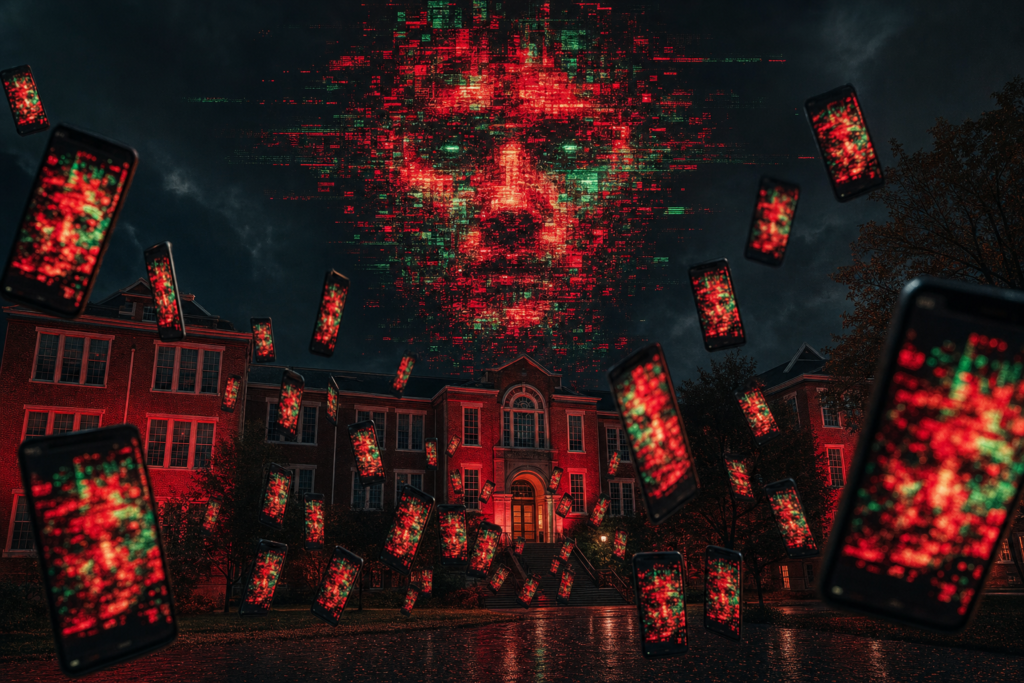
AI deepfakes are creating school safety risks through cyberbullying, impersonation, sextortion, misinformation, and attacks on trust.
AI deepfakes can turn an ordinary school morning into a crisis before the first bell rings. A principal arrives to learn that a fabricated video involving a teacher has circulated through student group chats overnight. A student refuses to come to school after classmates share an AI-generated explicit image bearing her face. Families begin calling the district about an alarming audio recording attributed to the superintendent, while administrators scramble to determine whether the voice is authentic.
None of the content is real, yet every person affected must deal with real consequences.
Classes are disrupted. Investigations begin. Students gather in hallways to discuss what they have seen. Screenshots move from one platform to another. Employees face questions about conduct that never occurred, while targeted students are forced to defend themselves against images they never created.
Deepfakes have quickly moved beyond the worlds of entertainment, political misinformation, and online scams. They are entering middle and high schools, where easily accessible artificial intelligence tools can be used to humiliate classmates, impersonate educators, spread false information, and create sexually explicit images without the subject’s knowledge or consent.
This is not simply another violation of a school device policy. It is a rapidly developing school safety issue involving cybersecurity, cyberbullying, student mental health, sexual harassment, privacy, public trust, and crisis communication.
Deepfakes Give Cyberbullying a Powerful New Weapon
Cyberbullying has long included cruel messages, rumors, embarrassing photographs, fake social media accounts, and deliberate social exclusion. Deepfake technology adds something more dangerous: the ability to manufacture convincing visual or audio evidence of an event that never happened.
A deepfake is an image, video, or audio recording created or manipulated with artificial intelligence to imitate a real person. It can place someone’s face into a fabricated scene, recreate a person’s voice, or make someone appear to say or do something that never occurred.
Although synthetic media has existed for years, generative AI has dramatically lowered the technical barrier. Creating a convincing fabrication once required editing experience, specialized software, and significant time. Today, a student may need little more than a publicly available photograph and access to an inexpensive or free AI-powered app.
The ease of creation is part of what makes the threat so difficult for schools to contain. A student acting impulsively may create an image in seconds without fully considering the emotional, disciplinary, or legal consequences. What begins as an attempt to embarrass one classmate can quickly become a schoolwide crisis when the content is shared through group messages, anonymous accounts, social media platforms, or gaming communities.
The problem is already appearing in schools. A nationally representative RAND survey of K–12 principals found that 13 percent reported bullying incidents involving AI-generated deepfakes during the 2023–24 or 2024–25 school years.
Incidents were significantly more common in secondary schools. Twenty percent of middle school principals and 22 percent of high school principals said their schools had experienced bullying involving AI-generated images, fabricated photographs, deepfakes, or false online identities.
That means approximately one in five middle and high schools represented in the survey had already encountered this emerging form of digital victimization.
Students Can Be Targeted Without Sharing Anything Explicit
Some of the most disturbing school-related cases involve “nudify” tools, which use artificial intelligence to transform an ordinary photograph into a fabricated nude or sexually explicit image.
A student does not have to send an intimate photograph to become a victim. A yearbook portrait, athletic photograph, social media post, or picture taken in a school hallway can be enough to create exploitative content. The image may then be circulated among classmates, posted to an anonymous account, or used to threaten and control the person depicted.
The National Center for Missing & Exploited Children has warned that generative AI is being used to create exploitative imagery involving children. The organization identifies peer victimization—including the creation and circulation of AI-generated nude or sexually explicit content among classmates—as a growing child safety concern.
Girls have been disproportionately targeted in many reported incidents, although any student can become a victim. The targeted student may not learn that an image exists until a friend sends a screenshot or rumors begin circulating at school.
The discovery can create an immediate sense of panic and helplessness. Even when classmates know an image has been fabricated, they may continue sharing it for attention, entertainment, or cruelty. Other students may believe it is authentic. The victim is then placed in the painful position of repeatedly explaining that the image is not real while knowing that peers have viewed, saved, discussed, and possibly redistributed it.
The resulting harm can extend throughout a student’s life at school. A targeted student may avoid classrooms, lunch periods, athletics, extracurricular activities, or social events. Attendance and academic performance may decline. Some students experience anxiety, depression, humiliation, isolation, or fear that the image will resurface during college admissions, employment searches, or future relationships.
Describing the content as artificial should never be used to minimize the experience of the person depicted. The technology may have fabricated the image, but it cannot erase the invasion of privacy, loss of control, reputational damage, and psychological distress that follow.
Deepfakes Are Expanding the Danger of Sextortion
Deepfake technology also increases the threat of sextortion, in which an offender uses sexual content or the threat of exposure to demand money, additional images, or other forms of compliance.
Traditionally, sextortion schemes have often begun when a young person sends an intimate photograph to someone they believe they can trust. With generative AI, an offender may not need an authentic image. A fabricated but convincing picture can create enough fear and shame to manipulate the victim.
An offender could take a photograph from a student’s social media account, alter it, and threaten to send the result to parents, classmates, teammates, teachers, or college recruiters. The student may comply because the potential consequences feel immediate, regardless of whether the content is authentic.
Young people can be particularly vulnerable to this form of coercion. A student who fears punishment or public embarrassment may send money, provide additional content, or attempt to handle the situation alone rather than approaching an adult.
That isolation gives the offender more control. School communities must make it clear that students who are threatened or exploited will receive help rather than blame. They should be encouraged to stop communicating with the offender, avoid sending money or additional images, preserve available evidence, and contact a trusted adult immediately.
The FBI identifies sextortion as a serious crime and urges students, families, educators, and caregivers to understand the warning signs. Deepfakes complicate the threat because students can now be exploited using content they never created or shared.
Educators Can Face Fabricated Allegations
Students are not the only people at risk. Teachers, principals, coaches, superintendents, and school board members can also become deepfake targets.
A student can manipulate a teacher’s photograph to create an inappropriate image. AI-generated audio can make it sound as though a coach threatened a player or a principal made a discriminatory statement. A fabricated video can falsely depict an employee engaging in misconduct.
Such content can be especially damaging in a school environment, where leaders must respond quickly to credible allegations involving student or employee safety. Even when a video or recording is eventually proven false, the accusation may spread much faster than the correction.
An employee could be removed from the classroom while the district investigates. Families may demand immediate answers. The content may be reposted by people outside the school community who have no knowledge of its origin. The employee may receive threats or become publicly associated with conduct that never occurred.
District leaders face a difficult responsibility in these situations. They must take serious allegations seriously while avoiding the assumption that a convincing recording is authentic. That requires urgency, careful verification, due process, clear communication, and an understanding that manipulated media can be used as a weapon against both students and employees.
The administrative burden can also be significant. School leaders may need to preserve evidence, interview students, determine where the content originated, contact families, involve legal counsel, coordinate with law enforcement, respond to media inquiries, and support the targeted employee. All of that work occurs while rumors continue spreading and the normal operation of the school is disrupted.
Social Media Can Turn One Fabrication Into a Community Crisis
Deepfake technology creates the content, but social media supplies the distribution system.
An altered image can move from one student’s phone to hundreds of devices before administrators know it exists. Even if the original post is removed, screenshots and saved copies can continue circulating through group texts, direct messages, gaming platforms, private accounts, and temporary social media stories.
School communities are particularly vulnerable because students recognize the people, uniforms, classrooms, and locations depicted. A fabrication does not have to be perfect to cause harm. It only needs to look believable long enough for people to react.
The pressure to share shocking content also works against careful verification. Some students repost deepfakes because they assume the content is authentic. Others know it is false but share it because they find it funny, dramatic, or socially valuable. Every new share expands the audience and makes removal more difficult.
Schools must therefore confront more than whether students can identify synthetic media. They must also examine the behavior that follows discovery. Will students forward the content, confront the targeted person, or add humiliating comments? Or will they refuse to share it, report it to a trusted adult, and support the person being targeted?
Deepfake education cannot stop at teaching students how to detect a manipulated image. It must also teach consent, empathy, ethical decision-making, responsible reporting, and the consequences of participating in digital harm.
Deepfakes Are Also a Cybersecurity Threat
School cybersecurity efforts have traditionally focused on ransomware, phishing, stolen credentials, data breaches, and network security. Those dangers remain, but deepfakes introduce another critical vulnerability: an attack on identity and institutional trust.
A cloned voice could impersonate a superintendent and direct an employee to release confidential information. A fraudulent video could falsely announce a school closing, emergency, threat, or policy change. An attacker might imitate a principal, parent, vendor, or technology administrator to make a request appear legitimate.
Deepfakes become even more convincing when combined with information gathered from district websites, public meeting recordings, staff directories, social media accounts, or compromised email addresses. A message arriving from a familiar account may appear trustworthy even when its audio or video attachment has been fabricated.
This creates challenges that cannot be solved by installing a single detection tool. Schools must consider identity verification, account protection, communication protocols, employee training, social media management, digital evidence, crisis response, and the amount of personal information they publish online.
Commercial detection tools can help flag suspicious content, but they have limitations. As generative technology improves, older visual warnings—such as unnatural facial movements, distorted hands, irregular blinking, or mismatched lighting—become less reliable.
Schools need verification procedures that examine the source, context, account history, and original file rather than relying entirely on visual inspection or one automated detector. When a message involves money, private information, emergency directions, or an unusual request, employees should confirm it through a separate, trusted communication channel.
The Legal Landscape Is Beginning to Catch Up
Federal and state laws are evolving in response to AI-generated exploitation.
The federal TAKE IT DOWN Act addresses the nonconsensual online publication of intimate visual depictions, including AI-generated deepfakes. Covered online platforms must provide a process for requesting the removal of qualifying content and known identical copies within 48 hours of receiving a valid request. The Federal Trade Commission began enforcing those platform requirements in May 2026.
Deepfake incidents may also create responsibilities under Title IX. The U.S. Department of Education’s Office for Civil Rights has identified the nonconsensual sharing of intimate images—whether real, altered, or created through AI—as conduct that may constitute online or digital sexual harassment, depending on the circumstances.
State laws are also changing. Illinois, for example, expanded its definition of school cyberbullying for the 2026–27 school year to include the electronic distribution of certain AI-generated digital replicas. Other states have updated or introduced laws involving synthetic sexual content, impersonation, harassment, privacy, and child exploitation.
Legal obligations will differ according to the jurisdiction and details of an incident. Schools may need to consider Title IX procedures, mandatory reporting requirements, student discipline, law enforcement notification, evidence preservation, privacy protections, and the rights of both victims and accused individuals. Districts should work with legal counsel to clarify these obligations before facing an active crisis.
Schools Are Taking Action, but Important Gaps Remain
The RAND findings show that many schools take deepfake incidents seriously once they occur. Among the schools that reported an incident, 79 percent took disciplinary action and 66 percent referred the matter to law enforcement. Forty-seven percent provided training or education to students and employees.
However, only 23 percent reported updating their technology-misuse policies to include specific language about AI.
That gap suggests many schools are responding with policies written before students could easily fabricate another person’s face or voice. Existing bullying, harassment, sexual misconduct, and acceptable-use rules may apply, but vague language can create confusion about what is prohibited and how an incident should be handled.
Some districts are beginning to specifically prohibit the use of AI to impersonate, exploit, harass, threaten, or falsely represent another person. Others are establishing anonymous reporting options, incorporating synthetic media into digital citizenship instruction, reviewing how student photographs are published, and preparing coordinated response procedures.
The work cannot belong exclusively to the technology department. IT leaders may help secure accounts, analyze files, preserve evidence, and work with platform providers, but a deepfake incident can also require administrators, counselors, communications teams, Title IX coordinators, school resource officers, legal counsel, teachers, and families.
A fragmented response creates delays and increases the likelihood that the victim will have to repeat the story to multiple adults. A coordinated response helps the school protect the targeted person while investigating the conduct, limiting additional distribution, and communicating accurate information.
Deepfakes Threaten the Trust Schools Depend On
The deepest long-term danger may not be a single fabricated image. It may be the gradual erosion of confidence in everything students, educators, and families see and hear.
When any photograph can be altered, any voice can be cloned, and any video can be fabricated, authentic evidence may also become easier to dismiss. A student confronted with a real recording may claim it was generated by AI. A legitimate safety announcement may be questioned. A genuine report of misconduct could be treated with suspicion.
Schools must teach students to evaluate digital content without encouraging automatic disbelief. Healthy skepticism means asking who created the content, where it first appeared, whether trusted sources have confirmed it, and whether the person sharing it benefits from creating outrage or confusion.
It also means recognizing that verification is only part of responsible behavior. Students do not need to determine with absolute certainty whether humiliating or explicit content is authentic before deciding not to share it. Protecting another person’s dignity should not depend on successfully completing a digital investigation.
School Safety Now Extends Beyond the School Building
The boundary between online conduct and school life has largely disappeared. A deepfake created on a personal device at home can affect attendance, relationships, classroom behavior, athletic teams, employee reputations, and student mental health the next morning.
Schools cannot control every private account, app, or device. They can create a culture in which students understand the seriousness of fabricating another person’s identity, know how to report harmful content, and trust that adults will respond without blaming the victim.
Families must be part of that culture. They do not need to become deepfake detection experts, but they should understand that a child can be targeted without ever sending an explicit image. They must be prepared to listen calmly, preserve available evidence, contact the school, report the content, and reassure the child that seeking help was the right decision.
Artificial intelligence continues to offer valuable opportunities for creativity, accessibility, communication, and learning. Recognizing its potential does not require schools to ignore how easily the same technology can be weaponized.
The next era of school safety will involve more than protecting buildings, networks, and devices. It will require schools to protect the identities, dignity, well-being, and trust of the people inside them.
Part One of a Two-Part Series
Part Two will examine how districts can update policies, train employees, educate students, work with families, preserve evidence, and build an effective response plan before a deepfake crisis occurs.
Subscribe to edCircuit to stay up to date on all of our shows, podcasts, news, and thought leadership articles.
Related reading
More on School Safety