
Why High Schools Need Stronger CTE Pathways
Hands-on pathway programs give students room to explore, build real skills, and make better-informed decisions about college, careers, and adulthood.

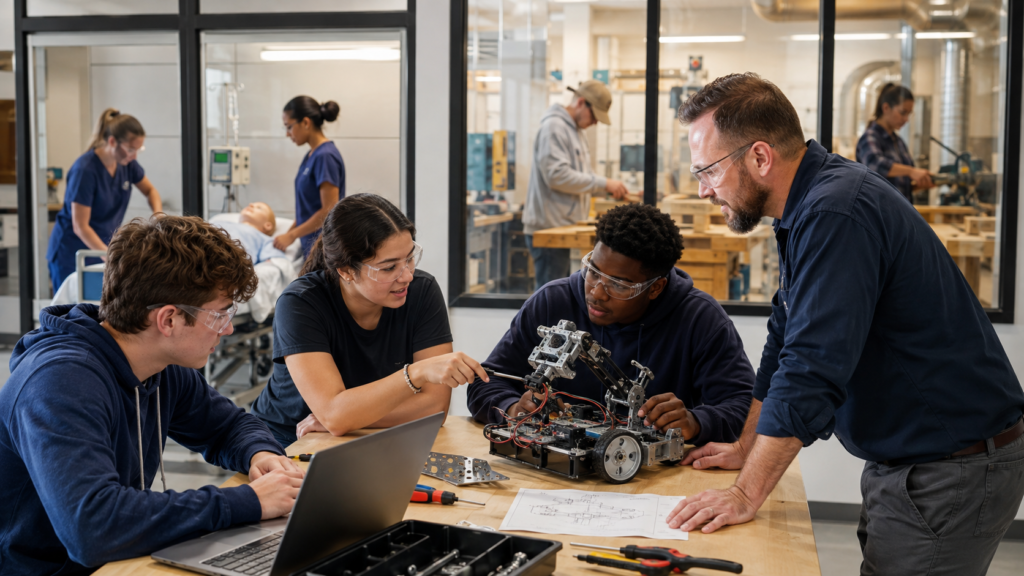
Strong CTE pathways connect high school learning with real experience, helping students build skills and make informed choices about what comes next.
You can often see the value of strong CTE pathways when something goes wrong.
The code fails. The cabinet door hangs crooked. The simulated patient’s condition changes. There is no answer key to rescue the student. Someone has to diagnose the problem, ask a better question, accept feedback, and try again.
That is hands-on learning at its best: work requiring judgment, persistence, communication, and technical knowledge—the same combination students will need long after high school.
For years, career and technical education was a separate track for students considered unlikely to attend college. Modern CTE can leave that history behind by giving students more ways to enter their future.
The False Choice Between College and Career
The phrase “college or career” still appears in conversations about life after graduation, as if students must choose one side. Actual lives are rarely that tidy.
A healthcare student might earn a nursing assistant credential, work part-time, and continue toward a nursing degree. An engineering student might enter an apprenticeship, complete an associate degree, or pursue a four-year program.
The National Center for Education Statistics found that 80 percent of 2013 public high school graduates who concentrated in CTE had enrolled in post-secondary education by 2021. Most continued learning after graduation, although their routes varied.
A good pathway lets a 16-year-old test an interest before making an expensive decision. Discovering that patient care, construction, cybersecurity, or teaching feels right is valuable. Discovering that it does not can be equally useful.
A Pathway Has to Lead Somewhere
Many high schools offer career-related electives. Fewer have built a fully connected experience.
A pathway should begin with exploration and become more demanding. Academic subjects appear inside the work: geometry in construction, biology in healthcare, chemistry in manufacturing, and writing in business. Advanced courses introduce professional tools and expectations. College credit, recognized credentials, internships, apprenticeships, and client projects extend the learning beyond school.
This is where career-connected learning moves from an appealing idea to an actual sequence.
Families should be able to see where a pathway goes. Which courses come next? Does the credential have value? Will the college credit transfer? What options remain if a student changes direction?
If those answers are unclear, the pathway may be little more than a new label placed on old electives.
Why the Learning Feels Different
Hands-on learning changes the student’s role. Instead of waiting for the teacher to confirm every step, students have to notice, decide, build, revise, and explain.
The work can be powerful for teenagers who have stopped seeing themselves as capable learners. Abstract assignments feel different when accurate measurements determine whether a structure stands square or clear communication helps a team finish safely.
Relevance does not lower expectations. It gives those expectations a visible purpose.
A systematic review highlighted by the U.S. Department of Education’s Institute of Education Sciences found positive effects on academic achievement, high school completion, employability skills, and college readiness. CTE participants were more likely to enroll in two-year colleges, just as likely to enter four-year colleges, and more likely to be employed. Researchers found no statistically significant effect on earnings, a reminder not to promise more than the evidence supports.
A dated curriculum, unsafe equipment, or an internship that amounts to free labor will not deliver those outcomes simply because it carries the CTE name.
The Economy Is Moving, but Schools Must Think Beyond Trends
The U.S. Bureau of Labor Statistics projects the economy to add approximately 5.2 million jobs between 2024 and 2034, with healthcare and social assistance accounting for much of the growth. Computer and mathematical occupations are projected to grow more than three times as fast as employment overall.
Schools should pay attention to those signals without chasing every headline. A pathway built around one employer, one piece of equipment, or one fast-growing occupation can become outdated surprisingly quickly.
Artificial intelligence already influences automotive diagnostics, logistics, healthcare, agriculture, and manufacturing. Students need emerging technology skills alongside abilities that survive a software update: problem-solving, communication, adaptability, safety awareness, and continued learning.
The goal is broader than filling today’s vacancies. High schools should help students develop skills they can carry from one employer, credential, or career stage to another.
CTE Must Not Become Tracking With Better Branding
The expansion of CTE carries a risk that deserves more attention. Schools can unintentionally recreate the old vocational divide by steering certain students toward certain pathways.
A counselor may assume a student with lower test scores is “better suited” for the trades. A young woman may never hear about advanced manufacturing. A student with a disability may be discouraged before anyone discusses accommodations. College-bound students may be told CTE will not fit their schedules, while others are pushed into a pathway without seeing post-secondary options.
None of those decisions may look dramatic on their own. Together, they can turn opportunity into a new form of sorting.
Federal CTE researchers have warned that selective programs can limit equitable access. Districts should examine who applies, who is admitted and completes a pathway, and who receives advanced courses, paid placements, dual credit, and valuable credentials.
Students also need room to change their minds. Career exploration should begin before high school, but specialization should not close off academic courses or future education. The point is to make choices more informed, not more permanent.
Offering a Program Is Not the Same as Providing Access
Even an excellent pathway has limited value if students cannot reach it.
Transportation is a barrier when programs are housed at regional centers or employer sites. Schedules can force students to choose between CTE and advanced academics, music, or athletics. Unpaid internships may be impossible for students supporting their families. Fees, limited seats, and instructor shortages narrow access further.
These are design problems, not student motivation problems.
Districts can respond with paid work, transportation assistance, flexible scheduling, regional programs, and college partnerships. Indianapolis Public Schools, for example, worked with Regional Educational Laboratory Midwest to examine work-based-learning barriers through surveys and process mapping—not simply by posting more internships.
Access has to be built into the pathway from the beginning.
What Every Graduate Should Experience
Not every high school can offer welding, aviation, healthcare, cybersecurity, culinary arts, construction, agriculture, and engineering under one roof. Every district can still establish a minimum expectation for career-connected learning.
Before graduating, students should solve an authentic problem, learn from someone in a field that interests them, understand the education and costs behind different careers, and demonstrate a skill to an employer or college.
Districts should measure more than enrollment: who completes each pathway, whether credentials have value, whether credits transfer, who receives paid experience, and what graduates do next. Student and employer feedback belongs alongside completion rates.
The answers will not always be flattering. That is precisely why they matter.
Giving Students a Better Next Step
Most teenagers will not leave high school with the rest of their lives mapped out. Adults rarely have that certainty either.
Students can leave with the experience of solving a difficult problem, contributing to a team, receiving professional feedback, and using classroom knowledge to accomplish something tangible. They can understand the difference between a job that sounds interesting and work they have actually tried.
That is a more honest promise than telling every student to follow the same route after graduation.
High school should provide young people with time to explore and enough structure to move forward. Strong CTE pathways do both. They do not decide a student’s future. They help the student make a better first decision about it.
School Shine – CTE Career Pathways Video for Glendale Unified School District (Play video)

Subscribe to edCircuit to stay up to date on all of our shows, podcasts, news, and thought leadership articles.
Related reading
More on Career and Technical Education (CTE)