edCircuit
  • Start Here
    • Login
    • Register
    • Subscribe
    • Submit a Press release
    • Advertise or Sponsor
    • Contribute
    • Get Interviewed
  • On The Wire
  • EdTech
    • All EdTech
    • Online Learning
    • Hybrid and Remote Learning
    • Augmented and Virtual Reality
    • ESports
    • Gamification and Game-Based Learning
    • Digital Citizenship
    • EdTech Entrepreneurs
    • Market Trends
    • Future of Education
  • K-12 Education
    • All K-12
    • K-12 Teachers
    • Teaching Strategies
    • Special Education and IEPs
    • Dyslexia
    • Gifted and Advanced Learning
    • Early Childhood, Pre-K and Kindergarten
    • School Calendar
    • Tutoring and Homework Help
    • Attendance and Absenteeism
    • After-School Programs
    • School Counselors
    • Homeschooling
    • School Models
    • Teacher Retention
    • Parents
    • Students
    • STEM and STEAM Education
  • Teaching and Learning
    • Literacy and Reading
    • Math Education
    • Civics and History Education
    • Financial Literacy
    • Assessment and Testing
    • Curriculum and Instruction
    • Personalized Learning
    • Project-Based Learning
    • Social-Emotional Learning
    • Executive Function
    • Creativity
    • Diversity, Equity, Inclusion
  • Professional Development
    • All Professional Development
    • Educators
    • Administrators
    • edLeaders
  • Higher Education
    • All Higher Education
    • College Admissions
    • Career and Technical Education (CTE)
    • Graduation
    • FAFSA and Financial Aid
    • Student Loans
  • Artificial Intelligence
  • Cybersecurity
  • School Safety
    • All School Safety
    • Science and Lab Safety
    • School Design and Facilities
    • Bullying
    • Duty of Care and School Liability
  • Continuing Education
    • All Continuing Education
    • Online Certificate Programs
    • Teaching Jobs and Careers
    • Teacher Appreciation
  • Education Policy and Government
    • All Education Policy
    • Department of Education
    • School Choice
    • Global
    • Advocates
  • EDU Shows
    • All EDU Shows
    • Safer Ed
    • Mind the Gap
    • EdTech Questions
    • CoffeEd
    • InFocus
    • InformED Report
  • EDU Podcasts
    • All EDU Podcasts
    • Author Chats
    • CoSN The Podcast
    • Education Today
    • Building the Bridge
    • Students Speak
  • Education Industry Guides and Reports
  • Archived Media
    • Future of School: The Podcast
    • Equity Everywhere
  • About edCircuit
  • Subscribe
edCircuit
  • LOGIN
Home Tags Posts tagged with "Headline"
Tag:

Headline

This if for posts to be in the featured/top section of site
A security camera mounted on the ceiling above blue lockers in a school hallway as students walk past
Hot Topics - controversialSchool SafetyArtificial IntelligenceK-12

Cameras in Schools: Safety, Surveillance, and Privacy

by EdCircuit Staff April 15, 2026
written by EdCircuit Staff 5 minutes read

Security cameras are now in nearly every American public school. Ninety-three percent of public schools used security cameras to monitor the school in 2021–22, up from 61 percent in 2009–10, according to the National Center for Education Statistics, including 97 percent of high schools. Most students walk under them every day without noticing.

School surveillance has also moved beyond the hallway camera. Cameras ride on buses, monitoring software watches what students type on school laptops, and some companies now sell artificial intelligence that can search hours of video or recognize faces. Each step brings real safety benefits and real questions about privacy. This article explains where cameras are used in schools, who can see the footage, whether schools can watch students through school laptops, and what district leaders and families should decide.

Why schools use cameras

School cameras are added for practical reasons. Modern network cameras are cheaper and easier to manage than older systems, and administrators can review footage from a computer or phone. Districts face constant pressure to prevent violence, bullying, vandalism and unauthorized visitors across large campuses. And cameras provide something schools rarely have after an incident: a record of what actually happened. When two students fight in a crowded hallway and witnesses disagree, footage can settle the facts in minutes, which protects students and staff from false accusations as well as holding people accountable.

Where cameras are used, and where they are not

Most school cameras cover places where people have a limited expectation of privacy: entrances and exits, hallways, cafeterias, libraries, gyms, parking lots and outdoor areas. School buses are another common location, with cameras inside to monitor behavior and outside to catch drivers who illegally pass a stopped bus. edCircuit looked at bus systems in detail in School Bus Cameras and Student Privacy.

Cameras are not placed where people reasonably expect privacy, such as restrooms, locker rooms and changing areas. Classrooms are a more complicated case. Cameras in classrooms are legal in many places but remain controversial; some states allow or require them in special education classrooms when parents request them, while many teachers worry they could be used for evaluation or discipline.

Who can see school camera footage?

Access is usually limited to administrators, security staff and, when needed, police. Families often want to see footage after an incident involving their child, and the federal Family Educational Rights and Privacy Act sets the basic rules. Under the U.S. Department of Education’s guidance on photos and videos, a video becomes part of a student’s education record when it is directly related to that student and kept by the school. Parents then generally have the right to inspect and review it, although the school is not usually required to give them a copy. If other students appear, the school must blur or separate their images when it reasonably can before showing the video.

How long footage is kept is set by each district. Many systems record over old video automatically after a few days or weeks unless an incident flags it for saving, so a family that suspects a problem should ask the school promptly, and in writing, to preserve the footage.

Can schools watch you through your computer camera?

Schools are not supposed to turn on a student’s laptop camera to watch them, and the best-known case of a district doing so ended badly. In 2010, the Lower Merion School District in Pennsylvania was sued after it used tracking software on school-issued laptops that took webcam photos and screenshots, in what it called an effort to locate missing computers. A review found tens of thousands of images, including photos of a student at home, and the district paid $610,000 to settle two lawsuits.

What schools commonly do is monitor activity on school-issued devices and accounts. Monitoring tools such as GoGuardian Beacon scan browsing, searches, email and documents on school devices for signs of suicide risk, self-harm or threats, and alert staff. Families can ask their district which monitoring tools are on student devices, what they scan, who reviews the alerts and what happens next.

The data behind the cameras

Camera systems are also computer systems. Most modern cameras connect to school networks and cloud platforms, and every connected device is one more way into a district’s network if it is poorly secured. Districts already dealing with ransomware should treat camera systems like any other sensitive system, with strong passwords and multi-factor sign-in, regular software updates, limits on who can view video, separate network segments and careful review of vendors’ security practices.

Artificial intelligence and facial recognition

Newer video systems use AI to search footage, flag unusual activity and, in some products, recognize faces. Facial recognition could, in theory, take attendance or spot an unauthorized visitor, and it is also the use that has drawn the most opposition. New York banned facial recognition in its schools in 2023, when the state education department prohibited schools from purchasing or using the technology. Districts considering any AI video tool should know exactly what it collects, whether it identifies individuals, and how long the data is stored.

Cameras and school culture

Supporters of cameras point to deterrence, faster investigations and protection for staff and students alike. Critics worry about what constant observation teaches young people about privacy, and about cameras being treated as a substitute for adults who know students. Both concerns can be true at once. A camera can record a fight in a hallway, but it cannot resolve the conflict that caused it, and it cannot replace the relationships that make students willing to report a problem before it happens.

Questions every district should answer

Districts can earn families’ trust by answering a few questions publicly. What problems are the cameras meant to solve? Where are cameras placed, and is audio recorded? Who can view footage, how long is it kept, and how can families ask to see it? How are the systems secured? Will the district use facial recognition or other AI analysis, and under what rules? Communities will reach different answers, but writing them down, and sharing them, is what separates a safety measure from a surprise.

Related reading

  • School Bus Cameras and Student Privacy
  • Student Data Privacy: What Happens After Graduation?
  • School Safety: SRO vs School Safety Officer Explained
  • Flock Cameras in Schools: Safety or Surveillance?

Subscribe to edCircuit to stay up to date on all of our shows, podcasts, news, and thought leadership articles.

April 15, 2026 0 comments
0 FacebookTwitterPinterestLinkedinWhatsappCopy LinkEmail
A crowd gathers near Chicago’s Cloud Gate sculpture with city skyscrapers in the background; overlaid text reads, CoSN 2026 Day 2: On the Ground with edCircuit at the CoSN Conference.
COSNArtificial IntelligenceK-12Hot Topics - controversial

CoSN 2026 Day 2: AI Drives K-12 Leadership

by EdCircuit Staff April 14, 2026
written by EdCircuit Staff 5 minutes read

CoSN 2026 Day 2 marked a decisive shift from early conference energy to full-scale engagement, where conversations turned into strategy and strategy began evolving into action. Inside the CoSN 2026 Conference, district leaders, technology officers, and education innovators leaned into one undeniable reality: artificial intelligence is no longer an emerging topic—it is now a foundational expectation.

From the first sessions of the morning to the closing keynote, Day 2 reflected a K–12 landscape that is rapidly moving beyond exploration. School systems are no longer asking whether AI belongs in education. They are now focused on how to implement it responsibly, sustainably, and at scale.

A Morning Defined by Urgency and Direction

The day began early, with networking opportunities setting the tone for collaboration before attendees dispersed into a dense schedule of sessions. Leaders were immediately faced with difficult choices—not because of a lack of options, but because nearly every session addressed a critical pressure point in modern education.

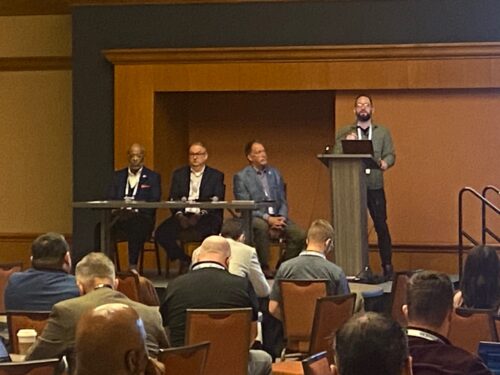
A speaker stands at a podium while three panelists, part of the CoSN conference, sit at a table onstage; audience members face the stage in a conference room.Discussions centered on leadership, innovation, and infrastructure. Sessions exploring AI integration, cybersecurity readiness, and device sustainability highlighted the interconnected challenges districts now face. Conversations around secure AI implementation, student data privacy, and technology lifecycle management underscored a growing understanding that these issues can no longer be addressed in isolation.

Cybersecurity sessions reinforced this urgency. District leaders examined real-world phishing simulations and system vulnerabilities, recognizing that as AI capabilities expand, so too do the risks. The takeaway was clear: AI innovation and cybersecurity strategy must evolve together.

AI Moves to the Center of Every Conversation

By mid-morning, a clear pattern had emerged—AI was no longer confined to a single track or specialty session. It had become the connective tissue across the entire conference.

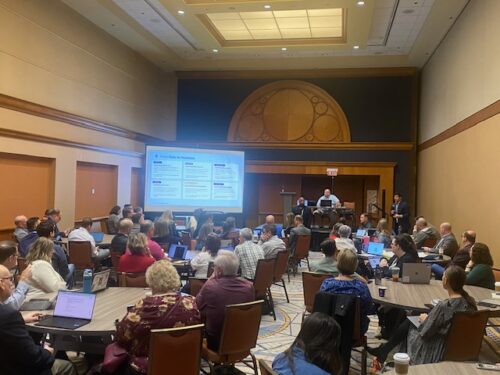
A conference room filled with people seated at tables, facing a presentation screen displaying a CoSN slide with text and graphics.Whether the topic was instructional practice, leadership strategy, infrastructure, or student safety, AI was embedded in the discussion. Sessions explored AI-driven voice tools, district-wide implementation strategies, and the evolving role of AI in defending against cyber threats. Even traditionally separate conversations—such as cloud computing, data privacy, and physical security—were reframed through an AI lens.

The continued draw of the AI Playground reinforced this shift. Attendees were not just listening—they were experimenting, testing tools, and engaging directly with emerging technologies. This hands-on approach reflected a broader trend: districts are moving from passive learning to active implementation.

Where the Conference Comes to Life

While sessions provided structure, the real momentum of Day 2 could be felt beyond the scheduled agenda. The exhibit floor—especially the EdTech Exchange—and surrounding networking spaces quickly became the heartbeat of the event, driving authentic, meaningful conversations.

This is where theory meets reality.

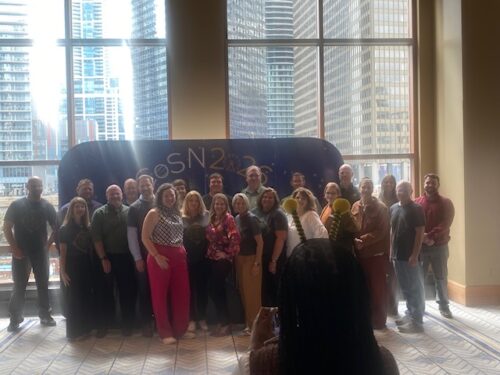
A group of people pose for a photo indoors in front of a sign reading “CoSN 2024,” with large windows and city buildings visible in the background.District leaders compared implementation strategies, shared lessons learned, and discussed challenges that rarely surface in formal presentations. Vendors and educators connected over real needs—not just product features—creating a more grounded and practical dialogue around edtech adoption.

For edCircuit, the positioning near registration proved especially impactful. With consistent foot traffic and organic interactions, it created a steady flow of conversations with educators, administrators, and industry leaders. These moments—unscripted and immediate—often provide the most accurate snapshot of where education is heading.

From Big Ideas to Real-World Application

As the day progressed, the focus shifted from high-level vision to practical execution. Sessions in the late morning and early afternoon emphasized implementation, sustainability, and long-term planning.

Topics such as E-Rate funding, technology lifecycle management, and post-ESSER budget realities reflected the financial pressures districts are navigating. Leaders are being asked to innovate while simultaneously managing shrinking or uncertain funding streams.

At the same time, sessions on responsible AI practices, micro-credentialing, and workforce development highlighted a growing commitment to building systems that are not only effective, but also scalable and sustainable.

This transition—from vision to execution—was one of the defining characteristics of Day 2. Districts are no longer satisfied with inspiration alone. They are demanding strategies that can be implemented, measured, and refined.

Balancing Innovation with Responsibility

The afternoon keynote, “Building What’s Next: Supporting Youth in a Digital World,” brought a broader perspective to the day’s discussions. While much of the conference focused on technology, the keynote served as a reminder that innovation must remain grounded in student experience.

Conversations expanded to include digital well-being, human connection, and the long-term impact of technology on learning environments. As AI continues to reshape education, leaders are being challenged to ensure that progress does not come at the expense of student development or community values.

This balance—between rapid innovation and thoughtful responsibility—is becoming one of the most important leadership challenges in K–12 education.

The Defining Takeaways from Day 2

Day 2 of CoSN 2026 reinforced several key themes that are shaping the future of education:

Artificial intelligence is now embedded in every major conversation, influencing decisions across leadership, instruction, and infrastructure. Cybersecurity is evolving alongside AI, creating a dual priority that districts must address simultaneously. Leaders are shifting from exploration to implementation, focusing on how to scale innovation in real-world environments.

At the same time, funding and sustainability remain significant concerns, particularly as districts move beyond temporary federal support. Perhaps most importantly, the value of the conference continues to extend beyond sessions—residing in the connections, conversations, and shared experiences that bring these ideas to life.

Looking Ahead

As CoSN 2026 continues, the momentum from Day 2 sets the stage for deeper conversations and more targeted strategies. The questions facing K–12 leaders are becoming more complex, but so too are the solutions being developed in spaces like this.

For edCircuit, the focus remains clear: listen, connect, and amplify the voices shaping the future of education.

Because if Day 2 made anything certain, it’s this—the future of K–12 is not being imagined. It is being built, right now.

Day One: CoSN 2026: On the Ground with edCircuit


Subscribe to edCircuit to stay up to date on all of our shows, podcasts, news, and thought leadership articles.
April 14, 2026 0 comments
0 FacebookTwitterPinterestLinkedinWhatsappCopy LinkEmail
A young man runs through a parking lot with a water balloon while two young women chase him with water guns; several people watch and smile in the background, highlighting the Senior Tag risks schools can’t ignore.
Hot Topics - controversialSchool SafetyK-12

Senior Tag Risks Schools Can’t Ignore

by EdCircuit Staff April 14, 2026
written by EdCircuit Staff 6 minutes read

It’s 9:30 PM on a weeknight. A car slows down in a quiet neighborhood. A student steps out, scanning the street, gripping what looks like a weapon. Minutes later, a neighbor calls the police.

It wasn’t a threat—it was Senior Tag.

What has become a widely accepted spring tradition among high school seniors is now drawing increased concern from school administrators, law enforcement, and families. While intended to be a fun and competitive sendoff to senior year, Senior Tag—also known as “Senior Assassin”—has evolved into something far more complex, and in some cases, far more dangerous.

What Is Senior Tag—and Why It’s Growing

Senior Tag is not a school-sponsored activity, yet it thrives in nearly every corner of the country. Organized through group chats and social media, students form brackets, contribute to a cash prize, and attempt to “eliminate” assigned targets using water guns or Nerf-style blasters.

The appeal is easy to understand. It’s competitive, social, and creates a shared experience during one of the most memorable times of a student’s life. The game taps into the excitement of senior year—a final opportunity to connect, compete, and leave a mark.

But what begins as a simple game quickly becomes something much more immersive. Students don’t just participate; they strategize, monitor, and adjust their daily routines. The game follows them beyond school grounds and into their neighborhoods, evenings, and weekends.

When the Game Leaves the School Behind

In communities like Columbus, Ohio and across the country, local reports and coverage from outlets such as Axios have highlighted growing concerns tied to Senior Tag. Law enforcement agencies have issued warnings as situations escalate beyond what participants initially intend.

One of the most immediate concerns is how the game influences student behavior outside of school. In an effort to gain an advantage, students often track each other’s movements, wait outside homes, or follow peers in vehicles. While these actions may feel like harmless strategy within the context of the game, they introduce real-world risks—especially when combined with inexperience behind the wheel and the pressure to “win.”

The result is a shift from passive participation to active pursuit, where decision-making can become impulsive and, at times, unsafe.

Blurring Lines: Property, Boundaries, and Perception

Senior Tag frequently crosses into spaces that extend beyond the comfort zone of the broader community. Students attempting to eliminate a target may enter private property, hide in backyards, or approach homes unannounced. While participants understand the context, neighbors and homeowners do not.

This disconnect creates a critical issue: perception.

To someone outside the game, these actions can appear suspicious or even threatening. In several cases nationwide, residents have contacted police after witnessing individuals hiding near homes or moving through neighborhoods at unusual hours. What students see as gameplay, others interpret as a potential security concern.

In today’s environment, that misunderstanding carries weight—and consequences.

The Most Serious Risk: When Toy Weapons Look Real

Perhaps the most alarming aspect of Senior Tag is the use of toy weapons that can resemble real firearms. Water guns and modified Nerf blasters, particularly in low-light conditions or from a distance, can easily be misidentified.

Law enforcement agencies have repeatedly emphasized a critical reality: officers responding to a report involving a possible weapon must act based on what they perceive in the moment—not on intent.

This creates a dangerous scenario where:

  • A game can be mistaken for a real threat
  • A bystander may call 911 out of concern
  • A situation can escalate before context is understood

The risk here is not hypothetical—it is rooted in how quickly perception can shape response.

Inside the School: Distraction and Disruption

Although Senior Tag takes place off campus, its impact is felt inside the building.

Educators are seeing a noticeable shift in student focus during this time of year. Conversations revolve around targets, strategies, and standings. Phones are checked more frequently. Attention drifts.

For seniors already navigating final exams, graduation requirements, and post-secondary plans, this added distraction can dilute engagement during one of the most critical academic periods of their high school experience.

Senior Pranks: Tradition or Liability?

Senior Tag often overlaps with another long-standing tradition: the senior prank. While historically viewed as a harmless rite of passage, pranks have increasingly crossed into territory that carries real consequences.

In recent years, schools have faced:

  • Property damage requiring costly repairs
  • Unauthorized access to buildings after hours
  • Disruptions that impact staff, custodial teams, and operations

What students intend as a memorable sendoff can quickly become a financial and logistical burden for districts. In some cases, these actions lead to disciplinary measures or legal consequences that follow students beyond graduation.

The Administrative Reality: A Shared Responsibility

For school leaders, Senior Tag presents a unique challenge. It is not school-sponsored, yet its effects are deeply tied to the school community. Administrators are often expected to respond to incidents that occur off campus but influence student behavior, school climate, and community safety.

This creates a shared responsibility model that includes:

  • Schools communicating expectations and risks
  • Parents understanding the full scope of the activity
  • Students recognizing the consequences of their decisions

The challenge is not simply enforcement—it is awareness.

Closing the Awareness Gap

One of the most consistent issues surrounding Senior Tag is that many families do not fully understand how the game is played today. To parents, it may sound like a harmless extension of childhood games involving water guns. What is often missing is the intensity, scale, and risk associated with the modern version.

Without that understanding, important conversations never happen.

Schools that take a proactive approach are beginning to address this gap early, communicating with families before the season begins and, in some cases, working alongside local law enforcement to reinforce key safety messages. These efforts are not about eliminating fun, but about ensuring that students can celebrate responsibly.

Shifting from Reaction to Prevention

Rather than responding after incidents occur, many districts are exploring ways to get ahead of the issue. This includes setting clear expectations, initiating conversations with students, and offering safer alternatives that still capture the spirit of competition and connection.

Some schools are beginning to reframe the conversation around Senior Tag by focusing on:

  • Decision-making and accountability
  • Understanding unintended consequences
  • Creating structured, supervised end-of-year activities

This approach recognizes a fundamental truth: students are not just looking for a game—they are looking for a memorable experience to close out their high school careers.

A Tradition Worth Rethinking

Traditions matter. They build community, create lasting memories, and mark important transitions. But not all traditions evolve in ways that align with today’s realities.

Senior Tag, in its current form, reflects a gap between intention and impact. What feels like harmless fun to students can look very different to parents, neighbors, and law enforcement.

The reality is simple: what feels like a game to students can look like a threat to everyone else.

And in today’s environment, that misunderstanding carries consequences schools cannot afford to ignore.

The Bottom Line for Schools and Families

Senior year should be a celebration—one defined by achievement, connection, and a safe transition into what comes next. Senior Tag may continue to be part of that experience, but it cannot exist without awareness, boundaries, and accountability.

For school leaders, the priority is clear: communicate early, act proactively, and lead with student safety in mind.

For families, it starts with asking questions and understanding the full picture.

And for students, it is an opportunity to reflect not just on how they want to celebrate—but on how they want to be remembered.

Play video: Police issue warning about 'senior tag' (2 minutes 35 seconds)2:35
Police issue warning about 'senior tag'2 min 35 sNBC4 Columbus on YouTube

NBC4 Columbus – Police issue warning about ‘senior tag’ (Play video)

Subscribe to edCircuit to stay up to date on all of our shows, podcasts, news, and thought leadership articles.
April 14, 2026 0 comments
0 FacebookTwitterPinterestLinkedinWhatsappCopy LinkEmail
Four students wearing safety glasses collaborate on building and programming a robotic vehicle at a table in the Career Pathways classroom.
Hot Topics - controversialCareer and Technical Education (CTE)K-12School Counselors

Career Pathways: Preparing Students for the Future

by EdCircuit Staff April 14, 2026
written by EdCircuit Staff 5 minutes read

Career pathways are becoming a major focus in education as schools work to help students explore careers, develop real-world skills, and connect classroom learning to the future workforce. For generations, high schools were largely designed around a single expectation: preparing students for college. While higher education remains an important goal for many students, educators, and policymakers increasingly recognize that there are multiple successful pathways beyond graduation.

Today’s students are entering a workforce that is evolving faster than ever. Emerging technologies, new industries, and shifting economic demands require schools to rethink how they prepare young people for the future. As a result, many districts are expanding programs that connect classroom learning with real-world career exploration and skill development.

These initiatives are helping students better understand their interests, explore career possibilities, and develop practical skills long before they leave high school.

Why Career Exploration Is Starting Earlier

In the past, career planning often began during the final years of high school. Guidance counselors typically focus on helping seniors navigate college applications, write essays, and apply for financial aid.

Today, many schools are introducing career exploration much earlier in a student’s academic journey.

Middle school and early high school programs increasingly expose students to a wide range of career fields—from healthcare and engineering to digital media, construction, business, and emerging technology sectors. The goal is not to require students to choose a career path prematurely, but rather to help them discover the possibilities available to them.

When students begin to see how classroom subjects connect to real-world careers, their motivation to learn often increases. A student interested in architecture may develop a deeper appreciation for mathematics. A student exploring healthcare careers may become more engaged in biology or chemistry courses.

Career exploration helps students understand that the knowledge they gain in school has meaningful applications beyond the classroom.

The Continued Growth of Career and Technical Education

One of the most significant developments in education today is the expansion of Career and Technical Education (CTE) programs.

Modern CTE programs look very different from the vocational tracks of previous generations. Today’s pathways include fields such as cybersecurity, robotics, aviation technology, healthcare sciences, advanced manufacturing, digital design, and engineering.

Students participating in these programs often combine traditional academic coursework with hands-on learning experiences. In some schools, students design prototypes using 3D printers in engineering labs. Others explore healthcare careers through clinical observation programs or work with simulation equipment that mirrors real-world medical environments.

These experiences help students build both technical knowledge and essential professional skills such as teamwork, communication, and problem-solving.

For many students, CTE programs provide a clear connection between what they learn in school and the careers they may pursue in the future.

Partnerships Between Schools and Industry

Career pathway programs are also strengthening the relationship between schools and local industries.

Businesses increasingly recognize the importance of engaging with students early. By partnering with school districts, companies can introduce students to career opportunities while helping schools align education with workforce needs.

These partnerships often include guest speakers, workplace tours, internships, mentorship programs, and job shadowing opportunities. Students gain valuable insight into how professionals apply academic concepts in real-world environments.

For example, a local hospital might collaborate with a school district to offer healthcare pathway students opportunities to observe clinical settings. Technology companies may partner with computer science programs to introduce students to careers in coding, cybersecurity, or software development.

These collaborations not only benefit students but also help communities develop strong pipelines of future talent.

The Role of School Counselors and Career Advisors

School counselors and career advisors play an essential role in helping students navigate these opportunities.

While counselors continue to support students through the college application process, their role increasingly includes helping students explore a wide range of postsecondary options. They guide students in identifying interests, understanding career pathways, and selecting courses that align with their future goals.

Many schools are also implementing digital career planning platforms that allow students to explore industries, track their interests, and map out potential career paths. These tools help students make informed decisions about coursework, extracurricular activities, and future training or education.

Through these systems, students gain a clearer understanding of how their academic choices today can influence their opportunities tomorrow.

Building Skills That Apply Across Every Industry

While career pathway programs provide technical training, they also emphasize broader skills that apply across industries.

Employers consistently highlight the importance of what are often called durable skills or soft skills, including:

  • communication

  • collaboration

  • critical thinking

  • adaptability

  • problem-solving

Schools are increasingly incorporating these skills into project-based learning experiences and collaborative classroom activities. Students may work together to design solutions to real-world challenges, present ideas to classmates, or complete projects that mirror workplace environments.

These experiences help students build confidence while preparing them for the expectations they will encounter in both higher education and the workforce.

What Career Pathways Mean for the Future of Education

The growing emphasis on career pathways reflects a broader shift in how educators define student success.

For decades, school systems often measured success primarily through college admission rates. While college remains an important goal for many students, educators increasingly recognize that every student deserves a pathway that aligns with their interests, strengths, and ambitions.

For some students, that path may lead directly to a university. For others, it may involve apprenticeships, workforce training programs, military service, entrepreneurship, or specialized certifications.

What matters most is that students graduate with a clear sense of direction and the skills needed to pursue their chosen path.

Helping Students See the Possibilities Ahead

Career pathway programs are helping students connect classroom learning to opportunities beyond school walls. By introducing students to careers earlier and providing meaningful hands-on experiences, schools are helping young people imagine the futures they might build.

When students can see how their education connects to real-world possibilities, learning becomes more meaningful. Lessons feel more relevant, goals become clearer, and motivation grows.

As education continues to evolve, career exploration and workforce readiness will play a critical role in helping students move confidently from classrooms into the opportunities that await them.

Subscribe to edCircuit to stay up to date on all of our shows, podcasts, news, and thought leadership articles.

April 14, 2026 0 comments
0 FacebookTwitterPinterestLinkedinWhatsappCopy LinkEmail
CoSN 2026 event promo highlighting learning, networking, and K-12 innovation; features the Chicago skyline reflected in a dome set against a blue background. Join education leaders at CoSN 2026 for inspiration and connection.
Hot Topics - controversialCOSNK-12

CoSN 2026: On the Ground with edCircuit

by EdCircuit Staff April 13, 2026
written by EdCircuit Staff 5 minutes read

At the CoSN 2026 Conference, the hallway is packed. Conversations overlap. District leaders compare notes on AI implementation while, just a few steps away, others debate cybersecurity strategies and funding realities.

You can feel it immediately—this is not a passive conference experience.

This is where ideas are tested, challenged, and refined in real time.

This is the Consortium for School Networking 2026 Conference—and edCircuit is on the ground in Chicago to learn, connect, and understand what’s next in K–12 education.

From the moment you step into the conference space, one thing is clear: this isn’t just about sessions. It’s about people working through real challenges, in real time, together.

More Than a Conference—A Community in Motion

What stands out immediately at CoSN 2026 is the alignment.

Attendees gather and network in a hotel lobby at a CoSN event, with a chandelier overhead and CoSN signage visible in the background.In hallways, between sessions, and during networking events, the same themes keep surfacing. Artificial intelligence, cybersecurity, and sustainability are not siloed conversations—they are shared challenges being worked through collectively.

For edCircuit, this is where the real value lives.

It’s in the conversations that happen between sessions.
It’s in the quick introductions that turn into deeper discussions.
It’s in hearing firsthand how districts are navigating change.

This is not passive learning. It is active engagement—and it’s happening everywhere.

AI Is Moving Fast—and Districts Are Moving With It

The pace of AI adoption is one of the most noticeable shifts on the ground.

In sessions focused on AI tutoring and strategic integration, district leaders are walking through how these tools are already being used to support instruction and streamline workflows. In hands-on environments, attendees are testing platforms, asking questions, and sharing early results.

But just as important are the conversations happening outside those rooms.

Leaders are comparing implementation strategies.
They’re discussing guardrails and policies.
They’re openly sharing what worked—and what didn’t.

The takeaway is clear: AI is no longer a future conversation. It is happening now, and districts are working to keep pace.

Cybersecurity Carries Urgency—and Attention

If AI represents speed, cybersecurity represents urgency.

Across multiple discussions, there is a consistent tone: districts are under pressure to protect increasingly complex systems while maintaining day-to-day operations. Conversations around phishing attacks, identity management, and securing AI environments reflect a growing awareness of both risk and responsibility.

What stands out most is who is part of these conversations.

Superintendents.
District administrators.
Technology leaders working side by side.

Cybersecurity is no longer a back-office issue—it is a leadership priority tied directly to trust, safety, and continuity.

Leadership Is the Real Work

At its core, CoSN 2026 is not about technology—it is about leadership.

A woman in a red dress speaks on stage to a large seated audience at a CoSN conference, with her image projected on a screen beside her.

Every session, every conversation, and every connection points back to the same reality: innovation only works if it is led effectively.

District leaders are navigating funding challenges, evaluating long-term technology investments, and making decisions that impact entire systems. They are balancing opportunity with risk, all while managing the expectations of students, staff, and communities.

Being on-site makes this visible in a way that no agenda ever could.

It’s not about finding the next tool.
It’s about building systems that work.
It’s about leading through complexity.

The Power of Being There

There is something that cannot be replicated through a schedule or session description.

It’s the experience of being there.

It’s the conversation you didn’t plan to have.
It’s the connection that happens unexpectedly.
It’s the ability to listen, ask questions, and understand context in real time.

For edCircuit, this is the purpose of being at CoSN 2026.

Not just to cover the conference—but to be part of it.

Connect with edCircuit On-Site

EdCircuit CoSN display table at an event, featuring a branded tablecloth, brochures, promotional materials, and a standing banner with images and the tagline Empowering the Voices of Education.As we continue to move through the conference, edCircuit is focused on connecting with educators, leaders, and partners who are shaping the future of K–12 education.

If you’re attending CoSN 2026, you can find us near the registration area throughout the event.

Whether it’s a quick introduction, a conversation about what you’re seeing in your district, or ideas you want to share with a broader audience—we’d welcome the opportunity to connect.

Because some of the most valuable insights don’t happen on stage—they happen in conversation.

What We’re Taking Back

As the conference unfolds, one thing is already clear.

Education is in the middle of a significant shift, and the leaders at CoSN are not waiting to react—they are actively shaping what comes next.

For edCircuit, the goal is to take these conversations, insights, and perspectives and bring them back to our audience in a meaningful way.

Because what happens here doesn’t stay here.

It influences decisions.
It shapes strategy.
It defines direction.

Building What’s Next—Together

The theme of CoSN 2026, “Building What’s Next, Together,” is not just a message—it’s visible in every interaction.

A large audience seated in a conference room faces a stage with multiple screens displaying a CoSN presentation.It’s in the willingness to share.
It’s in the openness to learn.
It’s in the understanding that no single district has all the answers.

But together, they are building something bigger.

Because what’s happening at CoSN 2026 isn’t just conversation.

It’s direction.

And the leaders in the room are helping decide where education goes next.

Subscribe to edCircuit to stay up to date on all of our shows, podcasts, news, and thought leadership articles.

April 13, 2026 0 comments
0 FacebookTwitterPinterestLinkedinWhatsappCopy LinkEmail
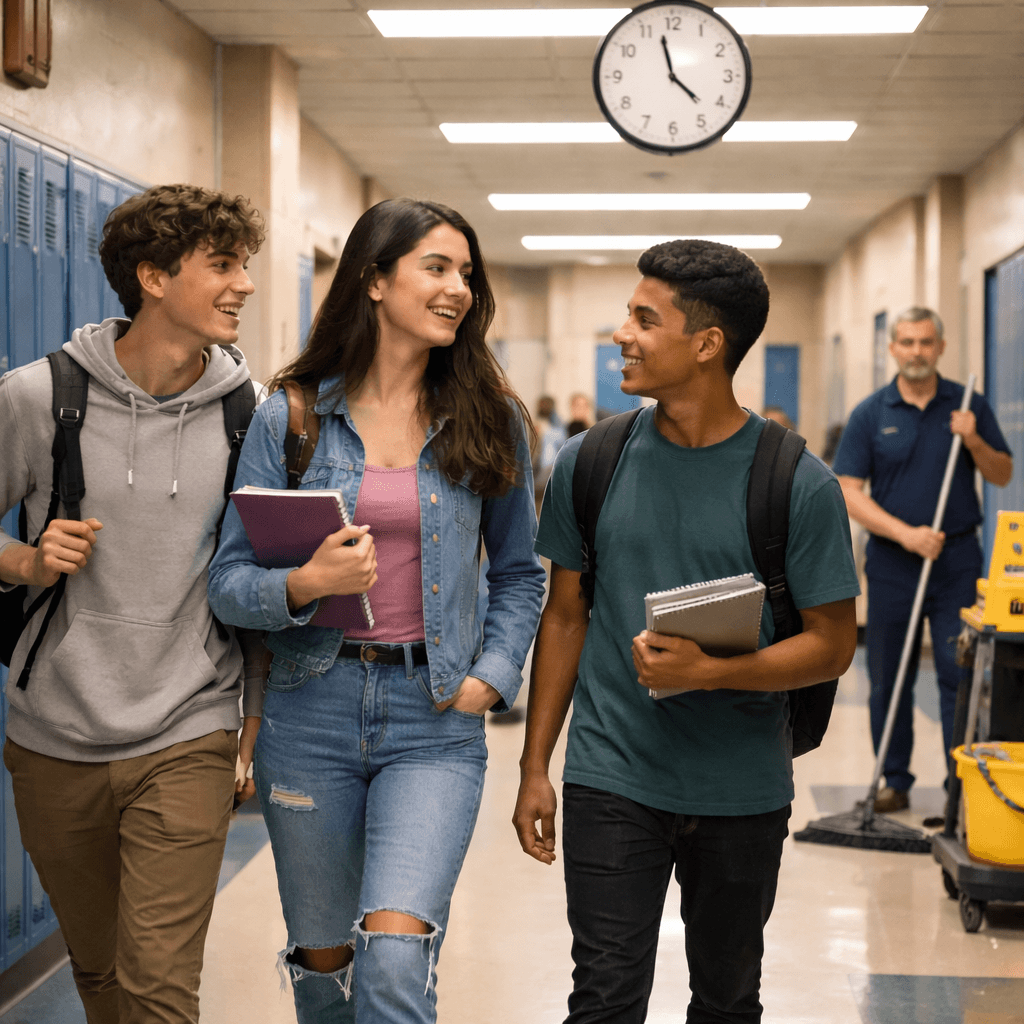
Three students walk and talk in a school hallway, holding notebooks, while a janitor cleans the floor in the background. A large clock is visible above them.
Hot Topics - controversialSchool SafetySafer EdK-12

After-Hours School Safety Gaps Leaders Miss

by EdCircuit Staff April 13, 2026
written by EdCircuit Staff 6 minutes read

After-hours school safety gaps leaders miss often exist in the quietest moments of the day—after the last bell rings, when staff begin to leave, and when the structure that defines the school day starts to fade.

The assumption is simple: the day is over.

But in reality, the building is still active.

Students remain in hallways. Athletic teams move between spaces. Clubs meet in classrooms. Doors open and close as groups enter and exit. A custodian walks the halls. A coach supervises a small group. A teacher finishes grading before heading out.

The activity hasn’t stopped.

The system has simply changed.

In the latest episode of the Safer Ed Podcast, “The Hidden Gaps: What Schools Think Is Safe (But Isn’t),” we examine how after-hours activity creates one of the most overlooked safety challenges in schools—an environment where students are present, but systems are no longer fully aligned to support them.

Safer EdThe Hidden Gaps: What Schools Think Is Safe (But Isn’t)April 13, 2026 · 9 min 24 sPlay episode: The Hidden Gaps: What Schools Think Is Safe (But Isn’t) (9 minutes 24 seconds)0:00-9:24Follow on SpotifyApple

When the Day Ends—but Responsibility Doesn’t

During the school day, safety is structured and visible:

  • Teachers supervise classrooms
  • Administrators monitor hallways
  • Movement is scheduled and controlled
  • Communication is immediate and defined

Every part of the system works together to create a predictable, managed environment.

But after school, those structures begin to shift.

Not all at once—but gradually.

Teachers leave. Administrators wrap up their day. Support staff remain, but their roles are different. Students are still present, but no longer operating within the same level of oversight.

And yet, the building itself hasn’t changed.

The same classrooms exist.

The same labs are accessible.
The same equipment and materials are in place.

This creates a critical question that many schools don’t fully answer:

Who is responsible for students still in the building after hours?

The Illusion of Supervision

One of the most common misconceptions in after-hours environments is the belief that “someone is there.”

A custodian may be working down the hallway. A coach may be supervising practice. A club advisor may be in a classroom.

From a distance, it appears that supervision exists.

But supervision is not the same as coverage.

Custodial staff are not responsible for student oversight. Coaches are focused on their teams. Advisors are responsible for their specific groups—not the building as a whole.

So while adults are present, system-wide supervision is often fragmented or undefined.

Students move between spaces. Hallways are used informally. Entry points are less controlled. And in many cases, no single individual has full awareness of who is in the building or where they are.

This is not a failure of people—it is a gap in system design.

Students in Motion Without Structure

During the school day, student movement is controlled:

  • Passing periods are timed
  • Hallway presence is monitored
  • Entry and exit points are limited

After hours, that structure disappears.

Students move independently. They enter and exit through different doors. They walk between spaces without consistent supervision. They may arrive late, leave early, or return to areas they used earlier in the day.

This shift creates unpredictability.

And unpredictability makes it difficult to maintain awareness.

A student walking down a hallway after school may not raise concern. But multiply that by multiple students, multiple entry points, and overlapping activities—and the building begins to function very differently.

The question is no longer “Is someone in the building?”

It becomes: “Does anyone know who is in the building—and where?”

Locked Doors Don’t Eliminate Risk

It’s easy to assume that locked classrooms or secured labs reduce risk after hours.

And in some cases, they do.

But access in schools is rarely absolute.

Doors are opened temporarily. Rooms are used by different groups. Staff move between spaces. Students who are familiar with the building understand how to navigate it.

A science lab, for example, may be fully controlled during the school day. Materials are accounted for. Procedures are followed. Students are supervised.

After hours, that same space may be near an active classroom, a meeting area, or a hallway with student traffic. A door is opened briefly. A student steps inside out of curiosity or convenience.

Nothing happens.

And that’s exactly what makes it dangerous—because the system begins to trust an outcome that hasn’t actually been tested.

Safety isn’t defined by past outcomes—it’s defined by present conditions.

If access exists without supervision, risk exists—even if it hasn’t been realized.

The Role of Duty of Care

At the center of this issue is a concept that is often misunderstood or overlooked in after-hours environments: duty of care.

Duty of care is not tied to the school day schedule. It is tied to the environment.

If a school building is open and students are present, the responsibility to provide a safe environment remains.

Duty of care doesn’t fade with the day—it follows the student.

This includes:

  • Ensuring appropriate supervision
  • Maintaining safe access to spaces
  • Managing movement within the building
  • Providing clear communication in case of an issue

When systems are designed only for the school day, but the building continues to operate beyond those hours, a gap forms between responsibility and reality.

And that gap creates exposure—for students, staff, and the institution.

When “Normal” Becomes Risk

The most challenging part of after-hours safety is that nothing feels wrong.

Students staying late is normal.
Teams practicing is expected.
Clubs meeting is encouraged.

Even students walking through hallways after hours can feel routine.

But risk often develops not from abnormal behavior—but from normalized conditions that are no longer supported by a system.

A door propped open for convenience.
A student cutting through a hallway to save time.
A group entering through a side entrance.

Each action is small. Each one feels harmless.

But together, they create an environment where:

  • access is less controlled
  • supervision is less consistent
  • awareness is reduced

And in that environment, small issues can escalate—not because people are careless, but because the system is not fully present.

What Strong Schools Do Differently

Schools that address after-hours safety effectively don’t eliminate activity—they align it.

They recognize that the building doesn’t stop operating—and they design systems that reflect that reality.

This includes:

  • Clearly defining who is responsible for the building during after-hours periods
  • Establishing expectations for student movement and access
  • Identifying which areas are accessible and which are restricted
  • Coordinating communication across groups using the building
  • Evaluating how entry and exit points are managed

Most importantly, they shift the mindset from:
“The day is over”
to
“The environment is still active—and must still be supported.”

Final Thought

After-hours activity is not the problem.

Unaligned systems are.

Because when students are still in the building, responsibility is still in the building.

And the question every school leader should be asking is not:

“Is someone here?”

But:

“Is the system still working—or has it quietly stepped aside while the building stays open?”

Subscribe to edCircuit to stay up to date on all of our shows, podcasts, news, and thought leadership articles.


April 13, 2026 0 comments
0 FacebookTwitterPinterestLinkedinWhatsappCopy LinkEmail
Newer Posts
Older Posts

Participate

  • Contribute
  • Sponsor
  • Submit Release
  • Subscribe
  • Get Interviewed

We value your privacy

We use cookies to enhance your browsing experience, serve personalized ads or content, and analyze our traffic. By clicking "Accept All", you consent to our use of cookies.

Customize
  • Needed for the site to work: signing in, the cart, your consent choice. Always on.

    8 cookies
    • ss_consent 1 yearYour cookie choice on this site, so you are not asked again.
    • wordpress_logged_in_* 2 days, or 14 days with "remember me"Keeps you signed in as you move between pages.
    • wordpress_sec_* 2 days, or 14 days with "remember me"The secure half of your sign-in.
    • wordpress_test_cookie SessionChecks that your browser accepts cookies when you sign in.
    • wp-settings-* 1 yearYour display settings when signed in.
    • wp_woocommerce_session_* 2 daysYour shopping session: the cart and the checkout.
    • woocommerce_cart_hash SessionTells the site whether your cart has changed.
    • woocommerce_items_in_cart SessionWhether your cart holds anything.
  • Remembers choices you make, such as a language or a region, and supports features like live chat.

    1 cookie
    • woocommerce_recently_viewed SessionThe products you looked at, so the site can show them again.
  • Helps us understand how visitors use the site: which pages are read, and for how long.

    2 cookies
    • _ga 2 yearsGoogle Analytics: tells one visitor from another. Set only after you allow analytics.
    • _ga_* 2 yearsGoogle Analytics: keeps your session state. Set only after you allow analytics.
  • Measures how fast pages load so we can make them faster.

  • Used to show you content and offers that match your interests, on this site and elsewhere.

    1 cookie
    • sbjs_* SessionWooCommerce order attribution: where you came from, so a purchase can be credited to the campaign or site that sent you.

Your browser asks us not to sell or share your information (Global Privacy Control), so advertising cookies stay off.

Do not sell or share my personal information

Some cookies from other companies help show you offers on other sites. Tick the box and save your preference to opt out of that sharing; untick it to opt back in at any time.

Your browser sends Global Privacy Control, so this preference is set for you and cannot be changed here.

Sign In

Keep me signed in until I sign out

Forgot your password?

Password Recovery

A new password will be emailed to you.

Have received a new password? Login here

Shopping Cart

Close

No products in the cart.

Close
-
00:00
00:00

Queue

Update Required Flash plugin
-
00:00
00:00

Your cart (items: 0)

Products in cart

Product Details Total
Subtotal $0.00
Shipping and discounts calculated at checkout.
View cart
Go to checkout

Your shopping cart is empty

Return to shop

Notifications