
edCircuit
  • Start Here
    • Login
    • Register
    • Subscribe
    • Submit a Press release
    • Advertise or Sponsor
    • Contribute
    • Get Interviewed
  • On The Wire
  • EdTech
    • All EdTech
    • Online Learning
    • Hybrid and Remote Learning
    • Augmented and Virtual Reality
    • ESports
    • Gamification and Game-Based Learning
    • Digital Citizenship
    • EdTech Entrepreneurs
    • Market Trends
    • Future of Education
  • K-12 Education
    • All K-12
    • K-12 Teachers
    • Teaching Strategies
    • Special Education and IEPs
    • Dyslexia
    • Gifted and Advanced Learning
    • Early Childhood, Pre-K and Kindergarten
    • School Calendar
    • Tutoring and Homework Help
    • Attendance and Absenteeism
    • After-School Programs
    • School Counselors
    • Homeschooling
    • School Models
    • Teacher Retention
    • Parents
    • Students
    • STEM and STEAM Education
  • Teaching and Learning
    • Literacy and Reading
    • Math Education
    • Civics and History Education
    • Financial Literacy
    • Assessment and Testing
    • Curriculum and Instruction
    • Personalized Learning
    • Project-Based Learning
    • Social-Emotional Learning
    • Executive Function
    • Creativity
    • Diversity, Equity, Inclusion
  • Professional Development
    • All Professional Development
    • Educators
    • Administrators
    • edLeaders
  • Higher Education
    • All Higher Education
    • College Admissions
    • Career and Technical Education (CTE)
    • Graduation
    • FAFSA and Financial Aid
    • Student Loans
  • Artificial Intelligence
  • Cybersecurity
  • School Safety
    • All School Safety
    • Science and Lab Safety
    • School Design and Facilities
    • Bullying
    • Duty of Care and School Liability
  • Continuing Education
    • All Continuing Education
    • Online Certificate Programs
    • Teaching Jobs and Careers
    • Teacher Appreciation
  • Education Policy and Government
    • All Education Policy
    • Department of Education
    • School Choice
    • Global
    • Advocates
  • EDU Shows
    • All EDU Shows
    • Safer Ed
    • Mind the Gap
    • EdTech Questions
    • CoffeEd
    • InFocus
    • InformED Report
  • EDU Podcasts
    • All EDU Podcasts
    • Author Chats
    • CoSN The Podcast
    • Education Today
    • Building the Bridge
    • Students Speak
  • Education Industry Guides and Reports
  • Archived Media
    • Future of School: The Podcast
    • Equity Everywhere
  • About edCircuit
  • Subscribe
edCircuit
  • LOGIN
Home Tags Posts tagged with "Headline"
Tag:

Headline

This if for posts to be in the featured/top section of site
A diverse panel of officials sits at a long desk facing an audience in a formal meeting room, representing School Boards, with flags and an emblem displayed on the wall.
edLeadersHot Topics - controversialK-12

Why School Boards Are Under More Pressure Than Ever

by EdCircuit Staff April 13, 2026
written by EdCircuit Staff 5 minutes read

School boards are under more pressure than ever as decisions once handled quietly at the district level now unfold in full public view, often under intense scrutiny. Board members are navigating complex issues involving artificial intelligence, student safety, curriculum expectations, and rapidly evolving community demands—all while maintaining transparency and public trust.

Across the country, school boards are being asked to make decisions that impact not only classrooms but also district operations, community relationships, and long-term strategic direction. As a result, the role of the school board has expanded significantly, bringing new expectations, challenges, and visibility.

The Expanding Role of School Boards

Traditionally, school boards were responsible for setting district policy, approving budgets, and hiring superintendents. While those responsibilities remain, the scope of decision-making has grown considerably.

Today’s boards are often involved in conversations around:

  • technology adoption and AI policies

  • cybersecurity preparedness and data privacy

  • student mental health and well-being

  • safety planning and emergency preparedness

  • curriculum transparency and instructional materials

  • equity, access, and student support systems

Each of these areas requires board members to interpret complex information, evaluate risks, and consider long-term implications. The role has evolved from governance alone to a form of leadership that requires adaptability, awareness, and continuous learning.

Increased Public Visibility and Scrutiny

One of the most noticeable changes in recent years is the level of public attention directed at school boards. In many districts, meetings that were once routine and lightly attended have become highly visible events, with community members, media outlets, and advocacy groups closely following board decisions.

Public comment sessions have expanded, and board members often hear a wide range of perspectives from families, educators, and community stakeholders. In some districts, meetings have become standing-room-only events as communities engage more actively in education policy discussions.

This increased visibility reflects the importance of education in communities—but it also adds pressure. Board members must balance transparency and responsiveness with the responsibility to make informed, student-centered decisions.

New Issues Boards Must Navigate

The issues facing school boards today are not only more complex—they are also more visible and more urgent.

Artificial Intelligence and Technology

Boards are being asked to approve policies related to AI tools, digital learning platforms, and data governance. These decisions require an understanding of emerging technologies and their potential impact on instruction and privacy.

Student Attention and Device Use

As schools address concerns around student focus, many boards are involved in decisions about cellphone policies and digital device use during the school day.

Cybersecurity and Data Protection

With increasing cyber threats targeting schools, boards must consider investments in cybersecurity infrastructure and policies that protect sensitive student and staff information.

Curriculum and Instruction

In many districts, curriculum decisions have become more visible, with communities taking a strong interest in what is taught and how it is delivered.

School Safety and Well-Being

Boards continue to play a role in ensuring safe learning environments, including physical safety, mental health supports, and emergency preparedness.

Each of these topics carries both educational and community implications, making decision-making more complex than ever before.

Decision-Making in a Complex Environment

School boards must often make decisions in environments where perspectives differ significantly. Parents, teachers, administrators, and community members may have varying expectations about what schools should prioritize.

Board members must consider:

  • student outcomes

  • educator perspectives

  • legal and regulatory requirements

  • financial constraints

  • long-term district goals

Balancing these factors requires careful deliberation and a commitment to keeping students at the center of decision-making.

In many cases, there are no simple or universally accepted answers. Decisions may involve trade-offs, and board members must navigate uncertainty while maintaining public trust.

The Superintendent–Board Relationship

A strong partnership between the school board and the superintendent is more important than ever. Superintendents provide operational leadership and bring expertise in education systems, while boards provide governance, oversight, and strategic direction.

Effective relationships are built on:

  • clear communication

  • defined roles and responsibilities

  • shared goals for student success

  • mutual trust and respect

When this relationship is strong, districts are better positioned to navigate complex challenges. When it is strained, decision-making can become more difficult and less effective.

What Effective School Boards Are Doing

Despite the increased pressure, many school boards are adapting successfully by strengthening their practices and approaches.

Effective boards are:

Prioritizing Clear Communication

Providing consistent, transparent communication with the community helps build trust and reduce misunderstandings.

Focusing on Student Outcomes

Keeping decisions centered on what is best for students helps guide discussions and align priorities.

Investing in Professional Learning

Board members are increasingly participating in training and professional development to better understand complex topics such as AI, cybersecurity, and data privacy.

Establishing Clear Policies

Well-defined policies provide structure and consistency, especially in areas such as technology use and safety.

Collaborating with District Leadership

Strong alignment between boards and district leaders supports more effective implementation of decisions.

These practices help boards navigate complexity while maintaining focus on their core mission.

A New Era of Educational Leadership

The role of the school board is evolving alongside the broader changes taking place in education. Technology, policy, and community expectations are reshaping how decisions are made and how districts operate.

School boards are no longer working behind the scenes. They are visible leaders responsible for guiding districts through some of the most important challenges facing education today.

School boards are under more pressure than ever, but they also have an opportunity to lead with clarity, purpose, and a focus on student success.

As education continues to evolve, school boards are no longer simply governing districts—they are shaping the direction of public education itself.

Subscribe to edCircuit to stay up to date on all of our shows, podcasts, news, and thought leadership articles.

April 13, 2026 0 comments
0 FacebookTwitterPinterestLinkedinWhatsappCopy LinkEmail
A student participates in a Phone-Free Schools initiative by placing her phone in a numbered storage pocket, while other students and a teacher are present in the background.
Education Policy and GovernmentHot Topics - controversialK-12

Phone-Free Schools: A Growing Education Movement

by EdCircuit Staff April 10, 2026
written by EdCircuit Staff 6 minutes read

Phone-free schools are rapidly becoming one of the most discussed topics in education as teachers, administrators, and policymakers debate how smartphones affect learning, student attention, and classroom culture.

For more than a decade, smartphones have been a constant presence in classrooms. Nearly every student carries one, and the devices connect them instantly to social media, messaging apps, games, and an endless stream of digital information. While smartphones have brought convenience and connectivity, they have also introduced new challenges for educators trying to maintain focus and engagement during the school day.

Research from Common Sense Media shows just how deeply smartphones are embedded in the lives of young people. Surveys indicate that teenagers receive dozens—sometimes even hundreds—of notifications throughout the day, making it increasingly difficult to separate digital communication from learning environments. When these notifications follow students into the classroom, the result can be a constant competition for attention.

Across the United States and around the world, schools are increasingly reconsidering whether unrestricted phone access belongs in the classroom. What began as individual classroom rules has grown into a broader movement toward phone-free learning environments, with districts and even entire states exploring policies that limit or prohibit student smartphone use during the school day.

For educators, the conversation is not simply about technology. It is about attention, relationships, and the conditions needed for meaningful learning.

Why Smartphones Became a Classroom Challenge

When smartphones first appeared in classrooms, many schools viewed them as another tool that could support learning. Students could quickly research information, access digital textbooks, and collaborate using online platforms.

However, as smartphones evolved, so did the platforms competing for student attention.

Social media apps, streaming services, gaming platforms, and constant notifications transformed smartphones into powerful distractions. Teachers began noticing that even highly motivated students struggled to resist checking their devices during lessons.

A quick glance at a notification can quickly become several minutes of scrolling through social media feeds, responding to messages, or watching short videos. Multiply that behavior across an entire classroom, and the effect on learning becomes clear.

Many educators describe smartphones as “attention magnets” that compete directly with instruction. Even when phones remain silent in backpacks or pockets, students may still feel the urge to check them. The anticipation of notifications alone can fragment attention.

This growing awareness has prompted educators to reconsider how smartphones fit within a learning environment designed for focus and engagement.

The Rise of Phone-Free School Policies

In response to these challenges, a growing number of schools are experimenting with structured phone-free policies. While these policies vary widely, they share a common goal: creating learning environments where student attention is focused on instruction rather than digital distractions.

Some schools require students to store phones in lockers or backpacks during class. Others use dedicated phone storage systems where devices are secured at the beginning of the day and returned at dismissal.

In some districts, phones may be permitted during lunch or passing periods but restricted during instructional time. Other schools have adopted full phone-free policies that limit smartphone access throughout the entire school day.

These policies are no longer limited to individual schools. District leaders and state policymakers are increasingly examining the issue as part of broader conversations about student wellbeing, digital balance, and academic engagement.

What Teachers Are Seeing in Phone-Free Classrooms

Teachers working in phone-free environments often report noticeable changes in classroom dynamics.

One of the most immediate differences is increased student attention during lessons. Without constant phone interruptions, students are more likely to remain engaged in discussions, collaborative activities, and problem-solving exercises.

Teachers frequently observe that classroom discussions last longer and involve more voices. Students who once sat quietly, glancing at their phones, often become more engaged in conversations with classmates and teachers.

In group projects, students interact more directly with one another rather than dividing their attention between peers and their devices. Even simple moments—such as the beginning of class—feel different when students are not immediately reaching for their phones.

Many educators describe phone-free classrooms as calmer environments where focus and participation improve naturally.

Student Perspectives: Mixed at First, Changing Over Time

Student reactions to phone-free policies are often mixed at first. Smartphones play a central role in how young people communicate, socialize, and access entertainment. For many students, their phones serve as a primary connection to friends and social networks.

Initial reactions to restrictions may include frustration or skepticism. However, in schools where phone-free policies are implemented consistently, student attitudes often shift over time.

Without constant notifications competing for their attention, many students find they feel less distracted and more engaged throughout the school day. Conversations during lunch and passing periods often become more social, with students interacting face-to-face rather than through screens.

Some students even report improved concentration when their phones are not immediately available. These experiences suggest that while smartphones provide convenience, they can also fragment attention in ways that affect both learning and wellbeing.

Finding the Balance Between Technology and Focus

It is important to recognize that the phone-free movement is not a rejection of technology in education.

Schools continue to invest heavily in laptops, tablets, interactive displays, and digital learning platforms designed specifically to support instruction. These tools allow teachers to deliver engaging lessons, provide personalized learning opportunities, and expand access to information.

The goal of many phone-free policies is not to eliminate technology, but to create intentional technology environments where digital tools support learning rather than compete with it.

In this sense, phone policies are part of a larger conversation about how technology should be used in education. Educators are increasingly asking not only what technology students should have access to, but also when and how it should be used to support meaningful learning.

What Phone-Free Schools May Mean for the Future of Education

The growing interest in phone-free schools reflects a larger shift in how educators think about attention and engagement in modern classrooms.

For years, conversations in education have focused on increasing access to technology. Schools worked to ensure that students had devices, connectivity, and digital tools needed for learning in a connected world.

Now the conversation is evolving. Educators are beginning to examine how constant connectivity may influence concentration, social interaction, and academic performance.

Successful schools in the future may be those that strike a thoughtful balance between innovation and focus. They will continue to adopt powerful educational technologies while also protecting the learning environment from distractions that undermine attention.

Protecting Attention in a Connected World

The debate surrounding phone-free schools is far from settled. Each district and community must consider its own priorities, student needs, and educational goals when deciding how smartphones fit into the school day.

What is clear, however, is that educators are increasingly recognizing the importance of protecting student attention in an age of constant digital interruption.

As schools continue to explore ways to support meaningful learning, protecting attention may become one of the most important responsibilities educators face in a digitally connected world.

Subscribe to edCircuit to stay up to date on all of our shows, podcasts, news, and thought leadership articles.
April 10, 2026 0 comments
0 FacebookTwitterPinterestLinkedinWhatsappCopy LinkEmail
A school counselor talks with three students about college applications at a table covered in brochures
K-12 TeachersHot Topics - controversialK-12School Counselors

How School Counselors Guide Students Toward Success

by EdCircuit Staff April 9, 2026
written by EdCircuit Staff 7 minutes read

A school counselor is a certified educator who helps students succeed in three areas: academics, career planning and social and emotional development. In high school that means building schedules that lead to graduation, helping students explore careers, guiding them through college applications and financial aid, and being a trusted adult when school or life becomes hard. Much of the work happens quietly, one conversation at a time, and its effects can last well beyond graduation.

What does a school counselor do?

The American School Counselor Association (ASCA) describes school counselors as educators who design and deliver school counseling programs that improve student outcomes, and who lead, advocate and collaborate to give every student equal access to opportunity. ASCA’s position on career development says counselors support student growth in three domains: academic, career, and social/emotional.

In practice, a school counselor’s week can include:

  • meeting with students about course selection, credits and graduation requirements;
  • teaching classroom lessons on study skills, decision-making or career exploration;
  • short-term individual and small-group counseling for stress, conflict or attendance problems;
  • interpreting test results and reviewing school data to find students who need help;
  • advocating for students at IEP and Section 504 meetings;
  • running college application and financial aid workshops for students and families;
  • responding when a student is in crisis and connecting families with outside professionals.

Helping freshmen find their way

For students entering high school, everything is new: a larger building, harder classes, a more complicated schedule and the first decisions that affect life after graduation. Counselors help students build schedules that meet graduation requirements while leaving room for courses that match their interests, and they explain how credits work, how a grade point average is calculated and how early choices open or close later options.

Some of the most important conversations are small. A freshman who stops by to ask where to find tutoring or how to join a club leaves knowing there is an adult in the building whose job is to help. That sense of connection makes the rest of high school less intimidating.

Supporting academic success

As students move through high school, counselors review graduation progress each year and help students choose courses that fit their strengths and goals. A student interested in engineering may be encouraged toward advanced math and science; a student who loves writing may explore journalism or creative writing electives.

When grades slip, counselors work with the student on a plan: time management, study strategies, tutoring or peer mentoring. They also coordinate with teachers so that a student who is struggling in several classes is noticed before the end of the semester rather than after it.

Supporting student wellbeing

High school is a time of growth and a time of stress. Students come to the counseling office to talk about academic pressure, friendships, family problems and worries about the future. Counselors help them build coping, communication and conflict-resolution skills, and they provide short-term counseling. When a student needs more, such as long-term therapy, counselors connect the family with outside mental health professionals and coordinate with teachers and administrators.

Career exploration, college and financial aid

Career planning starts early. Through interest inventories, one-on-one meetings, job shadowing, internships and career days, counselors help students see how what they learn in class connects to real work. Many counseling offices partner with local employers and community organizations to make those experiences possible.

In junior and senior year the focus often turns to life after high school. Counselors guide students as they research colleges, arrange visits from admissions representatives, run application workshops and make sure transcripts and recommendations arrive on time. Parent information nights help families understand timelines and costs.

Financial aid is where counselors can make a measurable difference. In a Brookings analysis published in February 2024, Katharine Meyer looked at Oklahoma, which requires one counselor for every 450 high school students. Schools just above that enrollment threshold had more counselor time per student, and more of their students received Pell Grants and the state’s Oklahoma Promise scholarship, with larger Pell gains for Black, Hispanic and Native American students.

Not every student is headed to a four-year college. Counselors also help students explore technical education, apprenticeships, military service and direct entry into the workforce, and connect them with training programs and certifications.

Do school counselors make a difference?

The research says yes. A study by Christine Mulhern, published in the American Economic Review in 2023, used the way Massachusetts high school students were assigned to counselors to estimate the effect of individual counselors. It found that counselors’ effects on how far students go in their education are similar in size to the effects of teachers, and that a counselor’s effectiveness matters most for low-income and low-achieving students.

How many students does a school counselor serve?

ASCA has recommended a ratio of 250 students per school counselor since 1965. The national average in 2024–25 was 372 students per counselor, and only four states met the recommendation: Colorado, Hawaii, New Hampshire and Vermont. At 372 students, a counselor who met with every student individually for 30 minutes would spend about 186 hours, nearly five weeks of full-time work, on one round of meetings.

Caseload is only part of the problem. Counselors are often given tasks that take them away from students. ASCA’s guide to appropriate and inappropriate activities lists the difference:

Appropriate for school counselorsBetter assigned to someone else
Academic advising and planningBuilding the master schedule
Short-term individual and small-group counselingCoordinating schoolwide testing
Counseling students who are often tardy, absent or in troubleSigning tardy excuses and disciplining students
Interpreting test results and analyzing school dataComputing grade point averages and data entry
Advocating for students at IEP and 504 meetingsCoordinating schoolwide IEPs, 504 plans and MTSS
Classroom lessons based on student standardsCovering classes and supervising common areas

For principals and district leaders, this is one of the most practical decisions available. Moving scheduling, testing coordination and clerical work to other staff gives counselors back time for the work the research shows matters. The Brookings analysis makes the same recommendation.

School counselor vs. guidance counselor

“Guidance counselor” is the older title, and many families still use it. ASCA prefers “school counselor,” and the title appears to shape expectations of the job. In a study of 276 school counselors at an Ohio conference, those shown a survey that used the term “guidance counselor” were significantly less likely to believe counselors were able to perform 25 core tasks.

How to become a school counselor

According to the Bureau of Labor Statistics, school and career counselors and advisors typically need a master’s degree. Public school counselors also need a state credential, which usually requires a master’s degree in school counseling, an internship or practicum and a test, and most states require a background check. The occupation had about 389,500 jobs in 2025, a median pay of $64,330 in May 2025, and projected growth of 3 percent from 2025 to 2035, with about 27,800 openings a year.

Recognizing the people behind the scenes

School counselors rarely ask for recognition. They are mentors, advocates, planners and problem-solvers, and much of what they accomplish shows up years later. Many graduates forget the details of a schedule or an assignment, but remember the counselor who listened, encouraged them when they doubted themselves and helped them see what was possible.

Frequently asked questions

What does a school counselor do? School counselors help students with academics, career planning and social and emotional development. They advise on courses, teach lessons, provide short-term counseling, guide college and career planning and advocate for students who need support.

Is a school counselor the same as a guidance counselor? Yes. “Guidance counselor” is the older title; the profession now uses “school counselor.”

What is the recommended student-to-counselor ratio? ASCA recommends 250 students per counselor. The national average was 372 in 2024–25.

Do you need a master’s degree to be a school counselor? In most states, yes. Public school counselors typically need a master’s degree in school counseling and a state credential.

Subscribe to edCircuit to stay up to date on all of our shows, podcasts, news, and thought leadership articles.

April 9, 2026 0 comments
0 FacebookTwitterPinterestLinkedinWhatsappCopy LinkEmail
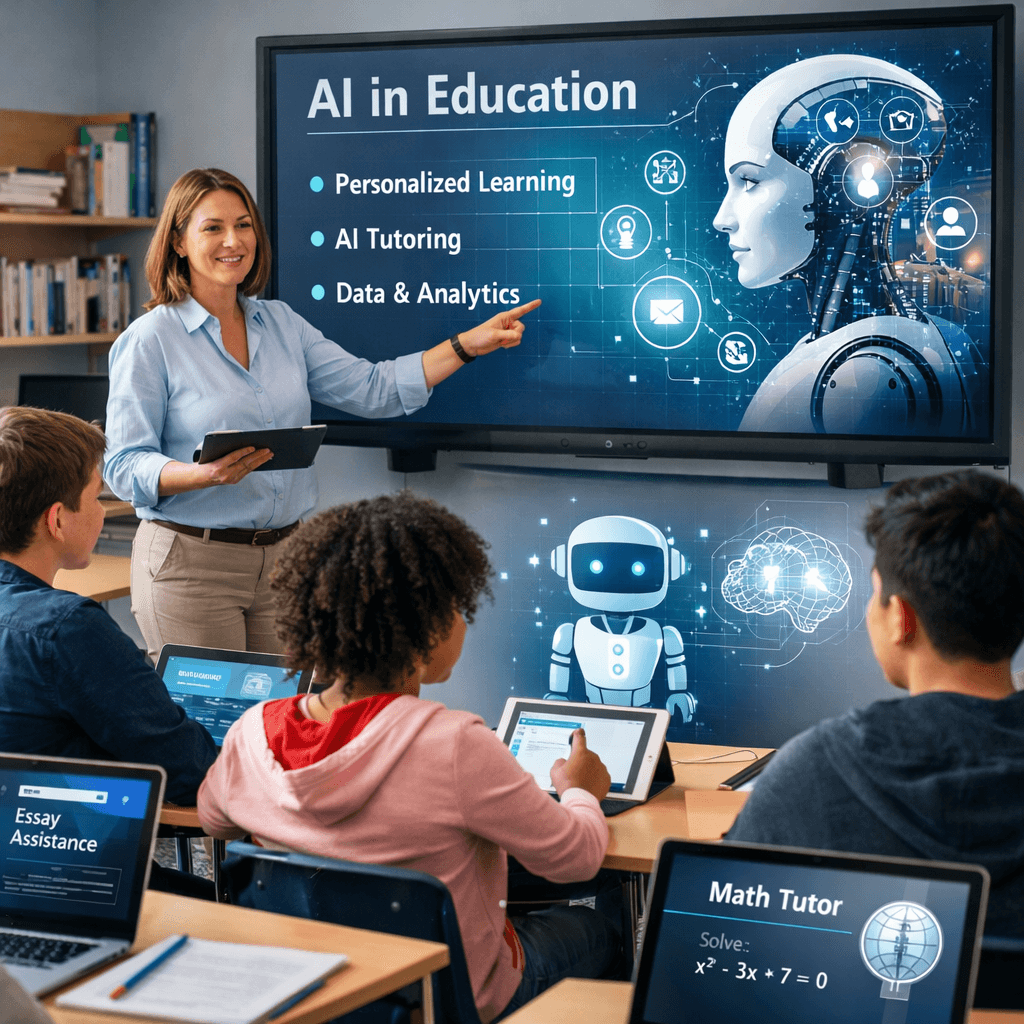
A teacher presents a slide about AI in education to students using laptops and tablets, a robot graphic on the screen
Hot Topics - controversialArtificial IntelligenceK-12Education Industry Guides and Reports

AI in Education: A Guide for Schools and Colleges

by EdCircuit Staff April 8, 2026
written by EdCircuit Staff 13 minutes read

Artificial intelligence in education means using AI tools to support teaching, learning and running schools: helping teachers plan lessons and give feedback, tutoring students, making materials accessible, and analyzing data. It has moved quickly from experiment to everyday practice. In a Pew Research Center survey of U.S. teens released in February 2026, 54 percent had used chatbots to help with schoolwork, and 59 percent of K–12 educators used AI tools during the 2025–26 school year, Gallup reported.

This guide to AI in education explains how AI is used in schools and colleges, what the research says about its benefits and risks, and what teachers, students and families need to know about AI tools, homework help, cheating, AI literacy, privacy and policy. The first part applies to K–12 and higher education alike; the second covers K–12 schools, and the third colleges and universities. Each section links to edCircuit’s more detailed coverage.

Updated October 2026.

In this guide

  • For everyone: What AI in education is · Who uses it · Benefits and risks · AI tutoring · AI homework help · Cheating and detectors · AI literacy
  • K–12 schools: How teachers use AI · AI tools for teachers · Tools by grade · Privacy · AI policy · Questions to ask
  • Colleges and universities: AI in colleges and universities

What is AI in education?

The U.S. Department of Education’s Office of Educational Technology describes AI as “automation based on associations”: systems that detect patterns in data and use them to make predictions, recommendations or new content. Its 2023 report, Artificial Intelligence and the Future of Teaching and Learning, lists the main uses in schools:

  • Teaching support. Writing or improving lessons, finding and adapting materials, and suggesting lesson plans.
  • Personalized learning. Adjusting the sequence, pace and hints a student receives.
  • Tutoring and homework help. Explaining concepts and walking students through problems.
  • Feedback and assessment. Giving faster feedback on student work.
  • Accessibility. Speech recognition, text-to-speech and captions that support students with disabilities and multilingual learners.

The same report’s first recommendation is to keep “humans in the loop”: teachers and school leaders, not software, should make decisions about students.

How many students and teachers use AI?

  • Teens. 54 percent have used chatbots for schoolwork, and one in 10 say they do all or most of their schoolwork with a chatbot’s help (Pew, 2026). The share of teens using ChatGPT for schoolwork doubled from 13 percent to 26 percent between 2023 and 2024.
  • Students and teachers. In 2025, 54 percent of students and 53 percent of English, math and science teachers said they used AI for school, according to RAND.
  • Educators. 59 percent of K–12 educators used AI tools in 2025–26, and most of them said it gave them more time for the work they value most (Gallup, 2026).
  • College students. 85 percent said they had used generative AI for coursework in the past year, in Inside Higher Ed’s 2025 Student Voice survey. See AI in colleges and universities below.

Benefits and risks of AI in education

In January 2026, a Brookings Institution task force that consulted experts, teachers and families across 50 countries concluded that generative AI’s risks for students are, for now, overshadowing the benefits. Its main concern is students handing their thinking over to AI. The evidence in this guide points the same way: the benefits are real, and they depend on how AI is used.

The benefits

  • Time for teachers. Teachers who use AI weekly estimate they save 5.9 hours a week, about six weeks over a school year (Gallup, 2025).
  • Tutoring that works. AI tutors designed to teach have produced real learning gains in controlled studies (see AI tutoring).
  • Access. Text-to-speech, captions, translation and reading-level adjustments help students with disabilities and multilingual learners.

The risks

  • Less learning. Students who simply get answers can do worse later, as a math study in Turkey found (see AI tutoring).
  • Unfair accusations. AI detectors wrongly flag some students’ work, especially that of non-native English writers (see Cheating and detectors).
  • Hidden bias. Common Sense Media rated AI teacher assistants “moderate risk” in 2025 and found that some tools generating IEPs and behavior plans showed bias based on students’ perceived backgrounds.
  • Privacy and safety. Student data, and new harms such as deepfakes and AI-enabled bullying, need clear rules.
  • Unequal access. Students without AI at home or at school can fall further behind; see AI Access Is Creating a New Digital Divide.

Does AI tutoring help students learn?

The research is promising when AI is designed to teach, and worrying when students simply get answers.

  • In Nigeria, a six-week after-school program using Microsoft Copilot raised secondary students’ English scores by 0.23 standard deviations, which the World Bank researchers equated to 1.5 to 2 years of typical schooling.
  • At Harvard, college physics students using an AI tutor built on teaching best practices learned more in less time than students in an active-learning class.
  • Tutor CoPilot, an AI tool that suggests strategies to human tutors, made K–12 students 4 percentage points more likely to master topics, and 9 points more likely with less experienced tutors, at a cost of about $20 per tutor per year.
  • In Turkey, high school students who used GPT-4 freely during math practice did better in practice but 17 percent worse on the later exam than students without it. A version designed as a tutor, with safeguards against handing out answers, largely prevented that harm.

The lesson for schools is that design matters. AI that guides students to think does more good than AI that thinks for them.

AI homework help: what students and parents should know

Homework is where most students meet AI: 54 percent of U.S. teens have used chatbots to get help with schoolwork, and one in 10 say they do all or most of it with a chatbot’s help (Pew, 2026). The Turkey study above shows why the way a student uses it matters: getting answers can feel like progress and still leave a student less prepared for the test.

The major AI companies now offer modes that tutor instead of answering:

  • ChatGPT study mode, launched by OpenAI in July 2025, works through problems step by step instead of giving the answer.
  • Gemini Guided Learning, launched by Google in August 2025, is designed to act as a personal learning companion, and teachers can share it with a class through Google Classroom.
  • Claude’s learning mode, introduced by Anthropic in April 2025, guides students’ reasoning rather than providing answers.

For parents, the useful questions are simple: did the tool explain the idea, or did it do the work, and could your child now do a similar problem without it? Many schools are rethinking homework for the same reason. See Homework in the AI Era: Why Schools Are Rethinking It and AI for Students: A Parent’s Guide by Age.

AI, cheating and AI detectors

Students and teachers both worry about cheating: 59 percent of teens think using AI to cheat is a regular occurrence at their school (Pew). AI detectors are not a reliable answer. A 2023 study found seven detectors labeled essays by non-native English writers as AI-written 61 percent of the time on average. OpenAI withdrew its own detector in 2023 because of its low accuracy, and Turnitin advises that its AI score should not be the sole basis for action against a student. A Common Sense Media survey found Black teens were about three times as likely as white teens to say their work had been wrongly flagged as AI-generated.

Clear rules work better than detection: telling students which assignments allow AI, how to disclose it, and designing work that shows thinking. See AI Rules for Schools: A Back-to-School Guide, Confronting AI Cheating in K–12 and Assessment in the AI Era.

What is AI literacy?

AI literacy is the knowledge and skills students need to use AI well and judge it critically. A framework from the OECD and the European Union, approved in 2026, defines it as the technical knowledge, durable skills and attitudes needed to engage with, create with, manage and shape AI, while critically evaluating its benefits, risks and ethics. It notes that AI literacy is different from simply using AI tools. In California, a 2024 law requires the state’s curriculum commission to consider adding AI literacy to math, science and history-social science frameworks. See AI Literacy for Students: A Grade-by-Grade Guide.

AI in K–12 schools

The sections below cover what is specific to elementary, middle and high schools: classroom practice, tools, children’s privacy law and district policy.

How teachers use AI in the classroom

Teachers most often use AI to save time on preparation. In Gallup’s 2025 survey, the most common monthly uses were preparing to teach (37 percent of teachers), making worksheets or activities (33 percent) and modifying materials to meet student needs (28 percent), and weekly users reported saving 5.9 hours a week. Many are doing this without much help: in 2026, only 18 percent of teachers said they received formal guidance on AI from their administrators, though about half of districts had trained teachers on AI by fall 2024, RAND found. See Teacher Professional Development in the Age of AI.

AI can also help with specific needs and subjects. edCircuit covers each in more detail:

  • How AI Is Transforming Reading for Students
  • How AI Is Revolutionizing Foreign-Language Learning
  • The Role of AI in Supporting Diverse Learners in Schools (special education)
  • Artificial Intelligence in Special Education and Accessibility
  • Art and AI: A New Era of Student Creativity
  • The Evolution of Music Education in Today’s Classroom
  • How AI Is Transforming Career and Technical Education (CTE)
  • How Driver’s Education Has Transformed in the Age of AI
  • Empowering Student Engagement in the Age of AI
  • How AI Supports Student Behavior in Schools
  • Fighting Absenteeism with AI and EdTech
  • Using Artificial Intelligence to Elevate Science Lab Safety

AI tools for teachers

Several large companies now offer AI tools for teachers at no cost:

  • ChatGPT for Teachers. Launched by OpenAI in November 2025, a secure workspace that is free for verified U.S. K–12 educators through June 2028.
  • Gemini for Education and Gemini in Classroom. Announced by Google in June 2025, with more than 30 no-cost AI tools for educators in Google Classroom.
  • Microsoft Teach. A lesson-preparation tool in the Microsoft 365 Copilot app, announced in October 2025 for education customers at no additional cost.
  • Khanmigo for Teachers. Khan Academy’s assistant for rubrics, quiz questions, exit tickets and other preparation, free for U.S. teachers since 2024.

Free does not mean risk-free. Common Sense Media warned in 2025 that teacher assistants can act as “invisible influencers” shaping what students learn, so teachers should review what any tool produces before it reaches students. For practical help, see AI Lesson Planning: A Teacher’s Summer Guide, AI as a Classroom Teaching Assistant and AI Training for Teachers: Beyond Prompts and Tools.

AI tools for students, by grade

Which tools fit depends on students’ ages, because many AI services are not built for children under 13 and some require users to be older. edCircuit’s grade-level guides list what each tool does and its age and privacy limits:

  • The Top 10 AI Tools for Elementary Education
  • The Best AI Tools for Middle School Classrooms in 2025
  • The Top 10 AI Tools Shaping High School Learning in 2025

Student privacy and AI

Two federal laws matter most. COPPA protects children under 13 online; a school may consent on parents’ behalf only when a company collects information for the school’s educational use and no other commercial purpose. Updated COPPA rules took effect in June 2025, with companies required to comply by April 22, 2026 (Federal Register). FERPA protects student education records; a company can receive them only under conditions such as the school’s direct control over how records are used. In practice, schools should use AI tools with a student data privacy agreement, especially for younger students.

AI policy for schools

As of August 2026, 35 states and Puerto Rico had issued official guidance on AI in K–12 schools. At the federal level, an April 2025 executive order created a White House Task Force on AI Education, and in July 2025 the Department of Education said federal grant funds may be used for AI that meets program requirements. Yet in 2025 only 45 percent of principals reported having AI policies or guidance (RAND). A district AI policy usually covers which tools are approved, privacy agreements, acceptable student use and disclosure, academic integrity, staff training and how families are informed.

Some districts are drawing firmer lines. In September 2026, New York City announced a one-year pause on student-facing generative AI from 2-K through eighth grade for the 2026–27 school year, while teachers may still use AI for planning and operational tasks. See New York City Schools Ban AI Through Grade 8 and Your School’s AI Policy May Already Be Outdated.

Questions to ask before using AI in a school

  • What problem will this tool solve, and how will we know it worked?
  • Is it built for our students’ ages, and do we have a privacy agreement with the company?
  • Does it help students think, or does it think for them?
  • Who reviews its output before it affects a student?
  • Have teachers been trained, and do students and families know the rules?

AI in colleges and universities

College students use AI even more than younger students. In Inside Higher Ed’s 2025 Student Voice survey of 1,047 students at 166 colleges, 85 percent said they had used generative AI for coursework in the past year, most often to brainstorm ideas (55 percent), to ask it questions as they would a tutor (50 percent) and to study for exams (46 percent).

Some systems have chosen to provide AI to everyone. In February 2025, the California State University system announced it would give its more than 460,000 students and 63,000 faculty and staff access to ChatGPT Edu across all 23 campuses. The same questions about learning, cheating and privacy apply, with more responsibility placed on students themselves. edCircuit covers higher education in more detail:

  • How AI Is Transforming the College Lecture Experience
  • AI in Higher Education: How Classrooms Transformed
  • The Top 10 AI Tools Transforming Student Research in Higher Education
  • Applying Smarter: How AI Is Transforming College Admissions

The teacher’s role

AI can draft, explain, translate and analyze, but it cannot know a student the way a teacher does. The research so far points in the same direction: AI helps most when teachers design how it is used, set clear limits and stay responsible for decisions about students. Schools that treat AI as a tool to support teaching, rather than replace it, are best placed to gain from it.

Related reading

  • AI in Education: What the New Year Brings in 2026
  • Future of Education: 10 EdTech Trends You Need to Know
  • AI Rules for Schools: A Back-to-School Guide
  • Beyond Fun and Games: The Impact of Gamification on Critical Thinking and Problem-Solving Skills

Subscribe to edCircuit to stay up to date on all of our shows, podcasts, news, and thought leadership articles.

April 8, 2026 0 comments
0 FacebookTwitterPinterestLinkedinWhatsappCopy LinkEmail
National Assistant Principals Week: an assistant principal in a shirt and tie smiles in a school hallway holding folders
EducatorsedLeadersHot Topics - controversialK-12

National Assistant Principals Week 2026

by EdCircuit Staff April 7, 2026
written by EdCircuit Staff 4 minutes read

Updated October 2026 with the 2027 dates and new research on assistant principals.

National Assistant Principals Week recognizes a group of school leaders whose impact is felt in every hallway, classroom and conversation, yet whose work often goes unseen. The week is sponsored by the National Association of Secondary School Principals (NASSP), with the National Association of Elementary School Principals (NAESP) and the American Federation of School Administrators, and is held each April.

When is National Assistant Principals Week 2027?

National Assistant Principals Week 2027 is expected to run April 5–9, 2027, according to the Oregon School Boards Association’s events calendar. NASSP had not yet posted 2027 dates on its own page as of October 2026; in 2026 the week ran April 6–10, and in 2025 it ran April 7–11. In both 2025 and 2026, senators introduced a resolution designating the week; in 2026 Sens. Dick Durbin, Mazie Hirono, Martin Heinrich and Ben Ray Luján introduced it with NASSP, NAESP and AFSA’s support.

Assistant principals by the numbers

The role has grown fast. In the 2024–25 school year, 67 percent of U.S. public schools had at least one assistant principal, up from 34 percent in 1990–91, and a quarter of schools had more than one, according to a June 2026 report by Mathematica, Vanderbilt University and Policy Studies Associates for the Wallace Foundation. Assistant principals are most common in middle and high schools, urban schools and schools with high shares of students of color, and many spend most of their time on student discipline and instructional leadership. Most principals, 69 percent, said at least some of their assistant principals were prepared to lead a school.

A role defined by action, not title

On any given day, an assistant principal may be:

  • handling student discipline with fairness and consistency;
  • coaching teachers and giving feedback on instruction;
  • managing schedules, testing logistics and building operations;
  • responding to parent concerns and community questions;
  • leading safety protocols and handling the unexpected.

What makes the role distinct is not only its breadth but its immediacy. Assistant principals are often the first to arrive when something goes wrong and the last to leave when something needs to be resolved.

The architects of school culture

Assistant principals’ presence in hallways, classrooms, cafeterias and events builds relationships and sets expectations. They reinforce positive behavior, address problems constructively and make sure rules are clear and fair. For many students, the assistant principal is the school leader they feel most comfortable approaching.

Supporting teachers where it matters most

Assistant principals work closely with teachers on instructional strategies, classroom management and professional growth. The role requires balance: high expectations alongside an understanding of what teachers face. At a time when teacher burnout and retention are ongoing concerns, an assistant principal who recognizes effort, gives useful feedback and advocates for staff can make a real difference.

The quiet leadership that makes schools work

Much of the work happens quietly. There are no announcements for a de-escalated conflict or a schedule that runs smoothly. An assistant principal’s success is often measured by what does not happen: problems solved before they grow.

National Assistant Principals Week ideas

NASSP’s activity ideas, e-cards and social media toolkit offer ways for students, teachers, parents and school leaders to take part. Simple ideas include:

  • student and staff thank-you notes or a short video;
  • a shout-out in morning announcements, the newsletter and social media;
  • a principal-led recognition at a staff meeting or school board meeting;
  • a breakfast or lunch hosted by the PTA;
  • a nomination for NASSP’s Assistant Principal of the Year program.

Frequently asked questions

When is National Assistant Principals Week 2027? April 5–9, 2027, according to the Oregon School Boards Association calendar; check NASSP for confirmation.

Who sponsors Assistant Principals Week? The National Association of Secondary School Principals, with the National Association of Elementary School Principals and the American Federation of School Administrators.

Is there an Assistant Principal Appreciation Day? The national observance is a full week. Many schools choose one day for a schoolwide thank-you.

How many schools have assistant principals? About two-thirds of U.S. public schools had at least one in 2024–25.

Celebrating the leaders behind the scenes

Assistant principals are leaders, mentors and problem-solvers who shape the daily experience of students and staff. They are the steady presence in difficult moments, the voice of support for teachers and a guide for students. National Assistant Principals Week is a chance to recognize that work, and a reminder to notice it every week of the year.

Subscribe to edCircuit to stay up to date on all of our shows, podcasts, news, and thought leadership articles.

April 7, 2026 0 comments
0 FacebookTwitterPinterestLinkedinWhatsappCopy LinkEmail
A group of students sit around a table with financial documents, as one person holds a savings jar and another displays a budget chart in a classroom decorated for Financial Literacy Month.
Hot Topics - controversialK-12Financial Literacy

Financial Literacy Month: Why Money Education Matters

by EdCircuit Staff April 7, 2026
written by EdCircuit Staff 7 minutes read

Financial Literacy Month highlights the growing importance of financial education, especially as students face a world of digital payments, instant purchases, and increasingly complex financial decisions. Observed each April across the United States, the initiative encourages schools, financial institutions, and community organizations to help individuals build the knowledge and skills needed to manage money responsibly.

For many students, adulthood begins with major financial decisions. From managing student loans and opening credit cards to budgeting for living expenses, young adults often take on financial responsibilities soon after graduation. Without a strong foundation in financial literacy, these decisions can lead to long-term financial challenges.

Financial Literacy Month provides an opportunity to emphasize the value of early financial education and encourage students to develop practical money management skills before they enter the workforce or take on significant financial commitments.

Why Financial Literacy Matters More Than Ever

Financial literacy has always been a valuable life skill, but modern technology has changed how people interact with money. In previous generations, financial transactions were often more visible and deliberate. People paid with cash, balanced checkbooks, and visited banks in person.

Today, financial transactions can happen instantly. Online shopping, digital wallets, subscription services, and mobile banking apps allow consumers to purchase items with a few taps on a phone. While these tools provide convenience, they can also make spending feel less tangible.

Students growing up in this digital environment may not always recognize how quickly small purchases can accumulate. Automatic renewals, buy-now-pay-later options, and in-app purchases can lead to spending that feels easy in the moment but difficult to manage over time.

Financial literacy helps students slow down and evaluate their financial choices. When individuals understand how budgeting, interest rates, and debt work, they are better equipped to make thoughtful decisions and avoid unnecessary financial stress.

The Growing Need for Financial Education

Educators and financial leaders increasingly recognize the importance of teaching financial skills early. Organizations such as the Jump$tart Coalition for Personal Financial Literacy, the Office of the Comptroller of the Currency (OCC), and the Council for Economic Education promote national efforts to improve financial education for young people.

These organizations support programs that help students understand real-world financial topics, including saving, credit management, investing, and financial planning. By providing tools, classroom resources, and awareness campaigns, they encourage schools and communities to prioritize financial literacy as a core life skill.

Financial education does more than teach numbers. It helps students develop critical thinking skills about money. Understanding how financial decisions affect future opportunities empowers young people to make choices that support long-term financial stability.

Starting Financial Education Early

Financial habits often begin forming during childhood and adolescence. Early exposure to financial concepts can shape how students approach money throughout their lives.

Simple lessons can begin with foundational concepts such as:

  • Understanding the difference between needs and wants

  • Learning how saving money supports future goals

  • Recognizing that earning money requires planning and effort

As students grow older, financial education can expand to include topics such as:

  • Managing bank accounts

  • Understanding credit scores

  • Evaluating loans and interest rates

  • Planning for education expenses

  • Learning the basics of investing

When schools integrate financial education into their curricula, students gain practical knowledge that helps them navigate the financial realities of adulthood with greater confidence.

Budgeting: The Foundation of Financial Health

One of the most important financial skills students can develop is budgeting. A budget helps individuals track income and expenses so they can manage money responsibly.

For students, income may come from part-time jobs, internships, financial aid, or allowances. Learning to track spending helps them understand where their money goes and identify opportunities to save.

A basic budget typically includes several key components:

  • Income: money earned from work or other sources

  • Fixed expenses: regular payments such as rent, transportation, or phone bills

  • Variable expenses: flexible spending like food, entertainment, or shopping

  • Savings: money set aside for future goals or unexpected expenses

Budgeting encourages students to think proactively about their finances. Instead of reacting to financial problems, they learn to plan ahead and make spending decisions that support their long-term goals.

Setting Meaningful Financial Goals

Financial Literacy Month also encourages individuals to evaluate their financial goals. Setting clear goals can help students stay motivated and focused when managing money.

Some common financial goals for students and young adults include:

  • Building an emergency savings fund

  • Reducing unnecessary spending

  • Paying down existing debt

  • Improving credit history

  • Saving for education or major purchases

Establishing goals helps transform financial knowledge into practical action. Even small steps, such as consistently saving a small portion of income, can create lasting financial habits over time.

Financial institutions and community organizations often use Financial Literacy Month to encourage individuals to review their financial progress and set new goals for the future.

Understanding Credit and Debt

Credit plays a significant role in modern financial life. Many young adults first encounter credit when they apply for student loans, open credit cards, or finance major purchases.

Without proper education, it can be easy to misunderstand how credit works. Interest rates, payment deadlines, and credit scores can significantly affect long-term financial health.

Financial literacy programs help students understand how to use credit responsibly. Key lessons often include:

  • Paying bills on time to maintain a strong credit history

  • Avoiding high-interest debt whenever possible

  • Understanding how credit scores are calculated

  • Recognizing how credit affects future borrowing opportunities

A strong credit history can influence access to housing, loans, and other financial opportunities. Learning these concepts early helps students avoid costly mistakes and build a more stable financial future.

Recognizing and Avoiding Financial Scams

As financial transactions increasingly take place online, understanding how to recognize fraud has become an important part of financial literacy.

Scammers often target young consumers through emails, text messages, social media, and fraudulent websites. These scams may attempt to steal personal information, request payment through suspicious methods, or create a false sense of urgency.

Resources from agencies such as the Federal Trade Commission help individuals learn how to identify warning signs of financial fraud.

Students can protect themselves by learning to:

  • Verify the legitimacy of financial requests

  • Avoid sharing personal financial information online

  • Recognize suspicious payment demands

  • Report fraudulent activity when it occurs

Developing awareness about financial scams helps individuals safeguard their identity, protect their finances, and make safer decisions in digital environments.

Accessing Educational Tools and Resources

Financial Literacy Month also highlights the wide range of resources available to support financial education.

Organizations such as the Office of the Comptroller of the Currency provide tools that help individuals learn about budgeting, saving, and responsible credit use. The Jump$tart Coalition offers educational materials designed specifically for teachers and students, while the Council for Economic Education supports classroom programs that introduce financial concepts in engaging and practical ways.

Universities, community organizations, and financial institutions frequently host workshops, seminars, and educational events throughout April. These programs allow students to ask questions, explore financial topics, and gain guidance from financial professionals.

Access to these resources makes financial education more accessible and encourages individuals to continue learning about money management throughout their lives.

Building a Financially Confident Generation

Financial Literacy Month ultimately focuses on empowerment. When students understand how money works, they gain confidence in their ability to make informed decisions.

Financial education helps young people evaluate financial opportunities carefully, manage expenses responsibly, and avoid common financial pitfalls. These skills not only support personal financial stability but also contribute to stronger communities and a healthier economy.

In a world where purchases can happen instantly and financial products are increasingly complex, knowledge is one of the most valuable tools students can have. Teaching financial literacy early helps ensure that convenience and technology do not lead to careless spending or long-term debt.

When students develop strong financial habits at a young age, they gain more than financial knowledge. They gain the skills, awareness, and confidence needed to make smarter choices and build a more secure financial future.

Subscribe to edCircuit to stay up to date on all of our shows, podcasts, news, and thought leadership articles.

April 7, 2026 0 comments
0 FacebookTwitterPinterestLinkedinWhatsappCopy LinkEmail
Newer Posts
Older Posts

Participate

  • Contribute
  • Sponsor
  • Submit Release
  • Subscribe
  • Get Interviewed

We value your privacy

We use cookies to enhance your browsing experience, serve personalized ads or content, and analyze our traffic. By clicking "Accept All", you consent to our use of cookies.

Customize
  • Needed for the site to work: signing in, the cart, your consent choice. Always on.

    8 cookies
    • ss_consent 1 yearYour cookie choice on this site, so you are not asked again.
    • wordpress_logged_in_* 2 days, or 14 days with "remember me"Keeps you signed in as you move between pages.
    • wordpress_sec_* 2 days, or 14 days with "remember me"The secure half of your sign-in.
    • wordpress_test_cookie SessionChecks that your browser accepts cookies when you sign in.
    • wp-settings-* 1 yearYour display settings when signed in.
    • wp_woocommerce_session_* 2 daysYour shopping session: the cart and the checkout.
    • woocommerce_cart_hash SessionTells the site whether your cart has changed.
    • woocommerce_items_in_cart SessionWhether your cart holds anything.
  • Remembers choices you make, such as a language or a region, and supports features like live chat.

    1 cookie
    • woocommerce_recently_viewed SessionThe products you looked at, so the site can show them again.
  • Helps us understand how visitors use the site: which pages are read, and for how long.

    2 cookies
    • _ga 2 yearsGoogle Analytics: tells one visitor from another. Set only after you allow analytics.
    • _ga_* 2 yearsGoogle Analytics: keeps your session state. Set only after you allow analytics.
  • Measures how fast pages load so we can make them faster.

  • Used to show you content and offers that match your interests, on this site and elsewhere.

    1 cookie
    • sbjs_* SessionWooCommerce order attribution: where you came from, so a purchase can be credited to the campaign or site that sent you.

Your browser asks us not to sell or share your information (Global Privacy Control), so advertising cookies stay off.

Do not sell or share my personal information

Some cookies from other companies help show you offers on other sites. Tick the box and save your preference to opt out of that sharing; untick it to opt back in at any time.

Your browser sends Global Privacy Control, so this preference is set for you and cannot be changed here.

Sign In

Keep me signed in until I sign out

Forgot your password?

Password Recovery

A new password will be emailed to you.

Have received a new password? Login here

Shopping Cart

Close

No products in the cart.

Close
-
00:00
00:00

Queue

Update Required Flash plugin
-
00:00
00:00

Your cart (items: 0)

Products in cart

Product Details Total
Subtotal $0.00
Shipping and discounts calculated at checkout.
View cart
Go to checkout

Your shopping cart is empty

Return to shop

Notifications